
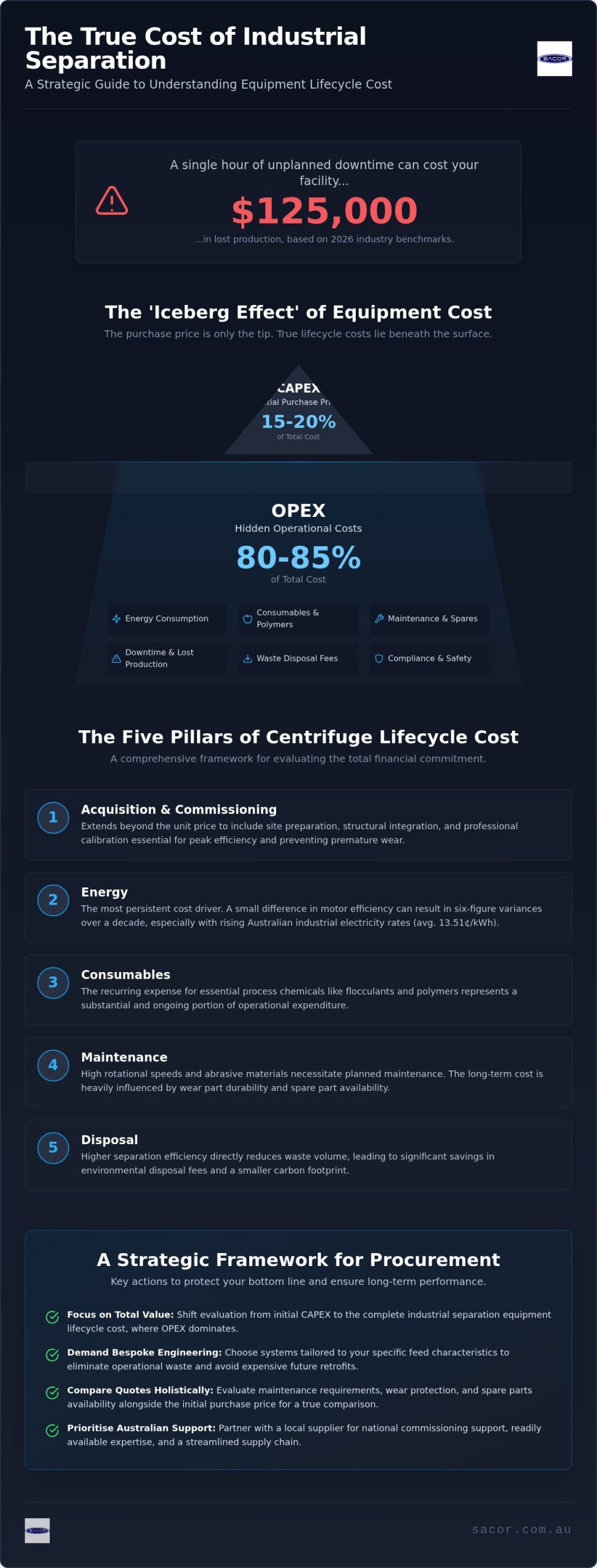
If your facility experiences a single hour of unplanned downtime this year, you could be looking at a loss of $125,000 according to recent 2026 industry benchmarks. For most plant managers and procurement officers, the initial purchase price of a decanter centrifuge represents only a small fraction of the total industrial separation equipment lifecycle cost. You likely recognise the mounting pressure of rising industrial electricity rates, which reached an average of 13.51¢/kWh this year, alongside the difficulty of comparing quotes with vastly different maintenance schedules. It’s a common frustration to see a low-cost asset quickly become a liability due to poor part availability or high energy consumption.
This guide provides a strategic framework to master the total cost of ownership, ensuring your separation process remains profitable and efficient over its entire service life. We’ll identify specific areas where bespoke engineering reduces long-term spend and provide a clear methodology for comparing equipment quotes based on real-world operational demands. Performance is the goal. By shifting your focus from capital expenditure to total lifecycle value, you can secure the reliability and performance your operation requires for the decade ahead.
Key Takeaways
- Shift procurement focus from initial capital expenditure to the total industrial separation equipment lifecycle cost, where operational expenses often account for the vast majority of long-term spend.
- Learn how to quantify the relationship between separation efficiency and environmental disposal fees to protect your facility’s bottom line.
- Utilise a standardised framework to compare centrifuge quotes by evaluating maintenance requirements and spare parts availability alongside the purchase price.
- Understand the role of bespoke engineering in eliminating operational waste through systems tailored to your specific feed characteristics.
- Recognise the strategic advantage of partnering with an Australian supplier for national commissioning support and local technical expertise.
Understanding Industrial Separation Equipment Lifecycle Cost
Effective procurement in the processing sector requires a shift from viewing machinery as a one-time expense to managing it as a long-term financial commitment. Within this context, Life-cycle cost analysis (LCCA) provides a rigorous framework for evaluating the total industrial separation equipment lifecycle cost. This metric encompasses every financial outlay from initial acquisition and commissioning through to energy consumption, spare parts, and eventual decommissioning. While the initial purchase price, or CAPEX, is the most visible figure on a balance sheet, it typically represents only 15% to 20% of the total spend over the equipment’s service life.
This creates what industry veterans call the ‘Iceberg Effect’. The purchase price is merely the tip, while the massive operational burdens of power usage and unplanned downtime remain submerged. When selecting an industrial decanter centrifuge Australia, failing to account for these hidden variables can erode profit margins for decades. A strategic approach ensures that every dollar spent at the procurement stage works to minimise the recurring costs that follow.
CAPEX vs. OPEX: The Strategic Balance
Differentiating between one-time acquisition costs and recurring operational expenses is essential for accurate budgeting. It’s often the case that high-quality materials, such as specialised stainless steel alloys or advanced wear protection, increase the initial CAPEX but significantly lower the long-term OPEX by extending service intervals. For Australian industrial assets, engineers often use Net Present Value (NPV) to compare different equipment options. This calculation discounts future costs, such as energy and maintenance, to their present-day value; it allows for a true comparison between a cheaper, less efficient machine and a premium, engineered solution.
Why LCC Matters for Australian Plant Managers
Plant managers often face the challenge of justifying higher-spec equipment to boards focused on immediate capital savings. By presenting a data-driven industrial separation equipment lifecycle cost projection, you can demonstrate how a strategic investment prevents the high maintenance burdens associated with ‘low-bid’ procurement. This analysis is particularly relevant for meeting sustainability targets. Efficient separation technology reduces waste volume, which directly lowers environmental disposal fees and energy-related carbon footprints. Choosing reliability over a low entry price protects the facility from the volatility of rising energy costs and the extreme financial penalties of lost production.
The Five Pillars of Centrifuge Lifecycle Cost
Centrifugal systems operate under extreme mechanical stress. High rotational speeds and abrasive feed stocks create a unique set of cost drivers that static filtration systems don’t share. An Iowa State University study on equipment lifecycle cost demonstrates that for high-rotation assets, the non-linear relationship between wear and operational hours is the primary determinant of long-term value. To accurately forecast the industrial separation equipment lifecycle cost, plant managers must evaluate five distinct pillars: acquisition, energy, consumables, maintenance, and disposal.
Acquisition and Commissioning Costs
Initial investment extends far beyond the crate price. Site preparation, including structural reinforcement for vibration management and electrical integration, can add significant weight to the procurement budget. Professional commissioning is a critical step; it ensures the system is calibrated to your specific feed characteristics from day one. Without this technical oversight, machines often operate outside their optimal efficiency curve, leading to premature wear and failure to meet moisture cake targets. Bespoke engineering at this stage avoids the “one-size-fits-all” trap that leads to expensive retrofits later.
Operational Expenditure (Energy and Consumables)
Energy consumption is the most persistent cost driver in high-throughput environments. Given current electricity price trends, even a small difference in motor efficiency can result in six-figure variances over a decade. Beyond power, the cost of flocculants and polymers represents a substantial recurring expense. A system that achieves superior cake dryness with less chemical assistance provides a compounding financial benefit. Efficient separation lowers the volume of waste destined for disposal, which directly mitigates the impact of rising environmental fees. High-performance centrifuges are designed to minimise these recurring burdens through precision control systems.
Maintenance and Spare Parts Management
Reactive repairs are the enemy of profitability. The cost of a failed gearbox assembly isn’t just the price of the component; it’s the cumulative loss of production during the outage. Implementing wear protection strategies, such as tungsten carbide tiles on the scroll, significantly extends service intervals. However, these components eventually require replacement, making the availability of industrial centrifuge spare parts Australia a non-negotiable factor in LCC calculations. For decanter centrifuge mining Australia operations, local technical support ensures that routine maintenance doesn’t turn into an extended shutdown. You can review our technical support services to see how local expertise reduces these operational risks.
Hidden Cost Drivers: Energy, Downtime, and Disposal
While acquisition costs are fixed at the point of purchase, the variables that truly define the industrial separation equipment lifecycle cost are often hidden within daily operations. These factors, ranging from energy fluctuations to waste disposal levies, can derail a procurement budget if they aren’t rigorously modelled during the design phase. Following a structured NIST guide to lifecycle cost analysis allows plant managers to move beyond guesswork and quantify these operational burdens. For those managing a sludge dewatering centrifuge Australia, understanding the interplay between machine efficiency and external costs is the difference between a profitable asset and a mounting liability.
Energy Optimisation in Rotating Machinery
High-speed rotation requires significant torque, making energy consumption a dominant cost over a 10-year period. Advanced bowl and scroll geometry reduce the internal friction and turbulence of the feed material, lowering the power required to maintain separation. Modern Variable Frequency Drives (VFDs) and power regeneration systems further alter the cost profile by capturing kinetic energy during deceleration and feeding it back into the plant grid. When calculating the ROI of high-efficiency motors, it’s essential to look at the cumulative savings across thousands of operational hours rather than the incremental cost of the drive itself.
The Massive Cost of Unplanned Downtime
Industry data for 2026 suggests that unplanned downtime can cost an average of $125,000 per hour. For remote mining or energy sites, this figure often escalates due to the complex logistics of repair. The time required to transport specialised technicians and heavy components to a remote basin can extend a simple failure into a multi-day crisis. Reducing the industrial separation equipment lifecycle cost therefore depends heavily on risk mitigation through condition monitoring. By integrating sensors that track vibration and temperature in real-time, operators can transition to predictive maintenance, addressing wear before it triggers a catastrophic shutdown.
Waste Management and Separation Efficiency
Separation efficiency has a direct, measurable impact on the bottom line. Achieving just 1% better cake dryness can save a facility thousands of dollars in annual transport and disposal costs, particularly as landfill levies continue to rise. Poor liquid clarity, or centrate, also carries a heavy price; it increases the load on downstream treatment processes and may lead to environmental non-compliance fines. Aligning your procurement with energy sector centrifuge equipment standards ensures that your facility meets both performance and sustainability targets, turning waste reduction into a core financial strategy.
How to Evaluate and Compare Lifecycle Cost Quotes
Comparing quotes for centrifugal systems is complex because vendors often highlight different performance metrics to suit their specific product strengths. To achieve a true understanding of the industrial separation equipment lifecycle cost, engineers must move beyond the face value of a proposal and perform a rigorous bid analysis. Technical Equalisation is the process of adjusting quotes to account for differences in performance, reliability, and support. This essential step ensures that a low-bid machine with high energy requirements is compared fairly against a premium unit with lower operational costs, preventing expensive surprises once the asset is commissioned.
Standardising the Data Request
Procurement teams should demand a standardised set of metrics from all vendors to eliminate ambiguity during the evaluation phase. Key requirements include power consumption per cubic metre of feed, anticipated wear-part life under specific process conditions, and the frequency of major service intervals. It’s advisable to request guaranteed performance benchmarks within the contract; if a supplier is unwilling to guarantee cake dryness or power limits, the financial risk of cost overruns remains with the buyer. Additionally, evaluate the supplier’s local spare parts inventory and the proximity of their technical support teams. These factors directly impact the cost of future downtime and should be weighted heavily in the final decision matrix.
Calculating the Annual Equivalent Cost (AEC)
The Annual Equivalent Cost (AEC) provides a single figure that represents the annualised financial burden of owning and operating the asset over its entire service life. This calculation combines the initial CAPEX, spread across the expected lifespan of the unit, with the annual OPEX, including maintenance, energy, and labour. In the Australian context, this formula must account for local discount rates and the projected inflation of energy prices through 2026. Using AEC allows decision-makers to determine whether refurbishing an existing centrifuge is more cost-effective than investing in a new, more efficient model. It provides the financial clarity needed to justify capital expenditure to stakeholders who may otherwise focus solely on the initial price tag. You can contact our engineering team for a detailed comparison of centrifuge performance specifications to support your LCC analysis.
By applying this structured framework, you can identify which solution offers the best long-term value. A machine that appears expensive in a CAPEX report often proves to be the most economical choice when the industrial separation equipment lifecycle cost is calculated over a ten-year horizon. Reliability and efficiency are the primary drivers of profitability in high-throughput environments.
Bespoke Engineering: The Sacor Approach to Reducing LCC
Sacor treats the industrial separation equipment lifecycle cost as a dynamic engineering challenge rather than a static financial burden. While standard machinery is often built to generic tolerances, our engineering team focuses on the specific rheology and abrasive qualities of the material processed within your facility. By intervening at the design stage, we ensure that the centrifuge is configured to handle the precise solids loading and particle size distribution of your feed. This proactive engineering eliminates the operational inefficiencies that lead to excessive power draw and premature component fatigue, securing the asset’s value from the outset. Our goal is to provide a system that is perfectly matched to your throughput requirements, avoiding the waste associated with over-specified or under-performing equipment.
Designing for Specific Feed Characteristics
Optimising the scroll pitch and bowl geometry for your unique slurry is the most effective way to reduce long-term wear and energy consumption. For instance, in high-volume dewatering, precise control over the pond depth allows for a significant reduction in polymer consumption, as the machine achieves superior flocculation with less chemical assistance. This focus on precision directly impacts the sustainability of your operation by reducing the volume of waste chemicals and improving the quality of the centrate returned to the process. Sacor provides robust, unit-specific technical documentation and training that empowers your onsite teams to perform routine maintenance with higher accuracy. This level of detail reduces the labour hours required for service and ensures the system consistently operates at its peak performance window throughout its service life, even as operational demands evolve.
Local Support as a Lifecycle Advantage
Partnering with an Australian-owned supplier provides a distinct advantage when managing the total cost of ownership over several decades. Sacor delivers national commissioning and technical support, ensuring that every installation is integrated seamlessly into your existing plant infrastructure. Our spare parts management is tailored to the critical components of your site, which drastically reduces the risk of extended outages. This commitment to a long-term partnership means we remain focused on your process outcomes long after the initial commissioning is complete. We provide ongoing technical assessments to ensure that as your feed characteristics change, your equipment settings are adjusted to maintain optimal efficiency and reduce environmental disposal fees. We invite you to consult with our team regarding agriculture separation equipment Australia or other sector-specific requirements to see how engineered precision can protect your bottom line and reduce your environmental footprint.
Securing Operational Excellence for the Decade Ahead
Mastering the industrial separation equipment lifecycle cost requires a departure from short-term procurement thinking. By prioritising energy-efficient drive systems and tailored engineering matched to your specific feed characteristics, you eliminate the hidden operational burdens that erode profit margins. Reliability isn’t a byproduct of luck; it’s the result of technical equalisation and a commitment to high-quality wear protection.
As an Australian-owned and operated partner with national reach, Sacor provides the bespoke engineering required for mining, food, energy, and wastewater applications. Our track record in increasing process efficiency and reducing environmental impact ensures your facility remains both compliant and competitive. Local technical support and strategic spare parts management are the final pillars that protect your investment from the risks of unplanned downtime.
Take the next step in optimising your facility’s performance. You can request a customised lifecycle cost analysis for your separation process from Sacor to identify specific areas for long-term savings. We’re ready to partner with you to achieve a more sustainable and profitable separation outcome.
Frequently Asked Questions
What is the typical lifespan of an industrial decanter centrifuge in Australia?
An industrial decanter centrifuge typically operates for 15 to 25 years when supported by a rigorous maintenance regime. This lifespan depends heavily on the abrasiveness of the feed material and the chemical environment of the plant. In the Australian mining and wastewater sectors, machines that receive regular calibration and component overhauls consistently outperform those managed through reactive repairs. Investing in robust wear protection at the outset is the most effective way to ensure the asset reaches its full service potential.
How much does maintenance contribute to the total lifecycle cost of a separator?
Maintenance generally accounts for 20% to 30% of the total industrial separation equipment lifecycle cost over a 20-year period. This figure includes the cost of routine service visits, specialised labour, and the replacement of high-wear components like scroll tiles and bearings. While these recurring expenses are significant, they are essential for preventing the catastrophic financial losses associated with unplanned downtime. A well-structured maintenance contract provides the budget predictability required for long-term financial planning.
Should I prioritise a lower purchase price or lower energy consumption?
Prioritising lower energy consumption is almost always the more profitable strategy due to the compounding nature of operational expenses. With industrial electricity rates averaging 13.51¢/kWh in 2026, a machine with superior motor efficiency can save hundreds of thousands of dollars over its service life. These savings often dwarf the initial price difference between a standard unit and a premium, high-efficiency model. Evaluating the total energy spend over a ten-year horizon is critical for an accurate procurement decision.
How does separation efficiency impact waste disposal costs?
Superior separation efficiency directly lowers waste disposal costs by increasing the dryness of the discharged solids. Every percentage point gained in cake dryness reduces the total mass of material destined for landfill or secondary treatment, which lowers transport fees and environmental levies. High-clarity centrate also reduces the chemical and energy load on downstream wastewater processes. Efficient separation transforms waste management from a mounting liability into a controlled operational expense that supports your facility’s sustainability targets.
What are the most common “hidden costs” in industrial separation procurement?
The most common hidden costs include site preparation, electrical integration, and the ongoing price of chemical consumables like polymers. Many procurement teams overlook the “logistics of repair,” which involves the cost of transporting heavy components and specialised technicians to remote Australian sites. The torque required for separation can also vary with feed changes, leading to higher-than-expected power consumption if the machine isn’t properly calibrated. Accounting for these variables during the bid stage prevents significant budget overruns.
How often should a lifecycle cost analysis be updated for existing equipment?
A lifecycle cost analysis should be updated every two to three years or whenever there is a significant shift in energy prices or feed characteristics. Periodic reviews allow plant managers to compare the performance of ageing assets against new, more efficient technology available in the 2026 market. This data helps determine whether refurbishing an existing centrifuge or investing in a modern decanter system provides the best return on investment. Regular updates ensure your procurement strategy remains aligned with current market conditions.
Can custom engineering really reduce the long-term cost of a centrifuge?
Custom engineering reduces long-term costs by matching the centrifuge’s mechanical specifications to the specific rheology of your feed material. By optimising the scroll pitch and bowl geometry, engineers can reduce internal turbulence and friction, which lowers both energy consumption and component wear. This bespoke approach also ensures that chemical dosing is precise, preventing the over-consumption of expensive polymers. Tailored solutions eliminate the operational waste inherent in generic machinery, securing a lower industrial separation equipment lifecycle cost.
What data do I need from a supplier to calculate an accurate LCC?
To calculate an accurate LCC, you require specific data on power consumption per cubic metre of feed, anticipated service intervals, and the expected lifespan of wear parts. Suppliers should also provide information on local spare parts availability and the cost of routine calibration visits. Demand guaranteed performance benchmarks, such as cake dryness and liquid clarity, to ensure the financial risks of underperformance are clearly defined. This technical data allows for a fair comparison between competing quotes using the Annual Equivalent Cost method.