With the August 2025 deadline for GISTM compliance now behind us, the Australian mining sector faces a critical turning point in how it handles waste. Traditional tailings dams are no longer just an environmental liability; they’re a financial drain that many modern operations can’t afford to sustain. Identifying the best dewatering technology for mining is no longer a matter of incremental improvement but a strategic necessity for those looking to remain competitive in 2026. You’ve likely seen the rising costs of dam construction and the increasing complexity of water recovery licences under the Rights in Water and Irrigation Act.
We understand that high downtime and inefficient equipment are the primary hurdles to achieving a sustainable process circuit. This guide provides a comprehensive look at how mechanical separation, specifically through advanced decanter centrifuges, can help you recover up to 85% of process water while significantly reducing tailings volume. You’ll learn how to optimise your tailings management to lower long-term OPEX and ensure your site meets the strictest environmental benchmarks. We’ll examine the technical shifts and performance metrics that define the current industry standard for reliable, high-force dewatering.
Key Takeaways
- Transition from traditional tailings disposal to a resource recovery model to ensure compliance with the latest Australian environmental regulations and GISTM standards.
- Compare the performance of centrifuges, filter presses, and belt presses to identify the best dewatering technology for mining based on your specific mineralogy and throughput goals.
- Utilise advanced decanter centrifuge systems to achieve superior water recovery and reduced tailings volume through automated control and high G-force separation.
- Reduce long-term operational expenditure by adopting energy-efficient drive systems and precision chemical dosing strategies that minimise flocculant waste.
- Partner with established Australian specialists to secure customised separation solutions and reliable national support for critical spare parts and maintenance.
The Evolution of Dewatering Technology in Australian Mining
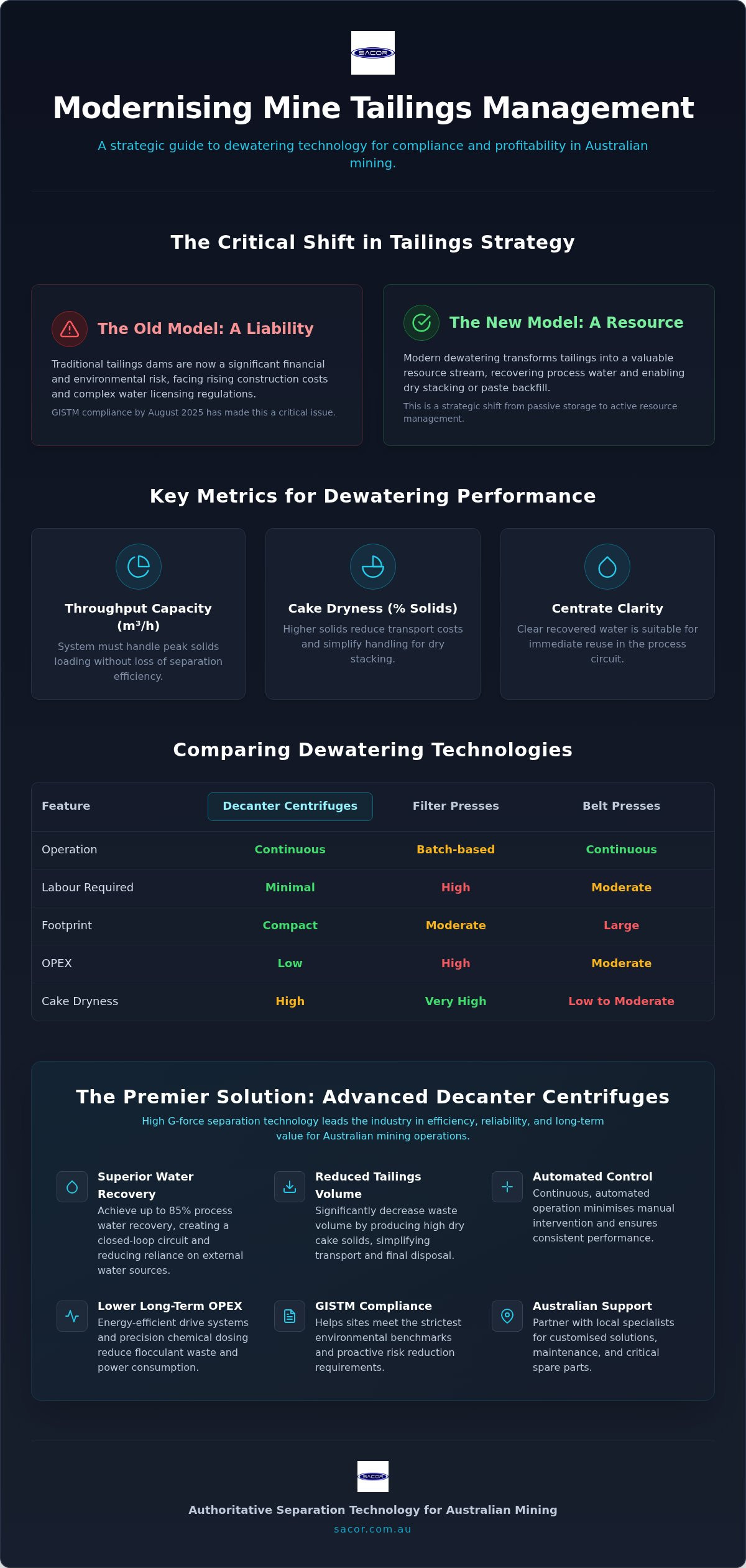
The landscape of Australian mining has undergone a fundamental shift. While the history of mine dewatering was once defined by the simple removal and disposal of excess water, the 2026 standard views tailings as a valuable resource stream. Modern operators no longer see water as a waste product to be pumped into vast, static dams. Instead, they recognise that recovered process water is a critical asset for maintaining closed-loop circuits, especially as water scarcity intensifies across the continent. This evolution is driven by a combination of economic pressure and the need for the best dewatering technology for mining to meet stringent environmental benchmarks.
Traditional tailings dams are increasingly viewed as a liability rather than a solution. The risks associated with dam stability, combined with the massive land footprint required, have made them difficult to justify under current Australian environmental standards. We’ve seen a decisive move towards mechanical dewatering systems that produce high dry cake solids. This transition allows for dry stacking or paste backfill, which significantly reduces the environmental risk profile of a site while reclaiming water that would otherwise be lost to evaporation or seepage. It’s a shift from passive storage to active resource management.
Drivers for Advanced Separation on Mine Sites
Regulatory pressure is a primary catalyst for this change. Compliance with the Global Industry Standard on Tailings Management (GISTM) requires operators to demonstrate proactive risk reduction, often necessitating a move away from wet tailings storage. Beyond compliance, the economic necessity of improving mineral recovery rates drives the adoption of advanced separation. By extracting more liquid from the waste stream, mines can often capture fine particulates of valuable ore that were previously lost, turning a waste management cost into a recovery opportunity. This dual benefit of compliance and recovery is central to modern site strategy.
Key Metrics for Evaluating Dewatering Performance
To identify the best dewatering technology for mining, several technical benchmarks must be considered. These allow plant managers to evaluate the true lifecycle value of their equipment, moving beyond initial CAPEX to focus on long-term operational efficiency:
- Throughput capacity (m3/h): The system must handle peak solids loading without compromising separation efficiency or increasing downtime.
- Cake dryness: A higher percentage of solids in the discharged cake reduces transport costs and simplifies handling for dry stacking or backfilling.
- Centrate clarity: The clarity of recovered water determines its suitability for immediate reuse in the process circuit without further treatment.
By focusing on these metrics, engineers can ensure that their separation processes contribute directly to the site’s overall sustainability and profitability targets.
Comparing the Best Dewatering Technologies for Mining
Selecting the right equipment requires a precise balance between mechanical performance and lifecycle economics. While several options exist, the industry consensus, often reflected in publications from The Dewatering Institute, points toward three primary mechanical solutions: decanter centrifuges, filter presses, and belt presses. Each technology offers distinct advantages depending on the mineralogy and the specific throughput requirements of the site.
Initial capital expenditure (CAPEX) is frequently the primary focus during procurement, yet operational expenditure (OPEX) often dictates the long-term viability of a project. Filter presses might offer high dry cake solids, but their batch-based nature and high labour requirements for cloth cleaning and cake discharge can inflate OPEX over time. In contrast, decanter centrifuges provide continuous operation with minimal manual intervention, making them a strong contender for the best dewatering technology for mining when Australian labour costs are a concern.
Remote sites benefit significantly from modular equipment that requires minimal civil works. Centrifuges offer a compact footprint compared to the sprawling infrastructure of thickener tanks or belt presses, allowing for easier integration into existing circuits. To handle abrasive slurries, modern systems utilise advanced tungsten carbide tiling and specialised coatings to protect internal components from wear, ensuring reliability in harsh conditions.
Decanter Centrifuges vs Filter Presses
The distinction between continuous and batch processing is vital for plant uptime. Centrifuges operate 24/7, adapting instantly to variable feed densities without the need for cycle interruptions. Filter presses require downtime for cycling and plate cleaning, which can create bottlenecks in high-volume circuits. While both technologies use flocculants to aid separation, centrifuges often allow for more precise dosing through automated control systems. For those seeking to optimise their separation circuits, exploring customised decanter centrifuge systems can reveal significant efficiency gains.
Belt Presses and Thickener Tanks
Lower-force separation through belt presses or static thickening is sometimes appropriate for coarse materials or where ultra-dry cake isn’t the primary goal. However, static thickening struggles with high-volume operations where rapid water recovery is essential. In these scenarios, integrating a centrifuge as a secondary stage to process thickener underflow is a proven strategy for capturing ultra-fine tailings that would otherwise remain in suspension. This combination ensures that the plant achieves the highest possible water recovery rates while maintaining a manageable tailings volume.
Why Decanter Centrifuges Lead Mining Separation in 2026
Decanter centrifuges represent a significant advancement in mechanical separation because they replace gravity with controlled centrifugal force. By generating force thousands of times greater than gravity, these systems achieve rapid separation of fine particulates that would otherwise take days to settle in a traditional pond. A decanter centrifuge for mineral tailings is a mechanical separation unit that applies high centrifugal force to achieve rapid, continuous sedimentation of fine particulates from a process slurry. This capability makes them a primary candidate for the best dewatering technology for mining when high throughput and consistent cake dryness are required.
Modern systems incorporate automated process control to manage variable feed characteristics. In a mining environment, the density and particle size distribution of tailings can shift unexpectedly. Advanced sensors allow the centrifuge to adjust its scroll speed and torque in real-time, ensuring optimal performance without manual intervention. This precision minimises the environmental footprint by maximising water recovery, allowing sites to return clean water to the process circuit immediately.
Continuous Operation and Process Integration
Centrifuges eliminate the operational bottlenecks associated with batch-based filter presses. Because the separation happens continuously, there’s no need for buffer tanks or cycle interruptions. These systems integrate seamlessly into existing PLC and SCADA frameworks, giving operators full visibility over performance metrics from a central control room. This level of integration reduces the reliance on large-scale settling ponds, which are increasingly difficult to manage under strict Australian environmental regulations.
Durability in Harsh Australian Environments
Operating in remote Australian locations demands equipment that can withstand abrasive slurries and hypersaline water. Sacor’s approach involves engineering decanter centrifuge systems with advanced wear protection, such as tungsten carbide tiles and specialised ceramic coatings on high-contact surfaces. These materials ensure that the equipment maintains its integrity even when processing high-temperature or corrosive streams. By matching centrifuge specifications to the specific mineralogy of a site, Sacor provides a robust solution that balances high-performance separation with long-term mechanical reliability.
Strategies to Reduce Dewatering Costs and Optimise Efficiency
Optimising the economic performance of a dewatering circuit requires a dual focus on energy recovery and chemical precision. Modern decanter centrifuges utilise high-efficiency drive systems that can recover energy from the braking of the scroll, feeding it back into the plant’s power grid. This energy recovery, combined with the ability to handle high solids loading without constant intervention, positions centrifugal separation as the best dewatering technology for mining when looking to reduce long-term OPEX. Chemical expenditure is another significant cost lever; automated dosing systems now use real-time feed sensors to ensure flocculant is applied only when necessary, preventing the expensive over-dosing common in manual systems.
The reliability of the supply chain is equally critical for national mining projects. Relying on international shipping for critical components introduces unacceptable risks to production schedules. Establishing a relationship with a supplier that maintains a comprehensive inventory of local spare parts ensures that maintenance cycles are predictable and that equipment remains in peak operational condition throughout its lifecycle.
Maximising Equipment Uptime
Unplanned downtime on a remote Australian mine site can cost thousands of dollars per hour in lost production. A robust preventative maintenance schedule, supported by industrial centrifuge spare parts Australia, ensures that critical components like bearings and tiles are replaced before failure occurs. Remote monitoring and diagnostics have become standard in 2026, allowing technical specialists to troubleshoot equipment performance without the need for immediate site travel. Training site personnel for basic maintenance tasks further reduces the reliance on external contractors and speeds up response times during minor technical adjustments.
Water Recovery and Sustainability ROI
The return on investment for sustainable dewatering solutions Australia is increasingly measured through the lens of Environmental, Social, and Governance (ESG) reporting. In arid regions, the value of recovered water often exceeds the cost of the dewatering process itself, especially when considering the expense of sourcing and transporting fresh water to site. By minimising tailings volume, operators can defer the expansion of storage facilities, significantly reducing disposal fees and rehabilitation liabilities. These outcomes provide a clear financial justification for high-efficiency mechanical separation. For operators seeking to audit their current tailings efficiency, contact our team for a customised separation performance assessment.
Sacor: Authoritative Separation Technology for Australian Mining
Sacor operates as a strategic partner to the Australian mining industry, providing high-performance separation equipment backed by deep domain expertise. We don’t simply supply hardware; we deliver integrated solutions that address the specific geological and operational challenges of each site. By maintaining a dedicated engineering and spare parts hub, strategically positioned for national reach, we ensure that our clients have immediate access to technical support and critical components, eliminating the risks associated with international logistics. This grounded, results-oriented approach is why many operators consider Sacor’s decanter centrifuges the best dewatering technology for mining in the current regulatory landscape.
Our commitment to environmental responsibility is reflected in every system we commission. We understand that site efficiency is inextricably linked to water recovery and waste reduction. By focusing on these outcomes, we help our partners achieve their sustainability targets while simultaneously lowering their long-term operational costs. Our technology is designed to perform in the most demanding conditions, providing the reliability that plant managers expect from a seasoned technical authority.
Customised Mining Separation Solutions
Successful tailings management requires a bespoke approach to equipment specification. We collaborate directly with plant engineers to ensure that every decanter centrifuge is configured to handle the unique particle size distribution and viscosity of the site’s mineralogy. This precision engineering has led to significant results in tailings volume reduction across various Australian projects, allowing for more stable waste storage and higher water reclamation rates. Our national network provides comprehensive support during the critical installation and commissioning phases, ensuring that the technology integrates seamlessly into existing process circuits. This collaborative design process ensures that the best dewatering technology for mining is tailored specifically to your throughput requirements and solids loading characteristics.
The Future of Mining Dewatering with Sacor
As we move through 2026 and beyond, the focus on process optimisation will only intensify. Sacor remains at the forefront of this evolution, continuously advancing our centrifuge technology to meet the demands of deeper mines and more complex ore bodies. We view every installation as the beginning of a long-term partnership focused on reliability and performance. Our technical support services extend far beyond the initial sale, encompassing regular maintenance audits and performance tuning to keep your operations running at peak efficiency. Partnering with Sacor means anchoring your innovation in practical, real-world outcomes that protect your bottom line and the environment. The next step in optimising your site’s dewatering performance is a direct consultation with our engineering team to discuss your specific requirements.
Strategic Implementation for Sustainable Mining Operations
The transition from passive tailings disposal to active resource recovery is a fundamental requirement for the modern Australian mine site. Achieving compliance with global standards like the GISTM requires more than just incremental changes; it demands the integration of high-efficiency mechanical separation. Selecting the best dewatering technology for mining is a decision that directly impacts your immediate water recovery rates and your long-term site rehabilitation liabilities. Decanter centrifuges have proven themselves as the most reliable solution for continuous, high-force separation of fine mineral particulates.
Sacor provides the technical expertise and national support needed to ensure your separation circuit remains optimised. Our Mandurah-based engineering hub and extensive inventory of spare parts ensure that your operation stays online, while our bespoke separation solutions deliver measurable reductions in tailings volume. By prioritising efficiency and environmental responsibility, you can lower your OPEX and secure your site’s future. Partner with Sacor to organise a customised dewatering audit for your mine site and begin the process of optimising your tailings management circuit today. We look forward to working alongside your team to achieve your production and sustainability goals.
Frequently Asked Questions
What is the best dewatering technology for high-volume mining tailings?
Decanter centrifuges are widely regarded as the best dewatering technology for mining high-volume tailings because they provide continuous, high-force separation. Unlike batch systems, these units handle variable feed densities in real-time, delivering consistent cake dryness and high-clarity centrate. This technology allows operators to recover process water rapidly, which is essential for maintaining closed-loop circuits and meeting the stringent environmental standards required on modern Australian mine sites.
How does a decanter centrifuge compare to a filter press in mining?
The primary difference lies in the processing method; centrifuges operate continuously while filter presses work in batches. This distinction means centrifuges typically require less manual labour and have a significantly smaller physical footprint. While filter presses can achieve very high cake dryness, the downtime associated with plate cleaning and cake discharge often results in lower overall plant uptime compared to the seamless integration of a decanter centrifuge system.
Can decanter centrifuges handle abrasive mineral slurries?
Yes, modern decanter centrifuges are specifically engineered to process highly abrasive mineral slurries. To prevent premature wear, high-contact internal surfaces are protected with tungsten carbide tiles and specialised ceramic coatings. These materials ensure that the equipment maintains its mechanical integrity and separation efficiency even when handling harsh ores. Sacor’s bespoke design process matches these wear protection features to the specific mineralogy and abrasive characteristics of your site’s waste stream.
What are the typical maintenance requirements for a mining centrifuge in Australia?
Typical maintenance involves regular vibration monitoring, bearing lubrication, and periodic inspections of the wear-protected tiles. Because mining environments are demanding, a structured preventative maintenance programme is essential to avoid unplanned downtime. Sacor supports this through a national network that provides technical audits and a reliable supply of critical spare parts. This ensures that Australian operators can maintain their equipment to original specifications without the delays associated with international shipping.
How much water can be recovered using centrifugal dewatering technology?
Advanced decanter centrifuges can recover up to 85% of process water from tailings streams, depending on the specific mineral characteristics and feed density. This high rate of reclamation is a critical factor for sites operating in arid regions where water scarcity is an economic and regulatory challenge. By returning this water directly to the process circuit, mines can significantly reduce their reliance on external water sources and lower their overall environmental footprint.
Is it possible to retrofit a decanter centrifuge into an existing mining plant?
Retrofitting a decanter centrifuge into an existing mining plant is a common practice due to the equipment’s compact and modular design. These systems require minimal civil works compared to large-scale thickeners or belt presses, making them ideal for sites with limited available space. Sacor’s engineering team works collaboratively with plant managers to ensure that the new separation technology integrates seamlessly into existing SCADA and PLC control frameworks for immediate operational benefits.
What is the expected lifespan of an industrial centrifuge in a mining environment?
The expected lifespan of an industrial centrifuge in a mining environment can exceed twenty years when supported by a rigorous maintenance schedule. While individual components like wear tiles and bearings are consumable items that require periodic replacement, the main structural elements are built for long-term durability. Investing in high-quality separation technology ensures that the core mechanical system remains a reliable asset throughout the entire lifecycle of the mining project.
How does dewatering technology impact tailings dam safety and compliance?
Dewatering technology significantly improves tailings dam safety by reducing the volume of liquid waste and enabling dry stacking or paste backfill methods. This shift away from wet tailings storage is a primary requirement for compliance with the Global Industry Standard on Tailings Management (GISTM). By producing a stable, low-moisture cake, operators can minimise the risk of dam failure and reduce the long-term environmental liabilities associated with traditional storage facilities.