
The lower-commitment option isn’t always the lower-cost one. In a centrifuge rental vs purchase Australia assessment, the right choice depends on how consistently the equipment will run, how well you understand your process requirements and who will manage maintenance, downtime and commissioning.
Rental may suit a defined project or uncertain throughput, while ownership may make more practical sense when demand is steady and the system will support ongoing operations. Headline costs alone won’t show the full picture. Installation, process fit, maintenance responsibilities and equipment utilisation all affect the decision across the asset lifecycle.
This guide provides a practical framework for comparing rental and purchase against your process demands, expected operating hours and whole-of-life responsibilities. It explains how feed characteristics, site conditions and commissioning support affect the choice of a fit-for-purpose system. Sacor supplies customised centrifuge solutions for Australian industrial operators, with installation, commissioning, maintenance, spare parts and technical support for equipment across its lifecycle.
Key Takeaways
- Compare rental and purchase by who carries responsibility for mobilisation, installation, maintenance, downtime and end-of-term arrangements.
- Use expected operating hours, campaign duration and confidence in future throughput to assess whether rental or ownership better fits your requirements.
- A sound centrifuge rental vs purchase Australia decision starts with feed characteristics, separation objectives and the operating capacity your process needs.
- Build a whole-of-life comparison that separates the initial commitment from ongoing operating and support responsibilities.
- For a purchase pathway, align system design with process and site requirements, then plan for installation, commissioning and lifecycle support.
Centrifuge rental vs purchase in Australia: what decision are you making?
The centrifuge rental vs purchase Australia decision is about more than securing equipment. It determines how your operation accesses a separation system, commits capital and allocates responsibility for integration and ongoing support. Rental provides time-based access under agreed commercial terms. Purchase adds the equipment to your operation’s assets and makes you responsible for planning its operating life. Neither model is automatically the better whole-of-life option.
In brief: Renting provides time-limited access to a centrifuge under agreed terms; purchasing means acquiring equipment for integration into an operation. The practical choice depends on process fit, utilisation, operating horizon and who is responsible for the work needed to keep the system performing.
What does renting or purchasing an industrial centrifuge involve?
A centrifuge separates components in a feed by applying centrifugal force. For a technical overview of what a centrifuge is, see this explanation of the principle and equipment types. In an industrial setting, the selected system still needs to suit the specific feed, separation objective and operating conditions.
Rental is time-based access to equipment, often considered for a defined project, campaign or period of uncertain demand. The agreement sets the commercial terms and determines which party handles transport, installation, maintenance, downtime and return at the end of the term. These responsibilities vary by arrangement, so include them in the comparison rather than assuming what is covered.
Purchase means acquiring a centrifuge for integration into an operation. The buyer takes on ownership and plans for the equipment’s operating life, including process fit, site integration and ongoing support. For a system intended to run as part of a continuing plant, solution design and commissioning matter alongside the purchase itself.
Why does the Australian operating context matter?
Across Australia, logistics and continuity can be central to procurement. Site access, equipment mobilisation and arrangements for installation or maintenance may affect how a system fits a project schedule. Consider these factors alongside the expected operating period, rather than treating equipment access as a standalone transaction.
Plant integration also shapes the decision. A centrifuge needs to work with the surrounding process, meet throughput requirements and support the separation objective. Where production continuity matters, account for how maintenance and technical support will be managed, and what the operational plan allows for if equipment is unavailable. Make these responsibilities clear before comparing options.
Start with the process requirement, then assess expected utilisation and how long the system will be needed. A low initial commitment does not, by itself, mean a lower whole-of-life cost. Include mobilisation, installation, support, downtime and end-of-term obligations in the comparison. The next step is to examine how each model affects those costs and responsibilities in practice.
How rental and purchase change centrifuge costs and responsibilities
A fair comparison separates the initial commitment from the costs and duties that continue during operation. A rental arrangement may spread equipment access across an agreed period, while purchase involves acquiring an asset and planning for its integration and ongoing care. The details depend on the specific agreement and project, so compare what each option includes rather than assuming particular services sit with either party.
Lifecycle cost is broader than the acquisition amount: it includes the resources required to mobilise, integrate, operate, maintain and eventually return or retain the centrifuge. This makes the centrifuge rental vs purchase Australia decision more transparent. The U.S. Small Business Administration’s overview of financial considerations for equipment offers a general framework for weighing equipment acquisition choices. Australian operators should assess their own commercial and accounting treatment separately.
Which cost categories belong in a fair comparison?
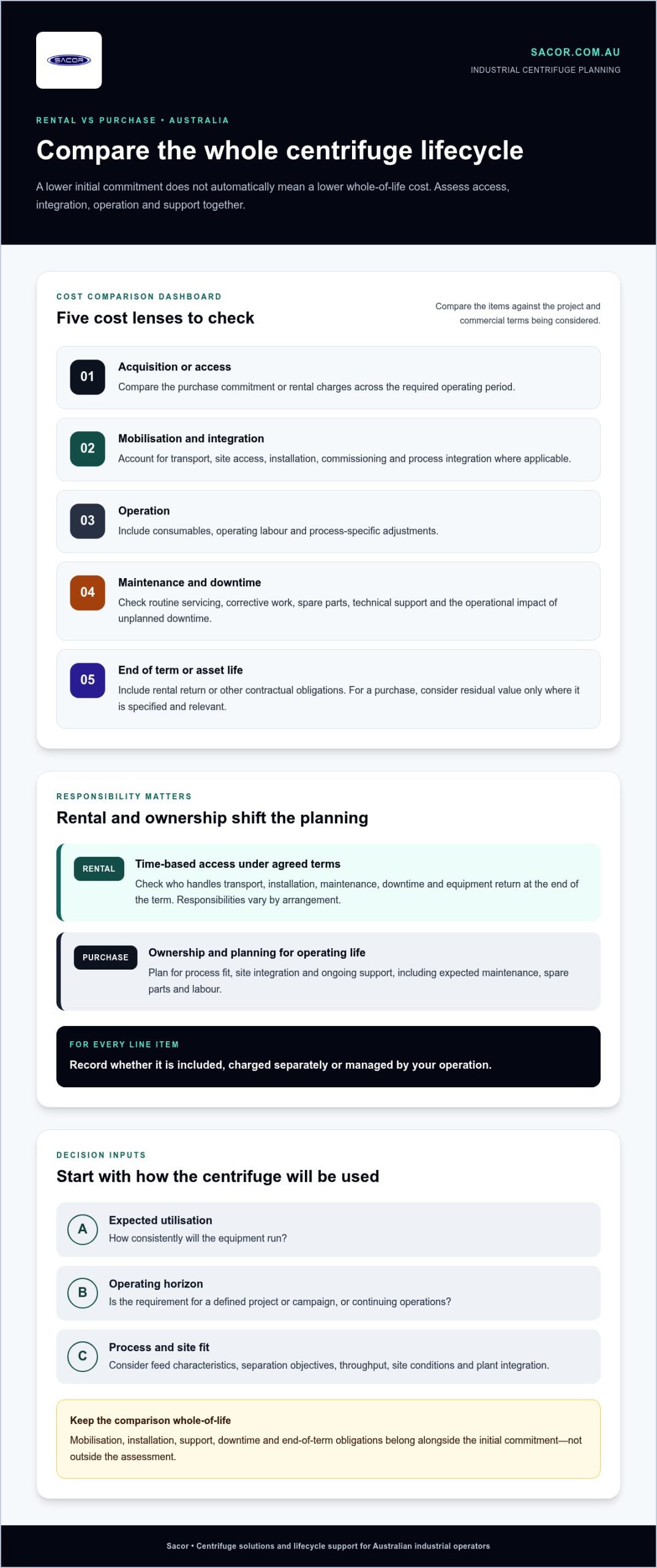
Build the comparison around your process and the terms being considered. Include one-off costs, recurring expenditure and possible end-of-term obligations. For each item, record whether it is included, charged separately or managed by your operation.
| Category | What to compare |
|---|---|
| Acquisition or access | Purchase commitment or rental charges across the required operating period. |
| Mobilisation and integration | Transport, site access, installation, commissioning and process integration, where applicable. |
| Operation | Consumables, operating labour and any process-specific adjustments. |
| Maintenance and downtime | Routine servicing, corrective work, spare parts, technical support and the operational impact of unplanned downtime. |
| End of term or asset life | Return or other contractual obligations for rental; residual value only where it is specified and relevant to purchase. |
For ownership, include expected maintenance, spare parts and labour in the operating assessment, not just the initial acquisition. For rental, include the full term and any applicable mobilisation or end-of-term requirements. Don’t assign a residual value or assume a service is included unless the arrangement sets it out.
Who carries maintenance, uptime and operating responsibilities?
Separate contractual duties from the site team’s day-to-day work. An agreement may allocate servicing, corrective maintenance or technical support to a particular party, but operators still need to manage routine use, monitor process conditions and follow site procedures. Make responsibility explicit for operating changes, performance monitoring and adjustments if feed characteristics or throughput requirements shift.
For a purchase, lifecycle planning can include access to maintenance, spare parts and technical support. Sacor’s centrifuge system design and supply can be considered alongside installation and commissioning requirements, helping align the equipment pathway with process needs and site conditions.
When does centrifuge rental or purchase suit your operation?
The right model depends on how the centrifuge will be used, not simply on whether the project is temporary or ongoing. Compare expected operating hours, campaign duration, required throughput and confidence in future demand. A short-term arrangement can still be unsuitable if the available configuration cannot meet the separation objective. Ownership may also involve unnecessary commitment if utilisation is low or process requirements are still changing.
When might rental be worth assessing?
Rental may be worth assessing for a trial, a temporary capacity gap, a short processing campaign or a project with uncertain duration. It can provide time-limited access without requiring a long-term ownership decision, but only if the equipment suits the feed characteristics, separation requirements and throughput target.
Check practical fit as well as duration. Mobilisation timing, site access, installation and commissioning can affect whether equipment is ready for the campaign. Support arrangements and end-of-term obligations also need to align with the operating plan. Terms vary, so do not assume a rental includes a particular configuration, service or return arrangement. Record the assumptions behind your demand forecast, and use industry benchmarking reports as a prompt for questions to test against your operating conditions.
When might purchase be the stronger fit?
Purchase may suit a plant with sustained or recurring demand, stable feed characteristics and defined throughput requirements. The system can then be selected and integrated around the operation’s process, site conditions and expected duty. A process-specific configuration may be especially relevant where a standard arrangement would not adequately address the feed or separation objective.
Ownership also calls for a lifecycle plan. Consider how maintenance, spare parts and technical support will be managed, and how the system will respond to changes in feed or operating requirements over time. Sacor’s customised centrifuge solutions are designed around process requirements, throughput targets and site conditions, with installation and commissioning support for equipment integration.
For the centrifuge rental vs purchase Australia decision, compare realistic scenarios rather than applying a universal rule. Model a short campaign and a sustained operating case against expected utilisation and process fit. Rental can be practical when temporary access meets the technical and logistical requirements; purchase can be stronger when predictable demand supports long-term integration and ownership planning. If neither scenario is clear, resolve uncertainty in throughput and process requirements before committing to a model.
How to decide: a practical centrifuge rental-versus-purchase framework
Use the same process requirements and operating assumptions to assess each procurement model. This five-step sequence helps expose technical gaps, lifecycle responsibilities and uncertainties before they shape the decision.
- Define the separation duty. Document feed characteristics, target outputs and separation objectives, then set the required throughput and operating hours. Record variability in feed composition or flow, as it can affect equipment selection and expected performance.
- Set the operating horizon. Establish the campaign or plant operating period, expected utilisation and confidence in future capacity needs. Separate confirmed demand from forecast demand so an uncertain project extension isn’t treated as guaranteed usage.
- Check equipment and site fit. Consider configuration, plant integration, site conditions, mobilisation, installation and commissioning. For process context, refer to Sacor’s industrial decanter centrifuge guide.
- Assign lifecycle responsibilities. Map who handles operation, performance monitoring, routine maintenance, corrective work, spare parts and technical support under each option. Include how process changes will be assessed and who coordinates adjustments.
- Compare scenarios consistently. Use the same throughput, operating schedule and evaluation period for rental and purchase. Include applicable access or acquisition costs, mobilisation, integration, labour, maintenance, downtime exposure and end-of-term obligations. Mark assumptions that remain uncertain rather than presenting them as established facts.
What should the comparison document capture?
Keep one evaluation record containing the technical requirements, commercial assumptions, inclusions, exclusions and decision risks. Note how downtime could affect production continuity, how changing feed or throughput may alter the duty, and what support access means for the site’s operating plan. For ownership, include spare parts planning alongside maintenance and technical support. Sacor’s centrifuge spare parts planning guide provides further lifecycle context.
A useful comparison makes uncertainty visible. If future throughput is unconfirmed, for example, record the operating scenarios being assessed and how each affects utilisation and support requirements. This gives engineering, operations and procurement teams a shared basis for evaluating the centrifuge rental vs purchase Australia decision without relying on headline cost alone.
For a purchase assessment grounded in feed characteristics, throughput targets and site conditions, discuss your centrifuge system requirements with Sacor.
Plan a fit-for-purpose centrifuge purchase with Sacor
A purchase pathway starts with the process, not a generic equipment category. Sacor works with Australian industrial operators to define requirements around feed characteristics, separation objectives, throughput targets and site conditions. This engineering-led approach helps shape a system for the duty it needs to perform and the plant it must integrate with.
For teams weighing centrifuge rental vs purchase Australia, ownership should include a plan for installation, commissioning and ongoing support. Sacor supplies customised decanter, three-phase centrifuge and disc separator systems, with the solution selected to suit the application.
From process requirements to commissioned equipment
Plant engineers and managers contribute essential operating knowledge, including feed variability, target outputs, production requirements and site constraints. Sacor uses these inputs to develop a fit-for-purpose solution and determine whether a decanter, three-phase or disc separator system aligns with the separation duty.
Equipment supply is one part of the project. Installation and commissioning support help integrate the system with the plant and establish its operation to specification. For mining projects, Sacor’s decanter centrifuge mining guide provides application-specific context. Other industries also need their own process and site requirements to guide system design.
Build lifecycle support into the ownership decision
Plan maintenance and spare parts as part of the ownership pathway, rather than treating them as separate concerns after installation. A clear support plan helps the operation prepare for routine servicing, replacement parts and technical assistance across the equipment lifecycle. Site teams can also identify who monitors process conditions and coordinates support if feed characteristics or operating requirements change.
Sacor supports equipment lifecycles through maintenance, spare parts and technical support, alongside solution design, equipment supply, installation and commissioning. Aligning these responsibilities with the plant’s operating plan gives procurement, engineering and operations teams a more complete basis for assessing ownership and continuity needs.
Share your process requirements with Sacor to discuss a practical, project-specific pathway for an industrial separation system. Discuss an industrial separation solution based on your feed, throughput targets and site conditions.
Make your next centrifuge decision with confidence
The centrifuge rental vs purchase Australia decision should reflect your plant’s operating reality: process requirements, expected utilisation, project duration and the responsibilities attached to each option. Compare whole-of-life costs and support obligations, not just the initial commitment. Rental may suit a defined or uncertain requirement when the equipment meets process needs, while purchase can suit sustained demand supported by clear integration and lifecycle plans.
For an ownership pathway, Sacor works with industrial operators to develop customised solutions matched to feed characteristics, throughput targets and site conditions. Equipment supply can include installation, commissioning and technical documentation, with maintenance, spare parts and technical support available across the equipment lifecycle.
Discuss your industrial separation requirements with Sacor to plan a practical next step based on your process and operating objectives. A clear specification and lifecycle plan can help your team move towards a fit-for-purpose centrifuge system.
Frequently Asked Questions
Is it better to rent or buy an industrial centrifuge?
Neither option is automatically better. The suitable model depends on process duration, utilisation, feed consistency and who carries support responsibilities. For the centrifuge rental vs purchase Australia decision, assess whether time-limited access suits a temporary or uncertain requirement, and whether ownership suits sustained, predictable demand. Confirm that the equipment configuration fits the separation duty, then compare lifecycle costs and operating risks using the same throughput and operating-hour assumptions.
Can you rent a centrifuge for an industrial project in Australia?
Rental may be an option for an industrial project, depending on the equipment, application, project duration and commercial terms. First define feed characteristics, required throughput, operating hours, commissioning needs and support expectations. Don’t assume laboratory centrifuge hire will meet an industrial separation duty. Assess whether the proposed configuration suits the process and site, and establish who is responsible for installation, maintenance, downtime and end-of-term arrangements.
How much does centrifuge rental or purchase cost in Australia?
Costs vary with equipment configuration, capacity, process requirements, installation, commissioning, maintenance, duration and commercial terms. A useful comparison includes more than the initial payment: account for operating expenditure, support responsibilities, downtime exposure and any specified end-of-term obligations. Avoid relying on a generic figure, as it may not reflect your system or operating conditions. Compare project-specific assumptions across the full operating horizon to understand the financial commitment.
What happens if production requirements change after choosing a centrifuge?
Changes in throughput, feed composition or operating hours can affect separation performance and whether the original procurement model remains suitable. Document expected process variability before committing, then understand how each arrangement handles equipment configuration changes, technical support and service responsibilities. For a purchase, include anticipated future operating needs in the design discussion. For any agreement, review the terms for process changes, support and exit arrangements so operational impacts are clear.
Does buying a centrifuge include installation and commissioning?
Installation and commissioning depend on the supply scope and project arrangements, so include them explicitly in the procurement plan. Assess site integration, utilities, operating requirements, technical documentation and acceptance criteria alongside equipment selection. Sacor provides installation and commissioning for supplied centrifuge systems, supporting integration with existing plant infrastructure and operation to specification. Include these activities, their responsibilities and timing in the lifecycle comparison rather than treating them as incidental to equipment acquisition.
Which costs should be included when comparing rental with ownership?
Include equipment access or acquisition, transport, installation, commissioning, operation, maintenance, spare parts, labour and downtime exposure where applicable. Account for end-of-term obligations or residual value only when the arrangement specifies them. Use consistent assumptions for operating hours, throughput and process demand, and distinguish confirmed terms from estimates. This gives engineering and procurement teams a clearer whole-of-life comparison and helps identify responsibilities or potential costs that could affect operational continuity.
Is purchasing a centrifuge suitable for a short-term project?
It can be, but project duration alone doesn’t determine the best procurement model. Consider integration requirements, expected utilisation, what happens to the equipment after the project and whether future applications are likely. Compare those factors with the suitability and terms of a rental arrangement. A process-specific assessment based on feed characteristics, separation objectives and throughput provides a more reliable basis for deciding than choosing solely by the length of the project.