
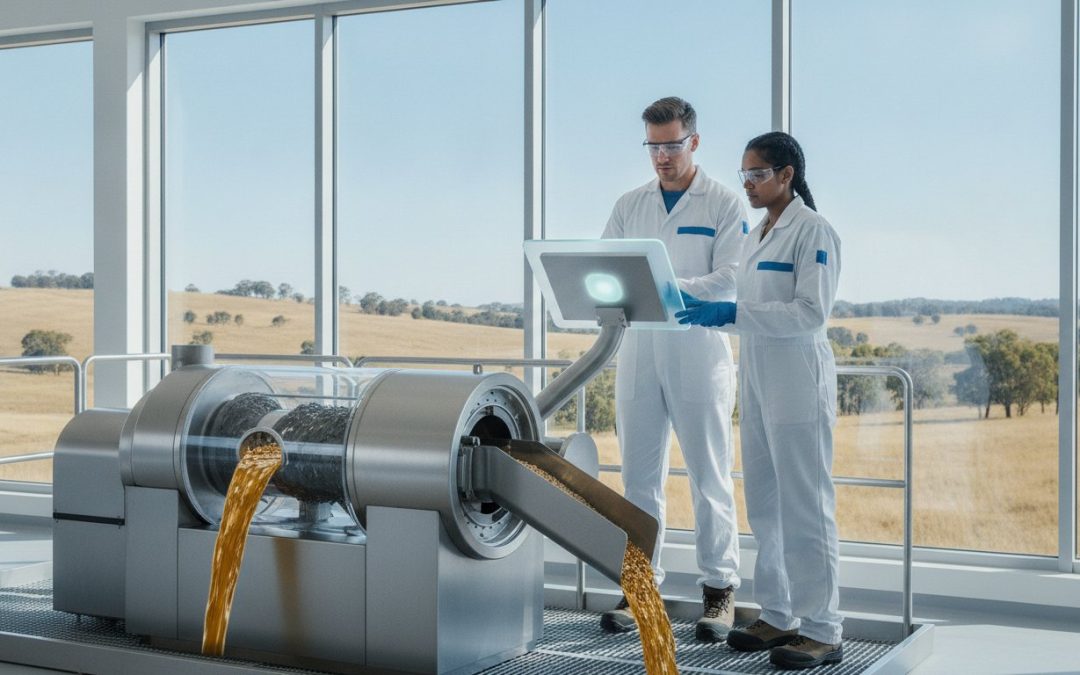
The traditional view of agricultural waste as a sunk cost is becoming an obsolete business model in the face of modern recovery technology. Every tonne of sludge or unrecovered animal by-product represents a missed opportunity to bolster your bottom line. We understand that managing these streams in remote locations is difficult, especially when high disposal fees and strict environmental discharge regulations put constant pressure on your margins. Finding reliable agriculture separation equipment Australia can handle requires a focus on both technical precision and mechanical durability.
This guide demonstrates how advanced centrifugal separation technology transforms these operational burdens into high-value revenue streams while significantly lowering waste costs. You’ll learn how to maximise your yields and ensure your facility remains compliant with the latest Australian standards. We examine the strategic implementation of decanter centrifuges and three-phase systems designed to thrive in the harshest local conditions. This overview provides the technical clarity needed to move from simple waste management to sophisticated resource recovery in 2026.
Key Takeaways
- Transition from basic screening to advanced centrifugal technology to transform agricultural by-products into high-value revenue streams.
- Compare the performance of decanter centrifuges against traditional mechanical pressing to achieve higher throughput and superior solid-liquid separation.
- Evaluate the technical requirements for agriculture separation equipment Australia processes, focusing on feed characteristics like viscosity and solids concentration for long-term reliability.
- Identify specific yield-maximisation strategies for rendering and dairy applications, including tallow recovery and fat separation.
- Align your processing facility with 2026 environmental discharge standards by integrating robust wastewater treatment and three-phase separation systems.
The Evolution of Agriculture Separation Equipment in Australia
Agricultural separation is the mechanical process of isolating solids from liquid phases within a processing stream. In the context of Australian agribusiness, this typically involves treating rendering effluent, dairy wash-down, or crop processing slurries. While the industry previously relied on rudimentary settling ponds or basic static screening, the landscape has shifted toward high-precision centrifugal technology. By 2026, the standard for operational success is defined by the ability to extract every unit of value from a feed stream while maintaining strict compliance with discharge limits. This transition reflects a broader move from simple waste disposal toward sophisticated resource recovery.
Modern agriculture separation equipment Australia requires must be robust enough to withstand harsh local climates and remote operational demands. The shift toward automation and data-driven processing means that separation is no longer a secondary concern; it’s a central pillar of plant efficiency. As biosecurity charges and regulatory oversight increase, the precision of these systems becomes a critical factor in protecting both the environment and the facility’s bottom line.
The Economic Drivers for Advanced Separation
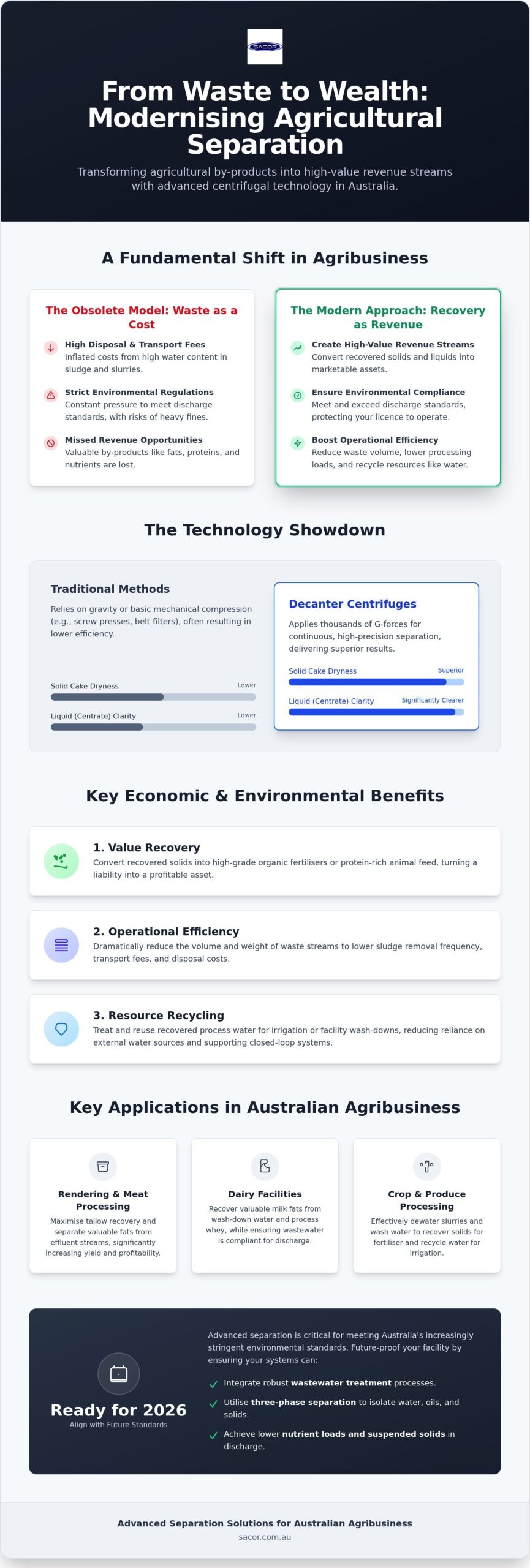
The commercial viability of large-scale agricultural processing often hinges on the efficiency of its dewatering phase. High water content in sludge or slurry significantly inflates transport and disposal costs. By removing this liquid on-site, processors reduce the weight and volume of waste material, leading to immediate logistical savings. Beyond cost reduction, effective separation allows businesses to convert liabilities into marketable assets. Consider these primary economic benefits:
- Value Recovery: Solids recovered from processing streams are frequently repurposed as high-grade organic fertilisers or protein-rich animal feed components.
- Operational Efficiency: Reduced volume in waste streams lowers the frequency of sludge removal and decreases the load on downstream treatment systems.
- Resource Recycling: Recovered process water can often be treated and reused for irrigation or facility wash-downs, reducing reliance on external water sources.
A Decanter centrifuge is the gold standard for high-volume agricultural dewatering because it provides continuous operation and the high G-force required for maximum cake dryness. It’s an investment in long-term reliability that traditional screening simply can’t match.
Environmental Stewardship and Compliance
Agribusinesses face increasing pressure to meet stringent Australian environmental standards for wastewater discharge. Regulatory bodies now demand lower nutrient loads and reduced suspended solids in effluent before it leaves a facility. Advanced agriculture separation equipment Australia ensures that discharge remains within legal limits, protecting local waterways and preventing the risk of heavy fines or license suspensions. This technology underpins the development of “closed-loop” farming systems where every by-product is accounted for. By recycling process water and returning recovered nutrients to the land, facilities minimise their environmental footprint and enhance the long-term sustainability of their regional operations.
Decanter Centrifuges vs. Traditional Separation Methods
Traditional mechanical separation in Australian agriculture has historically relied on gravity or physical compression. While screw presses and belt filters serve specific purposes, they often fall short when processing high-volume streams with varying feed characteristics. The current market for agriculture separation equipment Australia is increasingly defined by a shift from passive to active separation. By applying thousands of Gs, decanter centrifuges achieve results that gravity-based systems cannot replicate. These systems provide a level of precision that is essential for modern by-product recovery.
When procuring agriculture separation equipment Australia based facilities must balance throughput requirements with the desired quality of the output. Decanter centrifuges consistently deliver a drier solid cake and a significantly clearer centrate. This clarity is vital for facilities aiming to recycle process water or meet strict environmental discharge limits without extensive secondary treatment. Maintenance profiles also favour the decanter for long-term ROI. While the initial capital expenditure is higher, the absence of filter cloths or screens, which are prone to blinding and wear, reduces the frequency of manual intervention.
Technical Breakdown of Centrifugal Force
Centrifugal force is the primary driver behind the efficiency of a decanter. While gravity settling relies on the natural density difference between particles and liquid, a centrifuge accelerates this process by rotating the bowl at high speeds. This generates G-forces that are often thousands of times stronger than gravity. Such force ensures that even fine particles, which would remain suspended in a screw press, are effectively separated. Adjustable bowl speeds and differential speeds between the bowl and the scroll allow operators to fine-tune the process. This flexibility is essential when feed consistency fluctuates due to seasonal changes or varying crop types. Given the abrasive nature of many agricultural streams, high-quality wear protection is a non-negotiable feature for long-term reliability.
When to Choose a Decanter over a Screw Press
The choice between a decanter and a screw press often depends on the required dryness of the solids and the permitted level of suspended solids in the liquid. Screw presses are effective for coarse, fibrous materials where a moderate level of dewatering is acceptable. However, they struggle with fine-particle sludges that can blind the screens. Decanter centrifuges offer a continuous operation model that handles these challenging feeds with ease. They also occupy a smaller physical footprint compared to large belt presses or settling lagoons. While the energy consumption of a centrifuge is typically higher, the reduced need for chemical flocculants and the lower transport costs of drier cake often lead to a superior return on investment. If you are evaluating which system fits your specific plant layout, reviewing our Decanter Centrifuge Systems can provide technical benchmarks for your comparison.
Key Applications: Recovering Value from Agricultural By-Products
The strategic implementation of agriculture separation equipment Australia depends heavily on the specific characteristics of the processing stream. While the underlying physics of centrifugal separation remain constant, the configuration of the machinery must be tailored to the target by-product. Whether you’re managing protein recovery in a rendering plant or clarifying liquid streams in a dairy, the goal is to move beyond simple waste management toward high-value resource extraction. This transition allows facilities to stabilise their margins by creating new revenue streams from materials that were previously considered liabilities.
Rendering and Animal By-Product Processing
Rendering facilities are among the most demanding environments for separation technology. These plants must efficiently separate tallow, water, and solids to maximise yield and ensure product purity. Three-phase centrifuge systems are particularly effective here, as they allow for the simultaneous extraction of high-grade fats and proteins from slaughterhouse waste. By integrating advanced food processing centrifuge systems in Australia, processors can achieve higher tallow clarity while significantly reducing the organic load in their plant effluent. This precision not only improves the market value of the recovered fats but also lowers the cost of downstream wastewater treatment. In fish meal production, this same technology is utilised to maximise protein recovery and ensure oil purity, which are critical metrics for export-grade products.
Dairy and Beverage Clarification
Precision is the primary requirement in dairy and beverage processing. Disc separators are the preferred choice for these applications, offering the fine-tuned control necessary for milk clarification and fat separation. These systems ensure consistent product quality by removing even the smallest impurities and standardised fat content. In beverage and juice production, clarification is essential for maintaining hygiene standards and achieving the desired shelf-life and appearance. The equipment must meet strict food-grade specifications, featuring stainless steel construction and automated cleaning-in-place (CIP) cycles to maintain a sterile processing environment. This level of automation reduces manual labour costs and ensures that the facility remains compliant with national food safety standards.
Slurry and Digestate Management
Managing livestock manure and anaerobic digestate presents a significant logistical challenge for large-scale agricultural operations. The application of sludge dewatering centrifuge Australia technology allows farmers to transform liquid slurry into stackable, nutrient-rich solids. These solids are much more efficient to transport and apply to broadacre crops compared to raw liquid manure. By reducing the overall volume of the waste stream, facilities can significantly decrease their storage lagoon requirements and mitigate the risk of environmental runoff. This “closed-loop” approach ensures that valuable nutrients like nitrogen and phosphorus are returned to the soil in a controlled, sustainable manner, rather than becoming a source of groundwater contamination.
Selecting and Maintaining Agriculture Separation Equipment
Procuring high-capital industrial machinery in the agricultural sector requires a shift from viewing equipment as a commodity to viewing it as a long-term technical partnership. The performance of agriculture separation equipment Australia depends entirely on how well the system is matched to the biological and chemical profile of the feed stream. Factors such as solids concentration, viscosity, and processing temperature dictate the mechanical requirements of the centrifuge. For instance, separating tallow in a rendering plant requires precise temperature control to maintain liquid flow, while dewatering manure slurries demands a focus on handling high abrasive solids. Failure to account for these variables during the selection phase often leads to suboptimal cake dryness or excessive component wear.
The Equipment Selection Framework
A structured approach to selection ensures that the chosen system delivers the promised ROI without unexpected operational hurdles. We recommend a three-step process for plant managers and engineers:
- Step 1: Feed Analysis. Conduct a detailed laboratory analysis of your process stream. Understanding the particle size distribution and the specific gravity of the solids allows for the accurate calculation of the required G-force.
- Step 2: Target Performance. Define your success metrics. Are you prioritising the highest possible solids dryness for transport savings, or is the clarity of the liquid centrate more critical for environmental compliance?
- Step 3: Site Integration. Match the industrial decanter centrifuge Australia to your existing site infrastructure. This includes assessing power availability, footprint constraints, and the capacity of existing pumps and feed lines.
Total cost of ownership (TCO) should always take precedence over the initial purchase price. In high-volume agricultural operations, the costs associated with energy consumption, chemical flocculant usage, and unplanned downtime far outweigh the sticker price of the machine. A cheaper unit that requires more polymer or frequent manual cleaning will quickly become a financial liability compared to a precision-engineered system.
Ensuring Long-Term Reliability
Operating in remote Australian agricultural regions presents unique logistical challenges for maintenance. A robust industrial centrifuge spare parts Australia strategy is essential to mitigate the risk of extended downtime during peak processing seasons. Scheduled maintenance programmes are far more cost-effective than reactive repairs, as they allow for the replacement of wear components like tiles and bearings before they cause catastrophic failure. We also emphasise the importance of training on-site staff for basic monitoring and troubleshooting. When operators can identify early signs of vibration or changes in torque, they can intervene before a minor issue escalates. If you need assistance with custom engineering or ongoing technical support, contact our team for expert maintenance and technical support services.
Optimising Ag-Processing with Sacor’s Separation Solutions
Sacor positions itself as a technical authority in the Australian market, providing specialised agriculture separation equipment Australia requires for high-performance by-product recovery. We don’t simply supply hardware; we provide custom-engineered systems that address the specific rheology and throughput demands of individual processing plants. This collaborative approach ensures that every installation is optimised for the unique characteristics of the local feed stream, whether it’s a high-viscosity rendering effluent or a high-volume dairy clarification line.
Our national reach allows us to support agricultural operators across all Australian states, ensuring that remote facilities have access to the same level of technical expertise as those in metropolitan hubs. We work alongside plant engineers to meet specific yield targets and environmental compliance goals, establishing a partnership that extends well beyond the initial procurement phase. This focus on engineering excellence ensures that the technology we deploy contributes directly to the sustainable industrial practices of our clients.
Bespoke Engineering for Unique Feed Streams
Off-the-shelf separation solutions often fail in complex agricultural processes because they lack the flexibility to handle seasonal variability and fluctuating solids concentrations. Sacor’s engineering team focuses on matching centrifugal technology to your specific throughput and yield goals. We conduct a thorough analysis of the site infrastructure to ensure seamless integration into existing layouts. This expertise isn’t limited to agriculture; our experience with decanter centrifuge mining Australia projects allows us to apply heavy-duty engineering principles to agricultural plants that demand the highest levels of durability and performance. By customising the bowl geometry and scroll design, we ensure that your facility achieves maximum cake dryness and centrate clarity from day one.
Lifecycle Support and Technical Expertise
Maintaining the agriculture separation equipment Australia uses in remote areas requires a consistent technical presence and a comprehensive support framework. Every installation begins with on-site commissioning, where our technicians fine-tune the system parameters to ensure immediate operational efficiency. We provide detailed technical documentation and hands-on training for on-site staff, empowering them to monitor the equipment effectively and perform basic troubleshooting. This knowledge transfer is essential for maintaining performance between scheduled service intervals.
Our commitment to reliability is backed by a nationwide technical support network. We understand that in the agricultural sector, equipment downtime during peak seasons results in significant lost revenue. By providing rapid access to technical expertise and a consistent supply of spare parts, we help our partners maintain maximum uptime. This results-oriented positioning reflects our conviction that the right technology, supported by deep domain expertise, is the key to long-term profitability and resource conservation.
Future-Proofing Your Agricultural Processing Strategy
The transition toward high-precision centrifugal technology represents a fundamental shift in how Australian agribusinesses manage processing streams. By prioritising the recovery of high-value by-products like tallow and protein, facilities can transform operational liabilities into consistent revenue streams. Selecting the right agriculture separation equipment Australia requires involves a detailed understanding of your specific feed characteristics and a commitment to long-term reliability. This strategic approach ensures your plant remains compliant with 2026 environmental standards while significantly reducing transport and waste disposal costs.
Sacor provides custom-engineered solutions for high-value by-product recovery, backed by national installation and maintenance support across Australia. Our expertise in complex solid-liquid separation ensures your facility achieves maximum throughput and clarity in rendering and processing applications. Consult with Sacor to organise a customised separation solution for your agricultural operation. We look forward to helping you optimise your facility for a more sustainable and profitable future.
Frequently Asked Questions
What is the primary difference between a decanter centrifuge and a screw press for agriculture?
The primary difference lies in the method of separation; decanter centrifuges utilise high-speed rotation to generate G-forces thousands of times stronger than gravity, whereas screw presses rely on passive mechanical compression. This makes centrifuges far more effective at capturing fine particles that would otherwise blind a screw press screen. Consequently, centrifuges produce a drier solid cake and a significantly clearer centrate, which is essential for facilities aiming to recycle process water or meet strict discharge limits.
How much can a decanter centrifuge reduce waste disposal costs for a rendering plant?
Implementing advanced agriculture separation equipment Australia plants use can drastically lower waste disposal costs by reducing the volume and weight of sludge. By extracting more water from the waste stream, rendering plants spend less on transport and landfill fees. Additionally, the recovery of high-value tallow and proteins from the stream creates new revenue that offsets the cost of waste management. This transformation of process waste into a marketable by-product is a key driver for operational profitability.
Can agricultural separation equipment handle highly abrasive materials like manure or sand-laden slurry?
Yes, industrial-grade centrifuges are specifically engineered to process highly abrasive materials such as sand-laden manure or crop slurries. To ensure long-term reliability in these harsh conditions, the equipment is fitted with replaceable wear protection, including tungsten carbide tiles on the scroll and hardened bushings in the discharge ports. These features prevent the base metal from eroding, allowing the system to maintain high performance levels while processing the most challenging agricultural feed streams.
Is it possible to recover fats and oils from agricultural waste streams using a centrifuge?
Three-phase centrifuge systems are designed specifically for the simultaneous recovery of fats, oils, and solids from agricultural streams. These machines separate the feed into a heavy liquid phase, typically water, a light liquid phase, such as oil or tallow, and a solid phase in a single continuous process. This technology is vital for rendering and fish meal plants where oil purity and protein recovery are the primary metrics for success and high-value export quality.
What are the typical maintenance requirements for an industrial separator in a remote location?
Maintenance for industrial separators in remote locations focuses on scheduled inspections of high-speed rotating components, such as bearings and seals, alongside regular lubrication. Because downtime is costly in regional areas, Sacor provides national technical support and a consistent supply of spare parts. Training on-site staff to monitor vibration and torque levels allows for early detection of wear. This proactive strategy prevents minor issues from escalating into major breakdowns during peak processing seasons.
How does centrifugal separation help Australian farms meet environmental discharge regulations?
Centrifugal separation helps facilities meet 2026 Australian environmental standards by significantly reducing the nutrient load and suspended solids in wastewater discharge. By removing organic matter on-site, processors ensure their effluent meets the strict clarity requirements set by regulatory authorities. This capability is crucial for protecting local groundwater and surface water systems from contamination. It also enables closed-loop farming practices where recovered process water is safely reused for irrigation or facility wash-downs.
Can I customise a centrifuge system to fit my existing agricultural processing plant?
Sacor specialises in the custom design and engineering of centrifugal systems to ensure they integrate seamlessly with your existing plant infrastructure. We don’t believe in off-the-shelf solutions for complex agricultural processes. Our team works with your plant engineers to match the equipment to your specific feed characteristics, throughput targets, and footprint constraints. This bespoke approach ensures that the final installation delivers the precision and efficiency required for your unique operational goals.
What is the expected lifespan of a high-quality decanter centrifuge in an agricultural setting?
A high-quality decanter centrifuge typically has an operational lifespan of 15 to 20 years, provided it is supported by a rigorous maintenance programme. The longevity of the system depends on the quality of the initial engineering and the use of robust wear-protection materials. By investing in a system designed for industrial durability, agricultural processors ensure a lower total cost of ownership over the machine’s life. Consistent technical support and genuine spare parts are essential to maintaining this reliability.