
With the Global Industry Standard on Tailings Management (GISTM) implementation now mandatory for major operators as of August 2025, the pressure on Australian mining operations to move away from traditional wet storage has reached a critical point. You’re likely navigating the dual challenge of managing escalating maintenance costs for aging tailings dams while operating in remote regions where water scarcity remains a persistent threat to production continuity. Integrating a decanter centrifuge mining Australia solution into your flowsheet is no longer a simple technical upgrade; it’s a strategic necessity for sites aiming to secure their social licence to operate through 2026 and beyond.
This guide explores how advanced separation technology optimises mineral recovery and transforms tailings management into a streamlined, compliant process. We’ll examine the evolving 2026 regulatory landscape, including relevant legislative updates, and outline how custom-engineered systems help your site achieve higher dry cake solids and recover up to 85% of process water. By the end of this article, you’ll understand how to maximise on-site water recycling and reduce waste volumes to meet the rigorous ESG standards required in the current industrial environment.
Key Takeaways
- Understand how high G-force separation technology produces high-density tailings while significantly reducing the footprint required for on-site water management.
- Explore the methods for recovering valuable minerals from ultra-fine streams in gold, coal, and base metal processing to improve overall plant yield.
- Compare the automation capabilities and lower labour requirements of centrifuges against traditional filter presses to optimise operational expenditure.
- Learn how a decanter centrifuge mining Australia solution uses modular, skid-mounted engineering to simplify installation and maintenance in remote Australian environments.
- Identify the essential site audit and feed characterisation steps needed to ensure your separation system meets 2026 environmental and ESG regulatory standards.
What is a Decanter Centrifuge in the Australian Mining Context?
A decanter centrifuge is a horizontal solid-bowl separation system engineered to process high-solids slurries through rapid sedimentation. By using extreme rotational speeds, these machines generate high G-forces that separate solids from liquids based on density differences. This technology is now a critical component of decanter centrifuge mining Australia operations as the industry faces tightening environmental oversight and persistent water scarcity. With the Global Industry Standard on Tailings Management (GISTM) having set a firm compliance deadline for August 2025, and the Global Tailings Management Institute (GTMI) now overseeing audits, Australian mines are rapidly transitioning from traditional tailings ponds to mechanical dewatering. This move is accelerated by 2026 regulatory updates, such as the Mining Amendment in New South Wales, which places greater emphasis on proactive rehabilitation and waste volume reduction.
The Working Principle: From Slurry to Dry Cake
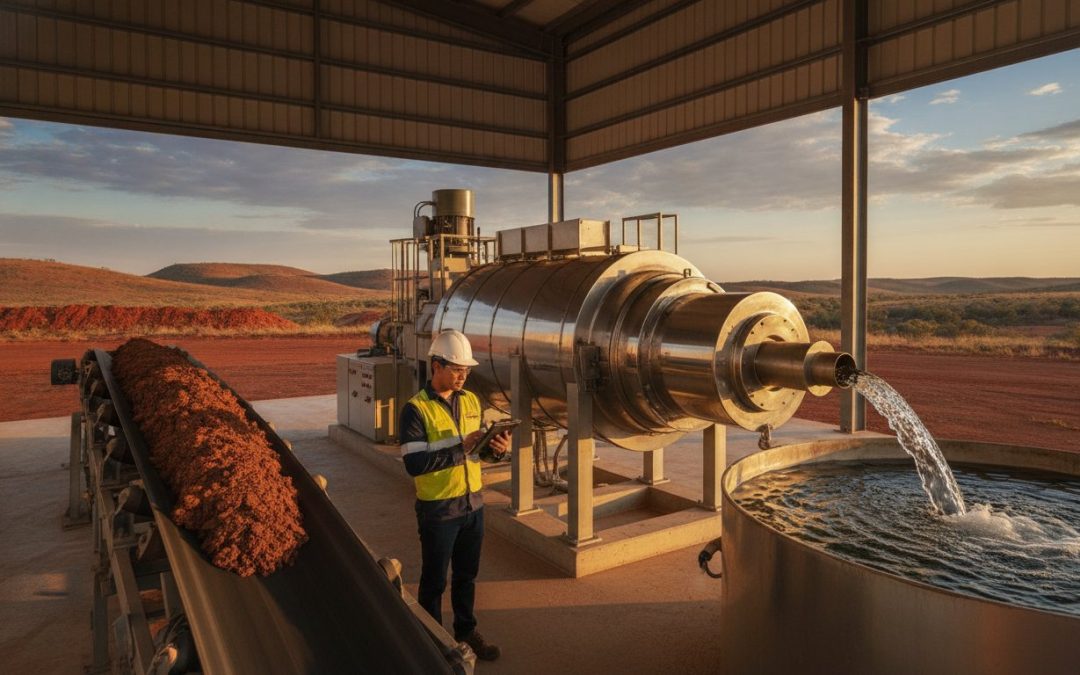
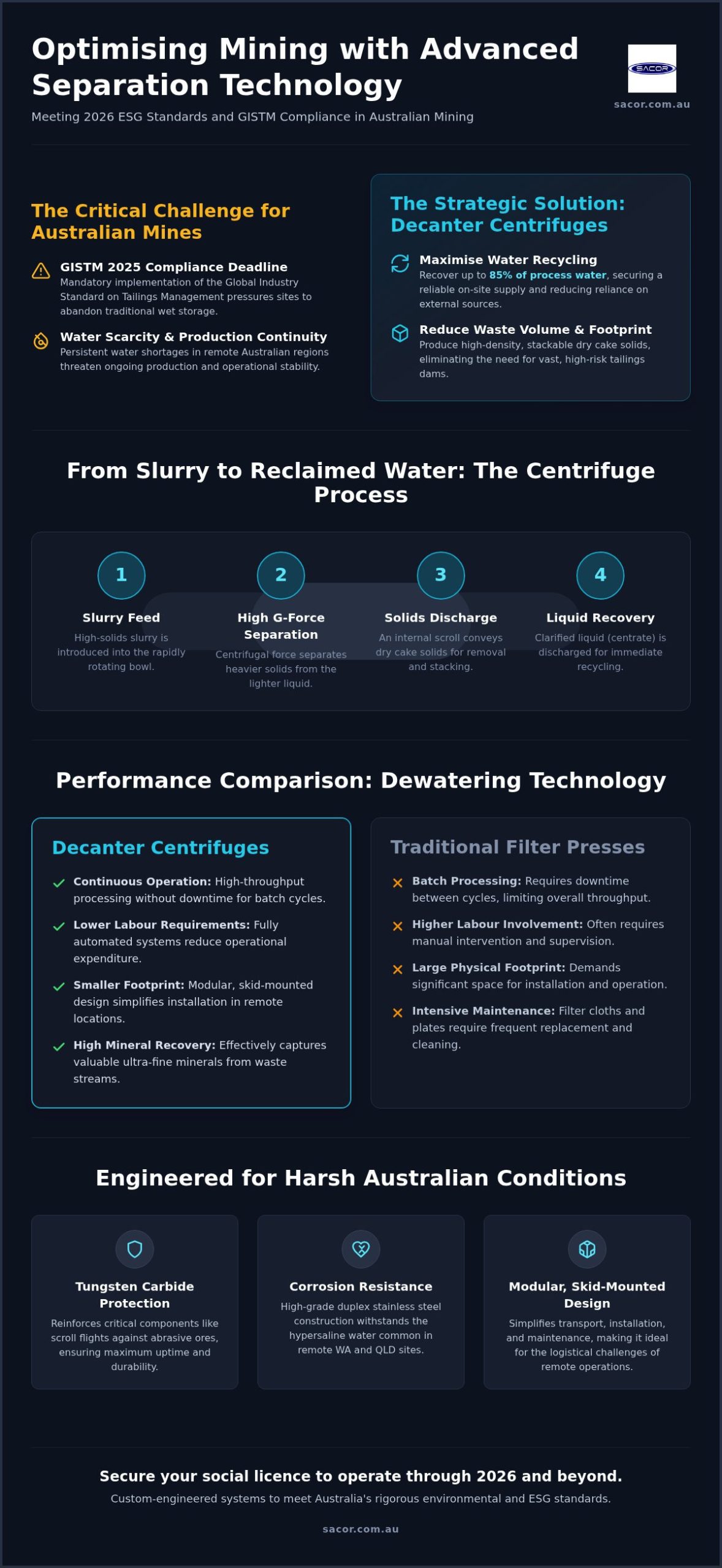
The separation starts when the feed slurry is introduced into the rotating bowl through a stationary feed pipe. Once inside, the slurry is accelerated to bowl speed, and the resulting centrifugal force drives the heavier solid particles to the bowl wall. The clarified liquid, known as centrate, remains in the centre and overflows at the liquid discharge end. An internal scroll conveyor rotates at a slightly different speed to the bowl, continuously pushing the settled solids toward the conical “beach” section for discharge as a dry cake. This continuous operation is vital for high-volume Australian sites, as it allows for a constant flow of processed material without the downtime required for batch processing or settling ponds. It’s a precise, mechanical method that effectively turns liquid waste into a manageable, stackable solid.
Key Components for Abrasive Australian Ores
Given the abrasive nature of many Australian ores, particularly in coal, gold, and base metal processing, component durability is essential for maintaining site uptime. Modern systems are built with specific features to handle these conditions:
- Tungsten Carbide Protection: To prevent premature wear from high-velocity particle impact, critical surfaces like the scroll flights and discharge ports are reinforced with sintered tungsten carbide tiles or hard-facing.
- Corrosion Resistance: Bowls are typically manufactured from high-grade duplex stainless steel to withstand the corrosive effects of hypersaline water frequently found in remote Western Australian and Queensland sites.
- G-Force Definition: In the context of mineral fines recovery, G-force represents the multiple of gravitational acceleration applied to particles to force the rapid separation of ultra-fine solids from the liquid phase.
These engineering choices ensure the equipment remains operational in harsh outback environments, supporting the long-term sustainability goals and 2026 water recycling targets that modern mine managers must now prioritise. By focusing on robust materials and high-performance separation, decanter centrifuge mining Australia solutions provide a reliable path toward zero-liquid-discharge goals.
Strategic Applications: Tailings Dewatering and Mineral Recovery
In the demanding environments of the Pilbara or the Bowen Basin, decanter centrifuge mining Australia solutions are primarily deployed to address two critical operational bottlenecks: tailings volume and metallurgical loss. As mines push for deeper or lower-grade deposits, the volume of ultra-fine waste increases, making traditional gravity-based separation insufficient. Mechanical dewatering provides a predictable, high-throughput alternative that ensures sites can maintain production rates while adhering to strict environmental benchmarks.
Tailings Management and Dry Stacking
The primary objective of centrifugal dewatering is to transform liquid slurry into a transportable, low-moisture cake suitable for dry stacking. This process eliminates the need for expansive tailings dams, which are increasingly viewed as a liability following the 2025 GISTM compliance deadlines. By removing the majority of liquid, mines effectively eliminate the risks of seepage and catastrophic dam failure, which are significant concerns for local communities and regulators. This shift is essential for maintaining a social licence to operate in a climate of increased scrutiny.
Beyond safety, the ability to recover up to 85% of process water is a transformative advantage for arid mining regions. In areas where water procurement costs are high or availability is restricted by local legislation, recycling this volume on-site directly reduces operational expenditure. Consulting with specialists like Sacor allows operators to determine the optimal G-force required for their specific mineralogy to ensure maximum water return.
Maximising Yield in Fine Mineral Circuits
Centrifuges are equally vital for enhancing the overall metallurgical recovery of a plant. In gold and copper circuits, ultra-fine particles often bypass traditional screens and hydrocyclones, resulting in valuable minerals being lost to the tailings stream. A decanter centrifuge captures these fines, allowing them to be reintroduced into the concentrate or further processed, which directly improves the total plant yield. This recovery of fines can represent a significant boost to the bottom line without requiring additional mining of new ore.
In the coal sector, dewatering ultra-fine coal streams is essential for maintaining product quality. High moisture content in coal fines can lead to handling issues and lower thermal values, potentially resulting in price penalties from buyers. Centrifugal separation ensures these fines are dewatered to a point where they can be blended back into the final product without compromising specifications. This precise control over moisture and solid recovery helps mine managers maintain a consistent, high-value output regardless of feed variability. For a broader perspective on how these principles apply across processing industries, the industrial decanter centrifuge Australia 2026 comprehensive guide outlines the strategic selection of 2-phase and 3-phase systems and their impact on operational costs.
Decanter Centrifuges vs. Filter Presses: A Performance Comparison
Selecting the appropriate dewatering technology involves balancing capital expenditure against long-term operational efficiency. While filter presses have historically been common, the decanter centrifuge mining Australia sector increasingly prioritises the compact footprint and automated reliability of centrifugal systems. The fundamental difference lies in how each machine handles the solids. A filter press relies on pressure to force liquid through a cloth medium, whereas a centrifuge uses G-force to settle solids against a solid bowl wall. While filter presses are batch-oriented, centrifuges offer continuous processing that aligns more effectively with high-throughput mine circuits.
Handling Challenging Feed: Clays and Silts
One of the most persistent issues in mineral processing is the presence of ultra-fine clays and silts, often referred to as slimes. In a filter press, these fine particles quickly blind the filter cloths, leading to increased cycle times and frequent manual cleaning requirements. Centrifuges avoid this mechanical bottleneck entirely because they don’t rely on a physical barrier for separation. Instead, they produce a consistent cake moisture regardless of fluctuations in feed density or particle size distribution. This “set and forget” capability allows automated systems to adjust internal speeds in real-time, maintaining performance without the labour-intensive oversight required by traditional filtration.
Operational Costs and Site Footprint
The civil engineering requirements for a centrifuge installation are significantly lower than those for a filter press hall. A decanter centrifuge system capable of processing up to 300m³/h occupies approximately 50m², allowing for a compact, skid-mounted design that is easily transported to remote sites. In contrast, a filter press of equivalent capacity requires a massive structural footprint and heavy-duty foundations to support the weight and vibration of the press frames. This difference in scale directly impacts the initial project cost and the complexity of the site layout.
Operational costs also diverge when evaluating maintenance cycles. Filter presses involve high consumable costs for cloths and plates, along with the labour required for regular replacements. Centrifuges require higher initial energy consumption to maintain bowl speeds, but they offer longer maintenance intervals. By using tungsten carbide wear protection on the scroll, as previously discussed, operators can achieve thousands of hours of uptime before requiring a major service. This trade-off between energy use and reduced labour intensity often makes the centrifuge the more commercially viable option for modern, tech-focused Australian mines aiming for maximum site availability. Mine sites managing process water discharge must also consider how centrifugal technology addresses broader effluent compliance obligations, as detailed in the wastewater treatment centrifuge Australia 2026 strategic guide, which examines how facilities can reclaim process water and reduce disposal volumes under tightening national regulations.
Implementation and Operational Excellence on Australian Mine Sites
Successful deployment of a decanter centrifuge mining Australia solution requires more than just high-specification hardware; it demands a thorough understanding of the specific site’s logistical and metallurgical constraints. The implementation process begins with a comprehensive site audit and feed characterisation to ensure the equipment is sized correctly for the expected solids load and fluid viscosity. Sacor facilitates this phase by analysing the specific density and abrasive qualities of the local ore body, which informs the custom configuration of each unit to prevent processing bottlenecks.
Custom Engineering for Site-Specific Conditions
Environmental factors play a significant role in equipment longevity, particularly in high-ambient-temperature regions like the Pilbara or the Goldfields. Systems must be engineered with advanced cooling circuits and robust lubrication programmes to maintain continuous operation in temperatures that frequently exceed 45 degrees Celsius. Sacor optimises the scroll pitch and bowl speed for each application, balancing solids dryness against liquid clarity to meet the site’s specific 2026 water recycling targets. The commissioning process is managed by technical specialists who verify that throughput and recovery rates align with the original design specifications before the equipment is handed over to the site team.
Logistical efficiency is further enhanced through modular, skid-mounted designs. These units are pre-assembled and factory-tested before being transported to remote sites, which significantly reduces the time and labour required for on-site installation and civil works. Modern centrifuges are designed for seamless integration with existing SCADA and plant control systems, allowing operators to monitor performance metrics and adjust parameters from a central control room to respond to feed variability in real-time.
Maintenance and Lifecycle Management
Reliability is maintained through a combination of scheduled interventions and real-time vibration monitoring. By identifying potential bearing or drive issues before they lead to mechanical failure, predictive maintenance programmes prevent the costly unplanned downtime that can stall an entire production circuit. Having a partner with a dedicated service centre in Mandurah, Western Australia, ensures that national sites receive rapid technical support and have immediate access to critical spare parts. This local presence is vital for maintaining compliance with the evolving 2026 regulatory landscape, including the updated rehabilitation standards currently under review in New South Wales.
To discuss a tailored separation strategy for your site, contact the technical team at Sacor for a detailed consultation.
Partnering with Sacor for Leading Separation Solutions
Sacor has established itself as the premier partner for high-performance separation technology within the local sector. Selecting a decanter centrifuge mining Australia solution requires a partner who understands the logistical and environmental realities of the Pilbara, the Goldfields, or the Bowen Basin. We don’t just supply equipment; we work alongside plant managers to engineer systems that meet the specific metallurgical demands of each site. This collaborative approach ensures that every installation is optimised for the unique feed characteristics of the ore body, whether you’re processing coal, gold, or base metals. We position ourselves as a technical authority, providing the quiet assurance that comes from deep domain expertise and a proven track record in harsh Australian conditions.
The Sacor Advantage: Local Expertise, Global Standards
Working with a Western Australian-based specialist ensures your operation remains compliant with evolving national regulations, such as the 2026 amendments to mine rehabilitation standards in New South Wales. Our engineering team brings global technical standards to local site conditions, providing custom solutions that increase process efficiency while reducing long-term operational costs. For operations requiring more complex separation, we provide Three-Phase Centrifuge Systems, such as the Delta Canter, which are capable of simultaneously separating two immiscible liquid phases and a solid phase. These units are essential for energy and oil separation duties where precision and reliability are paramount to maintaining production schedules. By focusing on robustness and resource conservation, we help sites achieve zero-liquid-discharge goals while maintaining high throughput.
Next Steps: Optimise Your Separation Process
The transition to advanced mechanical dewatering is a significant capital decision that requires detailed technical documentation and a clear implementation roadmap. We provide comprehensive support throughout the equipment lifecycle, from the initial site audit and feed characterisation to the provision of spare parts and long-term maintenance contracts. Our facility in Mandurah serves as a strategic hub for technical support, ensuring that national sites have immediate access to the expertise required to keep critical separation circuits operational. This end-to-end service model ensures your separation circuit continues to perform at peak efficiency, helping your site achieve its sustainability goals and 2026 water recycling targets.
By integrating robust technology with local technical support, we help Australian mines reduce waste volumes and maximise resource recovery. Our commitment to sustainability is reflected in every project we undertake, framing our work not merely as a commercial offering but as a contribution to sustainable industrial practice. We invite you to engage with our team for a site-specific assessment of your tailings or mineral recovery requirements.
Contact the Sacor team to discuss your mining separation requirements.
Securing Operational Continuity through Advanced Separation
The transition toward mechanical dewatering is no longer optional for sites aiming to meet the 2026 ESG benchmarks and global tailings standards. By implementing a high-performance decanter centrifuge mining Australia strategy, operators can effectively eliminate the risks associated with wet tailings storage while simultaneously recovering up to 85% of process water. This technology provides a predictable, automated alternative to traditional filtration, ensuring consistent cake dryness even when processing challenging ultra-fine clays and silts that typically blind filter cloths. Moving beyond legacy storage methods allows your site to reduce its environmental footprint and improve overall metallurgical recovery.
Sacor supports this transition through custom engineering tailored to your site’s specific mineral feed characteristics, ensuring the equipment handles the unique abrasive qualities of your ore. From our base in Western Australia, we provide national coverage including specialised maintenance and a reliable supply of spare parts to ensure maximum uptime for your separation circuits. We invite you to consult with Sacor for customised mining separation solutions that align with your long-term production and sustainability goals. Taking these proactive steps today ensures your operation remains resilient, compliant, and efficient in an increasingly regulated landscape.
Frequently Asked Questions
How does a decanter centrifuge handle abrasive mining slurries?
Decanter centrifuges handle abrasive mining slurries by using internal components reinforced with sintered tungsten carbide tiles. These protective layers are applied to the scroll flights and discharge ports where the highest impact occurs, preventing premature erosion. This engineering choice, combined with high-grade stainless steel bowls, ensures the machine resists the abrasive nature of mineral solids and hypersaline process water common in Australian operations.
What is the typical lifespan of a mining centrifuge in Australian conditions?
The operational lifespan of a centrifuge in Australian mining environments often extends over several decades if a structured maintenance programme is followed. While the primary wear components require periodic servicing, the main structural elements like the bowl and frame are designed for long-term durability. Regular vibration monitoring and predictive maintenance help identify wear before it leads to mechanical failure, ensuring the equipment remains a permanent asset on site.
Can a decanter centrifuge help our mine achieve zero-liquid-discharge?
A decanter centrifuge is a critical component for mines aiming for zero-liquid-discharge because it recovers up to 85% of process water for immediate reuse. By producing a dry, stackable cake with minimal moisture, the system reduces the reliance on evaporation ponds and traditional tailings dams. This capability is essential for meeting the 2026 water recycling targets and ESG standards required by Australian regulators.
How much maintenance is required for a decanter centrifuge on a remote site?
Centrifuges are designed for “set and forget” automated operation, which significantly reduces the daily labour requirements on remote sites compared to filter presses. Maintenance is typically limited to scheduled inspections and greasing, with major services planned around plant shutdowns. Integrating a decanter centrifuge mining Australia solution with your SCADA system allows for remote performance monitoring, ensuring technical issues are addressed before they cause unplanned downtime.
Is a centrifuge more cost-effective than a filter press for tailings?
Centrifuges are often more cost-effective than filter presses due to their smaller footprint and lower consumable costs. While filter presses require frequent manual cleaning and expensive cloth replacements, a centrifuge operates continuously with minimal operator intervention. The reduced civil engineering costs and the ability to process “slimes” without clogging often result in a lower total cost of ownership over the equipment’s lifecycle.
What mineral types are best suited for centrifugal separation?
Centrifugal separation is highly effective for gold, coal, and base metals, particularly when recovering minerals from ultra-fine streams. It’s especially suited for ores with high clay or silt content that typically cause issues for vacuum or pressure filters. The technology is also used in coal processing to dewater fines, ensuring the final product meets moisture specifications for transport and sale.
How does Sacor support equipment installation and commissioning?
Sacor provides end-to-end support starting with a detailed site audit and feed characterisation to ensure the system is correctly sized for your specific ore. Our technical specialists manage the commissioning process, verifying that throughput and recovery targets are met before final handover. Using modular, skid-mounted designs allows us to simplify the installation process, reducing the time and labour required on site.
Are spare parts for decanter centrifuges readily available in Australia?
Yes, spare parts for a decanter centrifuge mining Australia system are readily available through Sacor’s dedicated service centre in Mandurah, Western Australia. We maintain a comprehensive inventory of critical components and wear parts to ensure national sites receive rapid support. This local presence eliminates the long lead times associated with international shipping, helping mine managers maintain production continuity and meet strict operational schedules.