
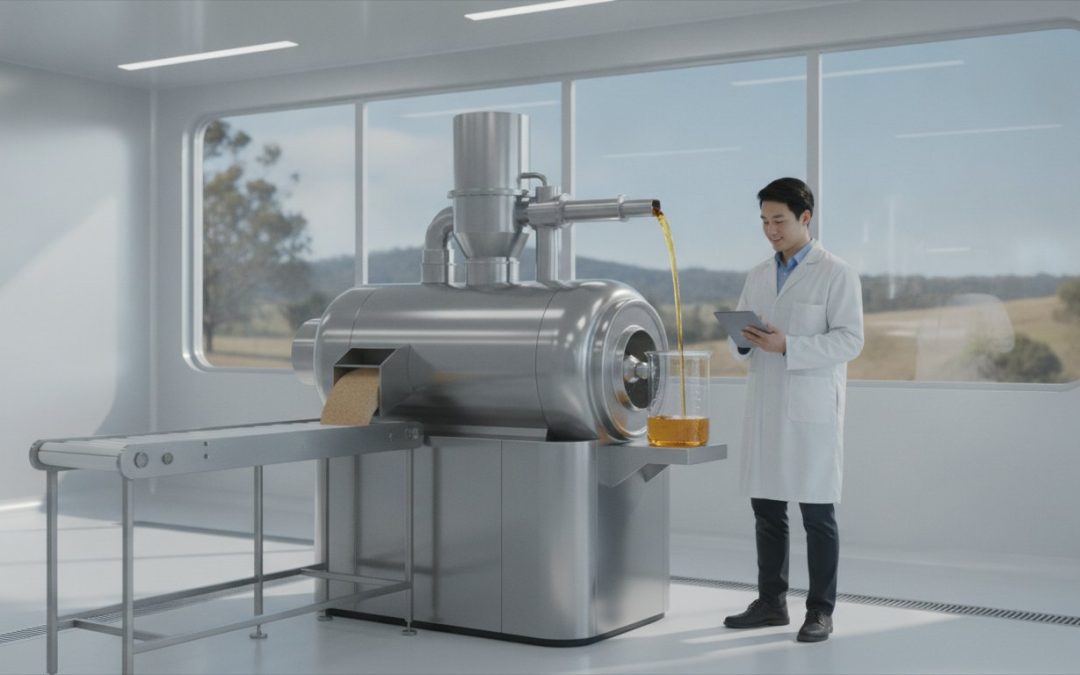
Accepting high product loss as an unavoidable cost of production is a strategic error that Australian food processors can no longer afford in 2026. You’re likely familiar with the frustration of seeing valuable yield trapped in waste sludge or the rising expenses associated with disposing of heavy, wet organic matter. By integrating a high-performance decanter centrifuge for food processing Australia, your facility can move beyond the limitations of traditional filtration to achieve a level of precision that protects both your product and your margins.
This guide demonstrates how advanced centrifugal separation ensures rigorous food safety compliance while significantly reducing manual intervention through automation. You’ll discover how to generate drier solids for repurposing and secure higher yields of clarified liquids from every batch. We provide a methodical overview of the latest technical advancements and maintenance strategies, positioning your operation to lead the industry in both efficiency and sustainable practice. We will examine the shift from simple waste management to sophisticated resource recovery, providing a clear roadmap for integrating continuous, high-capacity processing into your 2026 operational strategy.
Key Takeaways
- Transform waste streams into valuable resource recovery opportunities by utilising high-G separation to capture maximum yield from every batch.
- Navigate 2026 FSANZ requirements by selecting a decanter centrifuge for food processing Australia constructed from 316L stainless steel for total hygienic compliance.
- Reduce operational overheads and floor space requirements by replacing labour-intensive filtration with automated, continuous separation technology.
- Optimise specific processing lines, from beverage clarification to edible oil rendering, using specialised three-phase systems that protect flavour profiles.
- Minimise production downtime through bespoke engineering solutions and local technical support tailored to the unique characteristics of Australian feedstock.
What is a Food Processing Centrifuge and Why is it Essential in 2026?
A Decanter centrifuge is a specialised industrial separation system engineered to handle high-solids feedstocks with precision. In the context of modern Australian manufacturing, these systems provide a continuous method for clarifying liquids and concentrating solids. Unlike traditional batch filtration, which often results in significant downtime and product loss, a decanter centrifuge for food processing Australia allows for uninterrupted production cycles. This transition is driven by the 2026 industry shift toward circular economy principles, where what was once considered waste is now viewed as a recoverable resource.
The Core Mechanism: How Centrifugal Force Protects Product Integrity
The operation relies on a horizontal rotating bowl and an internal scroll conveyor that rotates at a slightly different speed. This differential speed is critical. It determines how effectively the solids are transported out of the machine while the clarified liquid discharges from the opposite end. Because the separation occurs rapidly and under controlled conditions, the nutritional value and flavour profiles of the food products are preserved. Low-heat separation prevents the degradation often associated with thermal processing or prolonged exposure to oxygen. G-force represents the multiple of the earth’s gravitational pull generated by the centrifuge’s rotation to accelerate the sedimentation of suspended solids.
Key Applications Across the Australian Food Landscape
Australian processors utilise these systems to extract value from diverse feedstocks through precise mechanical separation. The ability to handle varying densities makes them indispensable for several key sectors:
- Protein Recovery: Capturing high-value proteins from animal by-products and emerging plant-based sources like lupins or chickpeas to maximise yield.
- Clarification of Edible Oils: Refining tallow and seed oils to meet strict clarity and purity standards without the need for extensive chemical additives.
- Starch Extraction: Efficiently dewatering vegetable pulps to recover starch while minimising water consumption and reducing the volume of waste for disposal.
By moving away from labour-intensive batch systems, plants can achieve higher throughput with lower operational costs. The reliability of these automated systems ensures that production remains consistent, even when dealing with the unique characteristics of Australian agricultural inputs. This shift toward continuous processing is no longer just a matter of convenience; it’s a strategic requirement for maintaining competitiveness in a resource-constrained market.
Specialised Separation: From Beverage Clarification to Edible Oils
The diversity of the Australian food sector requires separation technology that can adapt to varying viscosities and delicate flavour profiles. Implementing a decanter centrifuge for food processing Australia is particularly effective in high-value streams where product integrity is paramount. Modern systems are now designed to integrate seamlessly with standard Clean-in-Place (CIP) regimes. This ensures that hygiene is maintained without compromising the speed of continuous production or requiring labour-intensive manual teardowns between batches.
Beverage Excellence: Wine, Beer, and Fruit Juice Clarification
In the wine and beer industries, the primary goal is removing sediment while preserving the delicate aromatic compounds that define the brand. For wine producers, centrifugal separation reduces the volume of lees. This directly increases the amount of sellable product harvested from every vintage. In the beer sector, the rapid removal of yeast and hops allows for faster tank turnover and improved cellar efficiency. While decanters handle the heavy solids, disc separators are often used downstream to polish the liquid to a mirror-like finish. This combination ensures consistent clarity and shelf stability for fruit juices and craft beverages, regardless of seasonal variations in raw ingredients.
Three-Phase Systems for Edible Oils and Tallow Rendering
The rendering of animal fats and the extraction of seed oils require the simultaneous separation of three distinct phases: oil, water, and solids. Three-phase centrifuge systems revolutionise this process by performing these tasks in a single pass. This efficiency reduces the energy required for downstream refining and improves the quality of tallow for the agriculture sector. By capturing a cleaner oil phase earlier, processors can significantly lower their operational overheads. These systems are particularly effective at handling variable feedstocks, such as differing fat contents in rendering, providing a reliable output that meets market specifications every time. For producers focused on premium oil recovery, the same centrifugal principles that drive tallow rendering also underpin the performance of an olive oil centrifuge separator, where preserving delicate polyphenols and maximising yield from every batch are equally critical objectives. Operators seeking to maximise edible fat recovery while simultaneously reducing waste disposal costs can explore how a tricanter centrifuge for food processing Australia automates the simultaneous separation of solids, oil, and water in a single continuous pass.
Maximising Protein Recovery and Side-Stream Value
The role of centrifuges in the Australian plant-based protein market is expanding as manufacturers seek to isolate proteins from pulses and grains with minimal denaturation. This process aligns with the Australia New Zealand Food Standards Code, which mandates strict safety and hygiene controls throughout the recovery and processing stages. Beyond proteins, recovering oils and fats from food waste streams allows facilities to diversify their revenue by creating high-value side-streams from materials that were previously discarded. Achieving these results requires a system tailored to your specific feedstock. You can explore customised separation solutions to see how these technologies apply to your unique production requirements.
Centrifuge vs. Traditional Filtration: A Performance Comparison
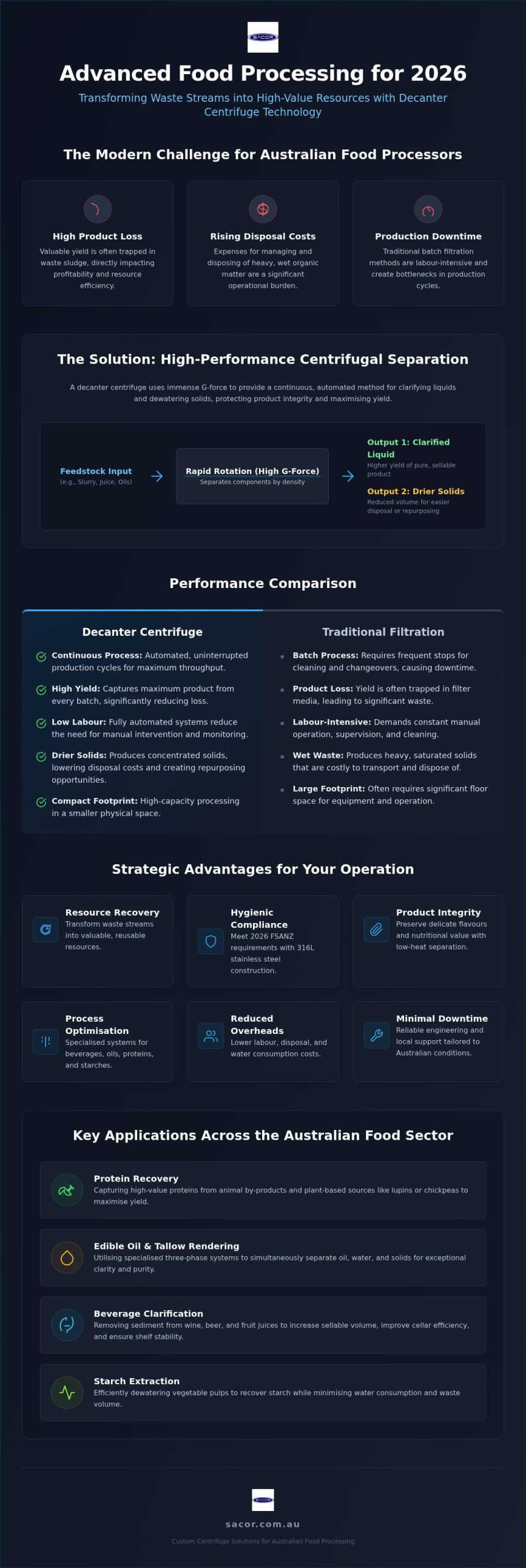
Choosing between centrifugal separation and traditional filtration requires a methodical evaluation of long-term operational efficiency. While rotary vacuum filters and belt presses have been industry staples, they often demand a significant physical footprint and high levels of manual intervention. A decanter centrifuge for food processing Australia offers a compact alternative, concentrating high-volume processing into a fraction of the floor space required by conventional systems. This spatial efficiency is particularly valuable in established Australian facilities where expansion is constrained by existing infrastructure.
Beyond the physical layout, the primary differentiator lies in the capture rate of suspended solids. Traditional filters often struggle with “fines”, which are microscopic particles that can pass through filter cloths or screens. The high-G force generated by a centrifuge ensures these particles are captured, resulting in higher yields and clearer liquid discharges. This precision is documented in various Centrifuge applications in food science, where the technology’s ability to standardise output quality is a key performance benchmark. The same principles that drive efficiency in food processing also underpin the performance of energy sector centrifuge equipment, where high-volume separation and regulatory compliance are equally critical considerations for Australian operators.
Evaluating Total Cost of Ownership (TCO)
Evaluating the financial impact of a decanter centrifuge for food processing Australia involves looking past the initial capital investment. Modern decanters are designed for continuous, automated operation, which virtually eliminates the labour-intensive cleaning cycles associated with plate and frame filters. Long-term savings are further realised through the reduction of consumables:
- Elimination of filter aids: There’s no requirement for diatomaceous earth or cellulose, reducing procurement costs.
- Reduced waste volume: Drier solids result in significantly lower disposal fees and easier handling.
- Minimal labour: Automated CIP regimes replace manual cloth washing and filter press scraping.
When you factor in lower disposal fees for drier solids and reduced downtime, the return on investment becomes clear within a few years of commissioning. Modern systems also feature improved energy efficiency, using variable frequency drives to match power consumption with the specific load requirements of the feedstock.
Product Quality and Purity Benchmarks
Maintaining product integrity is a non-negotiable requirement for premium Australian food and beverage brands. Filtration systems are frequently open to the atmosphere, which increases the risk of oxygen pick-up and subsequent oxidation. Centrifuges operate as closed systems, protecting sensitive liquids from environmental exposure. This containment is essential for preserving the shelf life and sensory characteristics of the product. The consistency of centrifugal separation remains stable regardless of feed fluctuations, unlike filters that can blind or bypass as the batch progresses. This reliability ensures that every litre produced meets the strict clarity requirements expected by the market.
Selecting the Right Centrifuge: Australian Standards and Compliance
Compliance with the Australia New Zealand Food Standards Code (FSANZ) serves as the fundamental benchmark for any separation project in 2026. Selecting a decanter centrifuge for food processing Australia involves more than comparing throughput rates. It requires a deep technical audit of the equipment’s material composition and structural design. Standards 3.2.2 and 3.2.3 dictate that all food-processing equipment must be constructed to prevent contamination and facilitate total sanitisation. 316L stainless steel remains the non-negotiable industry standard for all food-contact surfaces. It provides superior corrosion resistance and non-reactive properties when exposed to acidic feedstocks or aggressive cleaning agents.
Assessing the specific characteristics of your feed is equally critical. Viscosity, temperature, and particle size distribution determine the centrifugal force required for efficient separation. A feedstock with high viscosity or delicate particle structures requires precise torque control and bowl speed adjustments to maintain product integrity without sacrificing yield. Ignoring these variables often leads to excessive product degradation or incomplete separation, which directly impacts your bottom line.
Hygienic Design and CIP Integration
Modern food-grade centrifuges must support automated Clean-in-Place (CIP) cycles to minimise manual intervention and ensure batch-to-batch purity. This involves a design philosophy that eliminates dead legs where bacteria could potentially harbour. Surface finishes must meet strict roughness average values to ensure that no microscopic residues remain after a cleaning cycle. High-grade mechanical seals, often using food-safe lubricants, are essential to prevent external contaminants from entering the process stream during high-speed rotation. These features allow for continuous operation while maintaining the highest hygiene standards required by Australian health regulations.
Custom Engineering for Australian Process Conditions
A generic separation system often fails when confronted with the unique variables of Australian agricultural inputs. For instance, processing high-sugar fruits or specific seed oils requires customised bowl geometry and scroll configurations to prevent clogging and optimise discharge. You can find more detail on these technical specifications in our guide on the industrial decanter centrifuge Australia. Every system should be engineered to match the specific thermal and mechanical properties of the product. This ensures that the separation process doesn’t degrade the final quality or compromise nutritional value. If you’re ready to upgrade your facility’s compliance and performance, request a technical consultation with the Sacor team.
The Sacor Advantage: Custom Centrifuge Solutions for Food Processing
Sacor positions itself as a technical partner rather than a mere equipment supplier. The deployment of a decanter centrifuge for food processing Australia requires a deep understanding of local feedstock variability, from high-sugar fruit pulps to complex animal fats. Our collaborative engineering approach ensures that every system is customised to meet specific operational targets. We don’t believe in a one-size-fits-all model. Instead, we anchor our innovation in practical, real-world outcomes that prioritise resource recovery and waste volume reduction. This commitment to sustainable industrial practice allows our clients to meet environmental obligations while simultaneously improving their process margins.
End-to-End Project Support and Commissioning
Successful integration of centrifugal technology depends on seamless collaboration with your plant engineers. Sacor manages the entire project lifecycle, beginning with a detailed feed analysis to determine the precise G-force and torque requirements for your product. We provide full technical documentation and commissioning support to ensure the equipment operates to its exact specification from the first hour of production. Our team organises comprehensive operator training for Australian staff, empowering them to manage the system with confidence and precision. This methodical progression from design to operation minimises the risk of unforeseen delays and ensures that your facility achieves its yield targets immediately.
Maintenance and Spare Parts: Protecting Your Production Line
Reliability is the cornerstone of any high-capacity food processing facility. Unplanned downtime can result in significant product loss and missed delivery schedules. Sacor alleviates these risks through structured maintenance contracts and a national support network. Protecting your operation from the risk of a bearing failure or worn scroll component turning into a multi-week crisis requires a proactive approach to sourcing industrial centrifuge spare parts Australia, ensuring critical components are available locally rather than dependent on lengthy international lead times. While our primary focus is on food-grade separation, we also provide specialised solutions for waste streams, such as the sludge dewatering centrifuge Australia, ensuring that every aspect of your plant’s separation needs is covered. Access to genuine spare parts and local technical expertise ensures that your decanter centrifuge for food processing Australia remains in peak condition for its entire service life. By choosing a partner with a proven track record in the Australian market, you secure a long-term relationship built on competence and shared goals. Our national network ensures that help is never far away, protecting your production line from the volatility of global supply chains.
Optimising Production Efficiency for the 2026 Landscape
The transition toward more sustainable and efficient production cycles is a defining trend for the Australian food and beverage sector. Implementing a high-performance decanter centrifuge for food processing Australia allows your facility to move beyond the limitations of batch filtration; it enables continuous operation and superior resource recovery. By focusing on specialised 316L stainless steel hygienic designs and automated processing, you can ensure total compliance with national safety standards while significantly reducing the costs associated with product loss and waste disposal.
Sacor provides the technical expertise and bespoke engineering required to integrate these systems into your unique process flow. Our commitment to your success includes full commissioning and technical documentation support, alongside a national maintenance and spare parts network designed to protect your operational uptime. We invite you to enquire about a customised food processing centrifuge solution from Sacor today to discuss your specific yield and separation targets. We look forward to helping you achieve a more precise, profitable, and sustainable production future.
Frequently Asked Questions
How does a decanter centrifuge differ from a disc separator in food processing?
A decanter centrifuge is engineered to handle feedstocks with high concentrations of suspended solids, often exceeding 50% by volume. It utilises a horizontal bowl and an internal scroll to discharge solids continuously. In contrast, a disc separator is typically used downstream for liquid polishing or separating two liquids with very low solid content. While the decanter performs the heavy separation, the disc stack provides the final clarity required for premium beverage products.
Are Sacor centrifuges compliant with Australian food safety standards?
Every decanter centrifuge for food processing Australia supplied by Sacor is engineered to meet or exceed current FSANZ requirements. We utilise 316L stainless steel for all food-contact surfaces to ensure corrosion resistance and prevent chemical leaching. Our designs eliminate dead legs and include integrated Clean-in-Place (CIP) systems, facilitating the rigorous sanitisation protocols mandated by Standards 3.2.2 and 3.2.3 of the Australia New Zealand Food Standards Code.
Can a centrifuge handle high-viscosity food products like honey or thick oils?
High-viscosity products can be processed effectively provided the system is configured with appropriate torque control and thermal management. Heating the feedstock often reduces viscosity to a level where centrifugal force can achieve efficient separation without damaging the product. Sacor provides bespoke engineering to match the bowl geometry and drive power to these specific characteristics, ensuring that even dense oils or syrups are clarified with consistent precision.
What is the typical lifespan of an industrial food processing centrifuge?
An industrial centrifuge is a significant capital investment designed for a service life often exceeding 20 years when properly maintained. The longevity of the system depends on the robustness of the materials and the consistency of the maintenance regime. Using genuine spare parts and adhering to scheduled inspections prevents premature wear of critical components like bearings and seals, ensuring the equipment remains a reliable asset in your production line for decades.
How often does a food-grade centrifuge require maintenance?
Routine maintenance involves automated CIP cycles after every production run to maintain hygiene standards. Major technical inspections and bearing lubrication typically occur on an annual basis, or after a specific number of operational hours as defined in the technical documentation. Sacor offers scheduled maintenance contracts across Australia to monitor vibration levels and wear patterns, allowing plant managers to address potential issues before they result in unplanned downtime. A structured strategy for managing industrial centrifuge spare parts Australia is an essential complement to these scheduled inspections, ensuring that the correct components are on hand to minimise any interruption to production.
Can these systems be used to recover protein from food waste streams?
Recovering high-value proteins from side-streams is one of the most effective ways to improve plant profitability. Centrifugal separation allows for the isolation of proteins from animal by-products or plant-based wash waters that were previously discarded. By capturing these solids in a concentrated, dry form, processors can repurpose them into animal feed or nutritional supplements, directly supporting sustainable industrial practices and reducing the environmental impact of organic waste disposal.
Is a three-phase centrifuge necessary for all edible oil processing?
A three-phase system is only essential if you need to separate two immiscible liquids, such as oil and water, from a solid phase simultaneously. If your process involves removing solids from a single liquid phase, a standard two-phase decanter centrifuge for food processing Australia is often sufficient and more energy-efficient. We recommend a detailed feed analysis to determine if the additional complexity of a tricanter centrifuge in food processing Australia is required to meet your specific purity and yield objectives.
How much floor space is required for a typical decanter centrifuge installation?
One of the primary advantages of this technology is its compact footprint compared to traditional belt presses or large filter banks. A typical installation requires approximately 10 to 15 square metres, including the necessary clearance for maintenance and piping. This spatial efficiency allows Australian facilities to increase their processing capacity without the need for extensive building modifications, making it an ideal solution for plants where floor space is at a premium.