
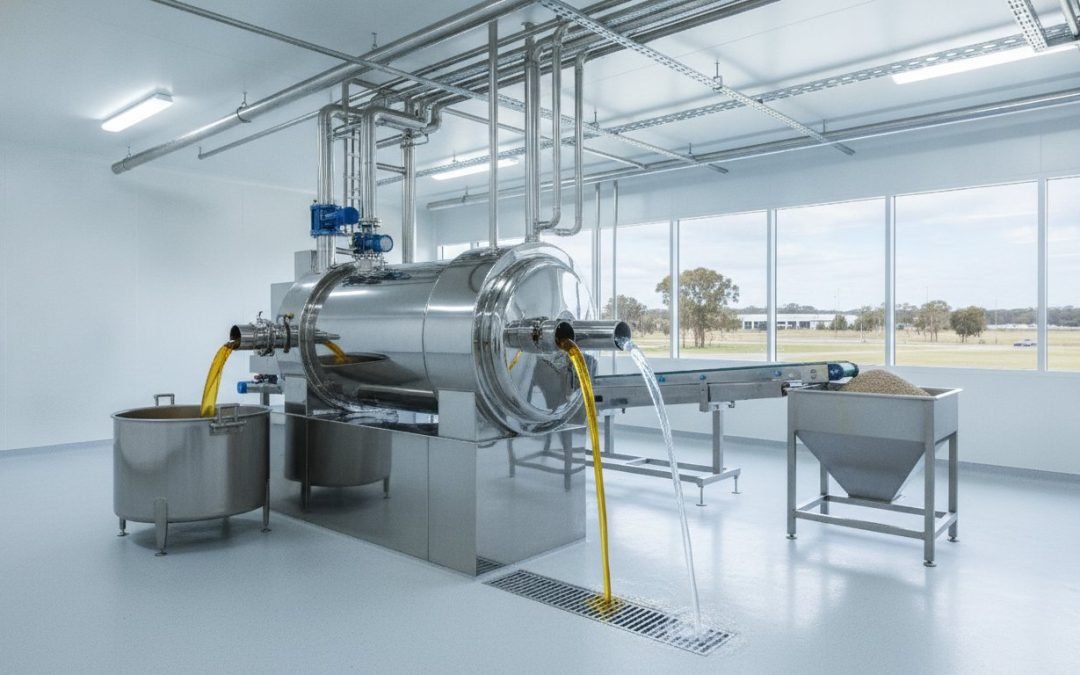
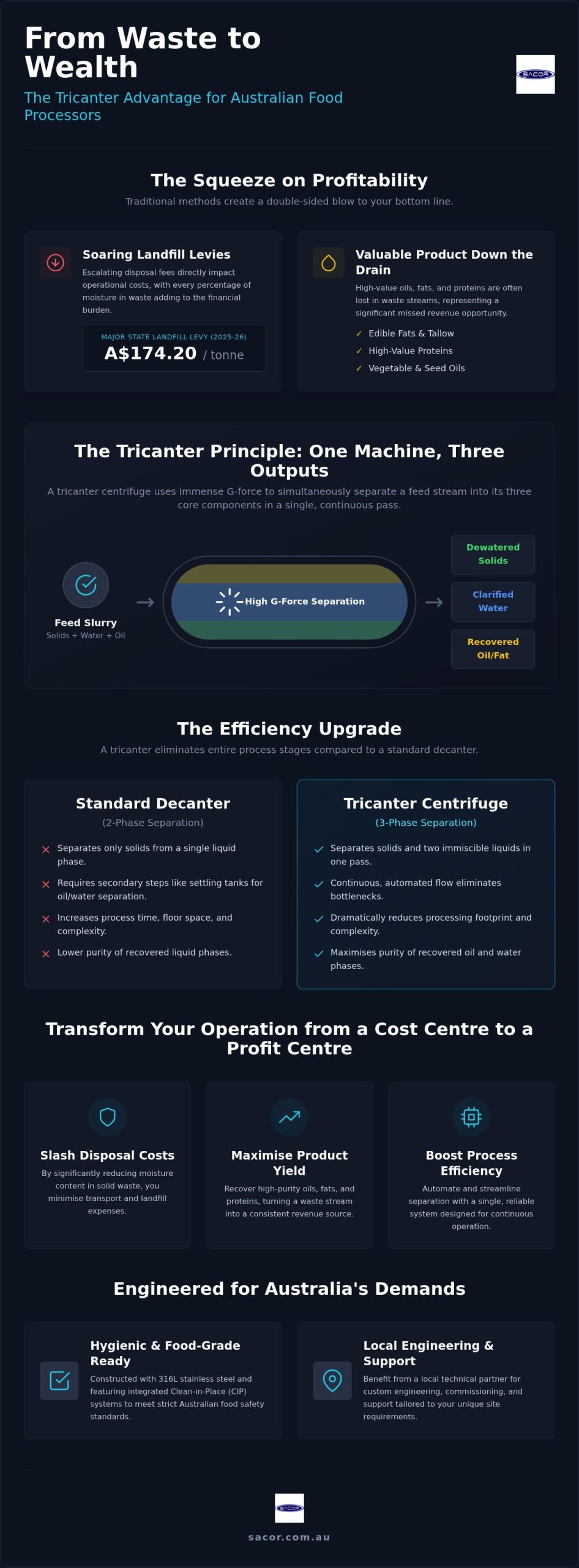
With landfill levies in major industrial states reaching A$174.20 per tonne for the 2025-2026 financial year, the cost of operational inefficiency has become a critical burden. Many operators find that a tricanter centrifuge in food processing Australia settings is now the only viable way to mitigate these costs while capturing lost revenue. Most processors recognise the frustration of watching high-value oils and proteins disappear into waste streams, only to pay a premium to have that same waste transported to landfill. It is a double-sided blow to the bottom line that traditional separation methods often fail to address.
This guide explores the strategic implementation of three-phase technology to address these challenges. By automating the simultaneous separation of solids, oil, and water, you can maximise the recovery of edible fats and significantly reduce the moisture content in solid waste. We will examine the technical mechanics of these systems, the impact of the 2026 PFAS NEMP 3.1 guidelines on biosolids management, and how local engineering support ensures your system remains reliable in demanding conditions. You’ll discover how to transform your waste stream from a mounting liability into a consistent source of recovered value through precise, continuous separation.
Key Takeaways
- Learn how the tricanter centrifuge food processing Australia relies upon utilises high-speed rotation and adjustable impellers to separate two immiscible liquids and a solid phase in a single pass.
- Mitigate the financial impact of escalating landfill levies by significantly reducing moisture in solid waste and recovering valuable proteins that are often lost to waste streams.
- Identify the specific advantages of three-phase separation for rendering and edible oil extraction, focusing on the maximised recovery of high-purity tallow and vegetable oils.
- Review the technical requirements for Australian food safety standards, including the use of 316L stainless steel and integrated Clean-in-Place systems to ensure hygienic process continuity.
- Discover the value of partnering with a local technical authority for custom engineering and commissioning support tailored to specific Australian site characteristics and feed requirements.
The Role of Three-Phase Centrifuges in Australian Food Processing
A three-phase centrifuge, commonly referred to as a tricanter, represents a significant technical evolution in industrial separation. Unlike traditional equipment, this system separates two immiscible liquids of different densities and a solid phase in a single, continuous process. For operators managing a tricanter centrifuge food processing Australia facility, this technology provides a streamlined alternative to complex, multi-stage separation lines. The shift toward these systems is driven by a requirement for higher purity in recovered fractions and a drastic reduction in overall waste volume.
The Economic Drivers for 3-Phase Separation in Australia
The financial landscape for Australian food processors has shifted significantly. For the 2025-2026 financial year, landfill levies in prominent industrial states have reached A$174.20 per tonne. This creates a powerful incentive to dewater sludge as thoroughly as possible. Every percentage of residual moisture left in the waste stream represents a direct increase in transport and disposal costs. By implementing advanced separation, plants can recover high-value lipids like tallow or edible vegetable oils that would otherwise be discarded. This recovery directly impacts the bottom line by turning a disposal cost into a revenue stream. For a broader look at how these systems integrate into modern facilities, refer to our Industrial Decanter Centrifuge Australia guide.
Tricanter vs Standard Decanter: Understanding the Shift
While a standard decanter centrifuge is highly effective for two-phase solid-liquid separation, it cannot isolate two distinct liquid phases simultaneously. In sectors like animal by-product rendering or olive oil production, a two-phase approach often requires secondary polishing steps or settling tanks. These methods consume floor space and introduce process delays. The tricanter eliminates these bottlenecks by facilitating a continuous, automated flow. This transition from batch-based processing to a single-step centrifugal solution allows for precise control over the liquid-liquid interface. It ensures that the recovered oil is free from water contamination and the discharged water contains minimal oil, protecting both product quality and environmental compliance. The adoption of a tricanter centrifuge food processing Australia system is now a strategic necessity for maintaining competitive margins in high-volume production environments.
How Three-Phase Separation Technology Works: The Tricanter Principle
The operational efficiency of a tricanter centrifuge food processing Australia facility relies on the precise application of centrifugal force. This process begins with the raw feed entering a high-speed rotating bowl. Inside, the mixture is subjected to forces thousands of times greater than gravity, which causes the components to stratify based on their specific densities. The heaviest phase, the solids, collects on the inner wall of the bowl. Simultaneously, the two liquid phases form concentric layers; the heavy liquid, typically water, sits against the solid cake, while the light liquid, such as oil or fat, forms the innermost layer.
The Mechanics of Liquid-Liquid-Solid Separation
The separation of these phases is governed by the pond depth concept. This refers to the radial thickness of the liquid layers within the bowl, which is precisely managed to ensure high-purity discharge. G-force serves as the primary driver for separation speed in a tricanter system. As the solids settle, an internal scroll conveyor, rotating at a slightly different speed than the bowl, continuously scrapes the material toward the conical end for discharge. Technical considerations for food grade operations dictate that this process must remain airtight to prevent the oxidation of sensitive oils. Efficiency is further influenced by feed characteristics; viscosity and particle size determine how quickly the phases can decouple under high acceleration.
Adjustability and Process Control
Modern tricanter systems provide operators with the ability to make on-the-fly adjustments to the separation zone. This is achieved through an adjustable impeller, which allows for the precise positioning of the liquid-liquid interface without halting production. Such control is essential when handling inconsistent feedstock, a common challenge in rendering and vegetable oil extraction. Variable speed drives allow the machine to adapt to changes in feed concentration or viscosity, maintaining optimal torque and separation performance. On Australian sites, where remote operation or limited staffing may be a factor, advanced automation reduces the need for constant manual intervention. These automated systems monitor bowl speed and scroll differential in real-time to ensure consistent output quality. If you are looking to refine your current process, exploring customised separation solutions can help identify the ideal parameters for your specific feed characteristics.
Optimising Yields in Edible Oils and Animal By-Product Rendering
Australian rendering and oil seed processing facilities are increasingly reliant on three-phase technology to maintain profitability. The ability to recover high-purity lipids while simultaneously dewatering solids is a critical advantage. In high-volume environments, a tricanter centrifuge food processing Australia system ensures that valuable fats are not lost to the wastewater stream, where they would otherwise contribute to higher treatment costs and missed revenue. By capturing these fractions early in the process, operators can secure the maximum possible value from every tonne of raw material.
Maximising Recovery in Rendering and Tallow Production
Rendering plants process a complex mixture of water, fat, and greaves. Traditional methods often require multiple stages of heating and settling, which can degrade the final product quality. A three-phase centrifuge performs this separation in a single pass, immediately isolating the tallow from the water and solid fractions. This rapid separation is vital for maintaining low Free Fatty Acid (FFA) levels; it prevents the prolonged contact between water and fat that leads to hydrolytic rancidity. Additionally, the solids discharged from the centrifuge have significantly lower moisture content. This reduces the thermal energy required for downstream drying, providing a direct saving on utility costs and increasing the throughput of the drying plant.
Plant-Based Proteins and Edible Oil Extraction
The Australian market for plant-based protein isolates and specialty oils is expanding rapidly. For producers of olive, canola, and nut oils, optimising yields in edible oils requires precise control over the extraction process to preserve delicate flavour profiles and nutritional content. Using a three-phase system allows for the continuous clarification of the oil while removing both water and fine particles. You can find more specific details on this application in our Olive Oil Centrifuge Separator guide.
Beyond oils, these systems are essential for starch production and the recovery of plant-based proteins. The centrifuge handles the separation of protein-rich fractions from fibrous waste with high precision, ensuring that the final isolate meets strict purity standards. This technology also extends to beverage bases and fruit juices, where it provides high-clarity liquid discharge and concentrated solids. Beverage producers in adjacent sectors, such as winemakers seeking to maximise juice recovery and manage lees efficiently, can explore how the same centrifugal principles apply in our guide to wine clarification centrifuge Australia solutions. For a broader perspective on how these technologies align with current industry movements, see our strategic guide on Food Processing Centrifuge Systems. By integrating a tricanter centrifuge food processing Australia solution, operators can secure higher yields from their raw materials while meeting the sustainability goals demanded by modern consumers.
Technical Considerations for Australian Food Grade Operations
Selecting a tricanter centrifuge food processing Australia operators can rely on requires a focus on material integrity and hygienic design. High-grade 316L stainless steel is the standard for all product-contact surfaces because it provides the necessary resistance to corrosion from acidic food feeds and aggressive cleaning chemicals. To ensure long-term reliability, these systems must incorporate advanced wear protection, such as tungsten carbide tiling on the scroll conveyor. This is particularly important when processing abrasive solids like bone fragments in rendering or seeds in fruit processing. Every component, from the sanitary seals to the food-grade lubricants, must be selected to prevent batch contamination and ensure the purity of the recovered oils and proteins.
Operational hygiene is maintained through integrated Clean-in-Place (CIP) systems. These systems allow for thorough internal sanitisation without the need for time-consuming equipment strip-downs, which is a mandatory requirement for maintaining high-volume production schedules. Automated CIP cycles ensure that every internal surface is reached by cleaning agents, effectively eliminating microbial risks. For processors requiring equipment that meets these stringent standards, Sacor provides customised food-grade separation solutions designed for local conditions.
Compliance with FSANZ and HACCP Standards
Australian food processors operate under some of the world’s most rigorous safety frameworks. Implementing a tricanter centrifuge food processing Australia system supports HACCP protocols by replacing manual, open-air separation with a fully enclosed, automated process. This reduction in manual handling significantly lowers the risk of human-introduced pathogens. Furthermore, the precise control systems on modern centrifuges provide the data logging necessary for full traceability. This transparency is vital for businesses participating in the Australian food export chain, where proving process consistency is often a contractual requirement. Robust equipment design prevents dead zones where product could stagnate, ensuring that microbial growth is suppressed throughout the production cycle. Processors in adjacent sectors such as dairy can find detailed guidance on meeting these same compliance requirements in our dairy separation equipment Australia buying guide.
Durability in Harsh Australian Environments
Environmental factors in Australia present unique challenges for high-speed rotating machinery. In regions where ambient temperatures frequently exceed 40 degrees Celsius, standard centrifuge cooling systems may be insufficient. High-capacity centrifuges must feature enhanced cooling for motors and bearings to prevent thermal expansion and premature component failure. Reliability in these conditions is not just about the machine’s build; it’s about the engineering support behind it. Locally supported technical expertise ensures that maintenance intervals are correctly calibrated for site-specific conditions. Because downtime on remote Australian sites can be exceptionally costly, using robust, locally engineered solutions is a strategic choice to protect operational continuity.
Implementing Three-Phase Solutions with Sacor Australia
Sacor positions itself as a technical authority rather than a simple equipment supplier. Every food processing facility has unique feed characteristics, from the protein content of rendering streams to the particulate size in fruit juices. A standardised approach often leads to suboptimal recovery rates and increased wear. Sacor’s methodology focuses on custom engineering, ensuring that the centrifugal system is precisely matched to the specific rheology of the material being processed. This tailored approach is the foundation for achieving the high-purity yields and reduced waste volumes discussed earlier in this guide. Choosing a tricanter centrifuge food processing Australia solution involves more than a simple purchase; it’s an investment in long-term operational reliability.
Customised Engineering and Site Integration
Achieving seamless integration into an existing production line requires deep collaboration between Sacor’s technical team and a client’s on-site engineers. We don’t just deliver machinery; we design the interface between the centrifuge and the surrounding process flow. This includes matching specifications to unique throughput targets and ensuring the control logic aligns with existing plant automation. For Australian operators, this level of customisation is backed by full technical documentation. Having precise manuals, process diagrams, and local commissioning support is essential for maintaining the high standards of safety and efficiency required in the local food sector. This ensures your staff are fully trained on the specific parameters of your custom-engineered system, allowing for a smooth transition to automated separation.
Lifecycle Support and Maintenance in Australia
The long-term performance of a tricanter centrifuge food processing Australia system depends on a proactive maintenance strategy. High-speed machinery operating under continuous load requires regular oversight to protect the capital investment. Sacor provides scheduled maintenance contracts that are designed to identify potential issues before they lead to unplanned downtime. Operating from our base in Mandurah, Western Australia, we maintain a comprehensive inventory of critical spare parts. This local availability is a significant advantage, as it eliminates the risk of lengthy international shipping delays that can cripple a production line. Our technicians understand the specific challenges of the Australian environment, from high ambient temperatures to remote site logistics.
Our commitment to partnership extends beyond the initial commissioning phase. We provide ongoing technical support to help operators refine their process as feed characteristics or production volumes evolve. This steady, grounded approach ensures that your facility remains at the forefront of sustainable industrial practice. If you’re looking to optimise your separation yields or reduce the impact of rising landfill levies, we invite you to contact Sacor for a technical consultation on your specific separation requirements.
Future-Proofing Australian Food Separation Yields
The adoption of a tricanter centrifuge food processing Australia system is no longer just an operational choice; it’s a strategic response to the economic and regulatory pressures of 2026. By integrating high-speed, three-phase separation, processors can simultaneously recover high-purity lipids and minimise the moisture content of solid waste streams. This dual outcome effectively offsets rising landfill levies while creating new revenue from fractions that were previously discarded. It’s a method for turning a mounting liability into a consistent source of recovered value.
Success in these high-stakes environments depends on more than just the hardware. It requires a partner who understands the nuances of Australian site conditions and food safety compliance. Sacor provides the technical authority and local support necessary to keep these complex systems running at peak performance. Our team offers custom-engineered solutions, comprehensive maintenance, and an extensive local inventory of spare parts. This ensures that your facility maintains the highest standards of reliability and sustainability.
We invite you to consult with our Australian engineering team about your three-phase separation needs to explore how we can optimise your plant’s yields. Taking this step ensures your facility remains competitive and ready for the future of industrial processing. We look forward to helping you transform your waste streams into measurable value.
Frequently Asked Questions
What is the primary difference between a decanter and a tricanter centrifuge?
A standard decanter is designed for two-phase separation, meaning it isolates solids from a single liquid phase. In contrast, a tricanter centrifuge food processing Australia application facilitates three-phase separation. This allows the machine to isolate two immiscible liquids of different densities, such as oil and water, while simultaneously discharging a solid cake. This single-step process replaces the need for secondary settling tanks or separate polishing centrifuges.
Can a three-phase centrifuge handle different concentrations of oil and water?
These systems are highly adaptable to fluctuating feed characteristics. By using an adjustable impeller, operators can modify the liquid-liquid interface while the machine is running to account for varying ratios of oil and water. This level of control is essential for Australian processors who deal with seasonal variations in raw materials, ensuring that the purity of the recovered oil remains consistent despite changes in the incoming feed stock.
What are the typical maintenance requirements for a tricanter in a food processing plant?
Routine maintenance focuses on ensuring mechanical stability through regular lubrication and monitoring of vibration levels. High-speed rotating components, such as the bowl bearings and the internal scroll conveyor, require periodic inspections to assess wear. Sacor provides comprehensive maintenance and technical support services from our local base. This includes the supply of spare parts like tungsten carbide tiles and sanitary seals, which helps to avoid the delays associated with international shipping.
How does a three-phase centrifuge help Australian companies meet environmental regulations?
By removing high-value oils and greases from the waste stream, a three-phase system ensures that process water meets strict discharge standards. This is critical for complying with the latest national guidelines regarding contaminant levels in industrial biosolids. The technology produces a cleaner liquid effluent and a drier solid discharge, which reduces the environmental burden on local water treatment systems and supports the sustainability goals of modern food production facilities.
Is a 3-phase centrifuge suitable for small-scale food processing operations in Australia?
Three-phase centrifuges are industrial-grade systems designed for continuous, high-volume flow. While they offer superior efficiency, the capital investment and infrastructure required are generally better suited to medium and large-scale operations. For these facilities, the recovery of high-value fats and the reduction in waste volume provide a clear financial return. Sacor focuses on delivering these large-scale separation solutions to ensure the highest levels of performance and reliability for commercial operators.
What materials are used to ensure the centrifuge is food-grade compliant?
Compliance is achieved by using high-grade 316L stainless steel for all components that come into contact with the product. This material is resistant to the acidic nature of many food feeds and the caustic chemicals used during Clean-in-Place cycles. Furthermore, the use of food-grade lubricants and sanitary seals ensures that the final output remains free from contamination, meeting the rigorous safety standards set by Food Standards Australia New Zealand.
How much can a three-phase centrifuge reduce waste disposal costs?
The reduction in disposal costs is achieved by significantly lowering the moisture content of the solid waste. Because landfill levies in Australia are calculated by weight, a drier solid cake results in lower tonnage and reduced transport fees. By recovering valuable lipids that would otherwise be discarded as waste, a tricanter centrifuge food processing Australia installation transforms a costly waste stream into a source of revenue, directly improving the plant’s overall profitability.
Does Sacor provide on-site training for centrifuge operators?
Sacor includes comprehensive operator training as part of our installation and commissioning support. We ensure that your plant engineers and technicians understand how to manage adjustable parameters like bowl speed and differential speed to maintain optimal performance. This training is a vital component of our partnership approach, as it empowers your team to operate the system with confidence and maintain the long-term reliability of your separation process.