
In the current Australian industrial climate, a decanter centrifuge is no longer just a piece of hardware; it’s a strategic hedge against the volatile costs of waste management and increasing water scarcity. You likely recognise that rising sludge disposal fees and tightening environmental compliance penalties are eroding your operational margins, yet the challenge of justifying capital expenditure for centrifuge Australia remains a significant hurdle during the procurement process. It’s difficult to quantify long-term savings when faced with a high initial investment, especially when site-specific variables aren’t clearly defined.
This guide provides the financial and operational framework required to build a bulletproof business case that translates technical efficiency into board-level ROI. We’ll equip you with a structured template to navigate internal approvals and demonstrate how modern separation technology secures your facility’s future. By the end of this article, you’ll understand how to apply clear ROI metrics and justify your investment based on the specific operational risks unique to the Australian market in 2026. We’ll move through the methodical steps of establishing a baseline, calculating total cost of ownership, and articulating the environmental value that resonates with modern stakeholders.
Key Takeaways
- Understand how high-speed separation acts as a strategic hedge against evolving Australian environmental standards and escalating sludge disposal fees.
- Learn the precise methodology for justifying capital expenditure for centrifuge Australia by calculating Total Cost of Ownership and Net Present Value over a 15-year lifecycle.
- Identify opportunities to increase plant throughput and achieve predictable dewatering consistency without expanding your facility’s physical footprint.
- Access a structured 5-step framework to baseline current separation gaps and define the specific performance targets necessary for a bulletproof business case.
- Discover how local technical support and bespoke engineering partnerships de-risk high-capital investments and ensure long-term equipment reliability.
The Strategic Context: Why Centrifuge CapEx is Rising in Australia
Australia’s industrial landscape in 2026 faces a convergence of high operational costs and tightening environmental oversight. Traditional filtration methods, while once standard, often fail to meet the throughput demands of modern mining and wastewater facilities. This technological gap has accelerated the transition toward high-speed centrifuge technology, which offers superior solids dryness and volume reduction compared to older belt presses or drying beds. This shift isn’t merely about performance. It’s a response to a market where water security and waste disposal costs have become primary drivers of plant profitability.
The current economic climate favours asset-heavy efficiency. Labour costs in Australia continue to rise, making manual or labour-intensive separation processes increasingly untenable for large-scale operations. Investing in automated decanter systems allows plants to scale operations without proportional increases in headcount. Successfully justifying capital expenditure for centrifuge Australia requires a shift in perspective. Decision-makers must view the equipment as a strategic hedge against resource volatility rather than a simple line-item expense.
The Cost of Inaction: Reactive vs Proactive Procurement
Maintaining legacy systems often incurs hidden costs that exceed the price of a new installation over a standard lifecycle. Frequent maintenance intervals, parts scarcity, and energy inefficiencies create a scenario of diminishing returns for plant budgets. Proactive procurement avoids the risk of catastrophic production bottlenecks. In high-throughput environments, even a few hours of downtime due to inadequate separation can result in losses that dwarf the initial CapEx. Reliability is the silent partner of profitability. Reliable systems ensure that production targets remain hit without the constant threat of equipment failure.
Regulatory Drivers and Compliance
Australian EPA standards for sludge disposal have become more stringent, focusing heavily on the moisture content of solids and the quality of centrate. Drier cake results in lower transport costs and reduced waste levies, which are rising across every state. By linking sustainability goals directly to capital expenditure approval, procurement teams can demonstrate how a centrifuge reduces the facility’s environmental footprint. This alignment between compliance and fiscal responsibility is the cornerstone of a successful business case. It’s about meeting today’s standards while future-proofing the site against the even stricter regulations expected in the coming decade.
Quantifying the Return: Financial Metrics for Centrifuge Investment
Bridging the gap between engineering performance and fiscal justification requires a methodical approach to financial modelling. While the initial price tag of a decanter centrifuge is substantial, it represents only a fraction of the Total Cost of Ownership (TCO) over a typical 15-year lifecycle. When justifying capital expenditure for centrifuge Australia, procurement teams must account for the dramatic reduction in daily operational expenses, particularly regarding chemical consumption and waste logistics. High-speed centrifugal systems often require significantly less flocculant than traditional belt presses. This efficiency results in substantial annual savings that directly improve the bottom line, especially as the cost of polymers continues to fluctuate in the global market.
Financial indicators like Net Present Value (NPV) and Internal Rate of Return (IRR) provide a clearer picture of the equipment’s value than a simple payback period. These metrics allow the board to compare the centrifuge investment against other capital projects with equal rigour. Given the current Australian resources and energy sector outlook, investing in high-efficiency separation technology is a proven method for maintaining competitiveness in a high-cost environment. A well-constructed business case demonstrates how the centrifuge pays for itself through volume reduction and recovered water. These savings often materialise within a timeframe that satisfies even the most conservative boards, particularly when considering the avoidance of future environmental levies.
CapEx vs OpEx: The Long-Term Savings Argument
The decision to approve a high-capital investment often rests on the ability to lower long-term OpEx. Automated centrifugal systems reduce the need for constant manual monitoring, which lowers labour costs and minimises the risk of human error. Durability is another critical factor; robust engineering ensures the asset remains on the balance sheet as a high-performing tool for decades. This consistency allows for more accurate long-term budgeting and reduces the likelihood of emergency capital requests for equipment replacement. To ensure these figures align with your specific site requirements, you should evaluate bespoke separation solutions that match your throughput targets.
Revenue Recovery Opportunities
In sectors like food processing and mining, a centrifuge isn’t just a waste management tool; it’s a recovery engine. By effectively separating valuable oils, proteins, or minerals from waste streams, companies can turn an expense into a secondary revenue source. Quantifying these yield increases is essential for board-level approval because it shifts the narrative from cost mitigation to revenue generation. This transformation of waste into a saleable product makes the investment far more attractive to financial stakeholders who prioritise growth and resource efficiency. High-performance separation ensures that every gram of potential product is captured, directly impacting the facility’s overall profitability and sustainability profile.
Operational Justification: Efficiency and Process Optimisation
Operational excellence is the cornerstone of justifying capital expenditure for centrifuge Australia. In industrial environments where space is at a premium, the ability to increase plant throughput without expanding the physical footprint is a significant advantage. High-speed decanter systems process large volumes of slurry in a compact area, allowing facilities to scale production within their existing boundaries. This spatial efficiency eliminates the need for costly land acquisition or the construction of additional processing bays. Beyond throughput, the consistency of output provided by a centrifuge ensures predictable dewatering performance. When moisture levels in the cake remain stable, downstream logistics and disposal schedules become easier to manage, reducing the risk of unexpected operational costs.
Modern separation systems integrate seamlessly into existing SCADA and automation frameworks. This connectivity allows for real-time monitoring and adjustment of process parameters, ensuring the equipment operates at peak efficiency. By leveraging automated controls, plants can maintain optimal performance even as feed characteristics fluctuate. This level of process control is vital for 2026 operations, where precision is directly linked to resource conservation and waste reduction goals.
Footprint and Infrastructure Savings
Centrifuges offer a distinct advantage for sites with limited space or those undergoing upgrades. They significantly reduce or eliminate the requirement for large-scale settling ponds or drying beds, which often occupy valuable real estate. By opting for a centrifugal solution, engineers can lower civil engineering costs and simplify site layout. This reduction in infrastructure complexity speeds up installation timelines and minimises the disruption to existing plant operations during the commissioning phase.
Technical Reliability and Maintenance Cycles
The longevity of a capital asset depends on the quality of its components and the rigour of its maintenance schedule. Utilising high-grade stainless steel and advanced components ensures that decanter centrifuges withstand the abrasive and corrosive conditions common in Australian mining and wastewater sectors. Predictive maintenance tools further protect the investment by identifying potential issues before they lead to unplanned downtime. Access to Australian-based technical support and locally held spare parts ensures that the risk of long-lead part failures is mitigated through rapid response and expert intervention. This combination of robust engineering and reliable support de-risks the investment, ensuring the asset remains productive for its entire intended service life.
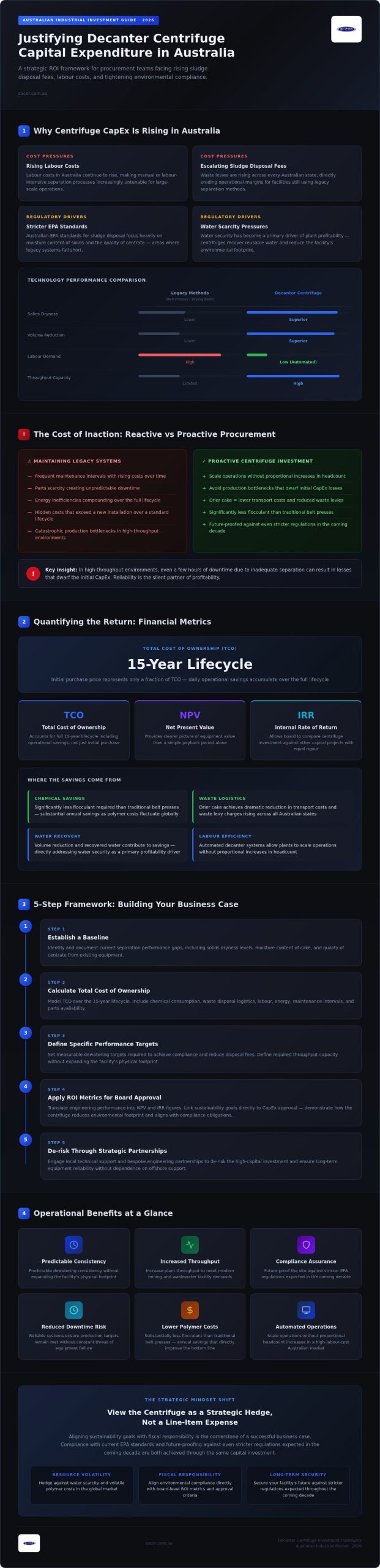
A 5-Step Framework for Building Your Business Case
Creating a compelling proposal for high-capital equipment requires a logical progression from current operational pain points to future financial gains. A methodical approach to justifying capital expenditure for centrifuge Australia ensures that every technical benefit is translated into a language that executive boards understand. This framework moves beyond simple machine specifications to focus on total system value.
- Step 1: Baseline current costs and performance gaps. Audit your existing separation process to document polymer consumption, disposal frequency, and labour hours. Use these figures to identify exactly where the current system is failing to meet 2026 standards.
- Step 2: Define specific throughput and dryness targets. Establish clear KPIs for the new system. Whether it’s achieving 25% dry solids or doubling hourly throughput, these targets form the basis of your performance guarantee.
- Step 3: Conduct a TCO and ROI analysis. Integrate the metrics discussed in previous sections to show the long-term fiscal impact. This is the most critical stage of justifying capital expenditure for centrifuge Australia, as it highlights the transition from high OpEx to controlled CapEx.
- Step 4: Identify and mitigate operational risks. Address potential hurdles such as site logistics and power requirements. Demonstrating a plan for these variables de-risks the project in the eyes of the board.
- Step 5: Align the proposal with corporate goals. Connect the investment to broader company objectives. If the organisation is committed to water recycling or carbon reduction, show how the centrifuge directly supports those pillars.
Identifying Key Stakeholders and Their Priorities
Each stakeholder views a capital request through a different lens. The CFO prioritises financial stability and risk mitigation; they need to see that the investment is protected by a realistic TCO model. In contrast, the Plant Manager focuses on reliability and ease of operation. They require assurance that the system won’t create new maintenance headaches. The ESG Officer looks for measurable improvements in water conservation and waste reduction. Tailoring your business case to address these diverse priorities increases the likelihood of a swift approval.
Addressing the Maintenance and Parts Objection
A common hurdle in procurement is the fear of long-term maintenance costs and parts availability. To overcome this, your business case should include a clear strategy for industrial centrifuge spare parts Australia wide. Demonstrating that technical support is available locally reduces the perceived risk of unplanned downtime. By linking the core pillars of an industrial decanter centrifuge Australia to your specific site needs, you show that the asset is backed by a reliable support network. This assurance is vital for remote Australian operations where logistics can be complex. To ensure your proposal is grounded in site-specific data, you should request a custom separation audit to define your exact ROI potential.
De-risking Investment through Strategic Partnerships with Sacor
Successfully justifying capital expenditure for centrifuge Australia requires more than just internal data; it necessitates a partnership with technical authorities who understand the local operational context. Sacor positions itself as a partner in the engineering phase, providing the precise technical documentation and performance guarantees that boards require for high-capital approvals. By delivering site-specific data on throughput and dryness, we help procurement teams bridge the gap between technical requirements and financial justification. This collaborative approach ensures that the business case is grounded in reality, reducing the risk of performance shortfalls after commissioning.
Our commitment extends across the entire lifecycle of the asset. From the initial design phase through to installation and long-term maintenance, we provide a structured path to operational reliability. This comprehensive support framework de-risks the investment by ensuring that the equipment is not only fit-for-purpose but remains so for its entire service life. It’s about providing a steady, grounded conviction that the technology and expertise will deliver the promised ROI.
Bespoke Engineering vs Off-the-Shelf Solutions
Australian industrial feeds often possess unique characteristics that off-the-shelf separation systems fail to handle efficiently. Choosing a generic solution increases the risk of post-installation modifications and costly downtime. Sacor’s bespoke engineering approach ensures that every decanter centrifuge is matched to specific site throughput and material variability from day one. This customisation maximises the value of every dollar spent on capital equipment, as it eliminates the inefficiencies common in standardised machinery. It’s a strategic choice that secures long-term performance and protects the facility’s bottom line.
Securing the Supply Chain
Remote Australian sites face significant logistical challenges, particularly regarding international freight delays for critical components. We mitigate these risks by providing Australian-based commissioning and technical support. A local industrial centrifuge spare parts Australia strategy is a financial necessity, as it prevents minor maintenance issues from escalating into major production bottlenecks. By maintaining a national support network, we ensure that your capital asset remains productive without the vulnerability of global supply chain disruptions. This level of local reliability is a key pillar in a bulletproof business case.
Partner with Sacor to develop your centrifuge business case and ensure your investment is backed by proven technical expertise and local support.
Securing Long-Term Operational Resilience
Building a robust business case for high-capital separation equipment is a methodical process that prioritises long-term value over initial purchase price. By focusing on Total Cost of Ownership and the strategic reduction of waste logistics, you can demonstrate a clear path to ROI that resonates with both financial and technical stakeholders. The transition to high-speed centrifugal systems is a necessary response to the tightening environmental regulations and rising disposal costs defining the 2026 Australian industrial market. Successfully justifying capital expenditure for centrifuge Australia relies on aligning these performance gains with broader corporate sustainability and efficiency goals.
Sacor supports this transition through specialist engineering tailored to the unique demands of Australian mining and wastewater sectors. Our comprehensive national spare parts support and proven track record in industrial separation optimisation ensure that your investment is protected against unplanned downtime and supply chain volatility. We work alongside you to provide the technical documentation and performance guarantees required to secure internal approval. Consult with Sacor to refine your centrifuge CapEx proposal and take the first step toward a more efficient, future-proof facility. We look forward to helping you achieve your throughput and sustainability targets.
Frequently Asked Questions
How do I calculate the ROI for a decanter centrifuge in a mining application?
ROI is determined by comparing current tailings disposal costs against the performance gains of high-speed separation. You must factor in the reduction in transport volume and the value of recovered process water. When justifying capital expenditure for centrifuge Australia, mining operators often find that yield increases in mineral recovery provide a significant secondary revenue stream. These combined savings typically result in a payback period that aligns with standard corporate investment hurdles.
What are the main differences between CapEx and OpEx for separation equipment?
CapEx represents the initial investment in the decanter centrifuge system, whereas OpEx encompasses daily running costs such as electricity, polymers, and labour. While centrifugal systems require a higher upfront capital commitment, they significantly lower the OpEx compared to traditional filtration. This reduction is achieved through automated controls and more efficient chemical dosing. A comprehensive business case must demonstrate how this shift from high daily expenses to a one-off capital asset improves long-term profitability.
Can I justify a centrifuge purchase based solely on environmental compliance?
Environmental compliance is a sufficient driver for investment, especially as Australian EPA standards for sludge disposal become more stringent. Non-compliance leads to escalating waste levies and potential legal penalties that often exceed the cost of equipment upgrades. A centrifuge ensures that solids meet dryness requirements for landfill or reuse, effectively de-risking the facility’s regulatory standing. This proactive approach protects the company’s reputation while avoiding the financial volatility of reactive waste management.
What is the typical lifespan of an industrial decanter centrifuge in Australia?
An industrial decanter centrifuge constructed from high-grade stainless steel typically has an operational lifespan of 15 years or more. Longevity is heavily dependent on the quality of the initial engineering and the consistency of the maintenance schedule. Sacor supports this through national spare parts supply and technical support, ensuring that critical components are replaced before they cause failure. Regular predictive maintenance is essential for protecting the capital asset in abrasive Australian mining or wastewater environments.
How does water scarcity in Australia impact the financial case for centrifuges?
Water scarcity significantly strengthens the financial case by increasing the value of every kilolitre of recovered process water. As raw water prices rise and access becomes more volatile, the ability to recycle water on-site reduces operational risk. High-efficiency dewatering allows plants to maintain production levels during drought conditions or water restrictions. This makes the centrifuge a strategic tool for resource conservation, directly impacting the facility’s sustainability profile and long-term water security.
Is it better to lease or buy industrial separation equipment?
Buying industrial separation equipment generally results in a lower total cost of ownership over the machine’s 15-year lifecycle. Ownership allows the business to capitalise the asset and benefit from long-term efficiency gains without ongoing rental fees. While leasing can preserve immediate capital for other projects, it often proves more expensive over a decade. Most Australian industrial operators choose to purchase bespoke systems to ensure the equipment is perfectly matched to their specific site throughput.
What hidden costs should I include in my capital expenditure proposal?
Proposals should include ancillary costs such as civil works, electrical integration, and commissioning support. It is also vital to factor in the cost of local technical support and a robust spare parts strategy to prevent unplanned downtime. When justifying capital expenditure for centrifuge Australia, omitting these integration costs can lead to budget overruns. Including a provision for operator training ensures that the plant team can maximise the performance of the new system from day one.