
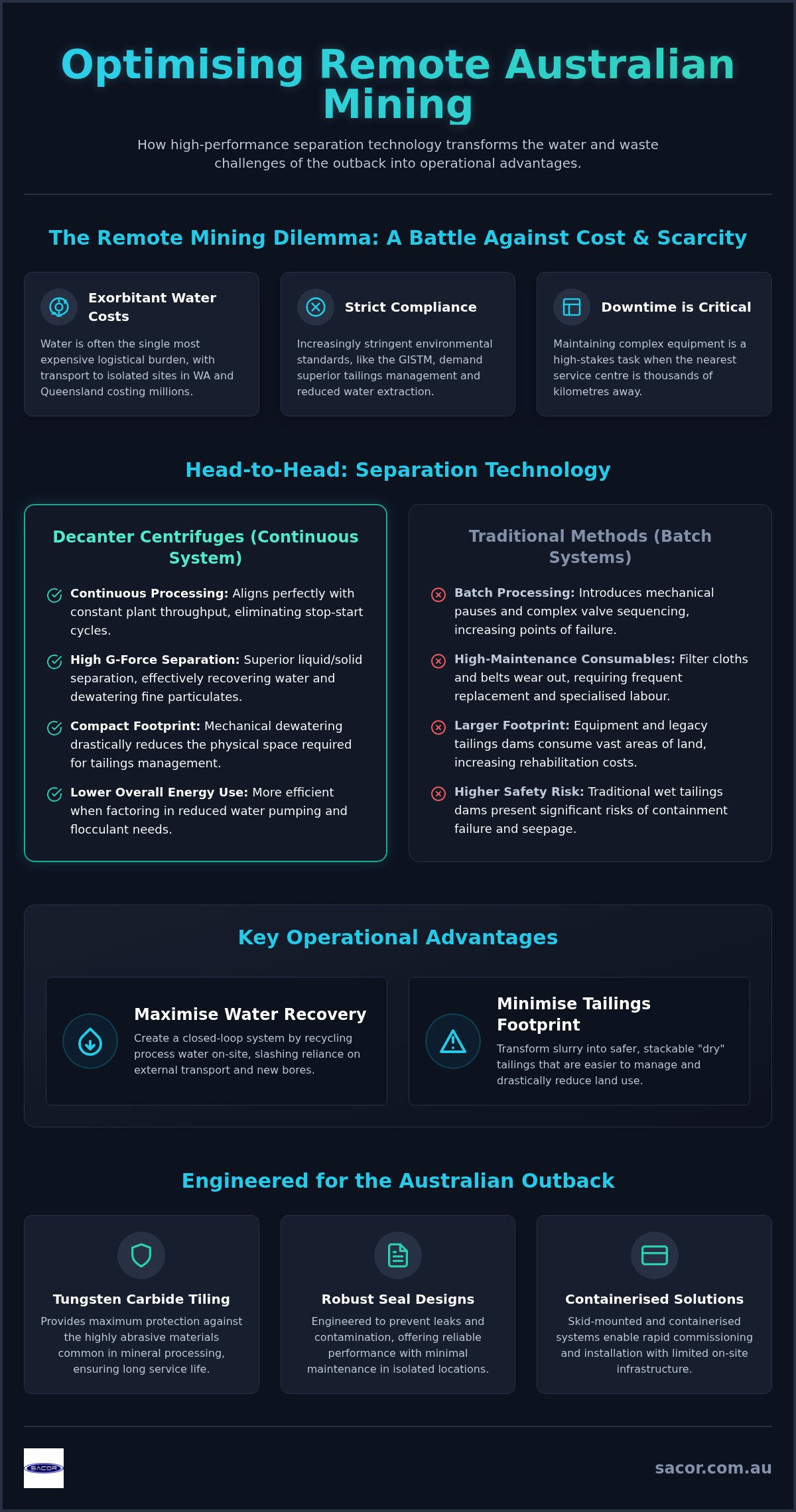
Across Australia’s vast and often arid landscapes, water is not just a resource; it’s frequently the single most expensive logistical burden on a mine’s balance sheet. You already understand that managing tailings and recovering process water in these isolated locations is a constant battle against evaporation, exorbitant transport costs, and the increasing pressure of environmental compliance. Maintaining sophisticated separation equipment for remote mine sites becomes a high-stakes endeavour when the nearest service centre is a thousand kilometres away and downtime directly impacts your bottom line.
This article explores how to optimise mineral processing and maximise water recovery in Australia’s most challenging environments through robust, custom-engineered technology. We’ll examine the critical role of high-performance decanter centrifuges in reducing your tailings footprint and ensuring operational continuity despite the harsh Australian climate. By focusing on equipment reliability and precision engineering, mine operators can transform waste streams into valuable resources while meeting the stringent requirements of the Global Industry Standard on Tailings Management. The goal is to provide a clear pathway toward sustainable, efficient production that survives the realities of remote industrial operations.
Key Takeaways
- Understand how high-performance separation equipment for remote mine sites reduces the exorbitant costs associated with water transport and tailings dam management.
- Compare the operational advantages of continuous decanter centrifuge systems against traditional batch processing methods for remote mineral recovery.
- Identify critical technical requirements, such as tungsten carbide tiling and robust seal designs, that ensure equipment survival in harsh Australian conditions.
- Explore the logistical benefits of containerised and skid-mounted separation solutions for rapid commissioning in areas with limited infrastructure.
- Learn how customised engineering and local technical support can transform waste streams into valuable resources while maintaining regulatory compliance.
The Strategic Role of Separation Equipment for Remote Mine Sites
Separation equipment for remote mine sites serves as the vital technical bridge between raw mineral processing and the stringent environmental compliance standards required by Australian law. In the isolated regions of Western Australia and Queensland, operations face unique geographical pressures that make traditional processing methods increasingly unviable. Limited access to local aquifers and the high cost of trucking water to site demand a closed-loop approach to resource management where every drop of process water is accounted for.
The decanter centrifuge serves as the primary technical solution for processing high-solids tailings by providing the intensive G-force required to separate liquids from fine particulates with high precision.
Adopting this technology facilitates a necessary transition from legacy tailings dams toward modern mechanical dewatering. This shift significantly enhances site safety by reducing the risk of containment failure while improving the long-term sustainability of the operation through superior waste management.
Water Recovery and Resource Conservation
Recycling process water on-site is no longer a luxury but a logistical necessity for remote operations. The cost-benefit of reclaiming water through advanced separation far outweighs the expense of constant transport or the development of new bores, which can cost millions in infrastructure and ongoing energy consumption. When separation efficiency is maximised, the mine’s overall water balance improves, allowing for higher throughput without increasing raw water intake. In arid regions like the Pilbara, reducing the “water footprint” is a core component of social licence and environmental responsibility. This approach delivers several key benefits for remote operations:
- Reduced reliance on expensive external water transport and associated fuel costs.
- Lower energy consumption for bore pump operations and distribution networks.
- Enhanced compliance with state-based environmental regulations regarding water extraction.
Tailing Management and Footprint Reduction
Mechanical separation transforms slurry into “dry” stackable tailings that are easier to manage and far more stable than wet waste. This process drastically reduces the volume of material directed to storage facilities, effectively shrinking the mine’s physical footprint and reducing the land area required for eventual rehabilitation. Dry stacking offers a superior safety profile compared to traditional wet tailings dams, mitigating the risks associated with dam wall failures and groundwater seepage. For a comprehensive look at how these systems integrate into local operations, the Decanter Centrifuge Mining Australia guide provides deeper context on strategic implementation. By adopting these mechanical dewatering techniques, the implementation of dedicated separation equipment for remote mine sites ensures compliance with the Global Industry Standard on Tailings Management (GISTM) while protecting the surrounding landscape from potential contamination.
Decanter Centrifuges vs. Traditional Separation Technology
Selecting the right separation equipment for remote mine sites involves more than comparing initial capital expenditure; it requires an evaluation of long-term operational resilience. While belt presses and filter presses are common in urban wastewater, their application in remote mining is often hindered by their reliance on batch processing and high-maintenance consumables. Centrifugal separation operates as a continuous process, allowing for steady-state operation that aligns with the constant throughput of a mineral processing plant. Batch systems, like filter presses, introduce mechanical pauses and require complex valve sequencing that increases the risk of component failure in isolated environments.
There’s a common misconception that centrifuges are too energy-intensive for remote power grids. While the instantaneous power draw of a high-speed rotor is higher than a belt press, the overall energy efficiency is frequently superior when factoring in the reduced requirements for wash water and flocculant preparation. Much like how ore sorting equipment reduces the energy required to process waste rock, high-efficiency centrifuges reduce the energy lost to water mismanagement. When choosing technology, operators should prioritise decanter systems for high-solids tailings where consistent cake dryness and high volume throughput are required.
Centrifuges vs. Filter Presses
Maintenance at a remote site is a significant logistical hurdle. Filter presses require regular cloth changes and plate cleaning, tasks that are labour-intensive and prone to error. A decanter centrifuge uses a sealed, rotating assembly that requires far less manual intervention. Its compact footprint also simplifies installation, as a single centrifuge can often replace multiple filter press units, reducing the civil engineering requirements for site preparation. Centrifuges also demonstrate greater tolerance for variable feed characteristics, maintaining consistent cake dryness even when the tailings density or particle size distribution fluctuates unexpectedly.
Continuous Processing and Automation
The shift toward autonomous mining makes decanter technology the logical choice for isolated sites. These systems are designed for 24/7 operation with minimal oversight, which is essential for reducing the high costs associated with FIFO staff. Modern units integrate smart sensors that allow engineers to monitor performance and adjust parameters from a central control room thousands of kilometres away. Detailed technical specifications for these automated systems can be found in the Industrial Decanter Centrifuge Australia guide. Consulting with a specialist about customised separation solutions ensures the technology matches your specific ore body characteristics and site constraints.
Technical Requirements for Separation Equipment in Harsh Environments
Separation equipment for remote mine sites must endure environmental extremes that would compromise standard industrial machinery within weeks. In the Pilbara or the Goldfields, the combination of abrasive mineral ores and fine, pervasive dust creates a relentless wear environment. To counter this, technical specifications must include specialised wear protection, such as tungsten carbide tiling on the centrifuge scroll and rotor. This shielding isn’t merely a durability upgrade; it’s a critical requirement for maintaining the precise mechanical tolerances needed for consistent liquid-solid separation over thousands of continuous operating hours.
Dust ingress represents a secondary but equally lethal threat to mechanical integrity. Robust, multi-stage seal designs are essential to prevent fine particulates from contaminating bearing assemblies and electrical drive systems. Furthermore, the extreme ambient temperatures common in the Australian outback, which frequently exceed 45°C during summer months, necessitate high-capacity cooling systems for the centrifuge lubrication and drive circuits. We consider “over-engineering” to be a fundamental survival strategy for remote operations. It’s far more cost-effective to deploy a system with a higher mechanical safety margin than to risk a catastrophic failure in a location where the nearest specialist technician is a full day’s travel away.
Material Selection and Corrosion Resistance
The chemical profile of process water in remote Australia is often highly aggressive, frequently drawn from hypersaline aquifers that accelerate traditional corrosion. We prioritise the use of high-grade stainless steels, such as Duplex or Super Duplex, which provide the necessary resistance to pitting and stress corrosion cracking. Sacor customises material selection based on specific site feed chemistry and liquid analysis to ensure the equipment remains compatible with the local ore body. Incorporating sacrificial wear parts further extends the lifecycle of the primary separation bowl, allowing for predictable maintenance cycles rather than emergency replacements.
Reliability and Redundancy in Design
Design simplicity is a core virtue when maintenance access is limited. Simplified drive systems with fewer moving parts reduce the statistical likelihood of mechanical failure while easing the burden on site-based maintenance teams. Modular, “plug-and-play” designs are particularly valuable for remote sites, as they allow for rapid on-site swaps of critical assemblies without requiring specialised workshop facilities. Maintaining a strategic inventory of industrial centrifuge spare parts Australia is a vital component of this reliability framework. By ensuring that essential components are stored on-site or in nearby regional hubs, operators can guarantee maximum uptime and protect the continuity of their mineral processing circuits.
Logistics, Installation, and Maintenance for Remote Mine Sites
Successful deployment of separation equipment for remote mine sites hinges on a logistics strategy that accounts for the vast distances and limited infrastructure of the Australian outback. Unlike metropolitan projects where technical support is minutes away, remote commissioning demands a self-contained approach. The process begins with rigorous factory testing to ensure that once the unit reaches its destination, the integration with existing mineral processing circuits is seamless and predictable. Reliable performance in these areas is as much about the delivery and support framework as it is about the mechanical specifications of the hardware.
Modular Installation Strategies
The use of skid-mounted or containerised systems allows for the majority of assembly and testing to occur in a controlled metropolitan environment. This significantly reduces the time and specialised labour required on-site, where civil works are often expensive and difficult to coordinate. Wide-load logistics require precise planning to navigate the unsealed roads and remote access tracks common in the Pilbara or Goldfields. Containerised units provide an added layer of security, acting as a protective shell during transit and serving as a robust, weather-shielded housing once the equipment is operational. This modularity ensures that the internal components remain isolated from environmental contaminants from the moment they leave the workshop.
Remote Support and Maintenance Planning
Bridging the geographical gap between the mine site and the service centre requires a sophisticated maintenance model. Remote telemetry plays a vital role here, providing a continuous stream of performance data that allows engineers to diagnose potential issues before they result in unplanned downtime. For on-site FIFO teams, comprehensive technical documentation is the first line of defence, enabling them to perform routine checks and minor adjustments with confidence. A well-structured centrifuge maintenance service Australia contract should prioritise the inclusion of a critical spares kit housed directly on-site. This ensures that essential wear items are immediately available, reducing the reliance on urgent hot-shot deliveries from regional hubs.
Choosing between a centralised service model and an on-site parts inventory is a critical decision for procurement managers. While a service centre provides deep technical expertise, the physical presence of parts on-site is the only way to guarantee immediate recovery from a mechanical interruption. We recommend a hybrid approach that combines remote monitoring with a strategic local inventory. Consult with Sacor to develop a logistics and maintenance strategy tailored to your site’s specific geographical and operational constraints.
Sacor: Customised Separation Solutions for Remote Australia
Sacor operates as an Australian-owned specialist with a profound understanding of the unique geographical and technical challenges inherent in local mining operations. We recognise that separation equipment for remote mine sites must perform under conditions that standard industrial builds cannot withstand. Our approach is defined by a steady, grounded conviction that technical expertise and customised engineering are the only ways to ensure long-term reliability in the outback. We position ourselves as a technical partner rather than a mere vendor, working alongside site engineers to deliver systems that meet specific throughput and recovery targets.
The collaborative engineering process begins with a detailed feed analysis to determine the exact characteristics of the tailings or process stream. This data informs every stage of the design, from material selection to the configuration of the internal scroll and drive systems. By leading with capability and following with verified outcomes, we ensure the commissioned system provides a high return on investment through increased process efficiency and reduced waste handling costs. This methodical progression from analysis to installation ensures that the final solution is perfectly aligned with the site’s operational reality.
Bespoke Engineering for Mining Tailings
Achieving optimal cake dryness and water clarity requires matching centrifuge specifications to the specific mineralogy of the ore body. Sacor provides customised decanter centrifuges that are engineered to handle the exact particle size distribution and chemical profile of your site’s waste stream. We provide comprehensive technical documentation and commissioning support to ensure that the integration into your mineral processing circuit is seamless. This focus on precision engineering supports sustainable industrial practice by enabling maximum water recovery in arid regions where resource conservation is a primary operational driver. Every system is built to survive the abrasive nature of Australian ores while maintaining the precise mechanical tolerances required for high-performance separation.
National Support and Parts Availability
Maintaining equipment uptime in isolated locations requires a partner who understands the logistical constraints of the Australian landscape. Sacor manages a robust supply chain to ensure that critical components and technical support are accessible when they are needed most. Working with an Australian partner ensures that your equipment meets all relevant national standards and safety regulations, including the latest Work Health and Safety (Mines) Regulations. Our commitment to full lifecycle support means we remain involved long after the initial commissioning, providing the expertise required to adapt the system as feed characteristics evolve over the life of the mine. To discuss your specific project requirements, organise a technical consultation for your remote site separation needs today.
Optimising Operational Resilience in the Australian Outback
The successful implementation of separation equipment for remote mine sites requires a shift from viewing machinery as a commodity to treating it as a critical strategic asset. Transitioning to mechanical dewatering through high-performance decanter centrifuges offers a verifiable pathway toward meeting international tailings standards while significantly reducing water transport costs. By prioritising continuous processing and robust, over-engineered designs, operators ensure consistent mineral recovery even in the most unforgiving environments.
Securing this level of performance depends on a partnership with an authority that understands the specific mineralogy and logistical constraints of the Australian landscape. Sacor provides the technical expertise and customised engineering required to transform complex tailings streams into manageable, dry-stackable resources. Our national support network and strategic spare parts inventory are designed to eliminate the risks of isolation, ensuring your processing circuit remains productive and compliant.
Contact Sacor to discuss your remote site separation requirements and take the first step toward a more sustainable, efficient mining operation. We look forward to engineering a solution that meets your specific site demands.
Frequently Asked Questions
What is the best separation equipment for high-clay tailings in remote sites?
Decanter centrifuges are the most effective solution for high-clay tailings because they use intensive G-forces to settle fine particles that gravity thickeners struggle to capture. Clay particles are difficult to dewater due to their high surface area and electrical charge. Centrifuges provide the mechanical force necessary to overcome these properties and produce a stackable cake. This results in superior water recovery compared to traditional belt presses or vacuum filters.
How does a decanter centrifuge handle variable water quality on a mine site?
Decanter centrifuges are resilient to fluctuations in feed water quality, including changes in pH, salinity, or chemical composition. Unlike membrane-based systems that foul easily, centrifugal separation is a purely mechanical process. This makes it ideal for mine sites using hypersaline bore water or recycled process water. The use of high-grade stainless steel and robust seals protects internal components from corrosion and scaling, ensuring consistent performance regardless of the raw water source.
Can separation equipment be powered by remote solar or hybrid microgrids?
Modern separation equipment for remote mine sites can be integrated into solar or hybrid microgrids through Variable Speed Drives. These drives allow for controlled ramp-ups that manage peak power demands, preventing voltage drops on sensitive remote grids. By synchronising the centrifuge’s energy consumption with peak solar generation periods, mines can reduce their reliance on diesel generators. This approach supports sustainability goals while maintaining the high throughput required for continuous mineral processing operations.
What are the transport dimensions for a typical modular mining centrifuge?
Standard dimensions for separation equipment for remote mine sites are designed to fit within standard shipping container footprints or on 40-foot flat-rack trailers to simplify logistics. A standard unit might have a footprint of approximately 4.5 to 6 metres in length and 2 metres in width. These dimensions allow for transport as a standard load on most Australian regional highways, though larger customised skids may require wide-load permits for certain access tracks.
How often do decanter centrifuges require major servicing in harsh environments?
In harsh Australian environments, major servicing for decanter centrifuges typically occurs every 8,000 to 12,000 operating hours. This interval depends on the abrasiveness of the ore and the quality of the pre-screening process. Regular diagnostic monitoring and vibration analysis help site teams identify wear on the scroll or bearings early. This allows for planned maintenance during scheduled plant shutdowns rather than reacting to unexpected mechanical failures that could halt production for extended periods.
Is it possible to recover minerals from tailings using centrifugal separation?
Centrifugal separation is an effective method for recovering fine minerals that were missed during the primary processing stage. By applying high G-forces to waste streams, operators can capture ultra-fine particles of gold, copper, or rare earth elements that would otherwise be lost to the tailings dam. This process turns a waste liability into a secondary revenue stream while simultaneously reducing the volume of material requiring long-term storage and management.
How does mechanical dewatering impact the cost of mine closure?
Mechanical dewatering significantly reduces the long-term costs of mine closure by eliminating the need for large, liquid-filled tailings dams. Dry-stacking tailings creates a stable landform that’s far easier to rehabilitate and revegetate once mining operations cease. This proactive approach reduces the risk of post-closure seepage and structural failure. It ultimately lowers the financial bonding requirements and environmental liabilities that operators must manage throughout the lifecycle of the mine.
What spare parts should be kept on-site for a remote decanter centrifuge?
Remote operations should maintain a critical spares kit that includes wear-prone components such as conveyor tiles, discharge bush inserts, and a complete set of seals and O-rings. Keeping a spare set of main bearings and drive belts is also recommended to ensure rapid recovery from mechanical interruptions. Having these items on-site is essential for maintaining uptime when the nearest regional logistics hub is located several hundred kilometres from the processing plant.