
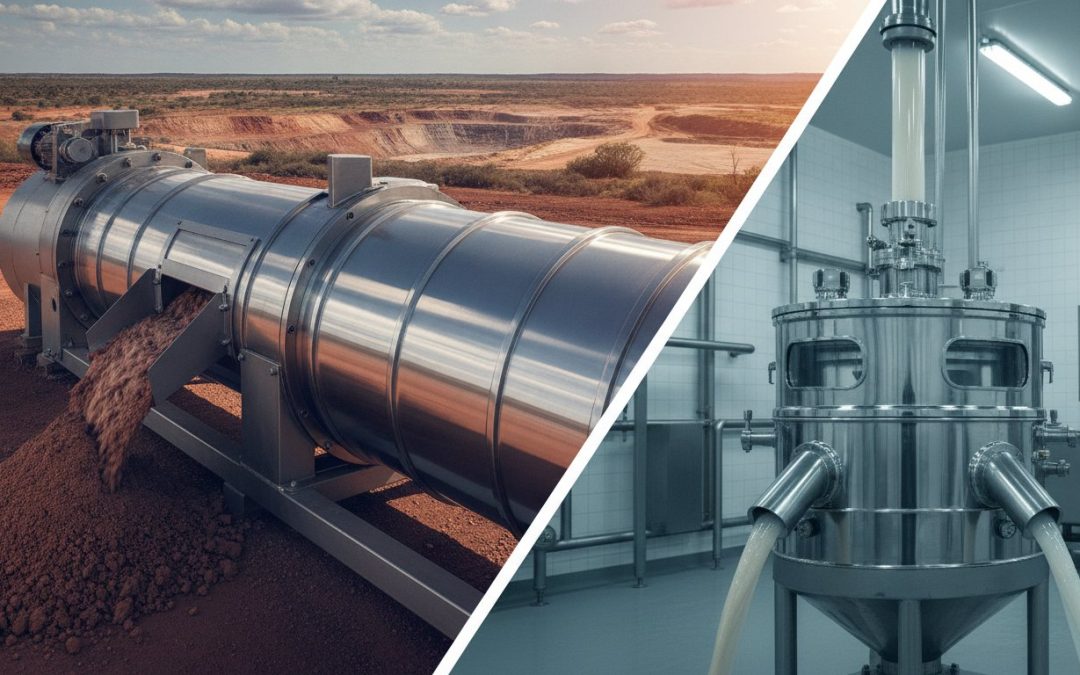
The highest G-force centrifuge on the market can actually decrease your plant’s efficiency if it’s misaligned with your feed’s specific solids concentration. Selecting the wrong separation technology doesn’t just impact your initial capital expenditure; it leads to inflated operational costs and frequent downtime that is particularly punishing in remote Australian locations. You likely recognise that while both machines utilise centrifugal force, their applications are not interchangeable, and the confusion over which handles specific particle sizes better often results in suboptimal waste recovery.
This guide provides a definitive technical and commercial framework to master the differences between a decanter centrifuge vs disc stack separator. By understanding these nuances, you’ll ensure the most efficient separation for your Australian operation while reducing total cost of ownership. We will examine how feed characteristics, particle size, and local environmental regulations, such as the POEO Act 1997, influence the optimal choice for your site. This methodical comparison clarifies whether your process requires the robust dewatering capabilities of a decanter or the precision clarification of a disc stack system, allowing you to minimise environmental impact through better resource recovery.
Key Takeaways
- Identify why feed solids concentration dictates your choice of hardware, with decanters handling up to 50% solids compared to the much lower thresholds required for disc stack efficiency.
- Master the technical trade-off between a decanter centrifuge vs disc stack separator by comparing high-torque dewatering capabilities against high-speed precision clarification.
- Recognise industry-specific benchmarks for the Australian mining and food processing sectors, ensuring your equipment meets local trade waste and environmental standards.
- Evaluate long-term operational costs by comparing the maintenance intensity of complex disc stack overhauls against the predictable wear-part replacement cycles of decanter systems.
- Learn why site-specific feed testing and custom engineering are the only reliable methods to secure a high return on investment for high-capital separation technology.
The Fundamental Mechanics of Centrifugal Separation
Industrial separation relies on the acceleration of sedimentation to isolate solids from liquids or to separate immiscible liquids of different densities. While gravity provides a natural settling force, industrial timelines require the intensified centrifugal force generated by high-speed rotation. This process creates a density differential that forces heavier particles to the outer periphery of a rotating bowl; it effectively compresses hours of gravity-based settling into seconds of mechanical processing. The fundamental decision between a decanter centrifuge vs disc stack separator hinges on how your process manages these forces and the volume of solids present in the feed. Orientation is not the only factor. The mechanical architecture dictates how solids are handled and discharged.
Understanding the Decanter Centrifuge Principle
The decanter centrifuge operates on a horizontal axis and is engineered specifically for continuous bulk solids removal. Its internal architecture features a cylindrical-conical bowl and a nested Archimedean screw, commonly referred to as a scroll. As the bowl rotates at high speeds, solids settle against the bowl wall. The scroll rotates at a slightly different speed to plough the solids toward the conical discharge end. The efficiency of this dewatering process is heavily influenced by the bowl length-to-diameter (L/D) ratio. This ratio determines the residence time and the clarity of the liquid phase. Ultimately, the decanter centrifuge serves as the reliable workhorse for processing high-solids slurries where robustness is paramount.
The Disc Stack Separator Mechanism
Unlike the horizontal decanter, the disc stack separator utilises a vertical bowl containing a series of closely spaced conical discs. This configuration creates a massive effective settling area within a remarkably compact footprint. Each disc provides an additional surface for particles to settle. This technology excels in clarifying liquids with low solids concentrations. It also achieves precise liquid-liquid-solid separation, which is essential for removing fine impurities from oil and water simultaneously. Depending on the application, these machines operate in either intermittent discharge modes or continuous discharge configurations. The choice depends on the specific volume of solids in your process stream.
Selecting the appropriate mechanical principle is the primary determinant of your plant’s throughput efficiency. A mismatch here leads to excessive energy consumption, poor product quality, or accelerated component wear. The results are often immediate and costly. A technical comparison of a decanter centrifuge vs disc stack separator reveals that throughput is a function of both G-force and surface area. Whether your Australian operation requires the high-torque capacity of a decanter or the high-speed precision of a disc stack, the mechanical alignment with your feed characteristics remains the foundation of a sustainable separation strategy.
Technical Comparison: Solids Loading, Particle Size, and G-Force
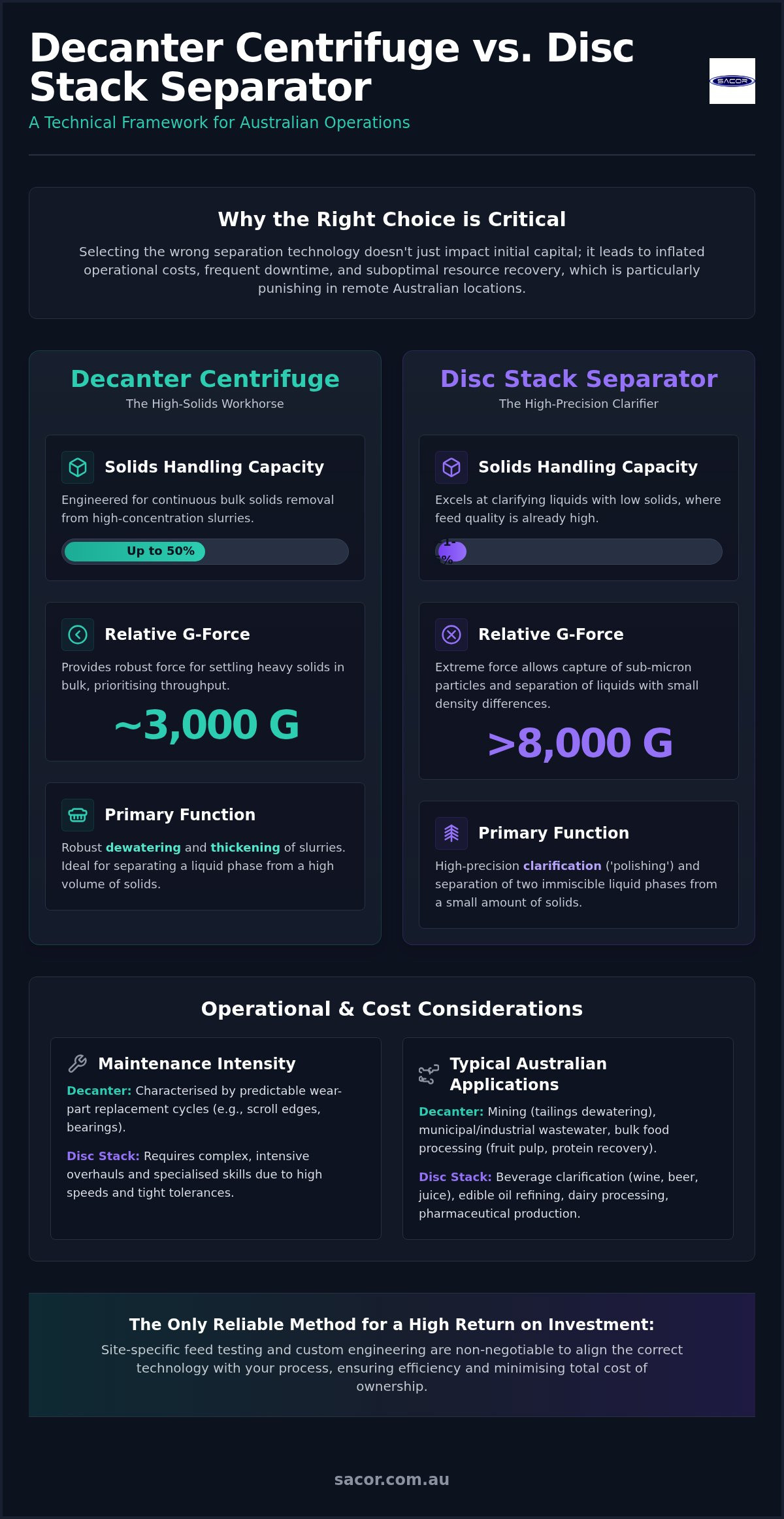
Separation performance is governed by two primary variables: centrifugal force and the physical characteristics of the feed stream. When evaluating a decanter centrifuge vs disc stack separator, the disparity in G-force capabilities becomes the first technical benchmark. Decanters typically operate in the 3,000G range, providing sufficient force to settle heavy solids from liquid phases in bulk. Disc stacks, however, often exceed 8,000G. This extreme force allows for the capture of sub-micron particles that a decanter might miss, providing the “polish” required for high-clarity applications where even trace impurities are unacceptable.
G-Force and Separation Efficiency
Higher G-force enables the separation of liquids with very small density differences, such as complex oil and water emulsions. These rotational speeds place immense stress on the structural metallurgy of the centrifuge bowl, requiring precision engineering to ensure long-term reliability. It’s important to recognise that higher G-force isn’t always advantageous for every application. For shear-sensitive biological products or specific food proteins, excessive force can damage the product’s molecular integrity. Engineers must balance the desire for separation efficiency against the delicate nature of the feed material.
Solids Handling and Feed Characteristics
The most distinct operational boundary between these technologies lies in solids concentration. Decanter centrifuges excel at “sludge handling,” as they’re designed to process feeds containing between 15% and 50% solids. They’re the industry standard for heavy dewatering where volume is the priority. In contrast, disc stack separators focus on “clarification” and typically require a feed with lower solids content, often below 5%. If feed solids exceed design specifications, the risk of rapid sediment buildup and mechanical clogging increases, which can lead to costly downtime. For a deeper look at high-solids hardware, consult our Industrial Decanter Centrifuge Australia: The 2026 Comprehensive Guide.
Balancing throughput with clarity requires a clear understanding of your specific process goals. While a decanter manages massive volumes of coarse solids, a disc stack provides the final refinement needed for a polished liquid phase. If you’re unsure which technology aligns with your specific feed profile, our team can help you evaluate your separation requirements to ensure your plant achieves its maximum yield and efficiency.
Industry Applications: Where Each Technology Excels in Australia
The industrial landscape in Australia presents unique challenges, from the abrasive mineral sands of remote regions to the strict sanitary requirements of metropolitan food hubs. Deciding on a decanter centrifuge vs disc stack separator requires an assessment of these environmental and regulatory factors. While the technical mechanics provide the foundation, the industry application determines the ultimate return on investment through improved yield and reduced waste. Selecting a machine that isn’t aligned with your specific sector often leads to premature wear or failed product specifications.
Mining and Heavy Industry Applications
The decanter centrifuge mining Australia standard is built around robustness and the ability to process massive volumes of abrasive slurries. In tailings dewatering, these machines are essential for recovering process water, which is a critical sustainability metric for remote, water-stressed mine sites. To withstand the extreme wear caused by mineral solids, these decanters are typically fitted with tungsten carbide tiles or spray coatings on the scroll flights. This protection ensures the equipment maintains its balance and separation efficiency over long maintenance cycles. By achieving a higher solids concentration in the discharge cake, miners reduce the volume of waste sent to tailings dams, thereby lowering environmental risk and disposal costs.
Food Processing and Sanitary Standards
In the food and beverage sector, the priority shifts from bulk solids handling to precision clarification and hygiene. Food processing centrifuge systems in Australia must adhere to rigorous safety standards, including the ability to perform automated Clean-in-Place (CIP) cycles. Disc stack separators are the preferred technology for beverage polishing and dairy separation. Their high G-force capabilities allow for the removal of fine yeasts and proteins, resulting in the high-clarity product consumers expect. These systems are engineered with polished stainless steel surfaces to prevent bacterial growth, ensuring compliance with Australian food safety regulations while maximising product shelf life.
Beyond these core sectors, separation technology plays a vital role in municipal and industrial wastewater treatment. Decanters are utilised for biosolids dewatering, where reducing the moisture content of sludge directly translates to lower transport and disposal fees. In the energy sector, three-phase centrifuges are increasingly used for oilfield applications to recover valuable hydrocarbons from waste streams. This process not only captures a source of revenue but also ensures that discharged water meets the stringent environmental criteria set by state EPAs. Whether the goal is resource recovery or regulatory compliance, the alignment of the machine to the industry remains the most important factor in plant design.
Operational Considerations: Maintenance, Energy, and TCO
Selecting between a decanter centrifuge vs disc stack separator involves more than just the initial purchase price. For Australian plant managers, the long-term operational expenditure (OpEx) often outweighs the capital investment. Factors such as chemical consumption, energy demand, and the logistical challenges of remote site maintenance define the true profitability of the installation. High separation efficiency directly reduces the volume of expensive polymers and flocculants required. It also ensures that waste streams are minimised, which is vital for meeting Australian trade waste regulations and avoiding heavy surcharges. These chemical savings can amount to thousands of dollars annually, significantly impacting the bottom line for high-volume processors.
Maintenance Cycles and Spare Parts Availability
Total Cost of Ownership (TCO) models must account for the high cost of unplanned downtime, particularly in the Australian mining and energy sectors. Maintenance for a disc stack separator involves a complex overhaul of the vertical spindle and the intricate disc package, which requires precise balancing to prevent vibration. Conversely, decanter maintenance typically focuses on the replacement of wear parts like tungsten carbide tiles and scroll bearings. Access to local industrial centrifuge spare parts Australia is a critical safeguard against prolonged outages. Sacor maintains a national support network to ensure that critical components are delivered rapidly. This bypasses the logistical delays and inflated freight costs associated with international shipping from European or American manufacturers.
Energy Efficiency and Operational Costs
Energy demand varies significantly between high-speed disc stacks and high-torque decanter systems. Modern Variable Frequency Drives (VFDs) are essential for both machine types. They allow operators to optimise rotational speeds based on real-time feed characteristics, which prevents wasted power. While disc stacks require substantial energy to maintain high bowl speeds for clarification, decanters consume power primarily through the torque required to discharge concentrated solids. Investing in high-efficiency motors is a strategic necessity given the current trajectory of Australian energy prices. These motors provide a consistent performance profile that stabilises your plant’s utility costs over the equipment’s lifecycle. You can request a comprehensive maintenance and energy audit to determine which system offers the best long-term value for your specific process.
Selecting the Right Separation System with Sacor
Navigating the technical trade-offs between a decanter centrifuge vs disc stack separator is a high-stakes process that requires more than a review of standard specifications. Off-the-shelf units often fail to reach peak performance because they aren’t calibrated for the specific density or viscosity of a local process stream. Sacor operates as a technical partner rather than a simple equipment vendor. We focus on delivering a separation system that integrates seamlessly into your existing infrastructure, ensuring that your plant achieves its maximum theoretical throughput.
Bespoke Engineering for Bespoke Separation
Generic hardware often results in suboptimal yields and inflated operational costs. Sacor tailors every mechanical detail; from bowl geometry and scroll pitch to specific disc configurations, we match the machine to your unique feed profile. Being an Australian-owned partner allows us to design for local site conditions, whether that involves extreme heat in remote mining regions or strict sanitary requirements in metropolitan processing hubs. This precision engineering ensures maximum cake dryness in decanters and superior liquid clarity in disc stacks. By optimising these outcomes, we help you significantly reduce waste disposal costs while improving the recovery of valuable resources.
National Support and Commissioning
Every successful project begins with rigorous process analysis. Feed testing is the first step we take to eliminate guesswork and verify that the proposed technology will meet your performance targets. Once the engineering phase is complete, our national support team manages the installation and commissioning process across the country. Professional commissioning is vital. It’s the stage where we fine-tune the system to ensure it meets all performance guarantees under real-world operating conditions. This comprehensive approach ensures that your investment delivers a measurable return from the moment it goes online.
Precision separation is also a fundamental component of modern industrial sustainability. By achieving better waste recovery and reducing the volume of sludge for disposal, our systems help Australian operators meet their ESG targets and comply with evolving environmental regulations. If you’re ready to optimise your process, Contact Sacor Australia for a technical consultation on your centrifuge requirements. We’ll work alongside your team to ensure your separation technology remains a reliable asset for the entire lifecycle of your plant.
Optimising Your Separation Strategy for Long-Term Performance
Identifying the correct hardware is the first step in protecting your plant’s throughput and long-term sustainability. Technical alignment is paramount. Whether your process demands the high-torque dewatering of a decanter or the precision clarification of a disc stack, the choice must be data-driven. This guide has detailed how the selection of a decanter centrifuge vs disc stack separator directly impacts your chemical consumption, energy demand, and total cost of ownership. Overlooking these nuances often leads to inflated OpEx and frequent mechanical failures that are particularly costly in remote locations.
Sacor provides the Australian-owned technical expertise required to move beyond standard specifications and off-the-shelf limitations. We offer custom engineering for maximum resource recovery. This ensures your equipment remains a robust asset through comprehensive national maintenance and spare parts support. By focusing on site-specific feed testing and local logistical reliability, we help your operation achieve its performance targets while minimising environmental impact. We look forward to partnering with you to refine your separation efficiency and secure your plant’s operational future.
Request a Customised Separation Solution Estimate
Frequently Asked Questions
What is the main difference between a decanter centrifuge and a disc stack separator?
The main difference between a decanter centrifuge vs disc stack separator lies in the solids concentration capacity and the primary separation objective. Decanters are horizontal machines designed for the continuous dewatering of high-solids slurries, typically between 15% and 50%. Disc stack separators are vertical units optimised for clarifying liquids with low solids content. While a decanter focuses on bulk volume, a disc stack prioritises liquid purity and precise liquid-liquid separation.
Which technology is better for high-solids mining tailings in Australia?
Decanter centrifuges are the industry standard for high-solids mining tailings in Australia due to their ability to handle massive volumes and abrasive particles. These machines facilitate water recycling on remote sites, which is essential for meeting environmental targets and reducing reliance on local water sources. Their horizontal design allows for the continuous discharge of dry solids, making them significantly more efficient for heavy tailings management than vertical disc stack systems.
Can a disc stack separator handle sub-micron particles?
Yes, a disc stack separator is capable of capturing sub-micron particles that a decanter centrifuge might miss. This is achieved through significantly higher G-forces, often exceeding 8,000G, and a massive settling area provided by the internal conical discs. This level of precision is critical in the beverage and dairy industries where high clarity is required to meet Australian food safety and quality standards for a polished final product.
Which centrifuge type has a higher Total Cost of Ownership (TCO)?
Determining which machine has a higher TCO depends on the specific application and the maintenance strategy employed. Disc stack separators often involve more complex maintenance cycles for the rotating assembly and disc package, which can increase OpEx. However, using the wrong machine for the feed profile leads to the highest costs. A mismatch in the decanter centrifuge vs disc stack separator selection results in excessive energy use, chemical waste, and unplanned downtime.
Is a decanter centrifuge more robust for abrasive industrial slurries?
A decanter centrifuge is inherently more robust for abrasive industrial slurries because it is engineered with wear-resistant materials such as tungsten carbide tiles. The internal scroll is designed to plough heavy solids toward the discharge end continuously, which prevents the clogging often seen in disc stacks when processing coarse materials. This robustness makes the decanter the preferred choice for heavy industrial applications where equipment longevity and reliability are the primary operational priorities.
How does G-force affect the separation of oil and water?
Higher G-force intensifies the density differential between oil and water, allowing for the rapid separation of complex emulsions. In energy and food processing applications, the extreme force generated by a disc stack separator breaks the surface tension of the mixture to isolate pure phases. This efficiency is vital for recovering valuable hydrocarbons or oils from waste streams, ensuring that the final discharge meets the strict environmental criteria set by state EPAs.
Does Sacor provide national maintenance support for both machine types?
Sacor provides comprehensive national maintenance and technical support for both machine types across Australia. This includes the supply of critical spare parts from an extensive inventory to minimise downtime for remote industrial sites. Our technical teams assist with everything from initial commissioning to lifecycle maintenance, ensuring that your separation technology continues to operate at its peak performance regardless of your site’s geographic location. This partnership ensures long-term reliability for your plant.