
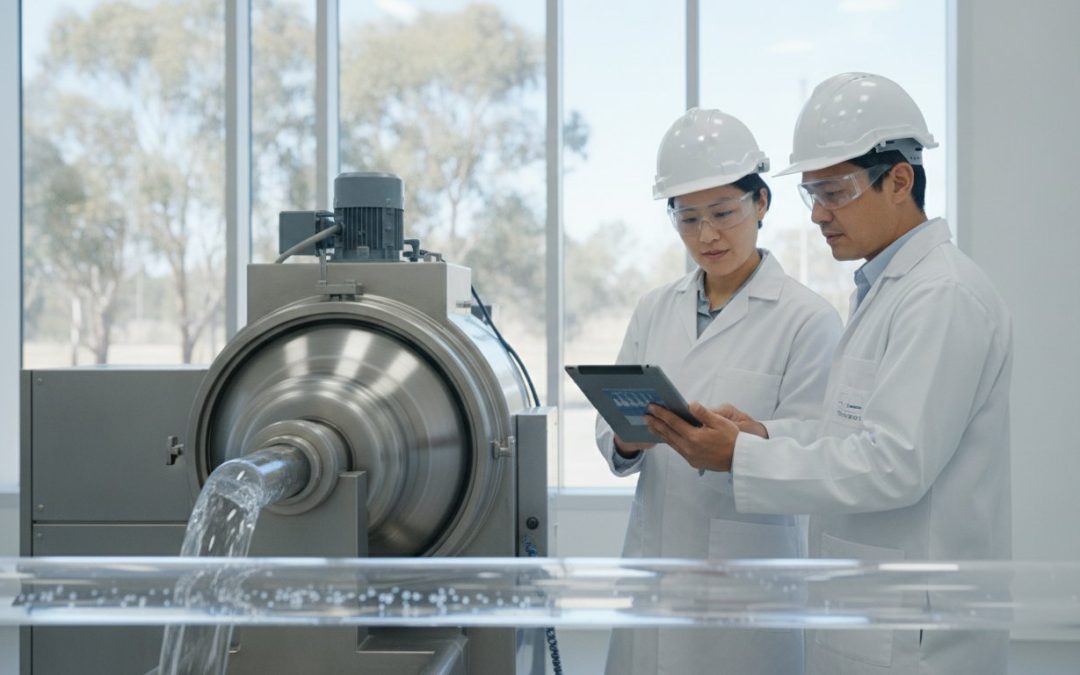
In 2026, the cost of discharging a single kilogram of industrial waste into the Australian sewage network is no longer just a minor line item; it’s a direct threat to your facility’s bottom line. You’ve likely noticed that relying on traditional gravity pits or basic filtration is becoming a losing game as water authorities across the country tighten their grip on trade effluent quality. Implementing a high-performance food processing wastewater treatment centrifuge is now the primary mechanism for decoupling your production growth from escalating utility costs.
This strategic guide explains how advanced centrifugal separation significantly reduces sludge volume while enabling the recovery of valuable proteins and oils that were once considered mere contaminants. We’ll examine the specific 2026 regulatory shifts across Australian states and provide a technical roadmap for achieving continuous, automated separation with minimal manual intervention. By the end of this article, you’ll understand how to transform your wastewater stream from a regulatory burden into a source of recovered value and operational efficiency.
Key Takeaways
- Analyse the financial impact of 2026 trade waste surcharge increases and how targeted separation reduces Total Suspended Solids (TSS) and Biological Oxygen Demand (BOD) charges.
- Evaluate the technical advantages of a food processing wastewater treatment centrifuge over traditional belt presses; specifically regarding odour control and plant footprint.
- Learn why decanter centrifuges are the industry standard for rapid sedimentation, enabling continuous operation with minimal manual intervention.
- Follow a structured two-step implementation process that prioritises comprehensive feed characterisation before engineering the system into your existing process line.
- Recognise the value of partnering with an Australian-owned specialist to design bespoke separation solutions tailored to the harsh realities of local industrial environments.
The Economic Drivers of Food Processing Wastewater Treatment
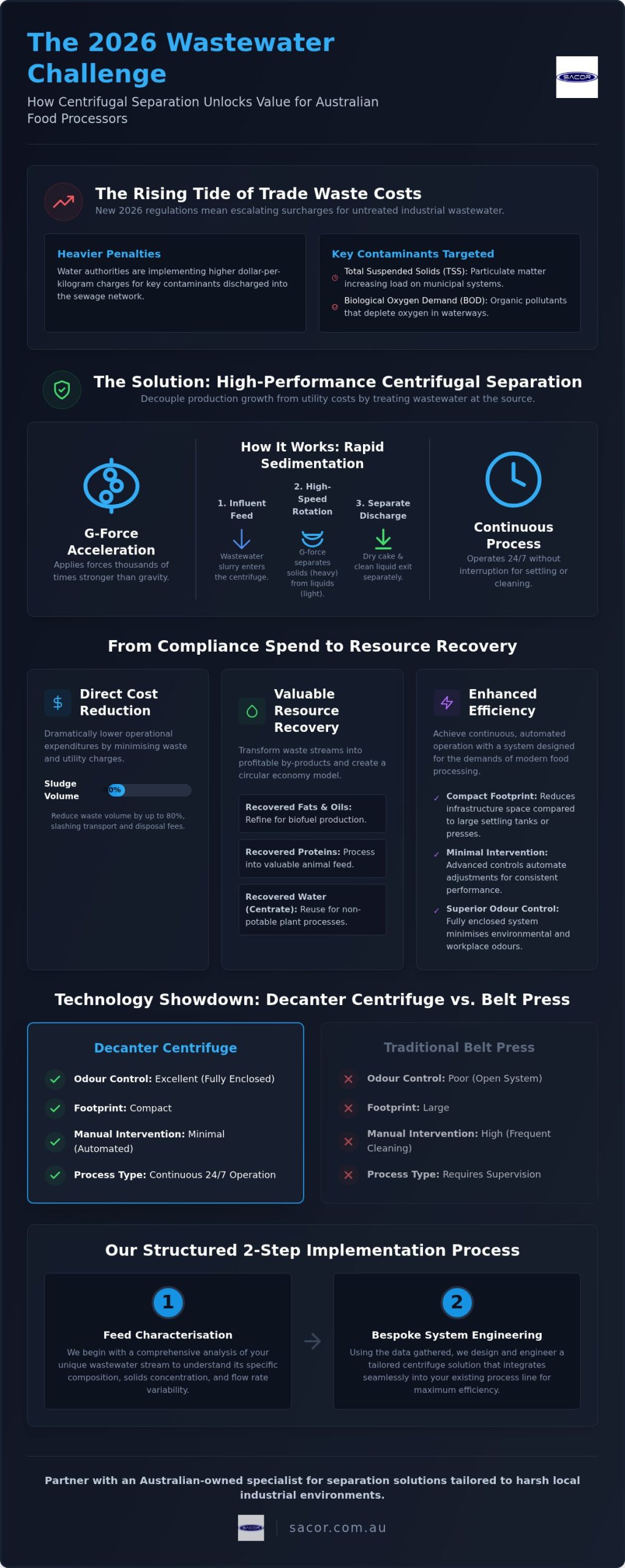
The economic landscape for Australian food manufacturers has shifted from passive compliance to active cost mitigation. In 2026, major metropolitan and regional water authorities have implemented revised trade waste quality charges that penalise high concentrations of Total Suspended Solids (TSS) and Biological Oxygen Demand (BOD). For industrial facilities, these charges are often calculated on a dollar-per-kilogram basis for every substance discharged. This makes the installation of a food processing wastewater treatment centrifuge a strategic priority rather than a discretionary capital expense. By removing solids at the source, you effectively lower the mass of pollutants reaching the municipal sewer, which directly reduces your monthly utility surcharges.
Beyond discharge fees, the logistics of sludge management represent a significant drain on operational budgets. Transporting wet sludge is essentially paying to haul water. On-site dewatering transforms this slurry into a concentrated cake, often reducing waste volume by up to 80 per cent. This reduction slashes the frequency of truck movements and associated fuel levies, providing a tangible hedge against rising transport costs. Moving from a “compliance spend” mindset to a “resource recovery” strategy allows plants to reclaim capital that would otherwise be lost to waste haulage and utility penalties. Sacor provides cutting-edge solutions to help achieve these efficiencies.
Australian Trade Waste Regulations and Compliance
Current regulations in 2026 reflect a national trend towards stricter enforcement and higher penalties. Across Australia, state and territory regulators have set diverse management and monitoring fees that reward facilities with consistent effluent quality. These charges often vary by jurisdiction and can include specific annual fees based on factors like peak load capacity or pollutant concentration. Integrating a food processing wastewater treatment centrifuge into your process line provides the mechanical force needed to meet these targets consistently. Meeting these standards requires more than just a grease trap; it demands a robust system capable of handling fluctuations in pH, temperature, and grease loads while satisfying the “Duty of Care” requirements that protect against environmental breach fines.
The ROI of Mechanical Separation
The return on investment for high-efficiency separation extends beyond cost avoidance. Applying advanced decanter centrifuge technology allows for the precise recovery of valuable by-products such as fats, oils, and proteins. Instead of paying to dispose of these materials, processors can often refine them for secondary markets like animal feed or biofuel production. Additionally, the recovered water, or centrate, can frequently be reused for non-potable plant processes after further treatment. This reduces fresh water intake and assists in meeting corporate water stewardship goals, creating a circular economy model where waste is viewed as a feedstock rather than a liability.
Mechanics of Food Processing Wastewater Treatment Centrifuges
The core principle of a food processing wastewater treatment centrifuge is the acceleration of sedimentation through high-magnitude G-force. While traditional gravity settling tanks rely on the slow, natural descent of particles, a centrifuge subjects the process stream to forces several thousand times stronger than gravity. This rapid separation allows for the immediate extraction of solids from liquids, which is essential for maintaining production momentum in high-throughput food plants. By converting a process that would otherwise take hours into a matter of seconds, facilities can significantly reduce the footprint of their treatment infrastructure.
Decanter centrifuges are often called the “workhorse” of the industry because they facilitate truly continuous processing. Unlike batch systems that require downtime for settling or filter cleaning, these machines operate without interruption. They are engineered to handle variable feed conditions, such as sudden fluctuations in solids concentration or flow rates common during plant wash-downs. Advanced control systems monitor the torque on the internal scroll, adjusting the differential speed in real-time to ensure consistent cake dryness even when the incoming waste stream is inconsistent. This robustness makes them the preferred choice for Australian manufacturers who require dependable, 24-hour operation.
Decanter Centrifuge Design and Engineering
Achieving optimal results requires precise management of bowl speed and differential speed. The bowl speed generates the centrifugal force necessary to pin solids against the wall, while the differential speed, the relative difference between the bowl and the scroll, dictates how quickly those solids are discharged. For sticky or abrasive food-grade solids, scroll geometry is customised to prevent material build-up and ensure smooth transport. Given the high rotational speeds involved, we prioritise wear protection using materials like tungsten carbide to safeguard internal components against erosion, ensuring long-term reliability in harsh industrial environments.
Three-Phase Separation for FOG Recovery
Many food processing streams contain complex mixtures of water, solids, and fats, oils, and greases (FOG). A three-phase food processing wastewater treatment centrifuge separates these three distinct layers in a single pass. This capability is particularly advantageous in meat rendering and dairy processing, where the goal is not just waste reduction but the recovery of high-purity oils for secondary markets. Integrating food processing centrifuge systems in Australia allows plants to maximise their yield of these valuable by-products while simultaneously producing a clean water phase for discharge or reuse. If you are aiming to improve the efficiency of your current separation process, you can explore our range of decanter centrifuge systems to see how these engineering principles are applied to solve specific waste challenges.
Centrifuges vs. Alternative Dewatering Technologies
The choice of dewatering technology determines the long-term viability of a plant’s waste management strategy. While belt filter presses have historically been used in municipal settings, they often struggle in the specialised environment of a food plant. A belt press is an open system, exposing process waste to the atmosphere. This creates significant odour issues and attracts pests, which are unacceptable risks in facilities governed by strict hygiene standards. In contrast, a food processing wastewater treatment centrifuge is a fully enclosed system, containing aerosols and odours while maintaining a sterile processing environment.
When comparing centrifuges to Dissolved Air Flotation (DAF), the distinction lies in the specific application. DAF systems are excellent for removing fats and suspended solids from the primary effluent stream via skimming. However, the resulting “DAF scum” is often high in water content. Using a centrifuge to dewater this secondary sludge is far more effective than relying on DAF alone. The centrifuge provides the mechanical force required to turn that slurry into a dry, stackable cake that is much cheaper to transport.
Evaluating the total cost of ownership (TCO) reveals that while the initial capital investment for centrifugal technology may be higher than some alternatives, the operational savings are decisive. Centrifuges require significantly less polymer for flocculation and operate with a high degree of automation. Modern food plants can’t afford to dedicate multiple operators to manage a single waste stream. Centrifugal systems provide continuous, unmanned operation, allowing your engineering team to focus on core production rather than manual waste handling.
Operational Footprint and Hygiene Standards
Enclosed centrifugal systems offer a clear advantage in pest and odour control. Because the separation occurs inside a stainless steel bowl, there is no risk of splashing or environmental contamination. This design is particularly beneficial for Australian facilities with limited floor area; a centrifuge occupies roughly one-third of the space required for a belt press of equivalent capacity. These units are engineered for easy integration into existing CIP (Clean-In-Place) cycles, ensuring they meet the highest food safety and wash-down requirements.
Performance Comparison: Cake Dryness and Clarity
The technical superiority of a centrifuge is most evident in the quality of the output. Centrifuges consistently achieve higher solids concentration in the cake, often reaching levels that traditional filtration cannot match. This results in lower disposal volumes and reduced haulage costs. Simultaneously, the clarity of the centrate is vastly improved. High-performance wastewater treatment centrifuge Australia technology ensures that the liquid phase is clean enough for secondary treatment or direct reuse in non-potable applications. This level of precision optimises the entire wastewater circuit.
Implementing a Centrifuge Solution on an Australian Site
Successful deployment of a food processing wastewater treatment centrifuge begins long before the equipment arrives on site. It requires a disciplined, five-step implementation framework to ensure the technology delivers its projected ROI within the Australian regulatory environment. This methodical approach minimises the risk of unforeseen integration issues and ensures the system meets the specific discharge limits set by local water authorities in 2026.
- Step 1: Feed Characterisation. Conduct comprehensive laboratory analysis of the raw effluent to determine particle size distribution, solids concentration, and the presence of fats and oils.
- Step 2: Systems Engineering. Map the hydraulic integration to ensure the centrifuge works in harmony with upstream buffer tanks and existing process pumps.
- Step 3: Chemical Optimisation. Fine-tune polymer selection and flocculant dosing rates through bench testing to achieve maximum cake dryness with minimal chemical consumption.
- Step 4: Maintenance Strategy. Establish a proactive schedule for routine inspections of high-wear components like the scroll, bearings, and discharge ports.
- Step 5: Operator Proficiency. Train site personnel on the automated control interface and safety protocols to ensure continuous, high-efficiency operation.
Custom Engineering for Specific Food Streams
Australian food processing is exceptionally diverse. A system handling high-fat dairy effluent requires different internal configurations and scroll geometries than one processing fibrous vegetable waste or abrasive meat rendering streams. Bespoke engineering ensures the machine accounts for seasonal surges, such as those seen during peak harvest periods, preventing process bottlenecks that could stall production. This level of customisation is what distinguishes a strategic separation asset from a generic piece of hardware. It ensures the equipment is robust enough to handle the specific abrasive or corrosive characteristics of your process stream.
Maintenance and Technical Support in Australia
Reliability in the local market is intrinsically tied to the availability of support. Remote processing hubs cannot afford extended downtime while waiting for international shipping of critical components. Maintaining a stock of industrial centrifuge spare parts Australia wide ensures that wear items are replaced before they lead to catastrophic failure. Developing a lifecycle management plan with an Australian-owned partner protects your capital investment and ensures the system remains compliant with state EPA standards. To begin your facility’s transition to advanced dewatering, contact our engineering team to discuss our wastewater treatment separation solutions and how they can be integrated into your specific site layout.
The Sacor Advantage: Expert Separation for Food Processors
Sacor stands as a 100% Australian-owned and operated specialist, dedicated to providing engineering excellence across the national food manufacturing sector. Our conviction is that a food processing wastewater treatment centrifuge shouldn’t be a generic off-the-shelf purchase. It’s a critical component of your facility’s long-term operational strategy. We work with quiet assurance, knowing that our technology is engineered to withstand the specific rigours of the Australian industrial environment. By choosing a local partner, you gain more than just equipment; you secure a commitment to reliability and professional competence that international vendors often struggle to match from afar.
Our process is defined by collaborative design. We don’t simply supply hardware. Instead, we work alongside your plant engineers to solve complex waste issues at the source. This partnership ensures that the final separation solution is perfectly matched to your site’s specific hydraulic loads and feed characteristics. National supply and commissioning capabilities mean we handle the logistics of project delivery from start to finish. This seamless approach allows your facility to transition into a leader in sustainable industrial practice without the friction of managing multiple third-party contractors.
Strategic Partnership and Lifecycle Support
The relationship begins with initial feasibility studies and extends through the entire operational life of the asset. We provide comprehensive technical documentation and on-site operator coaching to ensure your team is equipped for peak performance. Local expertise is critical for maintaining industrial reliability. When technical questions arise or process conditions change, having a partner who understands the Australian market context is invaluable. We focus on ongoing technical optimisation, ensuring your food processing wastewater treatment centrifuge continues to deliver maximum solids recovery and centrate clarity as your production volumes evolve.
Broader Industrial Applications
Our depth of expertise isn’t limited to the food sector. We leverage technical insights from other demanding industries, such as decanter centrifuge mining Australia applications, to build exceptionally robust waste solutions. This cross-sector knowledge allows us to adapt high-performance technology for the energy, agriculture, and beverage sectors with high precision. By closing the loop on process waste, we help you turn what was once a liability into high-value resources. This circular economy approach isn’t just about environmental responsibility; it’s about protecting your margins through efficient resource recovery and waste reduction.
Securing Long-Term Operational Efficiency in Australian Food Manufacturing
The 2026 regulatory environment in Australia demands a decisive shift from simple waste disposal to sophisticated resource recovery. By reducing sludge volume and reclaiming valuable by-products like fats and proteins, your facility can effectively mitigate the rising cost of trade waste surcharges. A high-performance food processing wastewater treatment centrifuge provides the mechanical precision needed to achieve these outcomes while maintaining the highest hygiene standards in a compact footprint.
As a 100% Australian-owned and operated specialist, Sacor provides the technical expertise and custom-engineered decanter centrifuge systems required for the most demanding process streams. Our commitment to national maintenance and spare parts support ensures that your investment remains a reliable, high-performing asset throughout its entire lifecycle. Consult with Sacor for a customised food wastewater separation solution to optimise your plant’s performance and ensure your site remains at the forefront of industrial efficiency. We look forward to partnering with your engineering team to achieve a more sustainable and profitable future.
Frequently Asked Questions
What is the most effective centrifuge for food processing wastewater?
The decanter centrifuge is the industry standard for managing high-solids effluent streams. Its ability to operate continuously while handling variable feed makes it the most effective food processing wastewater treatment centrifuge for dewatering applications. These systems provide the necessary G-force to achieve dry solids cakes and clear centrate, ensuring that your facility meets trade waste quality targets while minimising the volume of material sent to landfill.
How much can a centrifuge reduce food waste disposal costs?
Centrifugal separation can reduce the total volume of sludge by up to 80 per cent, which directly slashes the logistics costs associated with waste haulage. By removing suspended solids and organic matter on-site, you also lower the Total Suspended Solids (TSS) and Biological Oxygen Demand (BOD) levels in your discharge. This results in significant savings on trade waste surcharges imposed by Australian water authorities, providing a clear pathway to rapid equipment payback.
Can a centrifuge separate fats, oils, and grease from wastewater?
Yes, three-phase centrifuge systems are specifically engineered to separate water, solids, and fats, oils, and grease (FOG) in a single pass. This technology is highly effective in meat rendering, dairy, and edible oil processing. By separating these phases, you don’t just treat waste; you recover valuable oils and fats that can be repurposed for secondary markets, transforming a compliance cost into a potential revenue stream.
What is the difference between a decanter centrifuge and a disc separator?
The primary difference lies in the solids-handling capacity and the particle size each machine is designed to process. A decanter centrifuge is a robust “workhorse” that manages high concentrations of suspended solids and larger particles, typically found in primary sludge. A disc separator, or disc stack centrifuge, is used for liquid-polishing applications where the solids content is very low and the particles are extremely fine, often used for clarifying oils or beverages.
How does a centrifuge handle fluctuating wastewater flow rates?
High-performance centrifuges utilise advanced automated control systems to manage fluctuations in both flow and solids concentration. By monitoring the torque on the internal scroll, the system automatically adjusts the differential speed to maintain consistent cake dryness. This ensures that even during peak wash-down periods or seasonal production surges, the separation process remains stable and compliant with your trade waste agreement without requiring constant manual intervention from your plant operators.
What maintenance is required for a food-grade wastewater centrifuge?
Effective maintenance involves scheduled inspections of high-wear areas, such as the scroll flights, discharge ports, and bearings. Regular lubrication and vibration monitoring are essential to prevent unscheduled downtime in high-speed rotating equipment. Sacor supports Australian facilities with a national spare parts supply and technical maintenance services, ensuring that your separation system operates at peak performance throughout its lifecycle. Proactive management of these components is critical for protecting your high-capital industrial assets.
Are there specific Australian standards for food processing effluent?
While there is no single federal standard, discharge is strictly regulated by state Environmental Protection Agencies (EPAs) and local water authorities. In 2026, these authorities have implemented rigorous monitoring for pH levels, temperature, and nutrient concentrations like nitrogen and phosphorus. Compliance requires a robust treatment strategy to avoid significant penalties. Using a food processing wastewater treatment centrifuge helps ensure your effluent consistently meets these local trade waste quality charges and environmental discharge audits.
Can recovered solids from food wastewater be repurposed for animal feed?
Recovered solids are frequently repurposed for animal feed, organic fertilisers, or composting, provided they meet the relevant health and safety regulations. Centrifugal separation is particularly effective at capturing proteins and fats that would otherwise be lost to the sewer. This not only reduces your environmental footprint but also supports a circular economy model by turning industrial waste into high-value resources for the agricultural and energy sectors across Australia.