
Selecting a standard centrifuge based on nameplate capacity alone is often the most expensive mistake a plant manager can make in the current industrial climate. You likely understand that maintaining consistent product purity while trying to minimise operational downtime is a constant balancing act. In Australian food, mining, and energy sectors, the challenge is compounded by the difficulty of finding specialised technical support that understands the nuances of local feed characteristics.
This guide provides the technical and commercial framework required to master the variables of a disc separator industrial Australia wide, ensuring your plant achieves maximised yield recovery and reduced waste disposal costs. We will examine the critical shift from generic equipment to tailored disc stack configurations, the impact of G-force on material integrity, and how to secure reliable long-term performance through strategic lifecycle support. By focusing on precision engineering over off-the-shelf solutions, you can transform separation from a bottleneck into a competitive advantage for your facility.
Key Takeaways
- Understand how the conical disc stack architecture increases the effective settling area to deliver superior product purity in complex industrial processes.
- Discover the critical technical criteria for choosing a disc separator industrial Australia wide to ensure compatibility with specific feed characteristics like viscosity and density.
- Learn to distinguish between clarification, purification, and concentration modes to optimise your three-phase centrifuge performance and recovery yield.
- Evaluate the operational thresholds where disc stack technology outperforms decanter centrifuges based on precise particle size and solid load requirements.
- Recognise the value of custom engineering and national maintenance support in reducing waste disposal costs and ensuring long-term equipment reliability.
What is an Industrial Disc Separator and Why Is It Critical?
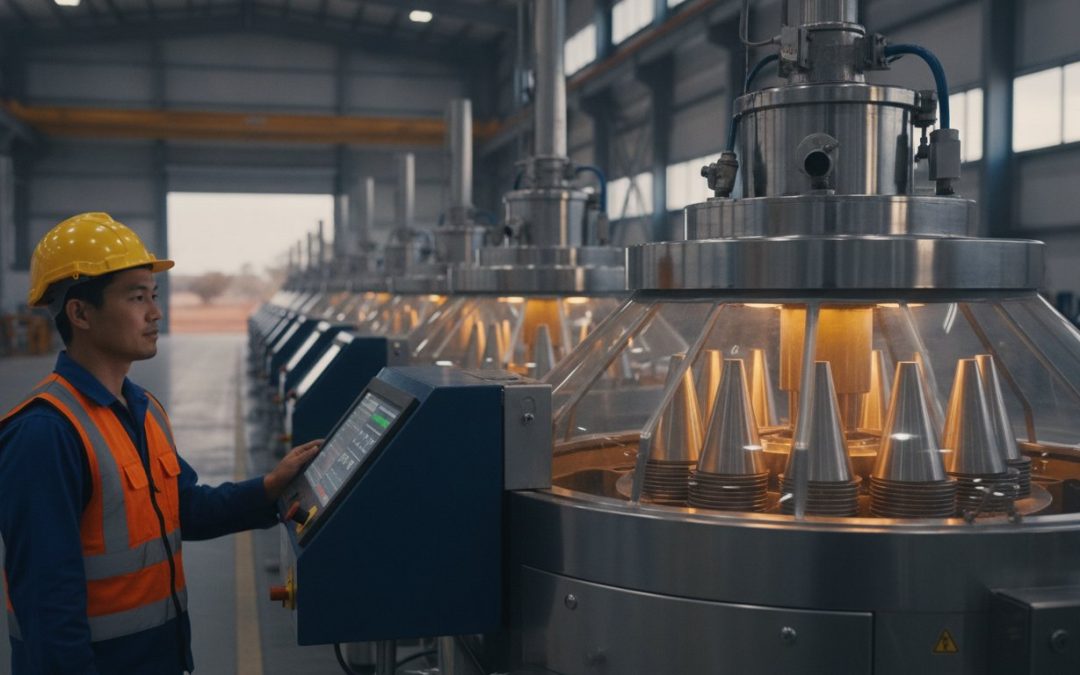
An industrial disc separator is a sophisticated, high-speed centrifuge designed for the continuous removal of solids from liquids or the separation of two immiscible liquids. Unlike static settling tanks that rely on the slow, inconsistent pull of gravity, these systems utilise intense centrifugal force to achieve precision results in seconds. For a disc separator industrial Australia based facilities often require, the primary objective is the extraction of minute particles that standard filtration or decanting might bypass.
The defining feature of this technology is the stack of conical discs housed within the rotating bowl. These discs effectively multiply the sedimentation area by providing a vast surface for particles to settle upon, even though the physical footprint of the machine remains compact. By shortening the distance a particle must travel before it is captured, the separator achieves a level of efficiency that is mechanically impossible for most other industrial centrifuges.
The Mechanics of High-Speed Centrifugal Separation
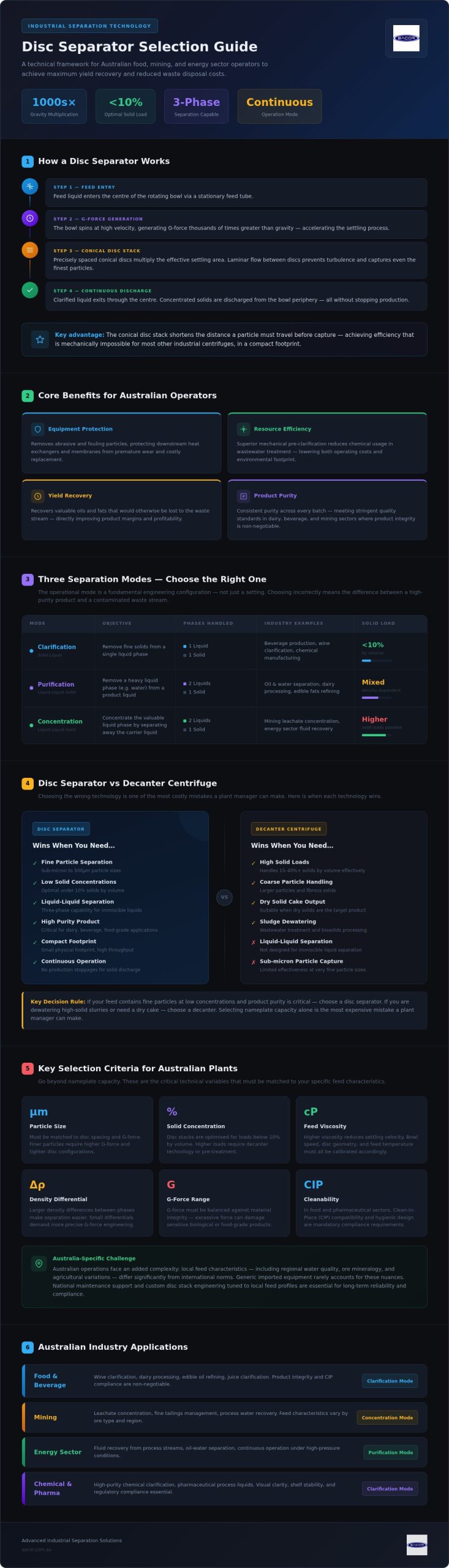
The process begins when the feed liquid enters the centre of the rotating bowl via a stationary feed tube. As the bowl spins at high velocities, it generates a G-force that accelerates the settling process by several thousand times. This force flings the heavier solid particles or the denser liquid phase outward against the discs. The spacing between these discs is precisely engineered to create a laminar flow, which prevents turbulence and ensures that even the finest particles are successfully diverted. This mechanical precision allows for the continuous discharge of clarified liquid and concentrated solids, which maintains steady production flow without the need for frequent manual intervention.
Core Benefits for Australian Industrial Operators
Implementing a disc separator industrial Australia wide provides a strategic advantage for sectors where product integrity is non-negotiable. In dairy, beverage, and mining processing, achieving consistent purity levels ensures that every batch meets stringent quality standards. Beyond product quality, these systems play a vital role in environmental responsibility. By efficiently separating waste streams, operators can significantly reduce their disposal volumes and associated costs. This technology offers several operational advantages:
- Enhanced protection: Removing abrasive or fouling particles protects downstream equipment like heat exchangers and membranes from premature wear.
- Resource efficiency: Superior mechanical pre-clarification leads to lower chemical usage in wastewater treatment processes.
- Yield recovery: High-performance separation allows for the recovery of valuable oils or fats that would otherwise be lost to the waste stream.
Clarification, Purification, and Concentration: Choosing Your Mode
The operational mode of a disc separator is not merely a software setting; it’s a fundamental engineering configuration determined by the physical properties of your feed material. For any disc separator industrial Australia based operations deploy, selecting the correct mode is the difference between a high-purity product and a contaminated waste stream. These machines are versatile enough to handle solid-liquid or liquid-liquid-solid mixtures, provided the internal components are correctly aligned to the density profile of the liquids involved.
Clarification: Removing Fine Solids from Liquids
In clarification mode, the primary objective is the removal of fine solid particles from a single liquid phase. This configuration is critical in industries like beverage production and chemical manufacturing where visual clarity and shelf stability are paramount. For instance, a wine clarification centrifuge Australia winemakers utilise must handle varying solid loads from grape must to finished wine without compromising the delicate flavour profile. The system forces solids to the periphery of the bowl for intermittent discharge while the clarified liquid exits through the centre. Success here depends on the feed’s solid concentration; disc stacks are typically optimised for loads below 10% by volume.
Purification and Concentration: Managing Multiple Liquid Phases
Purification and concentration involve liquid-liquid-solid separation, often referred to as three-phase separation. Purification focuses on removing a heavy liquid phase, such as water, from a lighter liquid like oil. Conversely, concentration aims to recover a heavy phase by removing the light phase. A classic example is found in the dairy industry where dairy separation equipment Australia wide is used to separate cream from skim milk. Density differences are the engine of this process. The greater the difference between the light and heavy phases, the more efficient the separation.
To maintain precision during these complex separations, high-performance systems utilise adjustable paring discs. These stationary pump-like components convert the rotational energy of the liquid into pressure. This allows for controlled discharge and fine-tuning of the “interface” position within the disc stack, which is the point where the two liquid phases meet. If you’re unsure which configuration best suits your site-specific feed characteristics, Sacor provides expert maintenance and technical support services to help you determine the optimal setup for your plant.
Disc Separator vs Decanter Centrifuge: Which Technology Wins?
Choosing between these technologies isn’t about finding a superior machine; it’s about matching mechanical capability to your specific feed profile. While both rely on centrifugal force, their architecture dictates their performance limits. A disc separator industrial Australia wide is the tool of choice when the goal is absolute clarity. In contrast, decanters are built for the heavy lifting of bulk solid removal and high-volume dewatering.
When to Organise a Decanter Centrifuge for Your Site
Decanter centrifuges are the workhorses of high-solids processing. If your feed contains a significant volume of large particles or heavy sludge, a decanter’s horizontal bowl and internal scroll conveyor are essential for continuous discharge. This is why they are the standard in decanter centrifuge mining Australia applications, where tailings and heavy slurries would quickly overwhelm the delicate disc stack. However, decanters struggle with ultra-fine particles below five microns and cannot match the liquid-liquid purity of a disc stack.
The Case for Disc Stack Separators in Precision Processing
When your process requires polishing a liquid to achieve ultra-low residual solids, the disc stack is indispensable. By offering G-forces that can exceed 12,000 G, these systems capture sub-micron particles that a decanter would simply vent. This precision is vital for an olive oil centrifuge separation where the final product must be free of any moisture or fine sediment to prevent oxidation. Beverage and dairy plants rely on this technology because it delivers a level of clarity and microbiological stability that maintains brand reputation and shelf life.
Beyond separation efficiency, the physical footprint and energy profiles differ significantly. Disc separators are vertical units, which saves valuable floor space but requires sufficient headroom for maintenance access. Their higher rotational speeds generate the intense G-force needed for fine separation, but this also demands a more rigorous balancing and maintenance schedule. For a disc separator industrial Australia operators select, the decision usually rests on the solid load threshold. If your feed has less than 10% solids and requires a high-purity discharge, the disc stack is the logical investment. For heavier sludge and bulk dewatering, the decanter remains the superior choice for durability and continuous high-mass throughput.
Key Selection Criteria for Australian Industrial Plants
Procurement of a disc separator industrial Australia wide requires a shift from capital expenditure focus to lifecycle performance. Feed characteristics like viscosity and density dictate the bowl geometry and disc spacing. If you’re processing corrosive materials, high-grade stainless steel components are essential to prevent pitting and stress corrosion. Modern plants also require seamless integration with existing PLC systems to ensure discharge cycles are optimised for the specific solid load of the day.
Operational Efficiency and Total Cost of Ownership
Energy consumption per cubic metre is a critical metric. A machine that’s cheaper to buy but consumes significantly more power will cost more over a ten-year lifecycle. The choice between manual and self-cleaning bowls depends on your solids concentration. Self-cleaning systems maximise uptime by discharging solids while the machine is at full speed, though they require more complex seal maintenance. Securing a reliable supply of industrial centrifuge spare parts Australia based ensures that routine service doesn’t turn into weeks of downtime.
Engineering for the Australian Environment
Australian industrial sites often face extreme ambient temperatures. Equipment must be engineered with robust cooling systems to maintain oil viscosity and motor health. Off-the-shelf imports often fail to meet local electrical and safety standards, leading to compliance hurdles during commissioning. Custom engineering ensures that throughput targets are met regardless of environmental stressors. When selecting a partner, consider these three factors:
- Material compatibility: Ensure the metallurgy matches the chemical profile of your feed to avoid premature failure.
- Automation depth: Evaluate how well the centrifuge control system integrates with your plant-wide SCADA or PLC.
- Technical proximity: Confirm the availability of local engineers who can perform site-specific feed analysis and commissioning.
Technical support is the backbone of reliability. Sourcing a machine without local engineering expertise leaves your plant vulnerable to extended outages. Sacor provides national supply and maintenance and technical support services to ensure your equipment operates at peak efficiency from day one.
Sacor Australia: Your Partner in Advanced Separation
Sacor positions itself as a technical authority rather than a traditional equipment vendor. We recognise that every industrial process has unique variables, which is why our engagement begins with a comprehensive feed analysis. By understanding the specific rheology and particle distribution of your material, we ensure that every disc separator industrial Australia based facilities receive is configured for optimal performance. This collaborative methodology extends beyond the initial sale, encompassing custom solution design and national commissioning support across the mining, food, and energy sectors. Our goal is to provide a steady, grounded conviction that our technology and expertise will deliver the results your procurement team expects.
Bespoke Engineering and Commissioning
Our engineering team focuses on matching equipment to specific throughput and purity targets. We don’t believe in the “off-the-shelf” approach because it often leads to inefficiencies or premature component failure. For example, in the Australian energy sector, our bespoke configurations have delivered high-performance results by aligning bowl speed and discharge frequency with real-world site conditions. Every installation is accompanied by full technical documentation and site-specific training. This empowers your operators to maintain the system’s integrity and respond effectively to process fluctuations, ensuring that the equipment remains a reliable asset for years to come.
Lifecycle Support and Technical Expertise
Sustainable industrial practice is a core pillar of our service model. We frame efficient separation not just as a commercial necessity but as a contribution to resource conservation. By maximising yield and reducing waste, our systems help plants lower their environmental footprint while improving the bottom line. This commitment is supported by a national reach for maintenance, repairs, and spare parts supply. Whether you are operating food processing centrifuge systems or heavy-duty mining separators, our comprehensive maintenance contracts are designed to ensure maximum equipment uptime.
The logistical challenges of the Australian landscape require a partner with boots on the ground. We provide national maintenance and technical support services that go beyond simple breakdown response. Our proactive approach includes regular system audits and performance benchmarking to identify potential bottlenecks before they impact production. We invite you to contact our engineering team to discuss a process audit. By reviewing your current separation efficiency, we can provide data-driven equipment recommendations that align with your long-term operational goals and technical requirements.
Securing Operational Excellence through Precision Separation
Optimising your facility’s separation efficiency requires a deliberate move away from generic equipment towards tailored mechanical solutions. As established throughout this guide, the long-term success of a disc separator industrial Australia wide depends on aligning high G-force capabilities with specific feed characteristics and density profiles. By prioritising bespoke engineering over off-the-shelf imports, you ensure that your plant achieves both maximised yield recovery and reduced waste disposal costs.
The transition to advanced centrifugal technology is a strategic investment in your plant’s future performance and environmental responsibility. Sacor provides the domain expertise required to navigate these technical variables, offering national Australian support and expert commissioning to eliminate the risk of operational downtime. We invite you to consult with Sacor’s engineering team for a tailored separation solution that meets your exact throughput and purity targets. Taking this step will help you transform your processing stream into a model of industrial precision and efficiency, ensuring your equipment delivers consistent results for years to come.
Frequently Asked Questions
What is the main difference between a disc separator and a decanter centrifuge?
The primary distinction lies in the particle size and solid concentration they are engineered to handle. A disc stack separator excels at removing fine particles and polishing liquids at high G-forces, whereas a decanter centrifuge is designed for bulk dewatering of heavy slurries. Decanters utilise a horizontal scroll to discharge high volumes of solids, while disc stacks provide superior clarity for liquid-liquid or liquid-solid mixtures with low solid loads.
Can a disc separator handle three-phase separation (liquid-liquid-solid)?
Yes, disc separators are specifically engineered to manage three-phase mixtures comprising two immiscible liquids and one solid phase. In this configuration, the centrifugal force separates the light liquid phase, the heavy liquid phase, and the solids simultaneously. This capability is essential for applications like oil purification where water and sediment must be removed from the oil stream to ensure product purity and meet stringent industrial standards.
What industries in Australia commonly use disc stack separators?
Disc stack separators are utilised across a broad spectrum of Australian sectors where precision clarity is non-negotiable. Common applications include dairy processing for cream separation, winemaking for final clarification, and the mining sector for mineral oil purification. Additionally, the energy and wastewater sectors deploy these systems to recover valuable resources from waste streams, ensuring that every disc separator industrial Australia based facilities operate contributes to both profitability and sustainable practice.
How often do industrial disc separators require maintenance?
Maintenance intervals are primarily dictated by the characteristics of your feed and the overall duty cycle of the machine. Generally, minor service inspections occur every 2,000 to 4,000 operating hours, with major overhauls required between 8,000 and 12,000 hours. Adhering to these schedules is vital for ensuring long-term equipment reliability and preventing the high operational downtime that often results from neglecting routine mechanical checks or seal replacements.
Are disc separators suitable for high-solids concentration streams?
Industrial disc separators are generally not suitable for streams with high solid concentrations, typically operating most efficiently with solid loads below 10% by volume. If your process involves heavy sludge or high-mass tailings, a decanter centrifuge is the appropriate choice. Feeding a disc stack with excessive solids leads to frequent discharge cycles and increased wear, which compromises the machine’s efficiency and significantly raises the total cost of ownership.
What is the difference between a self-cleaning and a solid-wall disc separator?
A self-cleaning separator features a hydraulic mechanism that periodically opens the bowl to discharge accumulated solids while the machine remains at full operational speed. In contrast, a solid-wall separator requires the machine to be stopped and manually disassembled for cleaning once the solid space is full. Self-cleaning models are preferred for continuous production lines, whereas solid-wall units are often sufficient for batch processes with very low solid content.
How does feed viscosity affect the performance of a disc separator?
Increased feed viscosity negatively impacts separation performance by creating higher resistance for particles moving through the liquid phase. To maintain the desired purity levels, operators must either reduce the throughput volume or increase the process temperature to lower the viscosity. Precision engineering ensures that the disc stack configuration is matched to the specific viscosity profile of your feed, which prevents carry-over and maintains consistent product quality.
Does Sacor provide installation and commissioning for disc separators in Australia?
Sacor provides comprehensive national installation and commissioning support for all centrifugal systems we supply. Our engineering team conducts site-specific technical audits to ensure the equipment integrates seamlessly with your existing PLC and process infrastructure. This hands-on approach includes operator training and performance benchmarking, ensuring that your disc separator industrial Australia wide investment operates at peak efficiency from the moment it is commissioned on your site.