
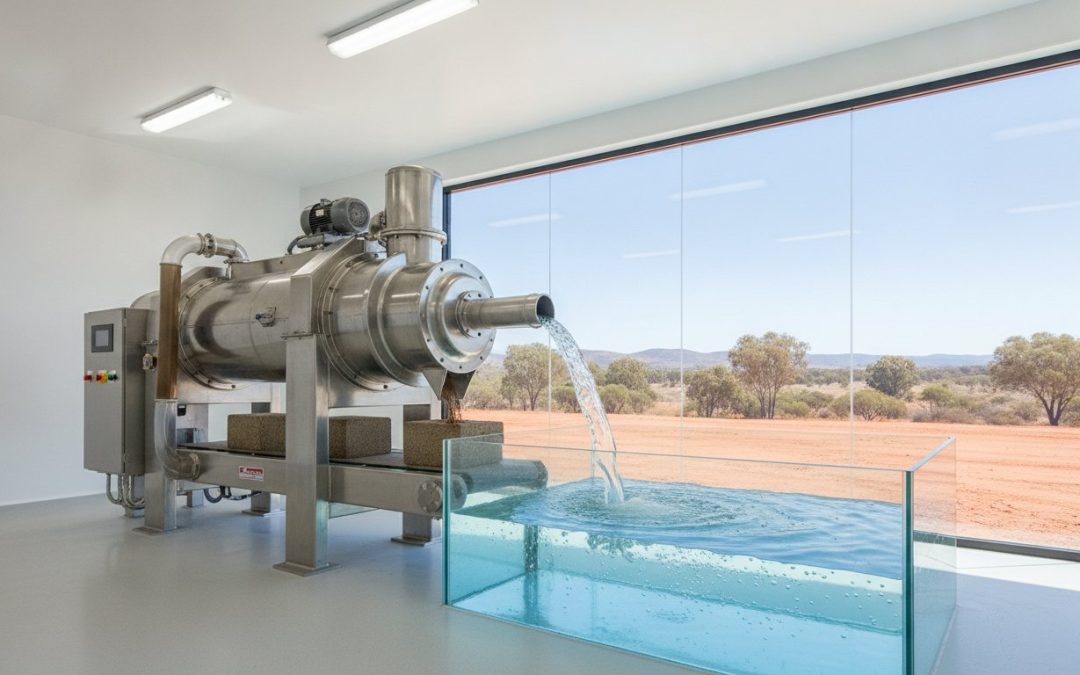
Australian mining and processing operations now face the urgent reality of 2026 water recycling targets, where recovering up to 85% of process water is becoming the baseline for operational viability. You likely understand the mounting costs of waste disposal and the logistical frustration of inconsistent product quality that stems from outdated separation methods. This guide ensures you can master the essentials of centrifugal separation to optimise your Australian industrial processes, reduce waste, and improve resource recovery. By implementing a robust industrial decanter centrifuge Australia wide operators can transition toward zero-liquid-discharge goals while lowering operational costs through automation and continuous processing.
We will examine the strategic selection of 2-phase and 3-phase systems, the impact of GISTM regulations on tailings management, and the technical steps required to ensure long-term reliability on remote sites. This methodical overview provides the technical clarity needed to transform separation equipment from a capital expense into a strategic asset for sustainable industrial practice. Through a focus on precision and proven performance, you’ll learn how to maintain consistent output and high resource recovery rates even in the most demanding Australian environments.
Key Takeaways
- Identify how to leverage an industrial decanter centrifuge Australia wide to achieve superior settling rates and continuous processing across diverse feedstocks.
- Distinguish between 2-phase dewatering and complex 3-phase liquid-liquid-solid separation to select the configuration that matches your specific feedstock requirements.
- Compare the long-term operational savings and reduced physical footprint of decanter systems against belt presses to justify capital investment through improved resource recovery.
- Align your processing operations with 2026 water recycling targets and GISTM tailings standards by leveraging mechanical dewatering for higher water return and dry, stackable cake.
- Identify the critical design features and local support networks necessary to maintain equipment uptime on remote Australian sites through modular maintenance and national spare parts supply.
Industrial Decanter Centrifuges: Why Are They Essential?
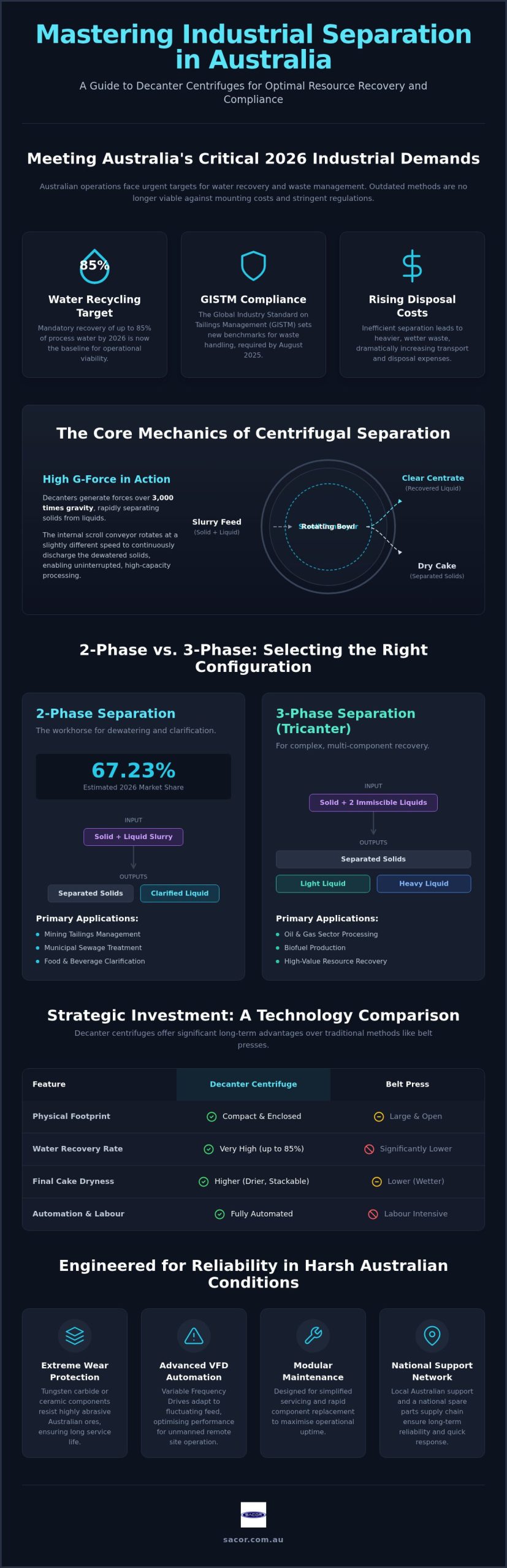
A Decanter centrifuge is a horizontal solid-bowl machine engineered for the continuous separation of solids from one or two liquid phases. Unlike batch processes that don’t allow for uninterrupted flow, these systems operate at high capacity, making them vital for large-scale Australian operations. The core value of an industrial decanter centrifuge Australia wide lies in its ability to generate high G-force, often exceeding 3,000 times gravity, to accelerate the settling of solids. This mechanical acceleration is significantly more efficient than traditional settling ponds, which is a critical advantage as major mining operators must now comply with the Global Industry Standard on Tailings Management (GISTM) as of August 2025.
The primary objective of this technology is to achieve a drier cake and a clearer centrate. A drier solid output reduces the weight and cost of waste transport, while a clearer liquid allows for immediate reuse in plant processes. With Australian industries facing pressure to meet 2026 water recycling targets, the ability to recover up to 85% of process water through precise centrifugal separation has moved from a preference to a regulatory necessity for many sites.
The Core Mechanics of Centrifugal Separation
Effective separation relies on a rotating bowl and an internal scroll conveyor working in tandem. As the slurry enters the bowl, the high rotational speed forces solids against the bowl wall. The internal scroll rotates at a slightly different speed, known as the differential speed, to continuously transport these accumulated solids toward the conical discharge end. The centrate is the clarified liquid phase discharged from the centrifuge, and its clarity is critical for meeting Australian industrial discharge standards or for direct reuse in site processes.
Key Components of a Robust Industrial System
Reliability in harsh Australian conditions requires specific engineering choices for any industrial decanter centrifuge Australia based operators might deploy. Because Australian ores are often highly abrasive, high-performance systems utilise tungsten carbide or ceramic wear protection on the scroll flights and discharge ports. Modern drive systems incorporate Variable Frequency Drives (VFD) to provide the process flexibility needed to handle fluctuating feed characteristics. These systems are often paired with advanced automation, allowing for unmanned operation on remote sites where technical support is limited. This combination of robust materials and smart controls ensures consistent throughput and reduces the risk of unplanned downtime.
2-Phase vs 3-Phase Separation: Choosing the Right Mechanics
Selecting the appropriate separation mechanics is fundamental to achieving operational efficiency and meeting environmental benchmarks. While the basic principle of centrifugal force remains constant, the configuration of the machine determines whether it separates two or three distinct phases. In 2026, data indicates that the two-phase segment continues to dominate the market with an estimated 67.23% share. This is primarily due to its versatility in standard dewatering tasks. However, for operations involving complex feedstocks where multiple high-value components must be recovered, a three-phase configuration is often the superior strategic choice. Understanding how to choose industrial centrifuge technology that matches your specific phase separation requirements is essential before committing to a capital investment.
2-Phase Decanters: Dewatering and Clarification
The two-phase industrial decanter centrifuge Australia relies on is the workhorse of municipal sewage treatment and mining tailings management. Its primary function is to separate a solid phase from a single liquid phase. By focusing on maximum cake dryness, these systems significantly lower the high costs of sludge transport and waste disposal that plague many Australian sites. In food processing, such as fruit juice clarification, the goal is a polished centrate free of suspended solids. These machines handle high solids loading with consistent reliability. This ensures that the final product meets strict quality standards without the need for secondary filtration stages.
3-Phase Systems: Recovering Multiple Phases
Three-phase systems, often referred to as tricanters, are engineered to separate two immiscible liquids and a solid phase simultaneously. This capability is critical in the Australian energy sector for processing oil-water-solids mixtures and in rendering plants for the recovery of valuable fats and proteins. By integrating what would typically require two separate processing steps into a single machine, operators can achieve a substantial reduction in their process footprint. This is particularly beneficial on offshore platforms or compact processing facilities where space is at a premium. Achieving this level of precision requires a sophisticated Three-Phase Centrifuge System that allows for real-time adjustments to liquid discharge levels.
Feed consistency and the precise control of the pond depth within the centrifuge bowl dictate the efficiency of these phases. Fluctuations in temperature or viscosity can impact the separation of the two liquid phases. When feedstocks are variable, the ability to fine-tune the discharge of the light and heavy liquid phases ensures that resource recovery is maximised. It also ensures waste is minimised, which directly supports the environmental responsibility goals common in the current Australian industrial market. The steady, grounded conviction that the technology performs under pressure is what makes these systems a trusted part of the modern industrial landscape.
Decanter Centrifuge vs Alternative Separation Technologies
While the initial capital outlay for an industrial decanter centrifuge Australia wide can be higher than traditional alternatives, the long-term operational savings often provide a rapid return on investment. Decision-makers must look beyond the purchase price to evaluate total cost of ownership. This includes factors such as chemical consumption, labour requirements, and waste disposal fees. Centrifuges typically require less flocculant than belt presses to achieve high separation efficiency, which directly reduces recurring chemical costs. The enclosed nature of a centrifuge also provides a significant safety advantage. It contains odours and prevents the release of volatile organic compounds, making it the preferred choice for hazardous or sensitive environments where worker safety and environmental compliance are paramount.
Decanter vs Filter Press: Throughput and Dryness
The primary advantage of centrifugal technology over a filter press is the transition from batch to continuous processing. Filter presses require a cycle of filling, pressing, and manual or semi-automated cake discharge, which creates bottlenecks in high-volume operations. In contrast, an industrial decanter centrifuge Australia based operators deploy allows for an uninterrupted feed and discharge cycle. While filter presses can sometimes achieve slightly higher cake dryness in specific mining tailings applications, they demand intensive labour for plate cleaning and cloth replacement. Automated centrifuges eliminate these manual interventions, providing consistent performance with minimal oversight and significantly higher throughput per hour of operation.
Decanter vs Belt Press: Reliability and Footprint
Space constraints often dictate technology selection on compact industrial sites. A decanter centrifuge requires a fraction of the physical real estate needed for a belt press installation of equivalent capacity. This reduced footprint simplifies integration into existing plants and lowers the cost of supporting infrastructure. Maintenance profiles also differ sharply. Belt presses rely on open, moving belts and rollers that are susceptible to wear and require frequent wash-water cycles. A centrifuge uses an enclosed rotating assembly that protects internal components from the environment. This design is particularly critical in the energy sector, where the handling of volatile materials necessitates a closed system to maintain process integrity and site safety. By choosing a centrifuge, operators gain a robust, compact solution that standardises performance while minimising the physical and logistical burden on the facility. For a detailed technical and financial analysis of these two technologies, including lifecycle costs and dry solids performance data, refer to our decanter centrifuge vs belt press strategic comparison for Australian industry. For a structured framework covering procurement criteria, lifecycle costs, and AS/NZS 4024.1-2019 compliance considerations, refer to the 2026 industrial centrifuge selection checklist.
Optimising Performance for Key Australian Industries
Optimising the performance of an industrial decanter centrifuge Australia wide requires a methodical approach to machine calibration. Engineers must tailor the G-force and scroll pitch to the specific rheology of the feedstock to ensure maximum separation efficiency. Environmental factors, particularly the harsh Australian climate and regional water quality, play a decisive role in polymer performance. High ambient temperatures can degrade chemical flocculants, while high salinity in process water often necessitates a more robust dosing strategy to maintain the integrity of the settling process. Achieving the right balance between bowl speed and differential speed is essential for handling the variable feed characteristics common in local processing plants.
Mining and Mineral Processing Applications
The strategic importance of decanter centrifuge mining Australia based systems has increased as sites transition toward dry stack tailings storage. This shift is driven by the need to recover up to 85% of process water and comply with 2025 GISTM regulations. When dewatering coal fines or base metal concentrates, the equipment must withstand extreme abrasion. We specify tungsten carbide tiling and hardened wear parts to protect the rotating assembly. This ensures that the machine maintains performance despite the high-wear characteristics of Australian mineral slurries. These configurations allow for continuous operation in remote environments where downtime is a significant financial risk.
Wastewater and Biosolids Management
In the wastewater sector, the focus is on achieving Class A biosolids for agricultural application while reducing the financial burden of landfill levies. By producing a drier cake, facilities reduce the volume of material requiring transport. This is a critical cost-saving measure for municipal plants facing rising operational expenses. With landfill levies reaching record highs and PFAS regulations tightening, deploying an advanced sludge dewatering centrifuge Australia operations can rely on is increasingly essential for achieving the disposal volume reductions and regulatory compliance that modern facilities demand. For a comprehensive overview of how advanced decanter technology is transforming this sector, the wastewater treatment centrifuge Australia 2026 strategic guide provides detailed technical specifications and compliance frameworks for modern facilities.
- Achieve higher cake dryness to lower transport costs.
- Reduce chemical consumption through precise torque control.
- Ensure compliance with environmental discharge standards.
Consistent performance in these applications relies on automated control systems that adjust to fluctuating solids concentrations without manual intervention.
Food and Beverage Clarification
Hygienic processing in the food and beverage industry demands equipment that supports comprehensive Clean-in-Place (CIP) cycles. Whether clarifying fruit juices, refining wine, or separating dairy products, the goal is to maximise yield without compromising product safety. These systems allow for continuous operation while meeting the stringent standards required by Australian regulators. Our engineering focus ensures that product quality remains consistent regardless of the batch size or seasonal variation in feedstock. To discuss a bespoke configuration for your facility, contact us regarding our Decanter Centrifuge Systems.
Ensuring Long-Term Reliability in the Australian Market
Maintaining an industrial decanter centrifuge Australia based operators rely on requires more than just high-quality engineering; it demands a logistical strategy tailored to the continent’s geography. Remote sites across the continent often face significant delays when relying on international supply chains for critical components. Ensuring long-term reliability starts with a robust national support network that provides immediate access to spare parts and technical expertise. The systems we supply feature modular components to facilitate easier maintenance and faster swap-outs in the field. This architectural choice reduces the reliance on heavy lifting equipment and specialised off-site facilities, which is vital for maintaining uptime in isolated locations.
The lifecycle of the equipment is heavily influenced by the quality of initial commissioning and operator training. A system that’s correctly integrated into the plant’s existing control architecture from day one will experience fewer operational stresses. We view each installation as a long-term partnership rather than a one-off transaction. This model ensures that site personnel are fully equipped to manage the specific nuances of their feedstock, from torque adjustments to polymer dosing, which directly contributes to the longevity of the rotating assembly.
Preventative Maintenance and Monitoring
Modern reliability strategies rely on data-driven early warning systems. Integrated vibration and temperature monitoring allow operators to detect bearing wear or imbalance before they lead to catastrophic failure. We recommend scheduled scroll re-tipping and bearing replacements based on actual run-hours and wear patterns rather than generic intervals. Remote telemetry now plays a decisive role in supporting distant sites. It allows our engineers to diagnose performance drifts in real-time, providing technical guidance to site teams without the delay of physical travel. This proactive approach prevents the high costs associated with emergency repairs and unplanned downtime.
Selecting an Australian Partner
Evaluating a supplier requires a focus on local engineering depth and inventory levels. Off-the-shelf imports often fail to account for the specific abrasive characteristics of Australian ores or the unique climate constraints mentioned in previous sections. A bespoke solution, custom-engineered for your feed characteristics, offers superior performance and a more predictable maintenance schedule. We maintain a comprehensive stock of critical spares to ensure our clients aren’t left waiting for international shipments during critical production windows. To secure the future of your processing operations, organise a technical consultation with our engineering team today.
Future-Proofing Your Industrial Separation Strategy
The transition from batch to continuous processing is now a fundamental requirement for meeting modern environmental standards and water recycling targets. Selecting the correct 2-phase or 3-phase configuration, supported by a reliable local technical network, ensures that your equipment remains a high-performance asset rather than a maintenance liability. Deploying an industrial decanter centrifuge Australia based operators can trust allows for consistent cake dryness and centrate clarity, even when handling the most abrasive mineral slurries or sensitive food products.
Sacor offers authoritative engineering expertise to deliver systems custom-engineered for unique Australian conditions. We anchor our technology with a national support network for maintenance and spare parts to ensure your operation maintains maximum uptime. By prioritising precision and reliability, your facility can achieve its resource recovery goals while establishing a more sustainable and cost-effective operational future.
Optimise your separation process with Sacor’s expert solutions. We look forward to partnering with you to enhance your site’s efficiency and environmental performance.
Frequently Asked Questions
What is the typical lifespan of an industrial decanter centrifuge in Australia?
An industrial decanter centrifuge Australia based operators use typically has an operational lifespan of 15 to 25 years. This longevity depends heavily on the abrasiveness of the feedstock and the consistency of preventative maintenance. Machines processing non-abrasive food products often reach the higher end of this range. Conversely, units in heavy mining applications require more frequent component rotations to maintain structural integrity. Adhering to a structured service schedule is the primary factor in extending equipment life.
How do I determine the right G-force for my specific separation process?
Determining the optimal G-force requires an analysis of particle size, liquid viscosity, and the density difference between phases. Finer particles and liquids with similar densities generally necessitate higher G-forces, often exceeding 3,000G, to achieve effective settling. We perform laboratory testing on specific feed samples to establish the precise acceleration needed for your process. This empirical approach ensures the centrifuge delivers the required centrate clarity without consuming excessive energy or causing unnecessary mechanical wear.
Can a decanter centrifuge handle abrasive materials like mining tailings?
Yes, these systems are specifically engineered to handle abrasive materials such as mining tailings and coal fines. To prevent premature wear, the internal scroll and discharge ports are protected with tungsten carbide tiling or specialised ceramic coatings. These wear-resistant materials allow the machine to maintain its internal geometry despite the constant scouring action of mineral slurries. Integrating these robust features is essential for ensuring the reliability of mining separation solutions in harsh Australian site conditions.
What are the power requirements for a large-scale industrial centrifuge?
Power requirements for a large-scale industrial centrifuge typically range from 15kW for smaller units to over 200kW for high-capacity models. The specific draw depends on the bowl diameter, rotational speed, and the solids concentration of the feed. Utilising Variable Frequency Drives (VFD) allows the system to adjust power consumption based on real-time process demands. This optimisation reduces the overall energy footprint of the plant while maintaining the high torque necessary for effective solids transport.
Is it possible to automate the entire dewatering process with a decanter?
Full automation is entirely possible and is standard for modern industrial decanter centrifuge Australia installations. Advanced control systems monitor bowl torque and solids loading to adjust the differential speed and feed rate in real-time. These systems also manage polymer dosing pumps to maintain consistent cake dryness without manual intervention. Automation is particularly beneficial for remote sites where limited technical staff are available, as it ensures the machine operates within its designed performance parameters continuously.
How does temperature affect the separation efficiency of the centrifuge?
Temperature significantly influences separation efficiency by altering the viscosity of the liquid phase. Higher temperatures generally reduce viscosity, which allows solids to settle more rapidly under centrifugal force according to Stokes’ Law. However, extreme temperatures can also impact the performance of chemical flocculants used in the process. It’s vital to calibrate the system for the specific thermal conditions of your plant to ensure that the settling rate remains optimised throughout seasonal temperature fluctuations.
What is the difference between a 2-phase decanter and a 3-phase tricanter?
The primary difference lies in the number of phases the machine can discharge simultaneously. A 2-phase decanter separates a single solid phase from a single liquid phase, which is ideal for standard dewatering tasks. A 3-phase tricanter incorporates an additional discharge mechanism to separate two immiscible liquids, such as oil and water, from the solid phase. Choosing between them depends on whether your process requires the recovery of multiple liquid streams or simple clarification.
How often does a decanter centrifuge require a major overhaul?
A major overhaul, including bearing replacements and scroll re-tipping, is generally required every 10,000 to 15,000 operating hours. The exact interval depends on the mechanical load and the abrasive nature of the material being processed. Monitoring vibration and temperature levels provides an early warning of when a service is becoming necessary. Implementing a proactive overhaul strategy prevents unplanned downtime and ensures the rotating assembly remains balanced, which is critical for the safe operation of high-speed centrifugal equipment.