

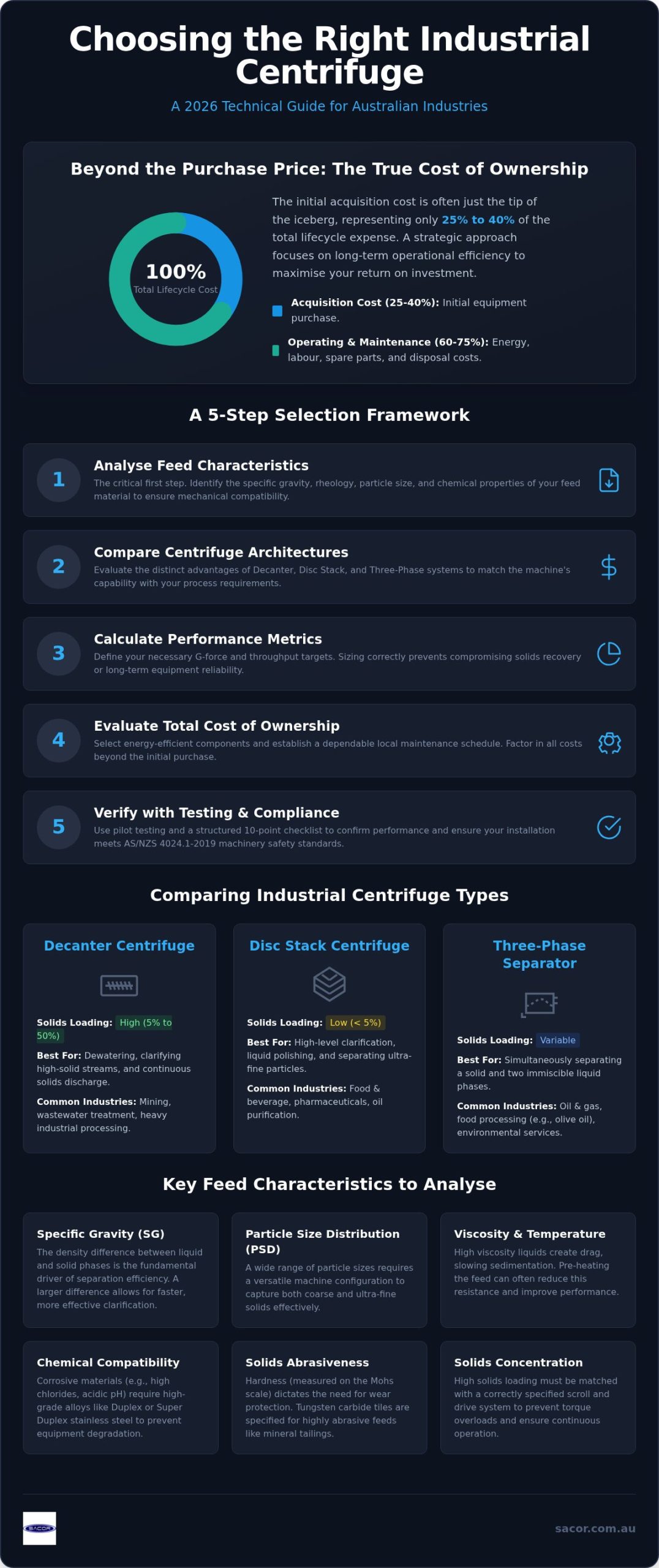
While the initial acquisition cost of a separation system is often the primary focus during procurement, research suggests that this figure typically represents only 25 to 40 per cent of the total lifecycle cost. For plant managers and engineers across Australia, selecting equipment based solely on capital expenditure frequently results in high maintenance costs and throughput specifications that fail to materialise under real world conditions. Understanding how to choose industrial centrifuge technology in 2026 requires a shift in perspective from viewing the machine as a standalone product to seeing it as a critical component of a broader, sustainable process.
We recognise the challenges of balancing operational efficiency with the stringent requirements of AS/NZS 4024.1-2019 machinery safety standards. This article provides a comprehensive technical framework designed to help you select the optimal centrifugal separation system for your specific application, whether in mining, food processing, or wastewater treatment. By following this methodical selection checklist, you can ensure maximised solids recovery and significantly reduced disposal costs over the equipment’s lifecycle. We will examine the essential criteria for matching fluid rheology to mechanical capability, the importance of local technical support, and the latest trends in automation and data driven optimisation.
Key Takeaways
- Identify the specific gravity and rheology of your feed material; it’s the critical first step in ensuring mechanical compatibility.
- Understand how to choose industrial centrifuge configurations by evaluating the distinct advantages of decanter, disc stack, and three-phase systems.
- Calculate the necessary G-force and throughput targets so you don’t compromise on solids recovery or long-term equipment reliability.
- Prioritise total cost of ownership by selecting energy-efficient components and establishing a dependable local maintenance schedule.
- Use a structured 10-point checklist and pilot testing to ensure your installation meets all relevant Australian machinery safety standards.
Analysing Feed Characteristics: The Foundation of Centrifuge Selection
The success of any separation project depends on the accuracy of the initial feed analysis. Engineers often focus on throughput first, but fluid rheology is the primary variable that dictates the mechanical limits of the system. Without a clear understanding of the material’s behaviour under stress, even the most advanced decanter can fail to meet performance targets. Determining how to choose industrial centrifuge equipment starts with a rigorous assessment of the feed material’s physical and chemical profile.
Specific gravity (SG) is the fundamental driver of centrifugal separation. The greater the density difference between the liquid and solid phases, the more efficiently a machine can achieve clarity. If the SG difference is marginal, the system requires higher G-forces or longer residence times to overcome the resistance of the carrier fluid. This relationship is central to basic Centrifuge principles, where centrifugal force accelerates the natural sedimentation process to achieve results that gravity alone cannot provide.
Particle size distribution (PSD) also plays a critical role. A feed with a wide PSD, containing both coarse and ultra-fine particles, requires a different approach than a uniform slurry. Fine particles often remain in suspension unless the centrifuge is configured for maximum clarifying capability. We also evaluate the feed concentration by both volume and weight; high solids loading can lead to torque overloads if the scroll and drive system aren’t correctly specified for the anticipated cake volume.
Fluid Rheology and Chemical Compatibility
Viscosity directly impacts the sedimentation rate of solids. High-viscosity liquids create drag that opposes the movement of particles toward the bowl wall, often necessitating pre-heating to reduce resistance. Chemical compatibility is equally vital. The presence of chlorides or acidic pH levels requires the use of high-grade alloys, such as Duplex or Super Duplex stainless steel, to prevent stress corrosion cracking. Temperature must also be monitored, as it influences both the structural integrity of the seals and the effective viscosity of the process fluid.
Solid Characteristics and Abrasiveness
Assessing solid hardness via the Mohs scale is essential for determining the level of wear protection required. For abrasive materials like mineral tailings or sand, we specify tungsten carbide tiles or hard-facing on the scroll flights to extend service life. If the solids are friable, meaning they break easily under shear forces, the discharge mechanism must be designed to minimise particle degradation. In many Australian wastewater and mining applications, the strategic use of flocculants or polymers can modify these characteristics, agglomerating fine solids into larger flocs that are easier to recover. Deciding how to choose industrial centrifuge configurations ultimately means balancing these material realities against your desired output.
Comparing Industrial Centrifuge Types: Decanter vs. Disc Stack vs. Three-Phase
Once you have established the rheology of your feed material, the next step in understanding how to choose industrial centrifuge systems is selecting the appropriate mechanical architecture. Most Industrial centrifuge classifications fall into either sedimentation or filtration categories; each is designed to handle specific solids concentrations and clarity requirements. Choosing the wrong type often leads to premature wear or a failure to meet throughput targets, making this comparison a critical stage of the procurement process.
When to Choose a Decanter Centrifuge
Decanter centrifuges serve as the primary workhorse for heavy-duty industrial applications. These machines are engineered to handle feed streams with high solids loading, typically ranging from 5% to 50% by volume. Their horizontal design allows for continuous discharge, which is essential for 24/7 industrial processes that cannot tolerate batch-related downtime. In the context of decanter centrifuge mining Australia, these units are frequently deployed for sludge dewatering and tailings management, where they provide the robustness required to process abrasive mineral slurries while maintaining high recovery rates.
The Role of Disc Stack Separators
When your process demands extreme liquid clarity or the recovery of ultra-fine particles, disc stack separators provide the necessary precision. These units operate at significantly higher rotational speeds than decanters, generating forces up to 12,000 G. This capability is ideal for the clarification of beverages and dairy products or for removing trace water and solids from fuel and oil streams. Because they feature a large surface area for sedimentation within a compact bowl, they’re most effective for feeds with low solids concentrations, generally under 5%.
Three-Phase Separation Applications
Three-phase centrifuges, often referred to as tricanters, are required when the process involves the simultaneous separation of two immiscible liquids and one solid phase. This technology is vital in the energy sector for processing oily sludge and produced water, as well as in rendering plants for the recovery of fats and proteins. While these systems offer high efficiency, they involve greater operational complexity. Managing phase purity requires precise weir adjustments to ensure the heavy and light liquid phases don’t contaminate one another. For specialised chemical or pharmaceutical applications, basket centrifuges may also be considered for batch processing where high-value solids require intensive washing.
If you’re evaluating which system best aligns with your plant’s operational goals, our team can provide a technical assessment of your process fluid to ensure you select a configuration that delivers long-term reliability.
Sizing and Performance Metrics: Capacity vs. Efficiency
Sizing a centrifuge requires a precise balance between hydraulic throughput and the time needed for particles to settle. When plant managers ask how to choose industrial centrifuge units, they often start with a target flow rate, such as 20 or 50 m3/hr. However, nominal capacity doesn’t always reflect clarity. High flow rates reduce residence time, which is the duration the fluid stays within the bowl. If residence time is too short, fine particles won’t have enough time to reach the bowl wall, resulting in high Total Suspended Solids (TSS) in the centrate. Building on the feed analysis discussed earlier, refining the search for how to choose industrial centrifuge models requires an understanding of the trade-off between G-force and residence time.
The relationship between bowl diameter and rotational speed is a fundamental engineering constraint. A larger bowl provides more volume and higher residence time but usually operates at lower RPMs to stay within safe material stress limits. Conversely, smaller bowls can achieve much higher G-forces but have limited hydraulic capacity. Finding the sweet spot ensures your process achieves both the required volume and the necessary separation efficiency without compromising equipment longevity.
Determining G-Force Requirements
G-force is the primary driver of sedimentation velocity. While it’s tempting to specify the highest available G-force, this often leads to excessive energy consumption and accelerated component wear. Effective selection involves matching the force to the particle size; ultra-fine particles require higher force, whereas coarse mineral solids might settle efficiently at lower speeds. Sigma Value (Σ) is the theoretical capacity of a centrifuge, representing the area of a gravity settling tank that would provide equivalent clarifying performance. For a deeper understanding of how these principles apply in practice, our guide to solid bowl centrifuge industrial technology covers the mechanical fundamentals that govern sedimentation performance across a range of applications.
Cake Dryness and Solids Recovery
Achieving optimal cake dryness depends on balancing torque control with differential speed. The differential speed, which is the difference between the bowl speed and the scroll speed, determines how quickly solids are transported out of the machine. A lower differential speed increases the time solids spend on the beach, the conical section of the bowl, leading to drier cake and reduced disposal costs.
The scroll pitch and beach angle also influence transport efficiency. A steep beach angle might improve dewatering but can cause slippage for certain types of sludge. Success is defined by meeting your specific target moisture content for either disposal or downstream processing. By optimising these performance metrics, you ensure the system recovers the maximum amount of solids while maintaining a sustainable operational profile. For facilities evaluating alternative dewatering technologies, our detailed analysis of the decanter centrifuge vs belt press provides a strategic comparison of how these systems differ in achieving cake dryness and managing disposal costs.
Total Cost of Ownership: Beyond the Initial Purchase Price
Evaluating the purchase price is only the beginning of a sound procurement strategy. When investigating how to choose industrial centrifuge systems, many operators overlook the long-term operational expenses that accumulate over a 20-year lifecycle. These costs include energy consumption, chemical additives, and specialised labour, which often dwarf the initial investment. A comprehensive Total Cost of Ownership (TCO) analysis ensures that your equipment remains a productive asset rather than a financial burden.
Energy efficiency is a primary driver of sustainability and cost control. Modern systems equipped with Variable Frequency Drives (VFDs) allow for precise control over bowl and scroll speeds, ensuring the motor only draws the power necessary for the current load. Chemical costs also represent a significant recurring expense. Efficient separation reduces the volume of polymers and flocculants required for pre-treatment, which directly impacts the bottom line and reduces the environmental footprint of your waste streams.
Maintenance and Wear Protection
For abrasive mining feeds, the choice between tungsten carbide tiling and hard-facing is a critical decision. While tiling involves a higher upfront cost, it offers superior resistance and longer service intervals compared to standard hard-facing. Establishing a reliable centrifuge maintenance service Australia ensures that major overhaul cycles and bearing replacements are planned around production schedules rather than reactive breakdowns. This proactive approach protects your investment and maintains the equipment’s residual value over time.
Operational Integration and Automation
Labour costs are often reduced through the implementation of fully automated PLC systems. These systems integrate with existing SCADA networks for remote monitoring, which is a key factor when deciding how to choose industrial centrifuge models for large-scale facilities. For food and beverage processors, automated cleaning-in-place (CIP) systems are essential for maintaining hygiene standards without manual intervention. Redundancy planning is also a factor; opting for multiple smaller units instead of a single large unit can provide process security during scheduled maintenance events, ensuring that your facility never faces a total production halt.
If you’re looking to optimise your plant’s performance and reduce long-term costs, you can contact our engineering team to discuss a customised separation solution that fits your specific operational requirements.
Final Selection Checklist and Commissioning in Australia
The procurement of high-capital separation equipment reaches its most critical phase during the final technical verification. When determining how to choose industrial centrifuge systems for Australian sites, the focus must shift from theoretical performance to regulatory compliance and mechanical durability. Successful integration requires a meticulous approach to technical documentation and site-specific safety protocols, particularly in remote mining and processing facilities where downtime is exceptionally costly. Selecting a partner who provides customised engineering and local technical support is essential for ensuring the equipment meets its intended lifecycle targets.
For non-standard feed materials or complex slurries common in Australian mineral processing, pilot testing remains the most effective method for mitigating risk. This empirical process provides the data necessary to confirm that the selected machine can handle the actual fluid rheology under continuous load. It allows for the adjustment of pool depths and differential speeds before the final unit is commissioned, ensuring that the performance promised during the tender stage is actually delivered on the plant floor.
The Procurement Checklist
A robust procurement checklist serves as the final safeguard against equipment that fails to meet operational reality. This 10-point technical verification should include:
- Material of Construction (MOC): Confirming the bowl and scroll alloys resist the specific chloride or acidity levels of your process stream.
- Electrical Standards: Verifying that all motors and control panels comply with Australian AS/NZS 3000 wiring rules.
- Machinery Safety: Ensuring the unit meets AS/NZS 4024.1-2019 standards for guarding and interlocks.
- Spare Parts Availability: Confirming a local inventory of critical wear parts to avoid international shipping delays.
- Technical Documentation: Requiring full commissioning records, maintenance manuals, and P&IDs in Australian English.
- VFD Integration: Ensuring the drive system is compatible with existing plant power factor requirements.
- Bearing Life: Verifying the L10 life rating for main bearings under maximum G-force conditions.
- Vibration Monitoring: Confirming integrated sensors for early detection of mechanical imbalance.
- PLC Compatibility: Ensuring the control system integrates seamlessly with site SCADA networks.
- Performance Guarantees: Establishing clear metrics for centrate clarity and cake dryness.
Commissioning and Site Support
The transition from installation to full-scale production is rarely a plug-and-play event. On-site commissioning allows specialised engineers to dial in the system based on the real world variability of your feed material. This stage is also the ideal time for training plant operators in routine maintenance and troubleshooting, which is vital for long-term reliability. Understanding how to choose industrial centrifuge partners means prioritising those who stay on-site until the system achieves its performance benchmarks. For more detailed insights on installation best practices, you can review our industrial decanter centrifuge Australia guide, which covers the nuances of site integration in local conditions.
Optimising Your Separation Process for Long-Term Performance
Selecting a centrifugal separation system is a high-stakes technical decision that defines a plant’s operational efficiency for decades. By prioritising fluid rheology and total cost of ownership over the initial purchase price, you ensure that your equipment delivers consistent recovery rates while minimising environmental impact. A successful installation relies on matching mechanical capability to specific site conditions, backed by a rigorous 10-point technical verification and on-site commissioning.
Understanding how to choose industrial centrifuge systems for the unique demands of the Australian mining and industrial sectors requires a partner who provides more than just hardware. We offer specialised engineering design and comprehensive commissioning support to ensure your system meets every performance benchmark from day one. Our national spare parts and maintenance network provides the reliability needed to protect your investment throughout its entire lifecycle.
Request a technical consultation for your customised centrifuge solution
We look forward to collaborating with you to achieve a more efficient and sustainable industrial future.
Frequently Asked Questions
What is the difference between a decanter and a disc stack centrifuge?
Decanter centrifuges are horizontal units designed for high solids loading, typically between 5% and 50% by volume. Disc stack separators are vertical units that excel at liquid-liquid separation or clarifying streams with low solids concentrations, usually below 5%. While decanters provide continuous discharge of heavy cake, disc stacks offer much higher G-forces for recovering ultra-fine particles. Choosing between them depends on your specific clarity requirements and the volume of solids in your feed.
How do I determine the right G-force for my specific application?
Determining the appropriate G-force involves analysing the sedimentation velocity of your smallest target particles. Finer or less dense particles require higher G-forces to settle within the available residence time. However, excessive force increases energy costs and component wear, so it’s vital to find the minimum force required to achieve your TSS targets. Understanding how to choose industrial centrifuge specifications means balancing these performance requirements against long-term operational sustainability and maintenance intervals.
Can one industrial centrifuge handle multiple different feed streams?
A single unit can often process different streams if their physical properties and chemical compatibilities align. Modern control systems with Variable Frequency Drives allow operators to adjust bowl speeds and differential settings to accommodate varying feed conditions. However, if the streams differ significantly in corrosivity or solids hardness, the machine’s material of construction and wear protection must be specified for the most demanding case to prevent premature failure or performance degradation.
What are the most common causes of centrifuge failure in industrial plants?
Mechanical imbalance is the most frequent cause of failure, often resulting from uneven solids buildup or worn scroll flights. Bearing failure due to inadequate lubrication or high-temperature operation also ranks highly in industrial settings. In abrasive applications, such as mining, the gradual erosion of hard-facing can lead to a loss of separation efficiency. Routine vibration monitoring and scheduled inspections are essential for detecting these issues before they cause catastrophic damage.
How much does it cost to maintain an industrial centrifuge annually?
Annual maintenance costs generally sit between 2% and 5% of the initial acquisition price, depending on the abrasiveness of the process. This budget typically covers lubricants, seal replacements, and minor wear parts. For high-wear environments, such as mineral processing, costs may be higher due to the need for specialised tungsten carbide tiling. Establishing a structured maintenance contract helps stabilise these expenses and ensures the availability of critical spare parts when required.
Is pilot testing necessary before purchasing a full-scale centrifuge system?
Pilot testing is highly recommended for any process involving non-standard or variable feed materials. This empirical approach allows engineers to confirm recovery rates and cake dryness under real-world conditions before committing to a full-scale installation. It provides the data necessary to refine the search for how to choose industrial centrifuge models, ensuring the final equipment is correctly sized and configured for your specific rheology, which significantly reduces procurement risk.
What safety features are mandatory for industrial centrifuges in Australia?
Industrial centrifuges must comply with the AS/NZS 4024.1-2019 safety of machinery series. Mandatory features include electronic vibration sensors that trigger an automatic shutdown and mechanical interlocks that prevent the cover from being opened while the bowl is rotating. Emergency stop buttons must be accessible and integrated into the plant’s safety circuit. These features ensure that the high kinetic energy of the rotating bowl does not pose a risk to plant personnel.
How does temperature affect the separation efficiency of a decanter centrifuge?
Temperature influences separation by changing the viscosity of the process fluid. As temperature increases, viscosity typically drops, which reduces the drag on particles and allows them to settle more rapidly toward the bowl wall. This often improves both clarity and cake dryness. However, elevated temperatures also affect the structural integrity of elastomers and seals, requiring specialised material selection to maintain reliable operation and prevent leaks in the separation chamber.