
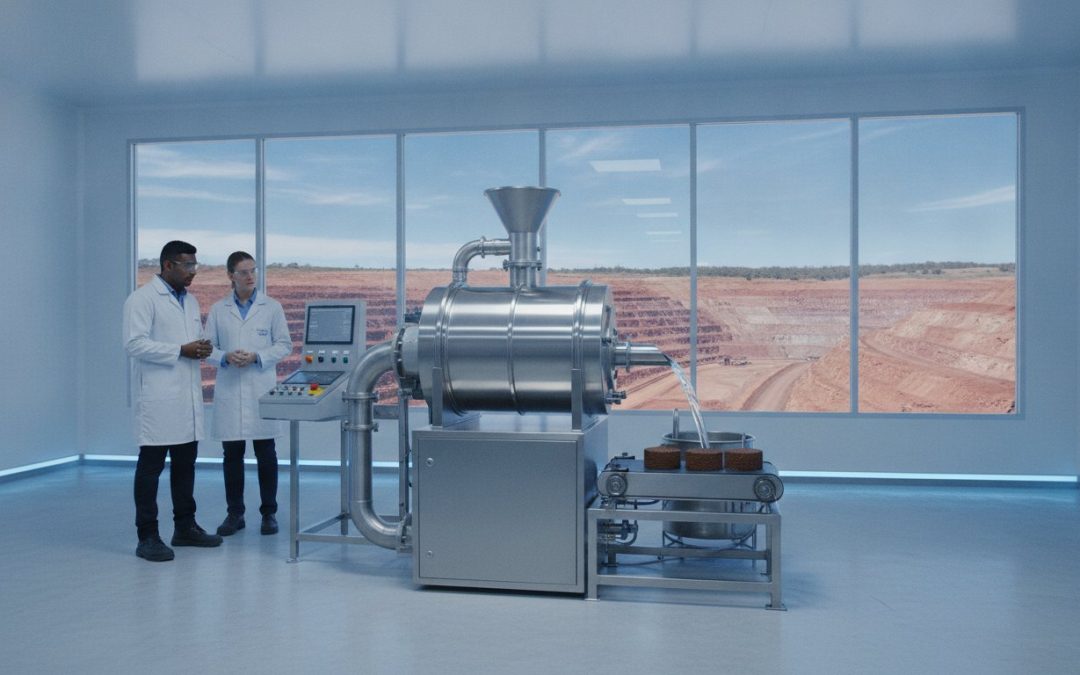
Did you know that advanced separation technology can recover up to 90% of process water in Australian mining operations? For plant managers and engineers across the country, managing wet sludge and the escalating costs of waste disposal is a constant challenge. You’re likely dealing with the limitations of older filtration equipment that fails to meet the stringent dewatering requirements of modern regulations like the Global Industry Standard on Tailings Management. It’s a high-stakes environment where inefficiency directly impacts your bottom line and your social licence to operate.
This guide demonstrates how the solid bowl centrifuge industrial standard has evolved to solve these specific pains; it offers a reliable path to maximised cake dryness and a significantly reduced environmental footprint. We’ll explore the technical mechanics of these systems, compare them against traditional belt presses, and outline how automated operation ensures your facility remains compliant and efficient. By the end of this article, you’ll understand why these machines are the engine of operational sustainability in Australia’s industrial landscape.
Key Takeaways
- Understand how accelerated sedimentation and real-time sensor technology enable continuous separation of solids from liquids with high precision.
- Compare the operational advantages of centrifuges against traditional filter presses to identify the most efficient solution for your plant’s throughput and physical footprint.
- Learn how a solid bowl centrifuge industrial configuration assists Australian operations in meeting GISTM compliance while significantly improving resource recovery.
- Identify proven methods to lower operational expenditure by maximising cake dryness and reducing the total volume of waste destined for disposal.
- Explore the importance of bespoke engineering and site-specific analysis to ensure your separation technology is perfectly aligned with your unique material characteristics.
What is an Industrial Solid Bowl Centrifuge?
A solid bowl centrifuge industrial unit is a high-speed rotating assembly designed for the continuous separation of solids from a liquid carrier. Unlike screen or basket centrifuges that rely on filtration through a perforated wall, this technology utilises a non-perforated, solid outer shell to contain the process material. In 2026, it stands as the primary solution for high-volume slurry dewatering in sectors where reliability and throughput are non-negotiable. This distinction is vital for operations handling abrasive or fine-grained materials that would quickly degrade or bypass standard filtration media.
To understand the foundational mechanics, one must look at What is a Solid Bowl Centrifuge? and how it applies mechanical force to achieve what gravity would take days to accomplish. These machines are engineered to handle feed streams with varying concentrations, making them highly versatile for Australian operations ranging from municipal wastewater to heavy mineral processing. Because the bowl is solid, the machine can maintain high internal pressures. It’s this capability that allows for the high-clarity liquid recovery required in modern resource conservation efforts.
The Core Principle of Sedimentation
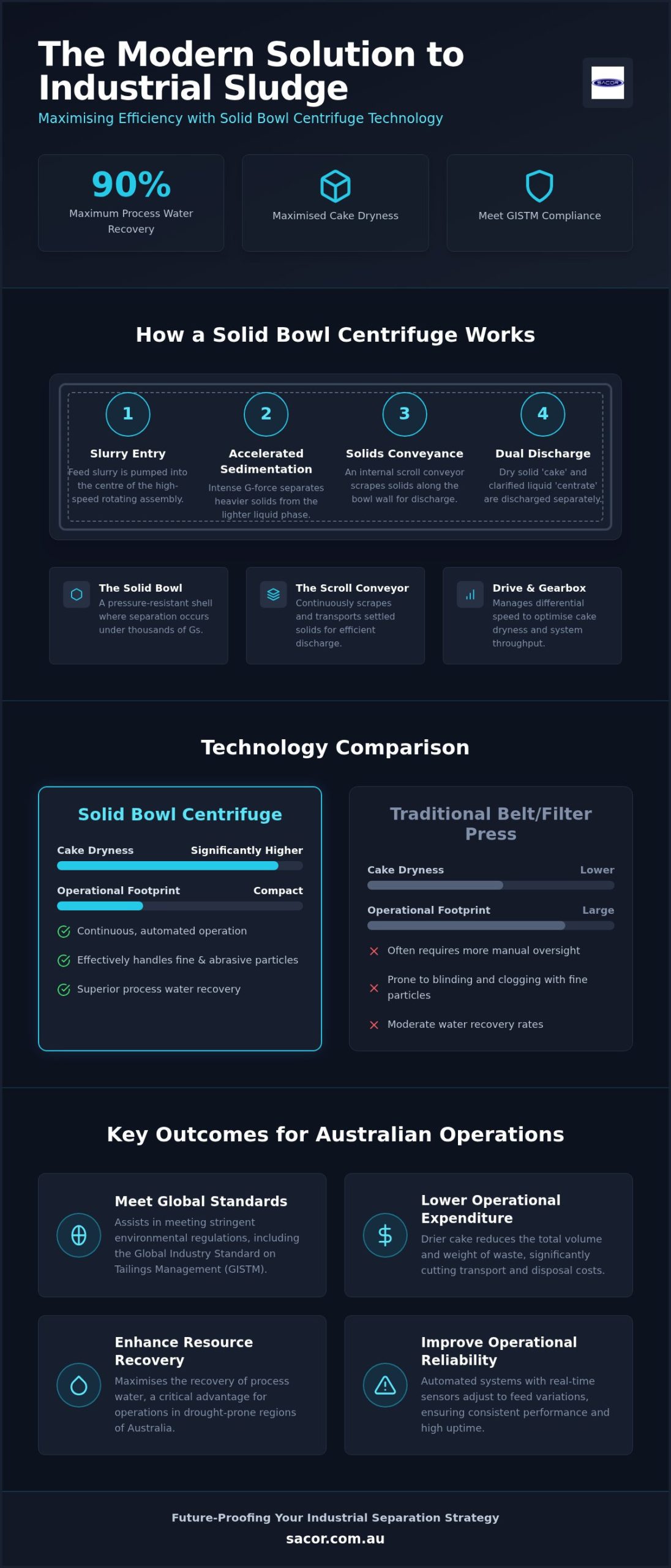
The process hinges on accelerated sedimentation. By spinning the slurry at high velocities, the equipment generates a centrifugal force (G-force) thousands of times stronger than gravity. This force acts on the density differences between the liquid and solid phases. Heavier solid particles are driven outward against the solid bowl wall, while the clarified liquid, or centrate, forms an inner layer. This design is particularly effective for fine particles and clays that would typically blind or clog the mesh of a screen-based system. It ensures consistent performance and high water recovery, which is vital for drought-prone Australian regions where every drop of recycled process water counts toward site viability.
Key Components of the Rotating Assembly
Achieving this level of precision requires a sophisticated mechanical assembly. Three primary components work in unison to manage the separation:
- The solid bowl: This is the cylindrical-conical shell that provides a pressure-resistant environment where the actual separation occurs under extreme G-force. It’s constructed from high-grade, wear-resistant materials to withstand the abrasive nature of industrial slurries.
- The scroll conveyor: Also known as the screw, this internal component rotates at a slightly different speed to the bowl. It functions as a continuous scraper, pushing the settled solids toward the conical end for discharge.
- The gearbox and drive system: These manage the critical differential speed between the bowl and the scroll. Modern systems allow for precise adjustments to this speed, which enables the operator to optimise the dryness of the discharged cake. This control is fundamental for reducing waste disposal costs, as even a small percentage increase in cake dryness leads to significant savings in transport and landfill fees.
Mechanics and Design: How the Separation Process Works
The internal environment of a solid bowl centrifuge industrial system is a study in simultaneous high-precision actions. It’s not just about spinning; it’s about controlled fluid dynamics and mechanical synchronisation. In 2026, leading systems incorporate advanced sensors that monitor torque and feed consistency in real-time, allowing the gearbox to adjust differential speeds instantly. This ensures the machine maintains peak performance even as the feed characteristics fluctuate, preventing the equipment from becoming overloaded or losing clarification efficiency. Properly engineered systems are designed to minimise internal turbulence, which is essential when separating delicate flocculated particles that would otherwise break apart under shear stress.
The 4-Step Separation Sequence
The transition from a raw slurry to a dry cake and clear centrate follows a logical, methodical progression within the rotating assembly:
- Slurry Entry: The process begins as the feed material enters the centre of the rotating bowl via a stationary feed pipe. It’s here that the material is rapidly accelerated to the bowl’s rotational speed.
- Sedimentation: Intense centrifugal force flings the heavier solid particles against the inner wall of the bowl. This creates a concentrated layer of solids while the lighter liquid phase remains closer to the centre.
- Conveyance: The internal scroll conveyor rotates at a slightly different speed to the bowl. This differential allows the scroll to ‘plough’ the settled solids steadily toward the conical end of the machine.
- Dual Discharge: Clarified liquid, or centrate, flows in the opposite direction to the solids. It exits through adjustable weirs at the large end, while the dewatered solids are ejected through discharge ports at the narrow end.
Bowl Geometry: Cylindrical vs. Conical Designs
The efficiency of this sequence is heavily dictated by the bowl’s geometry, specifically the relationship between its cylindrical and conical sections. The cylindrical section provides the necessary volume and residence time required for liquid clarification. It’s where the majority of the particles settle out of the liquid phase. In contrast, the conical section, often referred to as the ‘beach’, provides the mechanical compression required for dewatering the solids as they are lifted out of the liquid pool.
The ‘beach angle’ is a critical design variable that must be customised based on the friction characteristics of the specific material being processed. A shallower angle is typically required for slippery or greasy sludges to prevent the material from sliding back into the pool. Conversely, a steeper angle may be used for coarser mineral tailings to maximise throughput. For operations looking to optimise these parameters for specific site conditions, Sacor provides specialised engineering for decanter centrifuge systems to ensure maximum cake dryness and liquid clarity.
Solid Bowl Centrifuge vs. Alternative Separation Technologies
Choosing the optimal dewatering technology is a strategic decision that fundamentally dictates a plant’s operational efficiency. For many Australian operations, the debate often centres on the solid bowl centrifuge industrial solution versus traditional filtration methods. While filter presses have historical precedence, modern centrifuges provide a level of process control and physical compactness that is difficult to replicate with older designs. This choice is not merely about mechanical preference; it’s about aligning technology with the long-term sustainability goals of the facility.
Centrifuge vs. Belt Filter Press
When evaluating a Decanter Centrifuge vs Belt Press: A Strategic Comparison for Australian Industry, the physical footprint is often the most immediate differentiator. A centrifuge typically requires up to 70% less floor space than a belt press of equivalent capacity. This allows for more flexible plant layouts or the expansion of existing facilities without the need for costly structural extensions. The automated nature of the centrifuge also reduces the need for constant operator supervision, as the system can adjust to varying feed conditions without manual recalibration.
Beyond space, the enclosed design of a centrifuge offers superior performance in odour control and hygiene. This is particularly relevant for wastewater treatment and rendering applications where airborne contaminants must be strictly managed to meet environmental regulations. Centrifuges also consistently achieve a higher solids concentration in the final cake compared to belt presses. This increased dryness directly reduces the total volume of material destined for transport, which is a critical factor in lowering waste disposal costs across remote Australian sites.
Centrifuge vs. Chamber Filter Press
The primary advantage of a centrifuge over a chamber filter press lies in the transition from batch to continuous processing. Chamber presses operate in cycles, requiring significant downtime to clear plates and reset the system. A centrifuge operates without interruption, ensuring a steady flow through the processing circuit. This continuous nature aligns perfectly with the high-throughput requirements of modern mining and mineral operations where downtime equates to lost revenue.
Maintenance profiles also differ significantly between these technologies. While chamber presses require frequent and labour-intensive filter cloth replacements, centrifuges rely on durable scroll hard-facing. Although the initial cost of hard-facing is higher, the long-term reliability and reduced manual intervention often result in a lower total cost of ownership. Chemical consumption is another key variable; while polymer requirements vary by material, the high-precision torque control in modern centrifuges allows for the minute adjustment of flocculant dosing. This precision ensures that polymer is used efficiently, further contributing to the sustainability and cost-effectiveness of the separation process.
In the Australian industrial landscape, the adoption of a solid bowl centrifuge industrial system is often driven by a combination of economic necessity and regulatory pressure. These units serve as the mechanical backbone for diverse sectors, ensuring that operations remain productive while adhering to increasingly stringent environmental standards. For a broader look at the technology’s footprint across the country, consult our Industrial Decanter Centrifuge Australia: The 2026 Comprehensive Guide.
Mining and Mineral Processing
The mining sector remains the most significant user of this technology in the region. With the Global Industry Standard on Tailings Management (GISTM) compliance deadline having passed in August 2025, operators are under intense scrutiny to eliminate high-risk tailings dams. Solid bowl centrifuges are instrumental in dewatering these tailings to create stackable waste, which reduces the risk of dam failure and allows for the recovery of up to 90% of process water. This capability is vital in iron ore, coal, and gold processing where water scarcity can directly halt production. For a deeper analysis of these site-specific requirements, see our Decanter Centrifuge Mining Australia: The 2026 Strategic Guide.
Municipal and Industrial Wastewater
In municipal and industrial wastewater treatment, the primary objective is volume reduction. By thickening and dewatering sludge, centrifuges significantly lower the transport and disposal costs associated with wet waste. These systems are engineered to produce Class A biosolids, which are suitable for agricultural reuse, thereby transforming a waste stream into a valuable resource. The enclosed nature of the centrifuge ensures minimal odour and requires less chemical intervention than belt presses, meeting the expectations of both regulators and local communities.
Food, Beverage, and Agriculture
The food and beverage sector utilises the solid bowl centrifuge industrial configuration for high-clarity separation where product consistency is paramount. In juice and wine production, these machines clarify liquids rapidly, preserving flavour profiles and colours that might be lost in slower sedimentation processes. Dairy processors rely on them for precise fat and protein separation, while the emerging plant-based protein industry uses the technology to optimise yield from raw materials. In rendering and animal by-product plants, the technology is indispensable for the efficient separation of fats and proteins, ensuring high-value recovery from every process stream.
To integrate these efficiencies into your facility and ensure compliance with the latest Australian standards, explore our range of Wastewater Treatment Separation Solutions and other bespoke industrial offerings.
Selecting and Implementing a Solid Bowl System with Sacor
Implementing a solid bowl centrifuge industrial system is a significant undertaking that requires more than just capital expenditure. It demands a methodical engineering partnership to ensure the equipment performs reliably under specific site conditions. Successful integration begins with a comprehensive analysis of the feed material’s characteristics, including particle size distribution and liquid viscosity. For those in the early stages of procurement, our How to Choose an Industrial Centrifuge: The 2026 Selection Checklist provides a structured framework for evaluating technical requirements against operational goals.
The Engineering and Design Phase
Sacor’s engineering team focuses on customising the rotating assembly to match the specific G-force requirements of each application. In the Australian mining sector, where abrasive ores are common, we specify advanced wear protection such as tungsten carbide tiles on the scroll conveyor and discharge ports. This specialised approach extends to the control interface. We design the centrifuge’s automation to integrate seamlessly into existing plant SCADA or PLC systems, which allows for remote monitoring and real-time data acquisition. This level of technical alignment ensures the centrifuge functions as a fully synchronised component of the processing circuit rather than a standalone unit.
Commissioning and Ongoing Support
The transition from installation to full-scale operation is managed through a rigorous commissioning process. Sacor engineers provide on-site technical support to calibrate the system and conduct comprehensive operator training. This ensures your team is proficient in managing the machine’s automated functions and identifying early indicators of mechanical stress. Reliability is anchored in a proactive maintenance programme that prioritises long-term performance over reactive repairs. We emphasize regular vibration monitoring and precise lubrication schedules to prevent the premature wear of bearings and drive components.
To support these efforts, Sacor maintains a robust spare parts inventory within Australia. This local supply chain is critical for minimising unplanned downtime, as it ensures that essential components are available when they’re needed most. We don’t just supply equipment; we position ourselves as a committed partner in your facility’s operational success, providing the expertise required to maintain peak separation efficiency throughout the machine’s lifecycle.
Future-Proofing Your Industrial Separation Strategy
Integrating a solid bowl centrifuge industrial system is a strategic investment in long-term operational resilience. These machines deliver the continuous throughput and high cake dryness required to manage escalating waste disposal costs while meeting rigorous environmental standards like the GISTM. By moving away from manual, batch-oriented processes, your facility gains the reliability of automated sedimentation and the precision of real-time torque control. This transition doesn’t just improve your bottom line; it’s a fundamental step toward more sustainable resource management within the Australian industrial landscape.
Sacor provides the Australian-owned technical expertise and customised engineering needed to adapt these solutions to your specific site conditions. Our commitment to comprehensive maintenance and a robust spare parts supply chain ensures your equipment remains a high-performing asset throughout its lifecycle. We’re dedicated to working alongside you to solve complex dewatering challenges with quiet assurance and proven technology. Optimise your separation process with Sacor’s expert centrifuge solutions and secure a more efficient, dependable future for your operations today.
Frequently Asked Questions
What is the difference between a decanter centrifuge and a solid bowl centrifuge?
A decanter centrifuge is a specific type of solid bowl centrifuge designed for continuous separation. While these terms are often used interchangeably in Australian industry, the solid bowl designation specifically highlights the non-perforated wall of the rotating assembly. This design ensures that liquid cannot escape through the bowl wall, making it the preferred solid bowl centrifuge industrial choice for dewatering fine slurries where filtration through a mesh or screen would be ineffective.
Can a solid bowl centrifuge handle abrasive materials found in Australian mines?
These systems are engineered to withstand the abrasive nature of gold, coal, and iron ore slurries. Sacor specifies customised wear protection, such as sintered tungsten carbide tiles on the scroll conveyor and ceramic liners in the discharge ports. These materials provide a robust defence against erosion, which extends the operational life of the equipment and reduces the frequency of major overhauls in demanding mineral processing environments across the country.
How much water can be recovered using a solid bowl centrifuge in tailings management?
In Australian mining applications, a well-optimised system can recover up to 90% of process water from tailings streams. This high recovery rate is critical for maintaining site water balances in drought-prone regions and complying with the Global Industry Standard on Tailings Management. By recycling this water back into the processing circuit, operators significantly reduce their reliance on external water sources and lower their total environmental footprint and operational costs.
What are the typical maintenance requirements for an industrial solid bowl centrifuge?
Typical maintenance involves regular lubrication of the main bearings and the gearbox to ensure smooth operation under high centrifugal loads. Operators should also conduct routine vibration monitoring to detect early signs of imbalance or bearing wear. Periodic inspections of the internal scroll conveyor’s hard-facing are necessary to assess erosion levels. Proactive maintenance schedules help prevent unplanned downtime and ensure the solid bowl centrifuge industrial unit maintains peak separation efficiency.
Is a solid bowl centrifuge suitable for food-grade applications?
Yes, these systems are widely used across the food and beverage industry for applications like dairy separation and juice clarification. Food-grade models are constructed from high-quality stainless steel and feature polished internal surfaces to prevent bacterial growth. They also incorporate Clean-in-Place systems, which allow for thorough sanitisation without the need for manual disassembly. This ensures compliance with strict Australian food safety standards while maintaining high throughput and product consistency.
How does the G-force affect the separation efficiency of the centrifuge?
Centrifugal force, or G-force, accelerates the sedimentation process by multiplying the effect of gravity on the particles within the slurry. Higher G-forces allow for the separation of smaller, lighter particles that wouldn’t settle under normal conditions. This leads to clearer centrate and drier solids. However, the G-force must be carefully balanced against the structural limits of the material and the machine to avoid excessive wear or the shearing of delicate particles.
What happens to the solids after they are separated in the bowl?
Once the solids are driven against the bowl wall, the internal scroll conveyor ploughs them steadily toward the conical discharge ports. The separated solids, now in a dewatered cake form, are ejected from the machine and typically fall onto a conveyor belt or into a collection bin. Depending on the application, this cake can be further processed, used as agricultural biosolids, or transported to a tailings storage facility for dry stacking.
Are solid bowl centrifuges energy-efficient compared to other dewatering methods?
Centrifuges are often more energy-efficient than thermal drying or batch-based filtration when measured by total throughput volume. The continuous nature of the process eliminates the energy spikes associated with stopping and starting equipment for cleaning cycles. Modern drive systems also use variable frequency drives to optimise power consumption, ensuring the machine only uses the energy required to maintain the target differential speed during 24/7 automated operation.