

With metropolitan landfill levies across Australia reaching significant figures, such as A$174.20 per tonne for the 2025-2026 period, residual moisture in your waste stream has become a considerable financial liability. Plant managers across Australia recognise that selecting dewatering equipment is no longer a simple matter of throughput; it’s a strategic decision to mitigate escalating disposal costs and satisfy increasingly strict environmental regulations. The choice between a decanter centrifuge vs belt press often determines the long-term efficiency and profitability of a processing facility. While the lower initial capital expenditure of a belt press remains a factor, the demand for reduced labour intervention and minimal water consumption is driving a shift toward more sophisticated, automated systems.
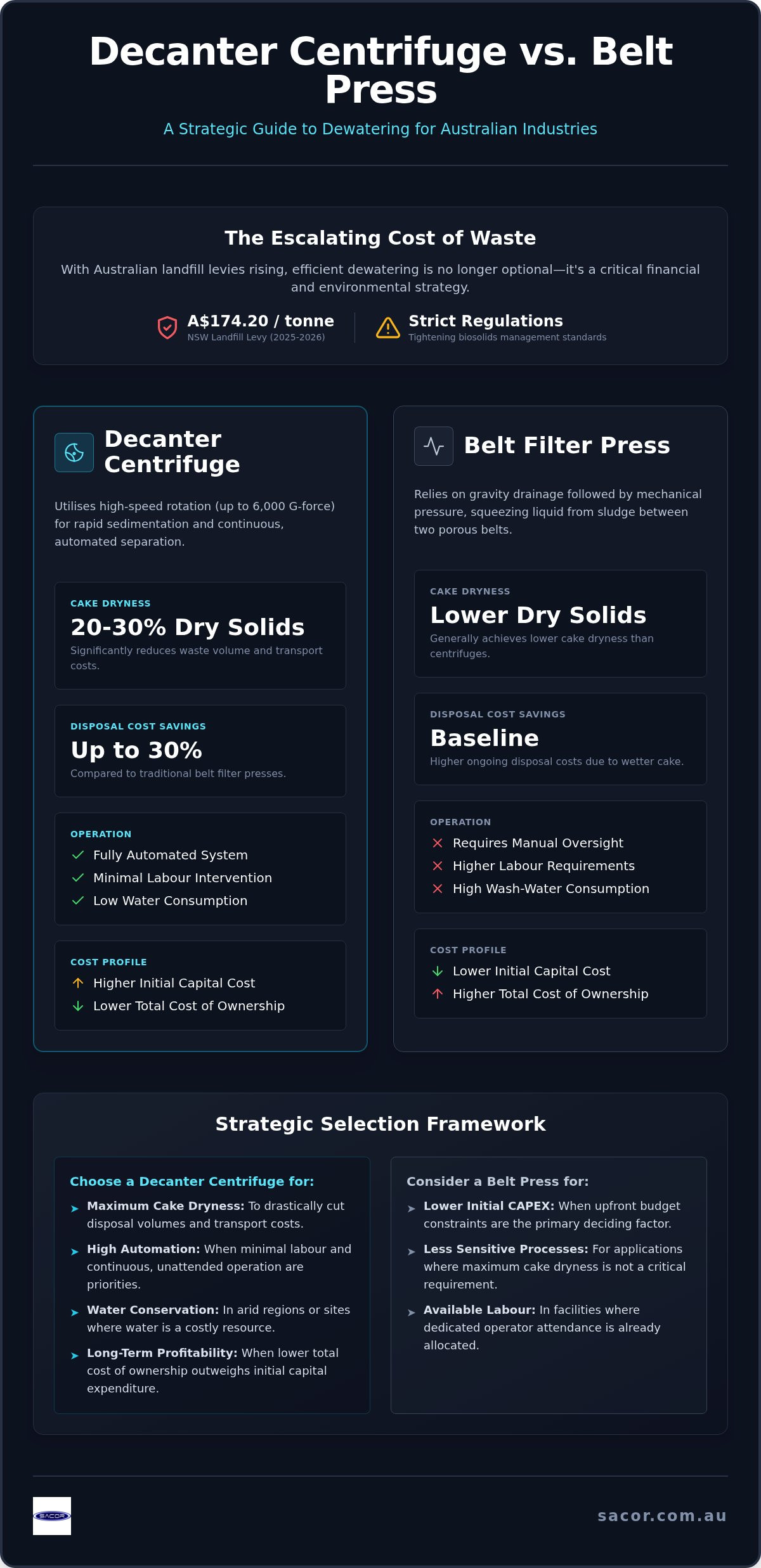
This article provides an authoritative technical comparison to assist engineers in selecting the technology best suited to their specific process requirements. You’ll learn how high-speed decanter centrifuges can achieve 20-30% dry solids content, which often results in disposal cost savings of up to 30% compared to traditional belt filter presses. We examine the critical trade-offs between energy consumption, solids recovery, and maintenance requirements to ensure your equipment choice supports a sustainable and cost-effective operation.
Key Takeaways
- Understand how escalating Australian landfill levies and updated biosolids regulations are making high-efficiency dewatering a critical financial priority for plant managers.
- Evaluate the mechanical trade-offs of a decanter centrifuge vs belt press to determine which technology provides the necessary automation and throughput for your specific site.
- Compare performance benchmarks for cake dryness and solids recovery to significantly minimise waste volumes and reduce transport costs across Australian operations.
- Analyse the hidden operational costs of dewatering, including the impact of wash-water consumption and manual labour requirements on your total cost of ownership.
- Apply a strategic selection framework to match separation technology to your unique feed characteristics, ensuring long-term reliability and process optimisation.
The Fundamentals of Industrial Solid-Liquid Separation in Australia
Industrial separation in Australia is no longer a peripheral concern for site managers. It’s a core operational pillar. With landfill levies in New South Wales reaching A$174.20 per tonne for the 2025-2026 period and Victorian metropolitan rates sitting at A$169.79 per tonne, the financial penalty for transporting liquid-heavy waste is severe. Effective dewatering transforms what was once a costly disposal problem into a manageable solids stream, significantly reducing the frequency and cost of haulage. For remote mining operations and agricultural processors in arid regions, the value of recovered process water often outweighs the savings in waste transport. Recovering this water for reuse within the plant reduces reliance on expensive mains supply and helps secure a site’s social licence to operate by demonstrating responsible resource stewardship.
The Economic Drivers for Dewatering
The economic case for advanced dewatering is built on three foundations: volume reduction, water conservation, and regulatory compliance. As state governments across Australia tighten biosolids management standards, such as the updated purification orders issued in Victoria in April 2026, the demand for higher cake dryness has intensified. Mechanical separation allows plants to meet these strict environmental thresholds while minimising the footprint of waste storage. By achieving higher solids recovery, facilities can also decrease their environmental impact, which is increasingly vital for maintaining positive community relationships and meeting corporate ESG targets.
Defining the Contenders
When sites look to upgrade their infrastructure, the decision almost always centres on the decanter centrifuge vs belt press. These two technologies represent the most mature and reliable methods for high-volume dewatering, yet they operate on fundamentally different physical principles. Choosing the right one requires a balance of upfront capital expenditure against long-term operational efficiency.
A decanter centrifuge utilises high-speed centrifugal sedimentation to separate solids from liquids. By rotating at high speeds, the unit creates forces thousands of times greater than gravity, forcing denser solid particles against the bowl wall while the clarified liquid is discharged. For a deeper look at the foundational principles, our industrial decanter centrifuge Australia guide offers a comprehensive technical overview. Understanding Decanter centrifuge mechanics is essential for engineers who require a system capable of continuous, automated operation with minimal manual oversight.
In contrast, a belt filter press relies on a combination of gravity drainage and mechanical pressure. Sludge is fed between two tensioned, porous belts that travel over a series of rollers. As the belts move, the mechanical squeeze forces liquid through the fabric, leaving a solid cake. While the belt press often involves lower initial capital costs, the ongoing debate of decanter centrifuge vs belt press usually hinges on total cost of ownership, where factors like wash-water consumption and labour costs become the deciding metrics for Australian plant managers.
Technical Mechanics: Decanter Centrifuge vs Belt Filter Press
The technical divergence between a decanter centrifuge vs belt press begins with the physical force applied to the feed material. One system relies on accelerated sedimentation through high-speed rotation, while the other utilizes mechanical pressure and gravity to squeeze liquid through a porous medium. This fundamental difference dictates how each machine responds to fluctuations in feed concentration and particle size, ultimately affecting the clarity of the filtrate and the dryness of the resulting cake.
How the Decanter Centrifuge Operates
A decanter centrifuge consists of a horizontal cylindrical bowl that rotates at high speeds, containing an internal screw conveyor known as a scroll. As the feed enters the bowl, centrifugal forces reaching up to 6,000 G drive the denser solid particles against the bowl wall. The scroll rotates at a slightly different speed to the bowl, continuously pushing the accumulated solids toward the conical end for discharge. This Dewatering Performance Comparison demonstrates how these extreme G-forces allow for the sedimentation of fine particles that might otherwise bypass a filter cloth. Because the entire process occurs within a sealed housing, it’s the superior choice for Australian wastewater or food processing sites where odour control and hygiene are paramount. Engineers seeking a comprehensive overview of how this technology has evolved can explore the solid bowl centrifuge industrial separation guide, which details the latest advances in maximising cake dryness and process water recovery.
How the Belt Filter Press Operates
The belt filter press functions through a sequential three-stage process: gravity drainage, a low-pressure wedge zone, and a high-pressure roller zone. Initially, the sludge is distributed onto a moving porous belt where free water drains away by gravity. The material then enters the wedge zone, where a second belt converges to begin applying pressure. Finally, the sludge is squeezed between a series of rollers of decreasing diameter, which exerts maximum mechanical force to expel remaining moisture. This system relies heavily on belt integrity and precise tensioning. While effective for fibrous materials, the open design can lead to aerosolisation of contaminants and requires a significant amount of wash-water to keep the belts from blinding.
When considering plant layout, centrifuges offer a much smaller footprint per cubic metre of processed material. They are compact, self-contained units that integrate easily into existing pipework. In contrast, a belt press requires a large structural frame and extensive space for belt tracking and cleaning systems. Both technologies require polymer flocculation to aggregate fine particles into larger flocs. However, the high-shear environment of a centrifuge often demands a more robust polymer dosing strategy to ensure the flocs don’t break apart before separation is complete. If you’re currently evaluating which mechanical configuration suits your facility, our team can provide customised separation solutions tailored to your specific site conditions.
Performance Metrics: Throughput, Cake Dryness, and Recovery Rates
The choice between a decanter centrifuge vs belt press for high-volume Australian applications often hinges on the quality of the separated streams. Performance is measured not just by how much material moves through the machine, but by the consistency of the output. In many mining and municipal wastewater facilities, feed characteristics shift rapidly due to process changes or environmental factors. Centrifuges excel in these scenarios. Their enclosed, high-speed operation allows for real-time adjustments to bowl speed and scroll differential, ensuring the solids discharge remains within specification even during feed spikes.
Throughput and Efficiency in Mining and Wastewater
Australian tailings management involves handling massive volumes of slurry containing fine, often abrasive particles. The decanter’s ability to process these streams continuously without the risk of belt blinding or tracking issues provides a significant operational advantage. For mineral-specific performance data, our decanter centrifuge mining Australia guide details how these systems optimise recovery in coal, gold, and iron ore processing. While a belt press might offer a slight edge in cake dryness for certain highly fibrous organic sludges, it often lacks the versatility required for the fluctuating concentrations common in industrial environments.
Solids Recovery and Filtrate Quality
The clarity of the liquid phase, referred to as centrate in centrifuges or filtrate in belt presses, is critical for downstream water reuse. A major performance metric is the net liquid recovery, which is often compromised in belt presses by the high volume of wash water required to clean the filter media. This wash water can dilute the recovered liquid and increase the hydraulic load on the rest of the plant. In contrast, decanters operate as a closed loop with minimal external water requirements during the separation cycle.
The solids recovery rate represents the percentage of dry solids retained in the cake relative to the total solids entering the system; industrial decanters consistently achieve benchmarks exceeding 95%. Achieving this level of capture efficiency requires a precise balance of polymer dosage. While centrifuges may consume more polymer to manage high shear forces, the resulting reduction in waste volume and superior centrate clarity often justifies the chemical expenditure. This trade-off is essential for sites aiming to maximise solids recovery while maintaining a high-quality liquid stream for recycling or compliant discharge.
Operational Realities: Labour, Maintenance, and Total Cost of Ownership
When evaluating the decanter centrifuge vs belt press, initial capital expenditure is often a poor predictor of long-term profitability. Australian plant managers must account for the high cost of manual labour and the increasing price of process water. While a belt press might appear more economical at the procurement stage, the operational realities of belt tracking, wash-water management, and manual cleaning often erode those savings within the first few years. A strategic focus on total cost of ownership (TCO) reveals that the higher degree of automation in centrifugal systems often yields a more favourable financial outcome over the equipment’s lifecycle.
The High Cost of Labour in Australia
Automation is the primary driver for centrifuge adoption across Australian industrial sites. Modern decanter systems are designed for near-total autonomy, integrating seamlessly with SCADA systems for remote monitoring and real-time adjustments. This reduces the need for dedicated operators to manage belt alignment or tensioning, tasks that are mandatory for belt press stability. Furthermore, the enclosed nature of a centrifuge protects workers from exposure to hazardous aerosols, odours, and pathogens. This is a significant safety benefit in wastewater treatment and chemical processing where reducing operator exposure is a critical compliance requirement.
Water consumption remains a hidden drain on the balance sheet for many facilities. A belt press requires a continuous supply of high-pressure wash-water to keep the filter media from blinding. This process can consume significant volumes of water that must then be re-treated. Regarding energy, while a belt press can operate at approximately 20% of the power consumption of a centrifuge, the gap is narrowing through innovation. Advanced control systems in modern decanters can achieve energy savings of 10-15% compared to older models. When these energy requirements are weighed against the costs of wash-water and manual intervention, the centrifuge often emerges as the more efficient long-term investment.
Maintenance and Spare Parts Availability
Maintenance profiles differ significantly between the two technologies. A belt press involves frequent belt replacements and potential roller bearing failures due to constant exposure to moisture and grit. A centrifuge requires planned maintenance for its high-speed bearings and scroll hard-surfacing, particularly in abrasive mining applications. In these environments, the scroll and bowl are subject to intense wear, necessitating specialised protection such as tungsten carbide tiles. Access to local technical support is vital to prevent extended downtime. Sacor provides comprehensive maintenance and technical support services nationally, ensuring that spare parts and expert technicians are available to support unique Australian site conditions and maintain peak equipment uptime.
Selecting the Optimal System for Your Site: A Strategic Framework
Selecting the right dewatering technology requires a methodical evaluation of both the immediate process needs and the long-term environmental footprint. The decision between a decanter centrifuge vs belt press shouldn’t be based on equipment cost alone; it must account for the specific site conditions that dictate operational success. Australian managers can use the following strategic framework to ensure their investment delivers the expected return.
- Step 1: Characterise feed material. Analyse particle size distribution, density, and abrasiveness. High-density mining tailings with abrasive silica content require different wear protection than organic municipal sludge.
- Step 2: Define output requirements. Establish targets for cake dryness and filtrate clarity. If your goal is to achieve 20-30% dry solids to minimise transport volumes, the centrifugal force of a decanter is often necessary.
- Step 3: Evaluate site constraints. Consider available floor space and utility access. Arid sites must prioritise water recovery, while plants with limited footprint will find the compact nature of a centrifuge more viable than the large frame of a belt press.
- Step 4: Conduct a 10-year TCO analysis. This analysis must include the cost of polymer consumables, wash-water waste, and the high price of Australian manual labour. Over a decade, the reduced water and labour requirements of a centrifuge often outweigh its higher initial energy demand.
When the Decanter Centrifuge Is the Clear Winner
A decanter centrifuge is the superior choice for applications where high automation and minimal operator intervention are non-negotiable. In sectors like food and beverage processing, where hygiene is paramount, the enclosed design prevents product contamination and maintains a sanitary working environment. Similarly, for wastewater facilities located near residential areas, the superior odour control provided by a sealed system is essential for maintaining a social licence to operate. To help refine your decision, our industrial centrifuge selection checklist provides a detailed guide for matching equipment to specific process variables.
The Sacor Advantage: Customised Engineering for Australian Sites
We recognise that no two Australian sites are identical. Bespoke engineering ensures that every system is matched to the unique feed characteristics of your facility, whether you’re processing mineral tailings in the Pilbara or biosolids in a metropolitan centre. This customisation extends beyond the machine itself; it includes the precise calibration of polymer dosing and scroll differentials to maximise efficiency. Our comprehensive commissioning support ensures day-one performance, providing on-site training to familiarise your team with the automated controls. Ultimately, Sacor’s national technical support and maintenance network reduces operational risk for Australian managers by ensuring that expert assistance and spare parts are always within reach.
Strategic Dewatering for Long-Term Operational Efficiency
The choice between a decanter centrifuge vs belt press represents a significant pivot point for any Australian processing facility. While the belt press may offer a lower entry cost, the decanter centrifuge provides the automation and consistency required to thrive in a high-labour, high-regulation market. With landfill levies in states like New South Wales reaching A$174.20 per tonne, the ability to maximise cake dryness and minimise waste volume is a financial necessity rather than a preference. Implementing a system that recovers high-quality process water while operating with minimal manual intervention ensures your site remains both compliant and profitable.
Sacor acts as a technical partner by delivering custom-engineered solutions tailored for the Australian mining, energy, and food sectors. Our commitment to your operational success is backed by comprehensive national maintenance and spare parts support, ensuring long-term reliability. We focus on reducing your operational costs and environmental impact through precise, high-performance separation technology. Discuss your separation requirements with a Sacor technical expert today to begin optimising your site’s dewatering performance. We’re ready to help you achieve a more sustainable and cost-effective future.
Frequently Asked Questions
Is a decanter centrifuge more expensive to operate than a belt press?
Centrifuges often have higher power costs but lower total operational expenses due to reduced labour and water needs. While a belt press uses about 20% of the energy, it requires constant manual oversight and high-pressure wash-water. In the Australian market, where labour costs are high, the automation of a centrifuge typically offsets the energy gap over a standard 10-year lifecycle, leading to a lower total cost of ownership.
Which technology produces a drier cake for municipal sludge?
Modern high-speed decanter centrifuges typically produce a drier cake, achieving 20-30% dry solids compared to 18-25% for belt filter presses. This difference is critical for reducing disposal volumes. Upgrading to a centrifuge can result in disposal cost savings of 20-30% because drier cakes occupy less volume and weigh less during transport to landfill, which is vital given the escalating landfill levies across most Australian states.
How much wash water does a belt filter press actually use?
A belt filter press consumes significant volumes of high-pressure wash-water to prevent the filter media from blinding. This continuous cleaning cycle can account for a large portion of a plant’s total water consumption and increases the hydraulic load on downstream treatment. Conversely, decanter centrifuges operate as a closed loop and only require water for periodic CIP cycles, making them the superior choice for water-scarce regions or sites prioritising resource conservation.
Can a decanter centrifuge handle abrasive mining tailings?
Yes, decanter centrifuges are highly effective for abrasive mining tailings when equipped with specialised wear protection. Sacor provides systems with tungsten carbide tiles and hard-surfacing on the scroll and bowl to withstand the intense friction of mineral processing. This engineering ensures the machine maintains performance in harsh conditions while extending the intervals between major overhauls, providing a reliable solution for remote Australian mining operations.
What are the space requirements for a centrifuge vs a belt press?
Centrifuges require a substantially smaller footprint than belt filter presses for the same processing capacity. A centrifuge is a compact, horizontal unit that integrates easily into existing pipework. A belt press requires a large structural frame, extensive vertical clearance, and additional room for belt tracking and cleaning systems. This often makes the centrifuge the only viable option for retrofitting into space-constrained Australian processing plants or mobile separation units.
How often do centrifuge bearings need to be replaced in industrial settings?
Centrifuge bearings generally require replacement every 15,000 to 20,000 operating hours, depending on the load and feed characteristics. Regular lubrication and vibration monitoring can extend this lifespan significantly. Maintaining a structured service schedule ensures that these high-speed components remain reliable. Sacor provides local Australian support and spare parts to ensure that bearing replacements are conducted efficiently with minimal disruption to your processing schedule or plant uptime.
Is the polymer usage higher in a centrifuge compared to a belt press?
Polymer usage is typically higher in a centrifuge because the high-shear environment requires a more robust flocculant to maintain particle integrity. While this increases chemical costs, it’s often justified by superior solids recovery rates, which frequently exceed 95%. When comparing a decanter centrifuge vs belt press, the trade-off involves weighing slightly higher polymer expenditure against the significant savings achieved through lower waste transport and disposal fees.
Which system is better for odour control in wastewater treatment?
The decanter centrifuge is the superior technology for odour control because it operates as a completely enclosed system. This design prevents the aerosolisation of pathogens and the release of volatile organic compounds into the plant environment. Belt filter presses are open systems that expose the sludge to the air, often necessitating expensive ventilation and scrubbing infrastructure to manage odours in sensitive municipal areas or food processing locations.