With Western Australian electricity tariffs increasing by 2.75 per cent as of July 2026, the financial burden of continuous pumping is no longer a manageable overhead. A typical site might move over a billion litres of water annually; however, many operations still rely on inefficient, high-maintenance systems that struggle with abrasive slurry. If your goal is to reduce dewatering costs mining, you’ve likely realised that simply buying bigger pumps isn’t the solution to rising energy prices and expensive waste haulage.
We understand that maintaining plant availability while managing wet tailings is a constant balancing act. This guide provides a strategic framework for 2026, showing you how to lower your operational expenditure through precise system optimisation and advanced centrifugal separation technology. We’ll explore how these methods reduce waste volume for easier haulage and protect your hardware from premature wear, ensuring a more sustainable and profitable operation. By treating water management as a separation process rather than just a pumping task, you can achieve a more reliable and cost-effective site footprint.
Key Takeaways
- Evaluate the total cost of ownership by identifying how uncontrolled water management inflates blasting expenses and haulage weights across your site.
- Learn to implement source control and high-efficiency pumping systems to reduce dewatering costs mining while decreasing energy consumption per cubic metre moved.
- Examine the efficiency gains of mechanical separation, comparing the compact footprint and reduced labour needs of decanter centrifuges against traditional methods.
- Transition from reactive maintenance to predictive strategies to mitigate the impact of abrasive slurries and extend the operational life of critical equipment.
- Understand why site-specific feed testing is essential for engineering bespoke separation solutions that integrate seamlessly with your current mining infrastructure.
Understanding the Total Cost of Ownership in Mine Dewatering
Achieving a sustainable reduction in operational expenditure requires a comprehensive understanding of the Total Cost of Ownership (TCO). In the context of Australian resource projects, TCO is the sum of capital expenditure (CAPEX) for equipment procurement and ongoing operating expenses (OPEX) including energy, labour, and maintenance. Integrating efficient separation technology is one of the most effective ways to reduce dewatering costs mining across the entire lifecycle of a project. When water management is poorly executed, the financial impact extends far beyond the pump station, affecting everything from explosive efficiency to the mechanical availability of the haul fleet.
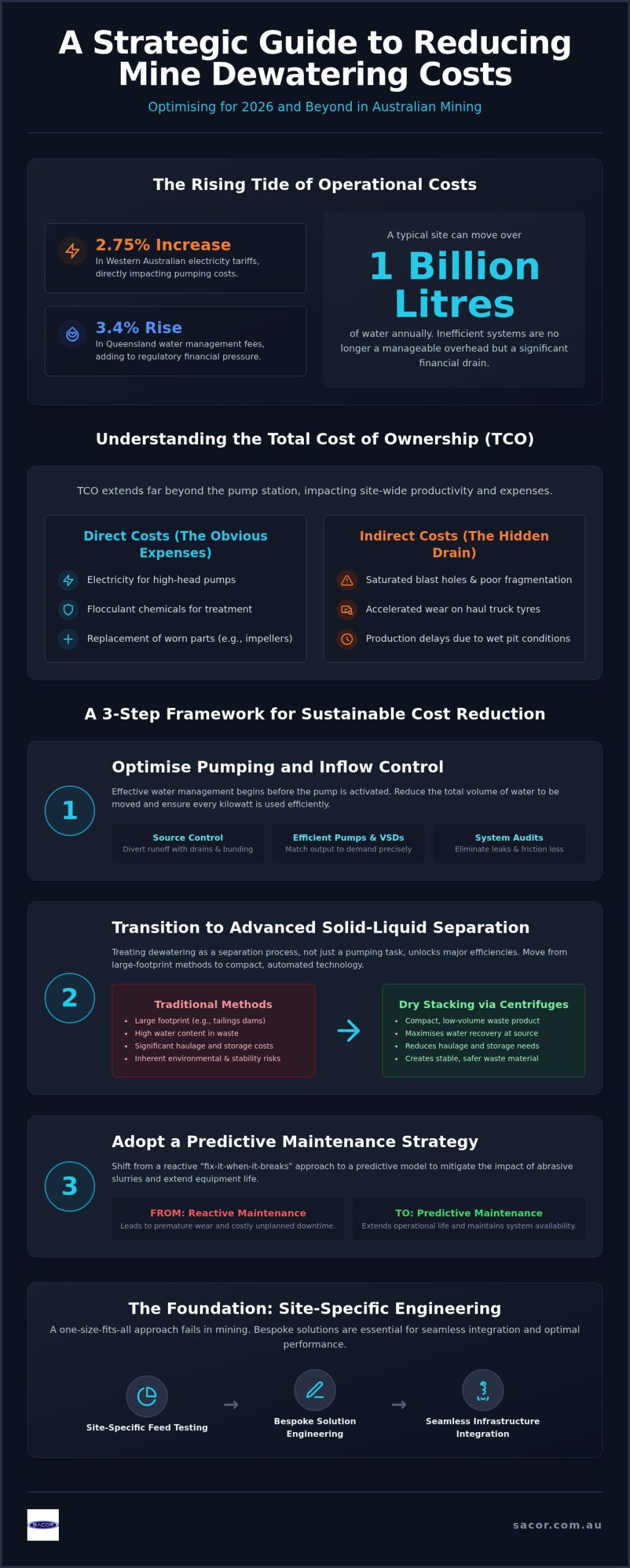
Energy consumption remains the primary driver of rising expenses as we move through 2026. With Western Australian electricity tariffs having increased by 2.75 per cent in July 2026, the cost of moving every kilolitre of water has become a critical metric for plant managers. Simultaneously, Queensland operations face a 3.4 per cent rise in water management fees. These regulatory and utility cost increases mean that Mine dewatering must be viewed as a precision process rather than a secondary utility. Uncontrolled groundwater doesn’t just require pumping; it saturates blast holes, leading to higher consumption of expensive emulsion explosives and poorer fragmentation, which subsequently slows down the primary crusher.
Direct vs. Indirect Dewatering Expenses
Direct costs are easily identified on a balance sheet, encompassing electricity for high-head pumps, flocculant chemicals for water treatment, and the replacement of impellers worn down by abrasive slurry. Indirect costs are more insidious but equally damaging to the bottom line. Wet pit conditions lead to production delays and significantly accelerate the wear on expensive haul truck tyres due to increased rolling resistance and heat build-up. The Total Dewatering Cost is defined as the cumulative financial impact of water removal from the pit combined with the subsequent processing and storage of solid-liquid waste streams.
The Hidden Cost of Wet Tailings
Residual moisture in tailings is a significant financial liability that many operations fail to quantify accurately. High water content increases the total volume of waste, requiring larger footprints for storage and more frequent lifts on tailings dam walls. These structures carry inherent financial risks associated with stability and potential water seepage into local aquifers, which can trigger substantial environmental compliance penalties. To reduce dewatering costs mining, many forward-thinking Australian sites are shifting toward dry stacking as their preferred economic model. By using mechanical separation to recover water at the source, mines can create a stable, low-volume waste product that is easier to handle and significantly safer to store long-term.
Optimising Pumping Systems and Inflow Control
Effective water management begins before the first pump is even activated. Implementing source control strategies, such as diversion drains and bunding, prevents surface runoff from entering the pit during high-rainfall events common in Northern Australia. This simple physical barrier reduces the total volume of water that needs to be mechanically moved, which is the most direct way to reduce dewatering costs mining. When mechanical intervention is required, selecting high-efficiency pumps tailored to the specific head and flow requirements of the site is essential. Using oversized pumps often leads to energy waste, while undersized units struggle with the duty cycle, leading to premature failure.
Variable Speed Drives (VSDs) play a pivotal role in modern dewatering strategies by modulating pump speed to match fluctuating demand. This eliminates the massive energy spikes associated with direct-on-line starting and allows the system to operate at its Best Efficiency Point (BEP). Regular auditing of the pipe network is equally critical; even minor leaks or scale build-up in the lines can significantly increase friction losses. These losses force pumps to work harder and consume more power to achieve the same discharge rate. By maintaining a streamlined distribution network, sites can ensure that every kilowatt of energy translates into maximum water displacement.
Smart Pumping and Automation
Integrating sensors into the dewatering circuit allows for real-time adjustments based on actual groundwater ingress levels. Automated controls are particularly effective at preventing “snoring”, a condition where a pump draws in air alongside water, causing cavitation and rapid wear on the impeller and casing. Remote monitoring systems allow engineers to manage deep-pit operations from a central control room, reducing the need for manual inspections in hazardous or hard-to-reach areas. This shift toward automation ensures that equipment only runs when necessary, which lowers energy expenditure and extends service intervals.
Strategic Borehole Placement
Hydrogeological mapping enables the strategic placement of boreholes to intercept groundwater before it reaches the working face. By dewatering the rock mass ahead of excavation, the pit remains dry, and the static head requirements for the pumping system are often reduced. Where the local terrain allows, gravity-fed drainage systems should be prioritised to move water away from the site without any electrical input. These proactive measures, combined with modern dewatered tailings technology, create a highly efficient water cycle that minimises waste. For sites looking to refine these processes, exploring customised separation solutions can help bridge the gap between simple pumping and total water recovery.
Reducing Costs Through Mechanical Solid-Liquid Separation
Traditional methods like evaporation or settling ponds are often inefficient and land-intensive. In the current economic climate, relying on natural evaporation is a passive approach that fails to capture the value of the water. Mechanical separation provides a controlled, scalable alternative that allows for immediate water recovery. This proactive strategy is essential to reduce dewatering costs mining, as it converts a waste stream into a secondary resource for the processing plant. By removing solids at the source, the volume of material requiring haulage is drastically reduced, leading to direct savings in fuel and maintenance for the transport fleet.
Mechanical separation also addresses the substantial labour and footprint requirements associated with older technologies. While belt presses were once the industry standard, they require significant floor space and frequent manual intervention to manage belt alignment and cleaning. In contrast, modern decanter centrifuges offer a compact footprint and automated operation. This shift not only lowers the initial CAPEX for housing the equipment but also reduces the ongoing OPEX by minimising the headcount required for oversight. Recovering process water for immediate reuse reduces the reliance on expensive external water sources, providing a buffer against the 3.4 per cent indexation of water management fees seen in 2026.
Decanter Centrifuges in Tailings Management
The separation process in a decanter centrifuge relies on high G-forces to accelerate the settling of fine mineral particles. This technology is uniquely suited for tailings dewatering centrifuge solutions for Western Australia mining, where abrasive slurries and variable feed densities are common. Centrifuges maintain consistent performance even when the feed characteristics fluctuate, which prevents the process bottlenecks that often occur with settling ponds. The resulting cake is significantly drier than that produced by gravity-based methods, which simplifies handling and ensures the long-term stability of the waste storage facility.
Centrifuge vs Filter Press: The Cost Comparison
When selecting a separation method, the choice often comes down to a decanter centrifuge vs filter press: choosing the right dewatering technology for Australian mining. While filter presses can produce a very dry cake, they operate in batch cycles and require high levels of maintenance for the filter cloths. Centrifuges operate continuously, which aligns better with the non-stop nature of modern mining operations. Modern centrifugal systems are engineered to require lower doses of flocculant chemicals, which is a major recurring expense in water treatment. By optimising chemical consumption and reducing manual labour, centrifuges provide a lower total cost of ownership over the life of the mine. For operations facing stricter federal environmental accountability under the 2026 regulatory framework, selecting the right mineral concentrate dewatering centrifuge is now a compliance requirement as much as a cost-saving measure.
Predictive Maintenance and Spare Parts Management
The abrasive nature of Australian mining slurries presents a significant challenge to the longevity of dewatering hardware. High concentrations of silica and other hard minerals can quickly erode internal components, leading to a rapid decline in hydraulic efficiency and eventual mechanical failure. To effectively reduce dewatering costs mining, operations must transition from reactive “break-fix” models to structured predictive maintenance. By identifying wear before it results in a catastrophic breakdown, plant managers can schedule repairs during planned shutdowns, thereby avoiding the exorbitant costs associated with emergency call-outs and lost production time.
Modern reliability engineering relies on data-driven tools such as vibration analysis and oil monitoring to assess the health of decanter centrifuges. Vibration sensors can detect subtle changes in bearing frequencies or bowl balance, providing an early warning of potential issues that are invisible to the naked eye. Similarly, regular oil analysis reveals the presence of metal particulates or moisture contamination, allowing for targeted intervention before internal surfaces are damaged. This methodical approach ensures that equipment remains in peak condition, maintaining the high separation efficiency required to keep operational costs under control.
Managing Wear in Abrasive Environments
Protecting the internal surfaces of a centrifuge is a primary concern when handling heavy mineral loads. Selecting tungsten carbide tiling or specialised ceramic coatings for the centrifuge scrolls can extend the service life of these critical parts by several thousand hours. Standardising components across different sections of the mine also helps to reduce the cost of inventory, as it allows for a leaner stock of spare parts that can be deployed where they’re needed most. Sacor’s maintenance contracts protect long-term equipment ROI by ensuring that every component is serviced according to its actual wear profile rather than a generic schedule.
Training and Technical Support
Upskilling on-site teams to perform basic maintenance tasks is a practical way to lower ongoing labour costs and improve response times. When site personnel can confidently handle routine inspections and minor adjustments, the reliance on external contractors is reduced. In 2026, remote diagnostic tools have become the standard for troubleshooting complex separation issues; they allow specialists to view real-time performance data from a central hub and provide immediate guidance to site engineers. Choosing a local partner like Sacor ensures faster commissioning and lower technical fees, as our technicians and spare parts are already positioned within the Australian market. To ensure your operation maintains peak efficiency with minimal downtime, explore our range of Maintenance and Technical Support Services.
Developing a Custom Dewatering Strategy with Sacor
Every mining site presents a unique set of geological and operational challenges that cannot be addressed with off-the-shelf equipment. To truly reduce dewatering costs mining, a strategy must be built on the specific characteristics of the site’s feed material. Sacor prioritises site-specific testing to understand the nuances of particle size distribution and slurry behaviour before proposing a technical solution. This data-driven approach ensures that the selected hardware is perfectly matched to the duty cycle. For a broader look at the industry landscape, our Decanter Centrifuge Mining Australia: The 2026 Strategic Guide provides a reliable benchmark for integrating these systems into your existing plant infrastructure. By retrofitting advanced separation technology into current circuits, we help operators minimise installation CAPEX while significantly improving water recovery rates.
Our engineering team works as a technical partner rather than a simple equipment vendor, collaborating directly with plant managers to ensure that throughput targets are met without compromising on cake dryness. Integrating a centrifuge into an established processing plant requires a deep understanding of upstream and downstream flows. We focus on creating a seamless interface that reduces the need for extensive civil works or structural modifications. This methodical integration is essential for maintaining production continuity and achieving the rapid return on investment that modern mining operations demand.
The Consultation and Design Process
The design process begins with a detailed analysis of feed characteristics, including particle size, density, and pH levels. We customise bowl geometry and drive systems to suit specific mineral types, ensuring the equipment can handle the high-torque requirements of dense mining slurries without excessive wear. This bespoke design process is supported by comprehensive technical documentation, which is essential for maintaining Australian regulatory compliance and meeting site safety standards. By tailoring the centrifuge parameters to the specific ore body, we ensure that the separation process is both efficient and repeatable, regardless of feed fluctuations. Sites navigating the new NEPA requirements introduced in July 2026 will find that our 2026 dewatering centrifuge guide for Australian mines offers a practical technical roadmap for aligning machine selection with current federal performance-based environmental standards.
Achieving Sustainable and Profitable Separation
Implementing a refined dewatering strategy results in a dual benefit: reduced environmental impact through resource recovery and enhanced profitability through lower OPEX. Advanced separation technology allows for the immediate reuse of process water, which is a critical advantage given the rising costs and stricter regulations surrounding water extraction in Australia. This transition from a waste-disposal mindset to a resource-recovery model is the most effective way to reduce dewatering costs mining over the long term. We encourage you to book a site assessment with our technical specialists to identify specific cost-saving opportunities and develop a roadmap for a more efficient, sustainable operation that protects your bottom line.
Engineering a More Profitable Dewatering Circuit
Managing the financial pressures of 2026 requires a shift from simple water removal to sophisticated resource recovery. To effectively reduce dewatering costs mining, operations must integrate efficient pump networks with advanced mechanical separation. High-performance decanter centrifuges replace land-intensive settling ponds to produce drier tailings and allow for immediate water reuse. This strategy directly lowers haulage expenses and utility costs, providing a clear path to improved site profitability.
Sacor acts as a technical partner to help you implement these precision systems. We provide custom engineering tailored to specific Australian mining conditions, supported by national spare parts and maintenance services. Our systems deliver proven results in reducing tailings volume and moisture content, ensuring your operation remains both compliant and competitive. Optimise your site’s separation efficiency with Sacor’s custom centrifuge solutions. We look forward to helping you build a more sustainable and cost-effective mining future.
Frequently Asked Questions
How much can I realistically save by switching to decanter centrifuges for dewatering?
Savings are primarily realised through the significant reduction of waste volume and the immediate recovery of process water for reuse. While initial investment varies based on site requirements, the strategy to reduce dewatering costs mining is most effective when you lower haulage frequency and chemical consumption. Many Australian operations find that the long-term reduction in OPEX far outweighs the initial capital outlay compared to traditional settling ponds.
What is the main difference between CAPEX and OPEX in mine dewatering?
CAPEX refers to the initial capital expenditure for purchasing and installing Decanter Centrifuge Systems and pumping infrastructure. OPEX encompasses the ongoing operational expenses such as electricity, flocculant chemicals, and maintenance labour. A successful strategy balances these two; investing in high-quality hardware often leads to a much lower OPEX over the total lifecycle of the mining project.
Do decanter centrifuges require more power than traditional filter presses?
Decanter centrifuges are designed for continuous operation, which often results in lower total energy consumption per tonne of solids when compared to the batch processing of filter presses. While the centrifuge motor has a consistent power draw, it eliminates the energy-intensive high-pressure pumping and the frequent, water-heavy cleaning cycles required to keep filter cloths from blinding.
Can mechanical dewatering help with environmental compliance in Australia?
Mechanical separation is a critical tool for meeting modern environmental standards and social licence requirements. By producing a stable, drier waste product, you can reduce the footprint of tailings storage facilities and minimise the risk of groundwater seepage. This proactive approach ensures your site stays compliant with increasingly strict state-based water management and discharge regulations.
What are the most common causes of high dewatering costs on remote sites?
High costs are typically driven by poor inflow control and the logistical expense of hauling saturated waste materials. If surface runoff isn’t diverted, pumps must work harder to move water that shouldn’t be in the pit. Remote sites also face higher downtime costs if they lack a reliable supply of spare parts, making efficient hardware and local support essential for profitability.
How does tailings moisture content affect my haulage and disposal budget?
Moisture content acts as a direct multiplier for your transport budget because water adds significant weight without adding any value to the waste stream. Reducing the moisture in your tailings by even a small percentage can lead to a substantial decrease in the number of truck cycles required. This lowers fuel consumption and reduces the mechanical wear on your haulage fleet.
Is it possible to automate the entire dewatering and separation process?
Full automation is achievable by integrating real-time sensors with Variable Speed Drives and advanced control logic. These systems automatically adjust the centrifuge speed and chemical dosing based on the density and flow of the incoming feed. This ensures the equipment always runs at its best efficiency point, even when groundwater conditions change without warning.
Why is local Australian technical support critical for reducing dewatering downtime?
Access to local technical support eliminates the production bottlenecks that occur when waiting for international parts or expertise. Having a national inventory of spare parts and technicians who understand the unique rigours of the Australian climate ensures that repairs are completed quickly. This local presence is the most effective way to maintain high plant availability and keep your project on schedule.