
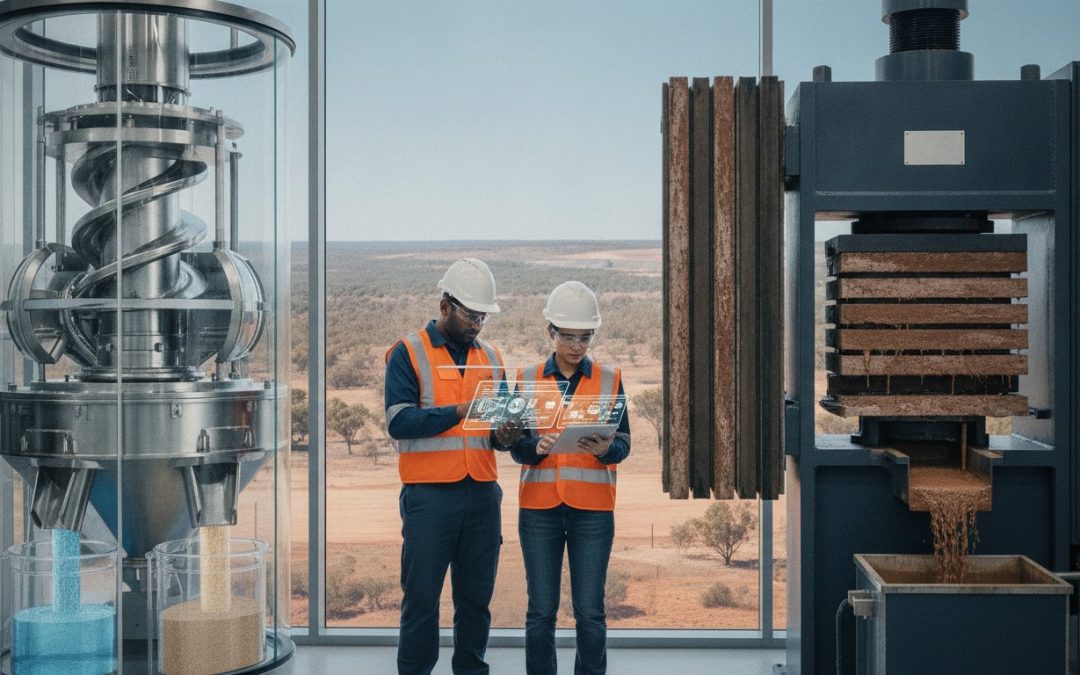
The assumption that a filter press is the default solution for tailings dewatering is increasingly challenged by the operational realities of modern Australian mineral processing. While achieving high cake dryness remains a priority, the shift towards continuous flow systems suggests that traditional batch processing may no longer be the most efficient path to profitability. Deciding on a centrifuge vs filter press mining strategy requires a rigorous evaluation of feed characteristics and the specific throughput demands of your site.
We recognise that mine managers today face escalating pressure to reduce tailings dam reliance while navigating water scarcity in remote regions. This article provides a comprehensive technical comparison to help you select the dewatering technology that best aligns with your long-term operational goals. We will examine how these systems impact the total cost of ownership, their reliability in harsh environments, and the way they support compliance with the 2026 mandatory climate disclosure standards. By evaluating performance metrics and lifecycle costs, you can ensure your chosen separation system delivers both environmental responsibility and sustained technical performance.
Key Takeaways
- Understand the technical trade-offs between absolute cake dryness and filtrate clarity to optimise water recovery within your specific mineral processing circuit.
- Evaluate the operational advantages of continuous decanter systems over batch-heavy filter presses, particularly regarding reduced on-site labour requirements and a smaller plant footprint.
- Conduct a rigorous centrifuge vs filter press mining comparison that accounts for long-term lifecycle costs and energy profiles rather than focusing solely on initial capital expenditure.
- Align your tailings management strategy with the 2026 Australian Sustainability Reporting Standards to ensure your dewatering processes meet new investor-grade climate disclosure obligations.
- Identify why bespoke pilot testing and slurry analysis are essential prerequisites to ensure your chosen separation technology is matched to the unique characteristics of your ore body.
Solid-Liquid Separation in Mining: Centrifuges and Filter Presses Explained
Australian mining operations are increasingly moving away from traditional wet tailings storage. This transition isn’t just about environmental compliance; it’s about operational resilience. Given Australia’s often arid conditions, water is a precious commodity for many mining operations. Efficiently separating solids from liquids ensures that process water stays within the plant rather than evaporating in a dam. Modern Mineral processing requires reclaiming every possible drop of liquid to maintain site water balances. Mechanical dewatering has moved from a secondary consideration to a primary operational pillar as sites strive to meet 2026 sustainability standards.
When site managers evaluate a centrifuge vs filter press mining strategy, they’re choosing between two distinct physical principles: centrifugal sedimentation and pressure filtration. Both technologies aim to produce a handleable solid and a clear liquid, yet their operational profiles differ significantly. Deciding which system “wins” depends entirely on the specific rheology of your tailings and the throughput requirements of your circuit. One offers the relentless pace of continuous flow, while the other provides the precision of high-pressure capture.
How Decanter Centrifuges Optimise Mining Slurries
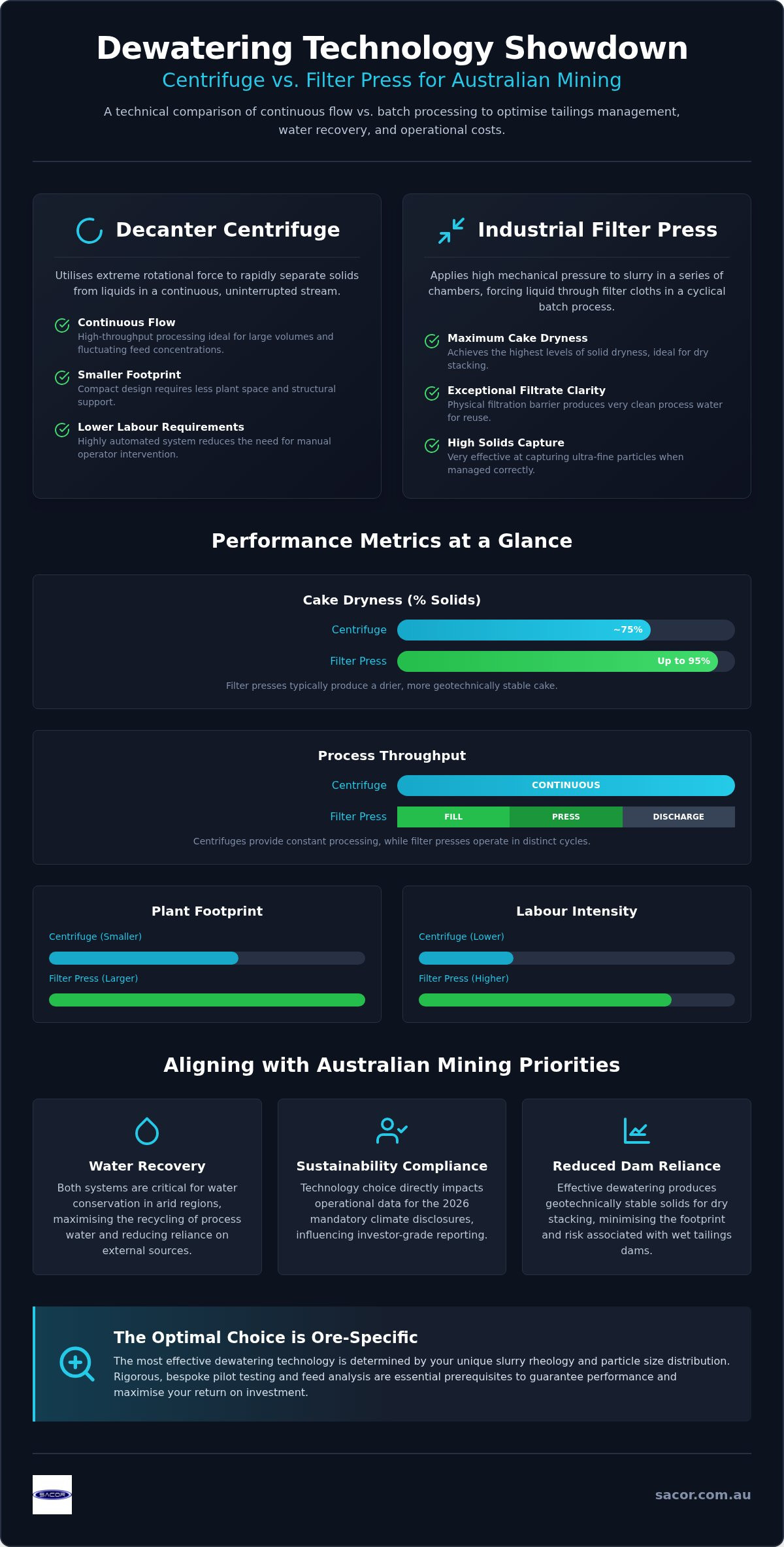
Decanter centrifuges utilise high-speed rotation to generate centrifugal forces thousands of times greater than gravity. This force accelerates the sedimentation of solids against the bowl wall, where an internal scroll conveyor continuously moves them toward the discharge end. This process allows for a steady, uninterrupted flow of material. It’s particularly effective for slurries with fluctuating feed concentrations because the system doesn’t need to stop to clear a batch. The decanter’s ability to handle abrasive mining slurries stems from bespoke engineering and hard-facing on critical components. Because it’s a closed system, it also minimises environmental exposure and reduces the risk of on-site spills. For a comprehensive overview of how these systems are being deployed across the country, the decanter centrifuge mining Australia strategic guide for 2026 outlines the evolving regulatory landscape and the operational case for advanced separation technology.
The Mechanics of the Industrial Filter Press
An industrial filter press relies on mechanical pressure to force liquid through a series of filter cloths. The process is cyclical. First, the chambers are filled with slurry; second, high pressure is applied to compress the solids into a cake; and finally, the press opens to discharge the material. While this batch-based method often achieves very low moisture content, it requires significant mechanical movement and periodic cloth cleaning. It’s a precise approach that excels when the priority is maximum solids capture. However, the reliance on filter cloths introduces a maintenance variable. These cloths can blind or tear, requiring manual intervention that can disrupt production schedules if not managed correctly.
Performance Metrics: Cake Dryness, Filtrate Clarity, and Recovery Rates
Performance in a mineral processing circuit is defined by the quality of its two outputs: the solid cake and the liquid filtrate. While the industry often defaults to moisture content as the sole indicator of success, a holistic centrifuge vs filter press mining assessment must account for how these outputs integrate into the wider plant. Filter presses typically lead in absolute cake dryness, often producing a material that is geotechnically stable for immediate dry stacking. However, the high-speed centrifugal action of a decanter provides a level of consistency in solids recovery that batch systems sometimes struggle to maintain over long shifts.
The impact of particle size distribution cannot be overlooked. Fines and ultra-fines respond differently to pressure than they do to centrifugal sedimentation. Scientific research into dewatering techniques for mining tailings suggests that the efficacy of particle capture is dictated by the interaction between mechanical force and slurry rheology. If a slurry contains a high proportion of swelling clays, a filter press may suffer from cloth blinding, whereas a decanter centrifuge can be tuned to handle these challenging materials through precise scroll speed adjustments.
Achieving Stackable Tailings
Geotechnical requirements for dry stack tailings in Australia are stringent. To meet safety and environmental standards, the final cake must be handleable by conveyors or earthmoving equipment. Filter presses excel here, producing a firm, low-moisture cake. While centrifuges traditionally produced a “pasty” discharge, modern high-G units now achieve comparable results. The strategic use of flocculants is essential for centrifuge performance. These polymers aggregate fine particles, allowing the centrifuge to discharge a solid that meets the necessary shear strength for mechanical transport. Consulting with a specialist for mining separation solutions can help define these requirements through site-specific slurry analysis.
Water Recovery and Process Water Quality
Water recovery is a critical KPI for remote Australian sites. Modern large-capacity filter presses can achieve water recovery rates above 85 per cent, which is mirrored by high-performance centrifuge systems designed for the same throughput. The clarity of this recovered water is vital for downstream processes. High-clarity filtrate reduces the wear on pumps and prevents the buildup of solids in process water tanks. While filter presses offer excellent clarity, a torn cloth can lead to immediate contamination of the filtrate stream. Centrifuges offer a more predictable centrate quality, as the separation is governed by physics rather than a physical barrier that can degrade over time.
The operational efficiency of an Australian mine site is often dictated by its ability to minimise manual intervention. When performing a centrifuge vs filter press mining evaluation, the distinction between continuous and batch processing becomes a primary driver of long-term site viability. Continuous operation allows for a streamlined workflow that aligns with modern automation goals; conversely, batch systems introduce periodic interruptions that can complicate the balancing of upstream and downstream circuits.
Labour Costs and Site Safety
In the Australian context, high labour costs make the reduction of on-site headcount a critical objective. Filter presses typically require more frequent manual oversight, particularly for plate shifting, cloth washing, and clearing stuck cakes. These tasks increase the exposure of personnel to mechanical hazards and high-pressure zones. Decanter centrifuges offer a significant advantage here. Their enclosed design contains the process entirely, and their continuous nature allows them to run for extended periods with minimal operator input. This shift from manual monitoring to remote supervision via SCADA systems enhances site safety and allows skilled personnel to focus on higher-value maintenance tasks rather than routine operation.
Remote Site Logistics and Scalability
Remote site logistics often favour the compact, modular nature of decanter systems. A filter press requires a substantial structural footprint and heavy foundations to manage the static and dynamic loads of the pressing cycle. In contrast, centrifuge systems are frequently delivered as pre-tested, skid-mounted units. This modularity simplifies installation and commissioning in challenging environments like the Pilbara or the Bowen Basin. If production requirements increase, it is often more practical to install additional centrifuge units in parallel than to expand a massive filter press installation. This scalability ensures that capital expenditure can be phased to match mine-life extensions or production ramp-ups without requiring a total redesign of the dewatering facility.
Maintenance cycles also differ fundamentally between the two technologies. While filter presses demand regular cloth replacements and hydraulic checks, centrifuges rely on high-durability wear parts like tungsten carbide tiles. These components are specifically engineered for the abrasive slurries common in Australian mineral processing. By integrating these systems into existing site monitoring frameworks, maintenance can be planned based on vibration analysis and performance data. This predictive approach ensures reliability in harsh conditions where unplanned downtime can cost a site thousands of dollars per hour.
Total Cost of Ownership and Sustainability in Tailings Management
Procurement decisions frequently fixate on initial capital expenditure, yet the true financial performance of a dewatering circuit is revealed through its total cost of ownership (TCO). A 2024 lifecycle cost analysis for an iron ore tailings application demonstrated that a modern solid-bowl centrifuge can offer over 30 per cent savings in capital expenditure and up to 21 per cent savings in operational expenditure over a 20-year period compared to a filter press. These figures highlight the necessity of looking beyond the sticker price to account for the ongoing costs of spares, labour, and energy. When performing a centrifuge vs filter press mining assessment, site managers must weigh the predictable maintenance of rotating equipment against the variable costs of batch filtration components. Operations seeking a structured approach to reduce dewatering costs in mining through advanced centrifugal separation and system optimisation will find that addressing energy consumption and waste haulage simultaneously delivers the most significant long-term savings.
Filter presses carry significant hidden costs in the form of filter cloths, plate maintenance, and hydraulic system servicing. In abrasive Australian mining conditions, cloths often require replacement every few hundred cycles, leading to both material costs and production downtime. Centrifuges utilise high-durability internal components, such as tungsten carbide wear protection, which extend service intervals and reduce the frequency of manual intervention. This reliability is essential for maintaining production targets in remote regions where specialised labour is both scarce and expensive.
Energy Efficiency and Power Management
Modern decanter centrifuges utilise Variable Speed Drives (VSDs) and sophisticated energy recovery systems to optimise their power profile. While the peak load of a rotating centrifuge bowl is higher than that of a static filter press, the continuous nature of the operation avoids the cyclical power spikes associated with batch processing. This steady demand makes it easier to integrate dewatering systems with site-based renewable energy sources, such as large-scale solar arrays or wind farms. By smoothing the power demand, sites can better manage their energy costs and reduce the overall carbon intensity of their mineral processing operations.
Sustainability and Social Licence to Operate
The Australian regulatory landscape is shifting rapidly toward stricter environmental accountability. With the introduction of mandatory climate disclosures under the AASB S2 framework starting in the 2025-2026 period, mining companies must provide investor-grade reporting on their environmental footprint. Transitioning to tailings dewatering centrifuge solutions in Western Australia supports these obligations by drastically reducing the reliance on traditional tailings storage facilities. Dry stacking tailings significantly mitigates the catastrophic risk of dam wall failure and seepage, providing a stable, non-liquefiable waste form that simplifies long-term site rehabilitation and closure. Meeting these standards is no longer just a regulatory hurdle; it’s a prerequisite for maintaining a social licence to operate in modern Australia.
If you’re looking to optimise your plant’s water recovery while meeting new environmental standards, contact our team for bespoke mining separation solutions.
Selecting the Optimal System for Your Mineral Processing Plant
The final selection between a decanter and a filter press shouldn’t rest on generalisations. While the mechanical and financial trade-offs are clear, the success of any centrifuge vs filter press mining strategy depends on rigorous, site-specific data. A “one size fits all” methodology is inadequate for complex mineral separation, as the specific gravity, particle size distribution, and chemical composition of the feed vary significantly between ore bodies. Relying on generic performance claims can lead to undersized circuits or excessive operational costs that compromise the viability of the project.
Comprehensive pilot testing and slurry analysis form the foundation of a reliable dewatering solution. By testing actual site samples under controlled conditions, engineers can determine the exact G-force or filtration pressure required to meet target moisture levels. This data-driven approach removes the ambiguity from procurement and ensures the selected equipment is capable of handling the peak loads of the processing plant. It also allows for the optimisation of chemical dosing, which is a significant component of long-term OPEX and environmental management. Mine operators navigating the post-NEPA regulatory environment will find that the 2026 dewatering centrifuge guide for Australian mines provides a practical technical roadmap for selecting a high-specification mineral concentrate dewatering centrifuge that aligns machine metallurgy with site-specific feed characteristics and GISTM compliance requirements.
Critical Factors for Plant Managers
Successful implementation requires a clear definition of operational priorities before the design phase begins. Decision-makers should evaluate the following parameters to ensure the technology integrates seamlessly into the existing plant:
- Moisture and Discharge Requirements: Determine if the downstream handling system requires the absolute dryness of a filter press cake or if the continuous output of a centrifuge discharge is more compatible with existing conveyor belts and stacking equipment.
- Spatial Constraints: Assess the available footprint within the current dewatering circuit, noting that compact centrifuge skids often integrate more easily into tight brownfield layouts without requiring extensive structural modifications.
- Water Balance Targets: Align the technology choice with the site’s long-term water recovery goals, ensuring the filtrate or centrate quality meets the standards for plant reuse and reduces the demand on local bores.
The Sacor Advantage: Local Expertise and Support
Sacor provides specialised engineering that bridges the gap between raw data and operational reality. Based in Western Australia with national coverage, our team understands the unique environmental and logistical challenges of the Australian mining sector. We don’t merely supply equipment; we work as technical partners to deliver bespoke centrifuge vs filter press mining solutions that are matched to the specific rheology of your tailings. This partnership extends from initial technical consultation through to installation, commissioning, and full lifecycle maintenance.
Our commitment to reliability is backed by a robust national supply chain for spare parts and technical services. By maintaining a local presence, we ensure that your separation system achieves maximum uptime, even in the most isolated regions of the country. If you’re ready to move toward a more efficient dewatering circuit that meets modern sustainability standards, you can enquire about a customised separation solution for your site today.
Optimising Your Mineral Processing Circuit
Selecting between a centrifuge vs filter press mining strategy is a decision that defines a plant’s operational efficiency and environmental footprint for decades. While filter presses offer high absolute dryness, the continuous throughput and lower labour requirements of decanter centrifuges provide a compelling case for modern, high-volume circuits. Success relies on looking beyond initial capital expenditure to account for the total cost of ownership; this includes evaluating maintenance cycles, chemical usage, and site-specific energy profiles.
As Australian mining operators prepare for mandatory climate disclosures in 2026, the shift toward mechanical dewatering has become a strategic necessity for maintaining a social licence to operate. Sacor provides the technical expertise required to navigate these complexities through bespoke engineering matched to your specific ore body. With our Western Australian based technical support and a national supply and maintenance network, we ensure your separation systems deliver consistent, high-performance results in the harshest conditions. Operators seeking to understand the full strategic and regulatory context for this transition can explore the 2026 strategic guide to decanter centrifuge mining in Australia for detailed guidance on GISTM compliance and advanced flowsheet integration.
Contact Sacor Australia for a technical consultation on your mining separation needs and take the first step toward a more sustainable and efficient processing plant. We look forward to partnering with you to achieve your water recovery and tailings management goals.
Frequently Asked Questions
Which technology achieves the driest cake for tailings management?
Filter presses generally achieve the highest absolute cake dryness, typically reaching between 80 per cent and 85 per cent solids depending on the mineral type. This process produces a firm, geotechnically stable cake that is suitable for immediate dry stacking or transport. While modern decanter centrifuges can achieve comparable results for many slurries, they sometimes produce a more pliable discharge that may require specific conveyor configurations or additional chemical conditioning to meet the same geotechnical shear strength.
How does a decanter centrifuge handle variations in mining slurry density?
Decanter centrifuges manage fluctuating slurry densities through real-time adjustments of the differential speed between the bowl and the internal scroll. Advanced control systems monitor the torque on the drive motor, automatically accelerating or slowing the solids discharge to maintain a consistent output moisture. This inherent flexibility is a primary advantage in a centrifuge vs filter press mining evaluation, as it allows for continuous processing without the need for manual recalibration when the ore body characteristics change.
What are the main maintenance requirements for a centrifuge in a mining environment?
Maintenance for centrifuges in mining environments focuses on managing the high-wear conditions of abrasive slurries. Key requirements include the periodic inspection of tungsten carbide tiles on the scroll conveyor and the replacement of wear liners in the feed and discharge zones. Regular lubrication of the main bearings and continuous monitoring of vibration sensors are also essential to prevent unplanned downtime. Because these units are enclosed, they are naturally protected from external dust and environmental contaminants.
Can a filter press be fully automated for 24/7 mining operations?
Filter presses can be automated using sophisticated plate-shifting and cloth-washing systems; however, they still require more frequent manual oversight than centrifuges. The mechanical complexity of the hydraulic rams and the potential for cake sticking mean that operators must remain available to clear blockages or replace blinded cloths. In contrast, the continuous flow of a decanter centrifuge is inherently more suited to autonomous, 24/7 operations with minimal human intervention required on a day-to-day basis.
How do labour costs compare between centrifuge and filter press systems in Australia?
Labour costs in Australia generally favour decanter centrifuges because their continuous operation reduces the need for a dedicated operator per shift. Filter presses are batch-based and often necessitate manual intervention for cloth maintenance, cycle monitoring, and cake discharge assistance, which can increase the total headcount required for tailings management. Over a 20-year lifecycle, the reduction in labour hours associated with a centrifuge system contributes significantly to a lower total cost of ownership for the site.
What is the typical lifespan of a decanter centrifuge in a mineral processing plant?
A high-quality decanter centrifuge typically has an operational lifespan of 15 to 25 years when supported by a rigorous maintenance programme. The structural integrity of the stainless steel bowl and the robustness of the gearbox are specifically designed for the heavy-duty cycles of a mineral processing plant. Reliability is further extended by using bespoke engineering and high-grade wear protection, ensuring the equipment remains productive through multiple mine-life extensions.
How much water can be recovered using mechanical dewatering vs settling ponds?
Mechanical dewatering systems can recover upwards of 85 per cent of process water for immediate reuse within the plant. In contrast, traditional settling ponds lose significant volumes to evaporation and seepage, particularly in the arid climates of Western Australia. By implementing a centrifuge vs filter press mining strategy, sites can drastically reduce their reliance on external water bores and improve their overall site water balance while meeting increasingly stringent environmental regulations.
Does Sacor provide on-site commissioning for mining separation equipment?
Sacor provides comprehensive national support, including on-site installation and commissioning for all tailings dewatering centrifuge solutions across Western Australia and beyond. Our Western Australian based technical team works alongside your site engineers to ensure the equipment is precisely tuned to your specific feed characteristics and plant requirements. Beyond the initial setup, we offer long-term maintenance contracts and a reliable supply of spare parts to ensure your dewatering circuit operates at peak performance throughout its service life.