
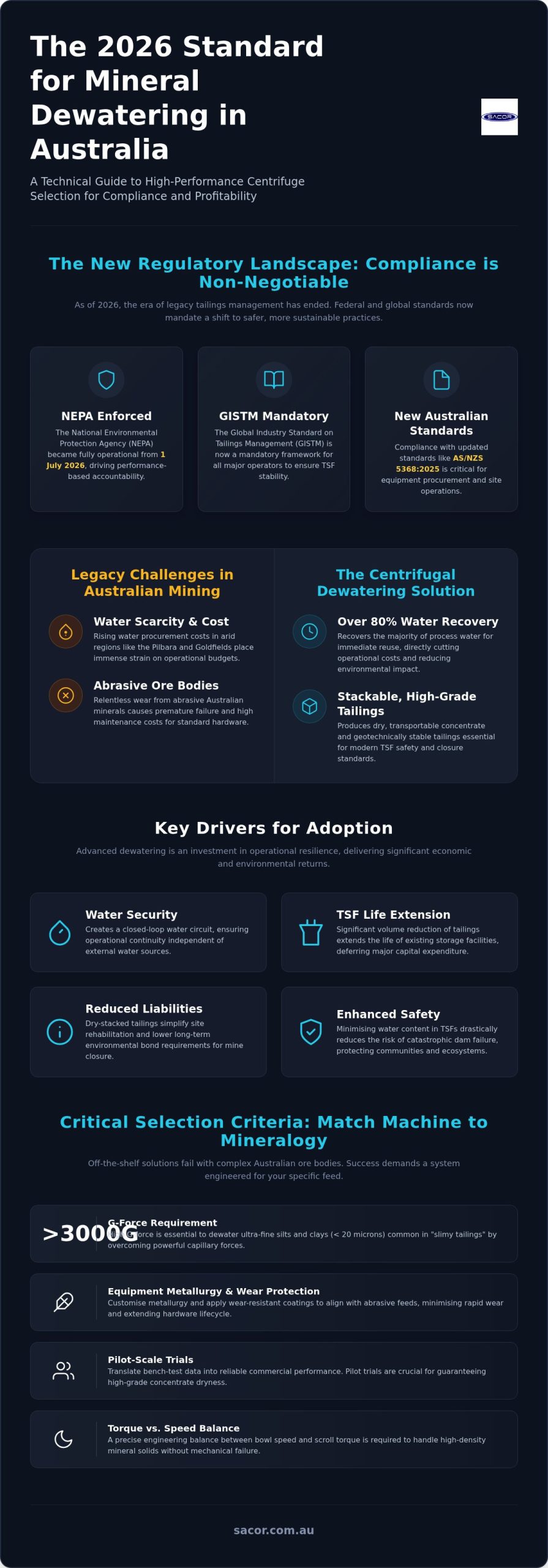
With the National Environmental Protection Agency (NEPA) now fully operational as of July 2026, the era of legacy tailings management has officially ended for Australian mine sites. Investing in a high-specification mineral concentrate dewatering centrifuge is no longer just a process optimisation choice. It’s a critical requirement for meeting the performance-based environmental accountability now demanded by federal regulators and the Global Industry Standard on Tailings Management (GISTM). You’re likely feeling the strain of rising process water procurement costs in arid regions, compounded by the relentless wear that abrasive Australian ore bodies inflict on standard separation hardware.
This guide provides a technical roadmap for selecting and implementing decanter centrifuges that don’t just survive these conditions, but actively recover over 80% of process water while producing the high-grade, stackable tailings required for modern safety standards. We’ll examine how to align machine metallurgy with your specific site feed and navigate the latest 2026 compliance frameworks, including AS/NZS 5368:2025, to ensure your operation remains both profitable and responsible. By the end of this article, you’ll understand how to specify a system that treats mineralogy as the primary driver of engineering design, ensuring your plant achieves maximum concentrate dryness and a reduced environmental footprint.
Key Takeaways
- Understand how to match technical specifications to specific ore characteristics, ensuring your mineral concentrate dewatering centrifuge effectively manages ultra-fine silts and abrasive feeds.
- Identify the critical role of pilot-scale trials in translating bench-test data into reliable commercial performance guarantees for high-grade concentrate dryness.
- Learn to evaluate the operational advantages of modular versus fixed installations to accommodate expanding mine lives and remote deployment requirements.
- Discover how to align equipment metallurgy with abrasive Australian ore bodies to minimise rapid wear and extend the lifecycle of your separation hardware.
- Gain insights into navigating the 2026 regulatory landscape, focusing on the impact of the GISTM on tailings storage facility safety and compliance.
The Strategic Shift to Centrifugal Dewatering in Australian Mining
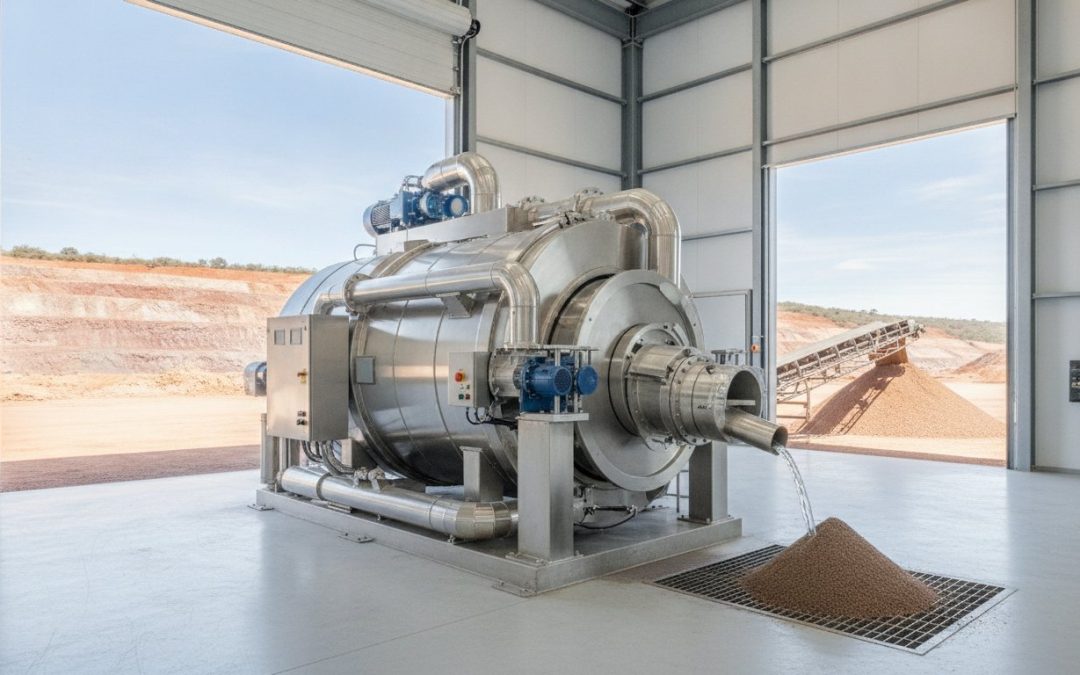
The Australian mining industry is undergoing a fundamental transformation in how it manages waste and product streams. Historically, tailings were handled as a liquid slurry and pumped into massive storage facilities that required decades of monitoring. However, the commencement of the National Environmental Protection Agency (NEPA) on 1 July 2026, alongside the mandatory implementation of the Global Industry Standard on Tailings Management (GISTM), has shifted the focus toward mechanical dewatering. At the centre of this shift is decanter centrifuge technology, which provides the high G-force necessary to separate solids from process water with exceptional precision.
A high-performance mineral concentrate dewatering centrifuge acts as a critical bridge between the processing plant and the final disposal or transport site. By removing the bulk of the liquid phase, operators can achieve the dry-cake consistency required for stackable tailings or high-grade concentrates. This transition is no longer optional for many sites. 2026 represents a pivot point where the cost of managing liquid liabilities often exceeds the capital investment required for advanced separation hardware. Modern circuits now prioritise these systems to ensure operational continuity in an increasingly regulated environment.
Meeting GISTM and Australian Regulatory Milestones
Following the August 2025 deadline for GISTM implementation, 2026 has become the year of active enforcement for major operators. High-consequence mining facilities are now under intense scrutiny to demonstrate that their tailings storage facilities (TSFs) are inherently stable. Centrifugal dewatering directly addresses this by reducing the saturation levels within the tailings mass, which significantly lowers the risk of dam failure. Aligning equipment procurement with “Safe for Closure” principles ensures that the site remains compliant with the NSW Mine Rehabilitation Regulation 2026 and similar state-level performance-based environmental accountability models.
Economic Drivers: Water Recovery and TSF Life Extension
Water security remains one of the most pressing operational risks in arid regions like the Pilbara or the Goldfields. Recovering over 80% of process water for immediate reuse isn’t just an environmental win; it’s a significant cost-saving measure that reduces the reliance on expensive bore water. By integrating a mineral concentrate dewatering centrifuge, sites can also extend the operational life of existing TSFs through significant volume reduction. This proactive approach helps in lowering long-term environmental bond liabilities. The rehabilitation requirements for dry-stacked tailings are far less complex and costly than those for traditional wet storage, providing a clear path to sustainable mine closure.
Key Selection Criteria: Matching Centrifuge Specs to Mineralogy
Selecting a mineral concentrate dewatering centrifuge requires a deep understanding of the feed’s physical and chemical properties. It isn’t enough to size a machine based on throughput alone. You must analyse the particle size distribution and solid concentration of the slurry. Australian ore bodies often present a high percentage of ultra-fine silts and clays, sometimes referred to as “slimy tailings,” where particles fall below the 20-micron threshold. These fines resist settling under gravity, making the mechanical advantage of centrifugal force indispensable for achieving clear centrate and dry cake.
Particle Size and G-Force Requirements
Achieving high-grade dryness in fine mineral concentrates requires sustained high-G force, typically exceeding 3000G. This force is necessary to overcome the surface tension and capillary forces holding water within the fine solid matrix. Balancing bowl speed with scroll torque is a precise engineering exercise. If the scroll cannot handle the high-density mineral solids being compacted against the bowl wall, the machine will trip or suffer premature mechanical failure. Increasing residence time within the bowl allows for maximum compaction, which is the primary driver for achieving optimal cake dryness in complex mineral circuits.
Wear Protection for Highly Abrasive Ores
Australian ores are notoriously abrasive, often containing high levels of silica or pyrite. Standard separation equipment can suffer rapid erosion without specialised protection. Effective wear management involves integrating tungsten carbide tiling or hard-facing on the conveyor assembly. Sacor prioritises the use of replaceable wear liners in high-velocity discharge zones. This allows for site-based maintenance without the need for extensive workshop overhauls. Additionally, the metallurgy of the bowl and scroll must be selected to resist corrosion, especially when processing plants use saline or acidic process water common in Western Australian and Queensland operations.
Chemical conditioning also plays a vital role in the separation process. Flocculant selection must be tailored to the specific mineralogy to ensure that the solids aggregate effectively before entering the centrifuge. Poorly selected chemicals can lead to “centrate carryover,” where fine solids escape in the recovered water, defeating the purpose of the separation. Consulting with a specialist to perform bench-top testing is the most reliable way to ensure your mining separation solutions are correctly configured for your specific site feed. This methodical approach ensures that the mineral concentrate dewatering centrifuge performs consistently under varying feed conditions.
Evaluating Throughput, Footprint, and Operational Efficiency
Determining the correct bowl diameter is the primary factor when matching a system to your hourly concentrate or tailings volume. In the context of an Australian mineral concentrate dewatering centrifuge, the relationship between bowl size and throughput isn’t linear. Larger diameters allow for higher flow rates while maintaining the residence time necessary for effective solids compaction. For brownfield plant upgrades, the compact footprint of a decanter system is often the deciding factor. Unlike traditional thickeners or large-scale filter presses, a centrifuge can be integrated into existing structures with minimal civil works, saving significant time and capital during the installation phase.
Energy consumption remains a major component of long-term operational expenditure (OPEX). Modern drive systems are designed to optimise power usage by using variable frequency drives (VFDs) that adjust bowl and scroll speeds based on the real-time feed density. This precision ensures that the machine doesn’t over-consume power during periods of lower throughput. For remote mining sites where power generation is a high-cost asset, these efficiency gains directly impact the bottom line. Modular installations offer additional flexibility, allowing operators to deploy units quickly or scale up capacity as the mine life extends or production targets increase.
Centrifuge vs Filter Press: A Selection Framework
When comparing centrifuge vs filter press mining applications, the choice often comes down to the balance between initial capital expenditure (CAPEX) and ongoing maintenance. Filter presses often require a higher initial investment and occupy a much larger footprint. They also operate on a batch basis, which can create bottlenecks in high-volume circuits. In contrast, decanter centrifuges provide continuous operation with longer maintenance intervals. This continuity leads to higher plant uptime, as there are no cloth changes or complex plate-shifting mechanisms to manage. For abrasive Australian minerals, the ability to perform routine maintenance on-site further tips the scale in favour of centrifugal technology.
Infrastructure Requirements for Site Integration
Successful site integration depends on a robust ancillary equipment strategy. This includes high-torque feed pumps, automated flocculant dosing plants, and reliable discharge conveyors to handle the dewatered cake. For remote sites, the electrical infrastructure must be capable of supporting VFD-controlled motors, which help manage the high starting inertia of the centrifuge bowl. Modern control systems allow these units to be fully integrated into existing plant SCADA or DCS architectures. This connectivity provides operators with real-time data on vibration, temperature, and torque, allowing for predictive maintenance and ensuring the system operates within its peak performance envelope at all times.
Implementation Strategy: From Pilot Trials to Site Commissioning
Success in centrifugal separation depends on the transition from theoretical specifications to site-specific reality. While laboratory analysis provides a baseline, a mineral concentrate dewatering centrifuge must be validated against the actual variability of your site’s feed. This validation process ensures that the commercial performance guarantees provided during procurement are grounded in measurable, real-world data. Implementing these systems is a methodical engineering journey that begins long before the equipment arrives on the mine lease.
The Pilot Trial Process
A “one size fits all” approach frequently fails when dealing with complex Australian mineralogy. Pilot-scale trials allow plant managers to test different flocculant doses and bowl speeds on-site using real-time feed characteristics. This empirical data is essential for calibrating the system to achieve maximum solids recovery and centrate clarity under varying load conditions. These trials also identify practical ways to reduce dewatering costs mining by optimising chemical consumption and energy use before the full-scale plant is commissioned. By refining the process parameters during the pilot phase, you eliminate the risk of underperformance once the system is integrated into the main production circuit.
Translating these pilot results into a full-scale deployment requires meticulous logistical planning. Delivering high-capital separation equipment to remote regions like the Pilbara or the Bowen Basin involves significant transport, heavy lifting, and site-specific safety protocols. Commissioning teams must ensure that the centrifuge integrates seamlessly with existing conveyors, pumps, and plant SCADA systems to prevent operational bottlenecks. Once the hardware is installed, comprehensive operator training and formal handover procedures are vital. These steps ensure that site personnel can manage continuous 24/7 duty cycles and respond effectively to feed fluctuations without compromising cake dryness or water recovery rates.
Commissioning and Lifecycle Support
Effective commissioning goes beyond the initial start-up and performance testing phase. It involves establishing rigorous preventative maintenance schedules that are specifically tailored to the abrasive nature of the ore being processed. Sacor provides the technical expertise required to monitor the condition of internal components, ensuring that tungsten carbide wear liners are inspected and replaced before they impact separation efficiency. The availability of a national maintenance and spare-part support network is a critical factor for remote Australian mines. Maintaining a local inventory of critical components is the only reliable way to minimise unplanned downtime and ensure the mineral concentrate dewatering centrifuge continues to meet its performance targets throughout its operational lifecycle.
For operations looking to secure their production yield and meet stricter environmental standards, the path forward involves a partnership with a proven technical authority. You can explore our range of customised decanter centrifuge systems to see how bespoke engineering can solve your site-specific dewatering challenges.
Why Custom-Engineered Decanter Systems are the 2026 Standard
The transition toward advanced mechanical separation is now a defining characteristic of the Australian mining industry. Achieving over 80% process water recovery and ensuring the stability of tailings storage facilities are no longer aspirational goals; they are the benchmarks for operational viability. A high-performance mineral concentrate dewatering centrifuge provides the technical foundation for these outcomes, offering a level of precision and consistency that traditional thickening methods cannot match. By converting slurry liabilities into stackable solids and reusable water assets, these systems directly support the long-term sustainability of the mine site.
Sacor positions itself as a technical partner for decanter centrifuge mining Australia, providing the bespoke engineering required to handle the specific abrasive characteristics of local ore bodies. The value of Australian-based engineering lies in the ability to respond rapidly to site-specific challenges, ensuring that separation hardware is optimised for the unique mineralogy of each circuit. This collaborative approach ensures that the technology isn’t just an equipment purchase but a fully integrated solution that evolves with the mine’s production requirements.
Sacor’s Engineering Edge in Mining
Bespoke engineering is essential for managing the rapid wear associated with Australian mineral streams. Sacor customises metallurgy and drive systems to match the specific density and abrasiveness of the feed. This precision extends to the provision of full technical documentation, which is vital for supporting regulatory compliance and meeting the rigorous safety requirements of the Global Industry Standard on Tailings Management (GISTM). Ongoing partnership models, including structured maintenance contracts and a robust national spare parts supply, ensure that these high-capital assets maintain their performance through every stage of the mine life.
Securing Your Operation’s Future
Modern mining operations are increasingly judged on their environmental, social, and governance (ESG) performance. Advanced separation technology plays a central role in meeting these targets by minimising the site environmental footprint and reducing the risks associated with wet tailings storage. Beyond compliance, these systems contribute to a lower total cost of ownership (TCO) by reducing water procurement expenses and extending the life of existing infrastructure. Investing in customised separation hardware is a strategic decision that protects the operation’s social licence to operate while simultaneously improving yield and profitability.
For plant managers and engineers, the next step in optimising a dewatering circuit is a thorough technical assessment of the feed and mineralogy. This analysis ensures that the selected mineral concentrate dewatering centrifuge is correctly specified for the particle size distribution and solids concentration of the stream. We invite you to enquire about a customised mineral dewatering solution to begin the process of aligning your separation technology with the 2026 industry standards.
Optimising Mineral Recovery for the 2026 Regulatory Environment
The transition toward mechanical dewatering is a strategic necessity for operators navigating the commencement of the NEPA and the rigorous demands of the GISTM. By implementing a high-specification mineral concentrate dewatering centrifuge, your site can convert slurry liabilities into valuable recovered water and stable, stackable solids. This approach doesn’t just ensure compliance with the NSW Mine Rehabilitation Regulation 2026; it also significantly reduces the long-term environmental bond liabilities associated with legacy tailings storage. Successful implementation relies on matching machine metallurgy to the abrasive characteristics of your specific ore body.
Sacor is an Australian-owned and operated specialist with proven expertise in managing the abrasive nature of local mineral streams. We provide the bespoke engineering and national maintenance support required to keep your separation circuits running at peak efficiency. Our team is ready to partner with you to translate technical feed data into reliable, high-performance outcomes through our extensive spare parts network and local technical support. We look forward to helping you achieve a more sustainable and profitable processing circuit.
Contact our engineering team for a technical tailings or concentrate assessment to secure your operation’s future.
Frequently Asked Questions
What is the typical water recovery rate for a mineral concentrate dewatering centrifuge?
A mineral concentrate dewatering centrifuge typically recovers over 80% of process water for immediate reuse in the processing plant. This rate depends on the initial feed density and the specific gravity of the mineral solids. In arid Australian regions, this high recovery rate is essential for reducing the costs associated with bore water procurement and maintaining a sustainable water balance. It also helps in achieving the dry-cake consistency required for stackable tailings.
How does mineral abrasiveness affect the maintenance lifespan of a decanter centrifuge?
High mineral abrasiveness can significantly reduce the maintenance lifespan of internal components if proper wear protection isn’t integrated. Australian ores often contain high levels of silica or pyrite which erode standard metallurgy. By using tungsten carbide tiling and hard-facing on the scroll, operators can extend service intervals to several thousand hours. This specialised engineering is critical for maintaining consistent performance in high-velocity discharge environments common in base metal circuits.
Can a centrifuge effectively handle “slimy” tailings with high clay and silt content?
Decanter centrifuges are highly effective at handling “slimy” tailings that contain a high proportion of ultra-fine silts and clays. While gravity-based thickeners struggle with particles under 20 microns, the high centrifugal force, often exceeding 3000G, forces these fines to settle. This results in a clear centrate and a stackable cake that meets the performance-based environmental accountability standards required for modern tailings storage facility safety and GISTM compliance.
What are the main differences between a centrifuge and a filter press for mineral tailings?
The primary difference lies in the operational mode; centrifuges offer continuous processing while filter presses operate in batches. Centrifuges also occupy a much smaller footprint, making them ideal for brownfield plant upgrades where space is limited. While filter presses can achieve slightly higher cake dryness in specific applications, the continuous nature and lower maintenance intensity of a centrifuge often lead to higher overall plant uptime and reduced labour costs.
Is specialised flocculant always required for centrifugal dewatering in mining?
Chemical conditioning with a specialised flocculant is almost always required to achieve optimal clarity in the recovered process water. The flocculant aggregates fine particles into larger flocs that settle more rapidly under high G-force. Determining the precise dose through on-site pilot trials ensures that you maximise the efficiency of your mineral concentrate dewatering centrifuge without over-consuming expensive chemicals or negatively impacting downstream processes in the plant.
How long does it typically take to install and commission a centrifuge on a remote site?
Installation and commissioning on a remote Australian mine site typically takes between two to four weeks, provided the civil and electrical infrastructure is ready. This period includes the mechanical positioning of the unit, integration with plant SCADA systems, and performance testing with live feed. Comprehensive operator training is conducted during the final stage to ensure a smooth handover for continuous 24/7 duty cycles on site.
What preventative maintenance is required for a centrifuge operating 24/7 in a mine?
Preventative maintenance for a centrifuge operating on a 24/7 cycle focuses on lubrication, vibration monitoring, and regular wear inspections. Automated greasing systems manage the main bearings, while digital sensors provide real-time data on bowl torque and vibration levels. Routine inspections of the discharge ports and scroll tips allow for the proactive replacement of wear liners before they impact separation efficiency or cause unplanned downtime in the circuit.
Are modular centrifuge systems available for short-term or mobile mining projects?
Modular and containerised decanter centrifuge systems are available for short-term projects or mobile mining operations. These units are pre-engineered with integrated control panels, feed pumps, and chemical dosing plants, allowing for rapid deployment and minimal site preparation. This flexibility is particularly useful for satellite pit developments or remote tailings reprocessing projects where a fixed installation isn’t economically or logistically viable for the remaining life of the mine.