
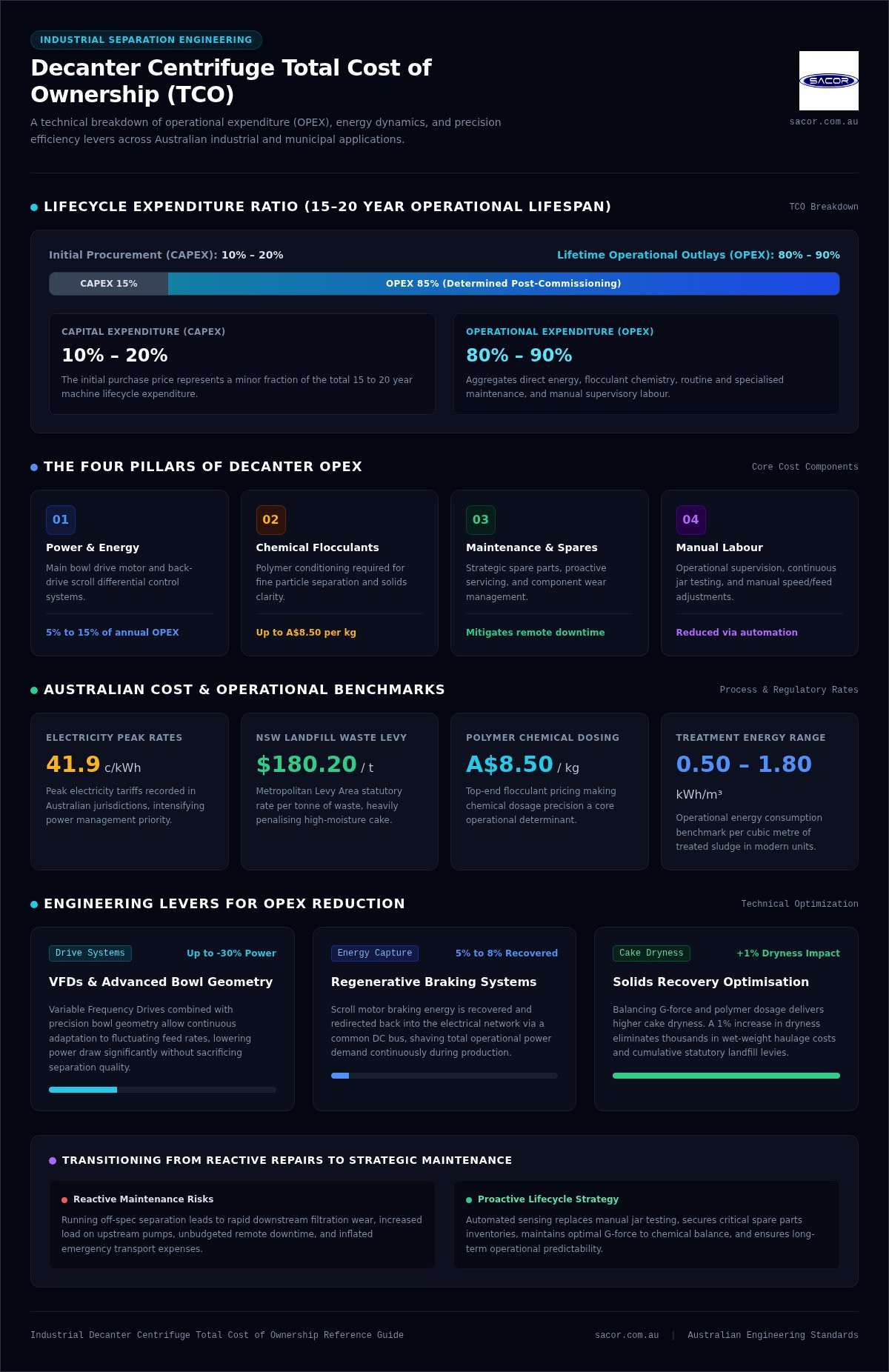
While the initial purchase price of industrial equipment often dominates procurement discussions, the operational cost of decanter centrifuge systems actually represents between 80% and 90% of their total lifecycle expenditure. In an Australian market where national landfill levies have climbed significantly and state rates sit at near-record highs, managing these ongoing outlays isn’t just a matter of accounting. It’s a strategic necessity for maintaining process viability. You’re likely already managing the pressure of rising polymer prices, which can reach A$8.50 per kg, alongside the logistical burden of maintaining remote operations.
This guide provides a clear framework for budgeting your annual OPEX while detailing specific strategies to reduce chemical and power consumption through precision engineering. We’ll examine how advanced bowl geometry and regenerative drive systems transform a standard separation process into a high-efficiency asset. You’ll gain the technical justification required to invest in technology that lowers your total cost of ownership by prioritising long-term reliability and environmental responsibility. By mastering these variables, you’ll ensure your facility remains competitive in a tightening economic and regulatory environment.
Key Takeaways
- Understand why up to 90% of total lifecycle expenditure is determined after the initial purchase and how to structure a realistic 20-year budget.
- Identify the “sweet spot” between G-force and chemical dosing to significantly reduce the operational cost of decanter centrifuge systems without compromising separation quality.
- Discover how a 1% increase in cake dryness can eliminate thousands of dollars in annual transport costs and statutory landfill levies across Australian jurisdictions.
- Learn to leverage Variable Frequency Drives and advanced bowl geometry to lower power consumption by up to 30% during fluctuating feed rates.
- Transition from reactive repairs to a strategic maintenance model that secures critical spare parts and minimises expensive downtime in remote operations.
Defining the Total Cost of Ownership (TCO) for Decanter Centrifuges
The acquisition of high-performance separation technology involves a financial commitment that extends far beyond the initial procurement phase. For plant managers and procurement officers, calculating the operational cost of decanter centrifuge systems requires a move away from simple price-tag comparisons toward a robust Total Cost of Ownership (TCO) model. This framework accounts for the four critical pillars: power consumption, chemical flocculants, maintenance and spare parts, and manual labour. Total Cost of Ownership in industrial separation is the aggregate of all capital investment, direct operational outlays, and indirect process impacts over the equipment’s entire functional lifecycle.
Process-specific variables, such as feed density and particle size, act as the primary drivers of these costs. A finer particle distribution often necessitates higher G-forces or increased polymer dosing to achieve clarity, which directly inflates the energy and chemical budget. Conversely, superior cake dryness provides “hidden savings” by reducing the wet weight of waste. In jurisdictions like New South Wales, where the Metropolitan Levy Area waste levy is $180.20 per tonne, even a 1% improvement in solids recovery can save hundreds of thousands of dollars over the machine’s 15 to 20 year lifespan.
The 80/20 Rule in Centrifuge Expenditure
Industry data confirms that capital expenditure (CAPEX) typically accounts for only 10% to 20% of a machine’s lifetime cost. The remaining 80% to 90% is consumed by ongoing operational expenditure (OPEX). When a continuous decanter centrifuge operation runs off-spec, the financial impact ripples through the entire facility. Poor separation doesn’t just increase disposal costs; it places an additional burden on upstream pumps and downstream filtration stages. Establishing a baseline cost-per-tonne of dry solids processed is essential for identifying these inefficiencies before they erode profit margins.
CAPEX vs OPEX: The Strategic Trade-off
Choosing a high-specification industrial decanter centrifuge Australia wide often involves a higher upfront investment that pays dividends through reduced annual overheads. Modern systems integrate advanced automation and sensing technology, which reduces the requirement for constant manual supervision and intervention. By automating the dosing and speed adjustments based on real-time feed characteristics, operators can maintain peak efficiency without the labour costs associated with manual jar testing. This strategic shift from reactive to proactive management ensures the operational cost of decanter centrifuge units remains predictable and optimised against fluctuating market conditions.
Energy Efficiency and Utility Consumption in Centrifugal Separation
Energy accounts for roughly 5% to 15% of the annual operational cost of decanter centrifuge systems. While this percentage seems modest compared to chemical or disposal costs, the volatility of Australian electricity rates, which can peak at 41.9 c/kWh in some jurisdictions, makes energy efficiency a priority. The primary power draw occurs at the main drive motor, which rotates the bowl, but the back-drive motor also plays a critical role by controlling the scroll differential speed. Modern systems use Variable Frequency Drives (VFDs) to manage these motors, allowing the centrifuge to adapt to fluctuating feed rates without wasting energy.
Advanced engineering now incorporates regenerative braking systems. In these setups, the braking energy of the scroll motor is captured and fed back into the system via a common DC bus, typically shaving 5% to 8% off the total power demand. Energy intensity varies significantly by application; for example, decanter centrifuge mining Australia operations often face higher solids loads that require more torque compared to municipal wastewater treatment. According to centrifuge dewatering operational benchmarks, modern units consume between 0.50 and 1.80 kWh per m³ of treated sludge, depending on the specific characteristics of the feed.
Optimising Power Usage Effectiveness (PUE)
Adjusting the bowl speed and pond depth is the most effective way to manage energy draw. Higher rotational speeds increase G-force for better clarity but also increase power consumption proportionally to the square of the speed. Implementing “deep-pond” bowl geometry can reduce hydraulic discharge power demand by up to 30%. Australian plants are increasingly adopting IE3 or IE4 high-efficiency motors to meet sustainability targets. Integrating these systems with SCADA allows for real-time monitoring of power consumption, enabling operators to identify and rectify efficiency drops immediately.
Utility Costs Beyond Electricity
Managing the operational cost of decanter centrifuge equipment also requires accounting for the water required for flushing and cleaning cycles. Effective cleaning prevents solids build-up that can cause unbalance and excessive vibration. Additionally, compressed air is necessary for operating pneumatic actuators and maintaining seals. In remote Australian operations, planning for utility redundancy is vital to prevent unexpected downtime. If you are looking to benchmark your current system, consulting with a technical expert can help identify potential energy recovery opportunities.
Optimising Chemical and Polymer Consumption for Lower OPEX
Polymer flocculants often represent the single largest variable expense in the operational cost of decanter centrifuge systems, particularly within municipal and industrial wastewater sectors. In sludge dewatering centrifuge Australia applications, cationic polyacrylamides typically trade between A$4.50 and A$8.50 per kilogram. Given that typical dosage rates for municipal digested sludge span 5 to 15 kg of active polymer per tonne of dry solids, any inefficiency in the dosing process quickly translates into significant financial losses. Finding the “sweet spot” between mechanical G-force and chemical conditioning is the primary objective for process optimisation.
While increasing rotational speed can squeeze out marginal extra water, it also accelerates abrasive wear on conveyor flights and increases motor load. Conversely, relying too heavily on chemicals to compensate for lower speeds leads to “over-dosing.” This doesn’t just waste expensive flocculant; it creates a slimy cake that inhibits drainage and produces poor-quality centrate. This centrate then recirculates back to the head of the plant, increasing the total suspended solids (TSS) load and further inflating treatment costs. Fluctuations in feed temperature and pH can also alter the charge density of the solids, leading to further chemical wastage if the system isn’t dynamically adjusted.
Advanced Flocculant Management
Transitioning from manual jar testing to automated polymer preparation and dosing systems is a critical step for modern Australian facilities. Manual mixing often results in “fish eyes” or undissolved polymer, which provides zero flocculation benefit while still appearing on the balance sheet. Automated loops, which often align with variable speed drives and motor efficiency guidelines for precise pump control, use online sensors to adjust dosage in real-time based on feed concentration. This precision ensures the plant only consumes what’s technically required for the specific feed characteristics at any given moment.
Impact on Centrate and Downstream Quality
Precise control over the bowl-to-scroll speed differential ensures that the settled solids are moved through the drying zone at a rate that allows for maximum liquid expression. When the differential speed is perfectly matched to the feed rate, the requirement for chemical assistance is minimised. This reduces the recirculating load on the wastewater treatment plant, preventing the hidden costs associated with reprocessing solids that should have been captured in the first pass. Polymer optimisation directly reduces annual OPEX by lowering chemical consumption while simultaneously decreasing the recirculating load on downstream processes.
Maintenance, Spare Parts, and Lifecycle Management Strategies
Maintenance and spare parts typically account for 5% to 10% of the annual operational cost of decanter centrifuge systems, yet their influence on overall plant profitability is disproportionately high. The primary wear components, including conveyor flights, discharge ports, and scroll tiles, operate in environments defined by extreme mechanical abrasion and hydraulic shear. In high-volume energy sector centrifuge equipment applications, the financial impact of unplanned downtime often exceeds the cost of the replacement parts themselves within the first few hours of a failure. Moving from reactive repairs to a predictive maintenance model allows operators to use vibration and temperature sensors to forestall failure and plan interventions during scheduled shutdowns.
Reliability is built on a foundation of consistent monitoring and the use of high-quality components. Identifying early signs of bearing wear or unbalance prevents the rotating assembly from sustaining permanent damage. This proactive approach ensures the equipment reaches its projected 15 to 20 year service life without the need for premature, capital-intensive replacements. By integrating diagnostic tools, site managers can maintain steady process throughput and protect the integrity of the entire separation circuit.
Wear Protection and Material Selection
Material selection serves as a critical lever for controlling long-term overheads. For abrasive mining feeds, tungsten carbide tiles offer a superior lifecycle compared to standard hard-facing, despite the higher initial investment. These tiles generally require refurbishment or replacement every 15,000 to 30,000 operating hours, depending on the silica and grit content of the feed. Corrosion-resistant alloys also play a vital role in extending service intervals when processing aggressive chemical or wastewater streams. Securing industrial centrifuge spare parts Australia wide ensures that critical components are available for rapid deployment, avoiding the 8 to 16 week lead times often associated with international logistics.
Labour and Service Intervals
Routine maintenance requires a disciplined schedule of inspections and lubrication to preserve mechanical efficiency. Main and conveyor bearings typically require regreasing every 500 to 1,000 hours and a complete overhaul every 15,000 to 20,000 hours. At the 30,000 hour milestone, a major overhaul is usually required, involving dynamic balancing and tile relining in a specialised workshop. Labour costs can be further optimised through remote monitoring and diagnostic support, which allows technicians to address minor issues before they escalate. This methodical lifecycle management ensures that the operational cost of decanter centrifuge units remains predictable and manageable over the long term.
To ensure your facility maintains optimal uptime and reliability, contact our technical support team for a comprehensive maintenance audit.
Evaluating the Return on Investment
Evaluating the return on investment for high-performance separation technology requires a shift in focus from the initial purchase price to the long-term savings generated through process precision. While previous sections detailed the technical drivers of the operational cost of decanter centrifuge systems, the true value lies in how these variables intersect to produce a measurable financial offset. By prioritising incremental gains in separation efficiency, facilities can transform an ongoing expense into a strategic advantage that strengthens the bottom line.
The “Cake Dryness” Multiplier acts as the most significant lever for ROI in many Australian sectors. A non-linear relationship exists between cake moisture and transport volume; for instance, increasing dry solids (DS) from 15% to 20% reduces the total wet cake volume by approximately 25%. In agriculture separation equipment Australia applications, where waste is often transported over long distances to disposal or reuse sites, this reduction directly insulates the operator from diesel fuel excise and regional transport rate spikes.
The Financial Impact of Separation Efficiency
Beyond waste reduction, superior separation performance facilitates the recovery of valuable products such as oils, minerals, or proteins that would otherwise be lost to the waste stream. These recovered materials often carry a market value that can partially or fully offset the daily running costs of the equipment. Additionally, high-efficiency plants that demonstrate significant water recovery and reuse may qualify for sustainability credits or energy incentives, further improving the financial profile of the operation. Recovering process water also reduces the reliance on expensive mains water, which is a critical consideration for industrial sites in water-stressed regions.
Partnering for Performance
To systematically manage your expenditure, we recommend a structured approach to auditing your facility. A comprehensive audit should include:
- Baseline Energy Usage: Measuring kWh consumed per dry tonne processed to identify motor or drive inefficiencies.
- Chemical Efficiency: Benchmarking polymer consumption (kg/t DS) against industry standards to prevent over-dosing.
- Separation Performance: Verifying cake dryness percentages against the theoretical maximum for your specific feed characteristics.
- Maintenance Velocity: Reviewing mean time between failures (MTBF) and the responsiveness of your spare parts supply chain.
- Disposal Volume: Quantifying the total wet weight reduction and its impact on landfill levies and haulage fees.
Achieving these outcomes requires a commitment to custom engineering that accounts for specific site conditions from day one. Sacor works alongside clients to design systems that prioritise a low total cost of ownership, ensuring that every operational parameter is tuned for maximum reliability and sustainability. Ongoing technical audits serve as a vital tool for maintaining this peak efficiency as feed characteristics evolve over time. Consult with Sacor to audit your centrifuge operational costs.
Securing Long-Term Profitability through Process Precision
Managing the operational cost of decanter centrifuge systems is a continuous process of refinement that extends far beyond the initial procurement phase. By prioritising precise chemical dosing, energy-efficient drive configurations, and predictive maintenance schedules, industrial operators can insulate themselves against rising utility rates and landfill levies. It’s a strategic move toward a model where mechanical performance directly influences transport logistics and environmental compliance. Each percentage gain in cake dryness represents a significant reduction in annual expenditure and a step toward more sustainable industrial practice.
Achieving these efficiency gains depends on a partnership with seasoned authorities who understand the Australian industrial landscape. Sacor provides Australian-owned technical expertise and customised separation engineering designed to lower total lifecycle expenditure from day one. Our commitment is backed by a comprehensive national spare parts support network, ensuring your facility maintains peak reliability regardless of location. Optimise your plant efficiency with a tailored Sacor centrifuge solution. We look forward to supporting your transition toward a more sustainable and cost-effective separation process.
Frequently Asked Questions
What is the typical power consumption of an industrial decanter centrifuge?
Modern decanter centrifuges typically consume between 0.50 and 1.80 kWh per m³ of treated sludge, or roughly 25 to 60 kWh per dry tonne of solids. This consumption depends on the rotational speed and the hydraulic load placed on the main motor. Australian operators often use high-efficiency motors and Variable Frequency Drives to manage these requirements. Adjusting pond depth can also lower power draw by up to 30% by reducing hydraulic discharge resistance.
How much does polymer contribute to the operational cost of a centrifuge?
Polymer flocculants represent a significant variable expense, usually accounting for 15% to 25% of annual operational expenditure. In Australian industrial applications, cationic polyacrylamides trade between A$4.50 and A$8.50 per kg. Precise dosing’s essential because over-dosing doesn’t just waste chemicals; it also creates a slimy cake that inhibits drainage and increases the recirculating load on the plant. Automation’s the most effective way to manage these ongoing chemical costs.
How often do decanter centrifuge wear parts need to be replaced?
Primary wear parts like tungsten carbide tiles and scroll hardfacing generally require refurbishment every 15,000 to 30,000 operating hours. Main and conveyor bearings typically need a complete overhaul every 15,000 to 20,000 hours, depending on the feed’s abrasive characteristics. Using high-quality materials and performing regreasing every 500 to 1,000 hours helps extend these intervals. Sacor provides national spare parts support to ensure these critical components are available for rapid replacement when needed.
Can I reduce operational costs by using a remanufactured centrifuge?
Using a remanufactured centrifuge can lower initial capital costs, but it won’t always reduce the long-term operational cost of decanter centrifuge systems. Older designs often lack the energy-recovery systems and advanced bowl geometries found in modern equipment. If a remanufactured unit can’t achieve the same cake dryness as a new model, the increased disposal levies and transport costs will likely outweigh the initial purchase savings within only a few years of operation.
What is the average maintenance budget for a decanter centrifuge in the mining industry?
A typical maintenance budget for a centrifuge in the mining sector sits between 5% and 10% of the annual OPEX. This budget must cover routine lubrication, vibration monitoring, and the periodic replacement of abrasive-wear components like discharge ports and scroll tiles. Given the remote nature of many Australian mining operations, it’s vital to factor in the logistics of spare parts. Sacor’s national network helps reduce these logistical costs by providing localised technical support.
How does cake dryness affect the total operational cost of a plant?
Cake dryness has a non-linear impact on total operational costs by reducing the wet weight of waste for transport and disposal. Improving dry solids from 15% to 20% eliminates approximately 25% of the total wet cake volume. In metropolitan areas where waste levies reach A$180.20 per tonne, this reduction can save hundreds of thousands of dollars annually. Higher dryness also reduces the number of truckloads required, insulating the plant from diesel price spikes.
Is it cheaper to run a decanter centrifuge compared to a filter press?
Decanter centrifuges are generally more cost-effective for continuous, high-volume separation compared to filter presses, which often require significant manual labour for cake removal and cloth washing. While filter presses can achieve high dryness, the operational cost of decanter centrifuge systems’s often lower due to their automated, enclosed operation and smaller physical footprint. This leads to reduced supervision costs and easier integration into existing industrial processes without the need for extensive structural modifications.
What role does automation play in reducing centrifuge OPEX?
Automation plays a vital role by dynamically adjusting machine parameters to match fluctuating feed characteristics. Online sensors monitor total suspended solids and adjust polymer dosing pumps in real-time, preventing expensive over-dosing. Automated systems also manage bowl and differential speeds to maintain the “sweet spot” for separation efficiency. This reduces the requirement for manual intervention and ensures the centrifuge operates at peak performance, directly lowering the power and chemical components of your annual OPEX.