
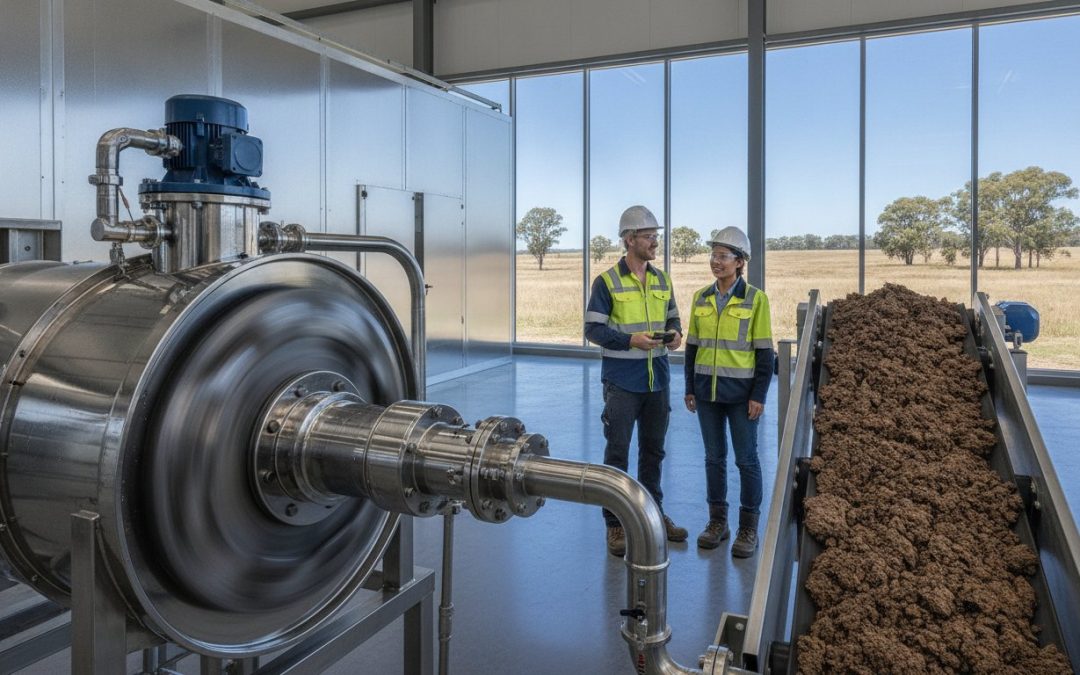
With New South Wales metropolitan landfill levies reaching $180.20 per tonne from 1 July 2026, the pressure to reduce sludge disposal costs has never been more acute for Australian industrial sites. You’re likely already feeling the strain of rising transport fuel costs and the heavy penalties associated with high-moisture waste. It’s a common frustration to see operational budgets drained by the disposal of excess water that should have been removed on-site through more efficient processing.
We understand that inconsistent cake dryness and frequent maintenance on legacy equipment make it difficult to maintain a predictable bottom line. This article demonstrates how you can significantly lower your operational expenditure by optimising your dewatering processes with advanced centrifugal technology to ensure long-term reliability with local technical support. We’ll examine the technical pathways to achieving a measurable reduction in sludge volume and weight while simultaneously lowering polymer and energy consumption through high-performance separation.
Key Takeaways
- Identify the financial impact of rising state-based landfill levies and how moisture content dictates your total transport overheads.
- Understand why decanter centrifuges provide superior solid-liquid separation compared to traditional belt or screw presses in space-constrained plants.
- Discover how to optimise bowl speed and polymer dosage to maximise cake dryness and effectively reduce sludge disposal costs.
- Explore the advantages of custom-engineered separation solutions and the importance of local technical support for maintaining peak operational efficiency.
Understanding the Economic Burden of Sludge Management
Industrial waste management in Australia has transitioned from a simple logistical task into a complex financial challenge. Operators now face a compounding cost structure where the price of mismanagement grows exponentially with every percentage point of moisture retained in the waste stream. To effectively reduce sludge disposal costs, one must first recognise that the majority of current expenditure is directed toward the transport and burial of water rather than the actual waste solids.
The Impact of Australian Environmental Levies and Transport
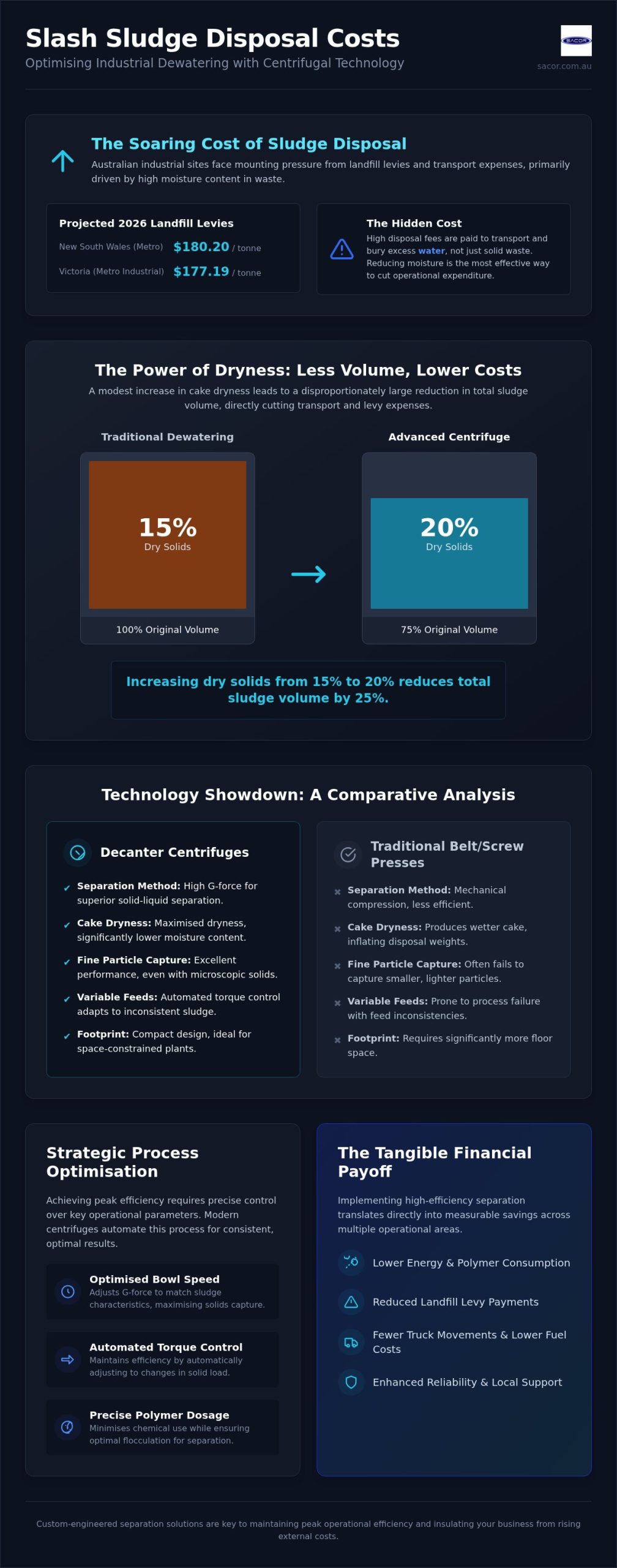
State-based waste levies serve as a primary driver for industrial Opex. From 1 July 2026, the Metropolitan Levy Area in New South Wales will reach $180.20 per tonne, while Victoria’s Metropolitan Industrial Waste levy will sit at $177.19 per tonne. These figures represent a significant overhead that is applied to every tonne of material leaving a site. When a plant produces sludge with low cake dryness, it is effectively paying these premium rates to dispose of liquid that could have been recovered and reused.
Logistical challenges further exacerbate this burden. Many industrial operations are located in remote areas, making them highly sensitive to fluctuating fuel prices and long-haul transport rates. Sludge disposal costs in 2026 represent the cumulative financial burden of state-mandated landfill levies, logistical transport expenses, and regulatory compliance fees associated with the management of industrial waste streams. Minimising the weight of the waste at the point of origin is the only sustainable method to insulate an operation from these rising external costs.
Volume Reduction as the Primary Cost Lever
The mathematical relationship between cake dryness and disposal volume is non-linear. A common misconception in plant management is that a small increase in solids content yields only a marginal saving. In reality, increasing the dry solids (DS) content from 15% to 20% can result in a reduction of total sludge volume by approximately 25%. This reduction directly translates to fewer truck movements, lower fuel consumption, and a substantial decrease in total levy payments.
Achieving these results requires a methodical approach to sludge dewatering processes. By utilising high-performance centrifugal separation, plants can reach the “tipping point” where the capital investment in advanced machinery is rapidly offset by the savings in monthly disposal invoices. This transition not only improves the bottom line but also aligns with the national trend toward resource recovery and the circular economy. Reducing the moisture content ensures that the waste is easier to handle, cheaper to transport, and fully compliant with stricter environmental regulations regarding the disposal of liquid-heavy materials.
The Role of Decanter Centrifuges in Maximising Cake Dryness
Decanter centrifuges represent the most technically advanced method for industrial solid-liquid separation. Unlike static filtration or gravity-fed systems, these machines apply thousands of Gs to force solids out of the liquid phase with extreme precision. This mechanical intensity is exactly what’s needed to reduce sludge disposal costs by producing the driest possible cake, effectively stripping away the excess water weight that inflates transport invoices.
Centrifugal Force vs. Mechanical Pressure
Traditional dewatering methods like belt presses rely on mechanical compression, which often fails to capture the fine particles found in complex mining or food processing waste. In contrast, high G-force separation overcomes the surface tension and hydraulic resistance inherent in industrial sludges. Modern industrial decanter centrifuge Australia technology utilises precise bowl geometry and optimised residence times to ensure that even the smallest particles are captured. This results in a stackable, low-moisture cake that is far easier to handle and cheaper to dispose of than the slurry produced by outdated equipment.
Achieving Consistent Results with Variable Feed Solids
Industrial waste streams are rarely uniform; they’re prone to sudden “slugs” or shifts in feed concentration that can cause process failure in less robust systems. Modern decanter systems address this through automated torque control. The internal scroll speed adjusts automatically relative to the bowl based on the solid load it detects, maintaining peak separation efficiency without requiring constant manual intervention from site engineers. This level of automation ensures that your output remains consistent regardless of the input conditions.
Adhering to the National Water Quality Management Strategy requires a high level of process control and environmental accountability. By achieving high-solids recovery at the primary dewatering stage, you reduce the burden on downstream treatment and lower the volume of effluent requiring further management. This mechanical reliability also means you can often reduce the dosage of expensive flocculants and polymers, further trimming your operational budget. If your plant is struggling with inconsistent waste weight, exploring custom Decanter Centrifuge Systems is a logical next step toward achieving long-term operational stability.
Centrifuges vs. Traditional Dewatering: A Comparative Analysis
Choosing the right equipment is a strategic decision that dictates your site’s long-term efficiency. While legacy systems like belt filter presses or screw presses have been industry standards for decades, they often struggle to meet the rigorous demands of modern industrial waste streams. Decanter centrifuges offer a superior alternative, particularly when the primary goal is to reduce sludge disposal costs through maximum volume reduction and automated operation.
Decanter Centrifuges vs. Belt Filter Presses
The primary performance metric in any dewatering application is the percentage of cake dryness achieved. In many industrial applications, decanter centrifuges consistently outperform belt filter presses by delivering a drier, more compact cake. This is particularly evident when handling fine particles or oily sludges where mechanical pressure alone is insufficient. For a deeper look at how these technologies perform in heavy industry, you can review our centrifuge vs filter press mining comparison.
Operating costs also diverge significantly when you consider wash-water requirements. Belt and screw presses require continuous high-pressure washing to prevent the filter media from blinding, which adds a hidden cost in both water consumption and secondary wastewater treatment. Centrifuges operate within a fully enclosed bowl, requiring minimal wash-water and effectively containing odours and aerosols. This contained design is crucial for meeting industrial wastewater management guidelines and maintaining a safe, compliant work environment on-site.
Evaluating the Total Cost of Ownership (TCO)
It’s easy to be swayed by the lower initial capital expenditure (Capex) of a belt press, but the total cost of ownership tells a different story. When you factor in the cumulative savings from lower disposal volumes, reduced polymer consumption, and minimal labour requirements, the decanter centrifuge often pays for itself within a few years. Because these systems are highly automated, they don’t require the constant manual oversight or frequent cleaning cycles associated with legacy presses.
Reliability is another critical component of TCO. High-quality centrifugal systems are built for 24/7 operation with long intervals between major services. Ensuring you have access to industrial centrifuge spare parts Australia wide is vital for preventing extended downtime. A cheaper initial purchase often masks the high long-term operational costs of frequent belt replacements, higher moisture disposal fees, and intensive manual labour. By prioritising mechanical efficiency and local support, industrial operators can secure a more predictable and sustainable cost structure.
Strategic Process Optimisation to Lower Operational Expenditure
Achieving peak performance in solid-liquid separation requires more than just high-quality hardware. It demands a systematic approach to process variables that can be adjusted in real time. Fine-tuning these parameters is the most direct way to reduce sludge disposal costs once the equipment is commissioned. By aligning bowl speed, differential speed, and chemical conditioning with the specific characteristics of your waste stream, you ensure the system operates at its highest efficiency point.
Fine-Tuning Polymer Consumption and Flocculation
Chemical conditioning is often one of the largest recurring costs in dewatering operations. A common mistake in plant management is the assumption that more polymer always leads to better results. In reality, over-dosing polymer can be counterproductive. Excessive flocculant can create a “slimy” cake that actually hinders the release of interstitial water, leading to higher disposal weights and increased chemical Opex.
Modern automated dosing systems mitigate this risk by linking polymer delivery to real-time feed sensors. These systems monitor the concentration of incoming solids and adjust the dosage accordingly, ensuring optimal flocculation without waste. This precision maintains high solids capture rates and produces a stackable cake while keeping chemical expenditure to a minimum. Regular jar testing and performance audits are essential to ensure the polymer type remains the best match for evolving site conditions.
Predictive Maintenance and Spare Parts Availability
Unplanned downtime is a silent profit killer in industrial operations. Every hour a centrifuge is offline, sludge accumulates in holding tanks, often necessitating expensive emergency cartage or bypass measures that offer poor dewatering performance. Implementing a predictive maintenance strategy is vital for maintaining a low cost per tonne of processed waste. Vibration monitoring and oil analysis allow site engineers to detect bearing wear or imbalance before they lead to catastrophic failure.
The speed of your recovery depends heavily on local support. Relying on international supply chains for critical components can lead to weeks of operational paralysis. Utilising an Australian-based centrifuge maintenance service ensures that technical expertise and critical spares are available within the country. This local reliability is a cornerstone of long-term Opex control, as it prevents the compounding costs of extended downtime. If you are looking to audit your current system’s performance, our team provides comprehensive maintenance and technical support services to keep your plant running at peak capacity.
Integrating upstream thickening is another effective strategy for lowering costs. By increasing the solids concentration before the sludge reaches the dewatering unit, you reduce the total hydraulic load. This allows the centrifuge to operate at a lower throughput with higher residence time, which consistently results in a drier cake and reduced energy consumption per dry tonne produced.
Implementing High-Efficiency Separation with Sacor Australia
Sacor Australia operates as a specialist technical partner, delivering customised centrifugal separation solutions that go beyond the limitations of generic equipment. While standard machinery might offer a lower initial price point, it often fails to provide the precision required to significantly reduce sludge disposal costs in complex industrial environments. Our approach focuses on engineering systems that are precisely matched to the specific rheology and volume of your site’s waste stream.
Bespoke Engineering for Mining and Food Processing
Off-the-shelf centrifuges frequently struggle with the unique demands of Australian industrial sectors, where throughput targets and material characteristics vary significantly. In the mining sector, abrasive feeds require specialised wear protection and specific scroll geometries to maintain performance over long service lives. Our expertise in mining tailings dewatering allows us to design decanter systems that handle high-density slurries with exceptional solids recovery.
Conversely, food and beverage processing waste often contains high levels of oils and fats that can complicate separation. We collaborate directly with site engineers to ensure that bowl designs and torque control settings are optimised for these specific challenges. This bespoke engineering ensures that the equipment achieves maximum cake dryness from the first day of operation, preventing the common issue of paying to transport excess moisture. It’s this focus on application-specific design that separates a vendor from a technical partner.
National Installation and Commissioning Support
Reliability in industrial separation is built on professional installation and rigorous commissioning. Sacor provides national support from our Western Australian base, ensuring that every system is integrated seamlessly into existing plant infrastructure. We provide comprehensive technical documentation and operator training as standard, empowering your team to maintain peak efficiency and extend the service life of the equipment. This ensures that the performance benchmarks established during commissioning are maintained throughout the life of the asset.
A national partnership offers the assurance that technical expertise and spare parts are always within reach. This proximity is vital for minimising the risk of extended downtime and ensuring that your dewatering process remains a predictable, low-cost component of your operations. Our commitment to sustainable industrial practice means we work alongside you to refine and optimise your separation processes as site conditions evolve. To take the first step toward a more efficient waste management strategy, Contact Sacor Australia to discuss your sludge dewatering requirements.
Securing Long-Term Efficiency in Industrial Waste Management
The escalating financial burden of state-based landfill levies and transport logistics makes it imperative for Australian industrial operators to optimise their dewatering infrastructure. Achieving superior cake dryness through advanced Decanter Centrifuge Systems is the most effective way to reduce sludge disposal costs. By transitioning from legacy mechanical pressure systems to high G-force separation, plants can achieve a measurable reduction in waste volume while simultaneously lowering polymer consumption and energy requirements.
Sacor Australia stands as a trusted technical authority, providing custom-engineered solutions for high-stakes industrial applications across the mining, food, and wastewater sectors. Our commitment to full lifecycle support, from national installation to the supply of critical spare parts, ensures your operation remains robust and compliant. We invite you to request a custom separation audit from Sacor Australia to identify specific optimisation opportunities within your current process. Investing in precise, reliable technology today provides the foundation for a more sustainable and profitable operational future.
Frequently Asked Questions
How much can I actually save by increasing cake dryness by 5%?
Increasing the dry solids content of your waste from 15% to 20% can result in a total sludge volume reduction of approximately 25%. This shift directly lowers both transport overheads and landfill levy payments. In high-volume industrial operations, this 5% improvement often represents hundreds of thousands of dollars in annual Opex savings, particularly as metropolitan levies in states like New South Wales reach $180.20 per tonne from July 2026.
Are decanter centrifuges suitable for abrasive mining tailings?
Decanter centrifuges are highly effective for abrasive mining tailings when equipped with specialised wear protection. Sacor provides custom-engineered solutions that include tungsten carbide tiling and hard-surfacing on high-wear components like the scroll and solids discharge ports. These technical modifications ensure the equipment maintains peak performance and reliability while handling the aggressive particle characteristics typical of Australian mineral processing waste and tailings management operations.
What is the typical ROI period for an industrial centrifuge upgrade?
The typical return on investment for a centrifuge upgrade usually falls within 18 to 36 months, depending on your current waste volume. While the initial capital expenditure is higher than legacy presses, the ability to reduce sludge disposal costs through significant volume reduction and lower chemical usage provides a rapid payback. We recommend a full lifecycle cost analysis to determine the precise ROI based on your site’s specific feed characteristics.
How does polymer consumption affect the total cost of sludge disposal?
Polymer consumption is a major component of recurring operational expenditure. Over-dosing not only increases chemical costs but can also result in a wetter, heavier cake, which further inflates transport and disposal fees. Implementing automated dosing systems linked to real-time feed sensors ensures optimal flocculation. This precision lowers chemical Opex and ensures the highest possible solids capture, which is essential for minimising the total cost of disposal.
Can a decanter centrifuge be integrated into an existing wastewater plant?
Decanter centrifuges are ideal for integration into existing wastewater plants due to their compact footprint and fully enclosed design. These systems require significantly less floor space than belt filter presses or drying beds, making them suitable for space-constrained industrial sites. Sacor provides full technical documentation and commissioning support to ensure the centrifuge integrates seamlessly with your existing infrastructure, including feed pumps, conveyor systems, and plant-wide control architectures.
What are the main maintenance requirements for a sludge dewatering centrifuge?
Routine maintenance focuses on lubrication, vibration monitoring, and the periodic inspection of wear components. Modern centrifuges feature automated grease systems for the main bearings, but regular manual checks of the scroll and bowl are essential to ensure long-term reliability. Sacor provides national maintenance and technical support services, including the supply of critical spare parts, to prevent unplanned downtime and maintain optimal separation efficiency throughout the lifecycle of the equipment.
Does Sacor provide on-site technical support across Australia?
Sacor provides comprehensive on-site technical support to industrial operators on a national scale. From our Western Australian base, we coordinate installation, commissioning, and scheduled maintenance services for clients across the country. This national reach ensures that site engineers have direct access to technical expertise and critical spare parts, which is vital for maintaining high equipment uptime and ensuring the separation system operates to specification at all times.
Is a decanter centrifuge better than a belt press for oily food waste?
A decanter centrifuge is significantly more effective than a belt press for oily food waste due to its high G-force separation and enclosed bowl. Belt presses often suffer from blinding where fats and oils clog the filter media, requiring excessive wash-water and frequent manual cleaning. Centrifuges use centrifugal force to separate oily phases efficiently without filter media, producing a drier cake and significantly reducing the volume of waste requiring disposal.