
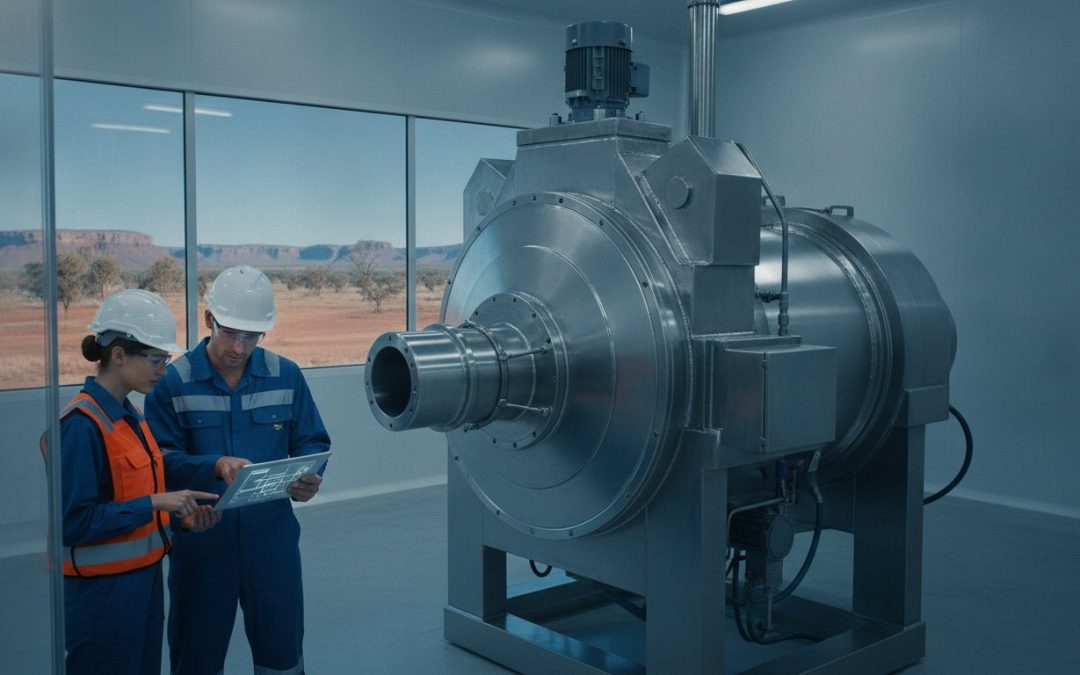
The most recognisable name in centrifugal separation isn’t always the most efficient choice for a remote Australian mine site or a municipal wastewater facility. While global market leaders provide a standard of quality, many local operators find that off-the-shelf designs struggle with the specific abrasive characteristics of Australian ore or the unique consistency of regional wastewater streams. You’ve likely experienced the frustration of extensive downtime while waiting for international spare parts or technical advice that doesn’t account for your specific plant integration requirements.
Identifying reliable Alfa Laval decanter centrifuge alternatives involves more than just comparing technical specifications; it requires finding a partner that understands the Australian industrial environment. This guide demonstrates how to evaluate high-performance separation solutions that offer bespoke engineering and dedicated local support. We’ll outline the methods for selecting equipment matched to your site-specific feed, the benefits of domestic maintenance for reducing operational expenditure, and how custom-engineered systems improve overall process throughput.
Key Takeaways
- Understand why evaluating the total cost of ownership over a ten-year horizon is more critical than initial capital expenditure when selecting industrial separation equipment.
- Identify the essential technical benchmarks for separation efficiency, including bowl geometry and high-grade wear protection, to ensure long-term mechanical reliability.
- Discover how choosing Alfa Laval decanter centrifuge alternatives with dedicated Australian engineering support can eliminate the hidden costs and delays associated with global procurement.
- Learn the importance of conducting a comprehensive feed analysis to ensure your centrifuge system is precisely matched to your site’s unique material characteristics.
- Explore how bespoke engineering and local maintenance support work together to improve process throughput while reducing overall operational expenditure.
Why Australian Operators Seek Alfa Laval Decanter Centrifuge Alternatives
Industrial separation remains a critical pillar of Australian mining, food processing, and wastewater management. While global giants often dominate procurement lists, their market position doesn’t always translate to site-specific efficiency. Many plant managers are now looking toward Alfa Laval decanter centrifuge alternatives to solve the persistent issues of rigid design and disconnected support. The decision to move away from a legacy brand is rarely about the initial purchase price alone; it’s a strategic shift toward long-term operational reliability.
Capital expenditure is only the first chapter of the equipment’s lifecycle. The true cost of ownership reveals itself through maintenance intervals, energy consumption, and the availability of technical expertise. Standardised decanter centrifuge technology sourced from international catalogues often lacks the flexibility required for bespoke plant integrations. When a machine is designed for a generic global market, it frequently fails to account for the unique abrasive qualities of Australian ore or the specific flow rates of regional processing facilities.
The Limitations of Standardised Global Equipment
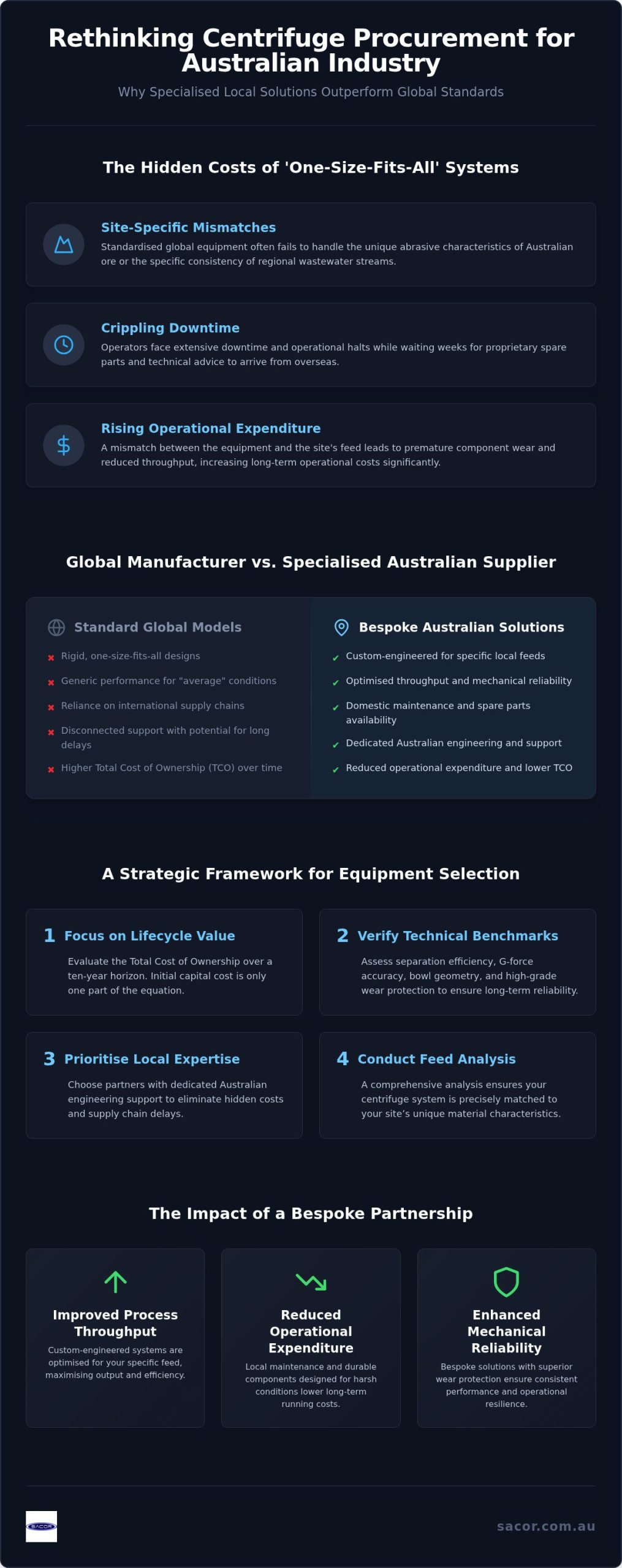
Global models are typically engineered for “average” conditions. In Australia, operators often face harsh environments that are anything but average. High ambient temperatures, dust, and highly variable feed characteristics can quickly expose the weaknesses in a one-size-fits-all system. If a standardised unit isn’t perfectly matched to the site’s feed, process throughput suffers and wear components degrade prematurely. Relying on a global supply chain also introduces significant risk. Waiting weeks for proprietary spare parts to arrive from overseas can result in crippling downtime that far outweighs any perceived benefit of a “big brand” name.
The Shift Towards Specialised Local Partnerships
There’s a growing demand for Australian-owned expertise that prioritises local agility over global scale. Local engineering partnerships allow for a deeper level of customisation, ensuring the equipment handles the specific solids loading and liquid characteristics of your site. This approach also offers a tangible environmental advantage. By sourcing technical support and components within Australia, companies significantly reduce the carbon footprint associated with international logistics. Shorter transport distances for heavy parts lead to lower fuel consumption and a more sustainable maintenance model. Choosing Alfa Laval decanter centrifuge alternatives backed by domestic expertise ensures that your operation remains resilient, responsive, and optimised for the long term.
Technical Benchmarks for Evaluating Industrial Centrifuge Alternatives
Selecting Alfa Laval decanter centrifuge alternatives requires a rigorous technical audit that moves beyond superficial data sheets. For Australian operators, the objective is to secure a machine that delivers consistent cake dryness and liquor clarity under fluctuating feed conditions. This necessitates a deep understanding of how G-force, bowl geometry, and residence time interact within your specific process flow.
Separation Performance and G-Force Accuracy
Centrifugal force is the apparent force that draws a rotating body away from the centre of rotation, and in industrial dewatering, this force facilitates the rapid separation of solids from liquids based on density differentials. High G-force is essential for achieving low moisture content in discharged solids; however, it must be balanced with adequate residence time. Bowl length and diameter ratios determine how long the material stays under force, directly impacting the clarity of the centrate. Adhering to the National Water Quality Management Strategy often requires precise control over biosolids moisture content, making G-force accuracy a critical benchmark for environmental compliance. Operators should verify manufacturer claims by requesting performance data from feeds with similar particle size distributions and viscosity profiles.
Robustness and Wear Protection for Harsh Feeds
The abrasive nature of Australian mineral tailings and industrial sludges demands superior material selection. High-grade duplex stainless steel provides the necessary structural integrity and corrosion resistance, but the real differentiator lies in the wear protection applied to the scroll and bowl. Tungsten carbide tiling on the scroll flights and replaceable wear liners at the discharge ports are non-negotiable for extending the equipment’s lifecycle. A robust design should also prioritise maintenance accessibility. Equipment that allows for internal inspections without total disassembly reduces labour costs and minimises the risk of extended outages. Evaluating Alfa Laval decanter centrifuge alternatives through this lens ensures that the chosen system can withstand the mechanical stress of continuous high-speed operation.
Matching the machine to process complexity is equally vital. Whether your facility requires a standard two-phase separation or a complex three-phase system for oil and water recovery, the automation interface must allow for seamless integration into existing plant SCADA systems. Selecting equipment that offers programmable logic controller (PLC) flexibility ensures that your team can monitor and optimise performance in real time. Consulting with a partner that provides bespoke separation solutions can help align these technical benchmarks with your facility’s specific operational goals.
Comparing Global Manufacturers with Specialised Australian Suppliers
Global manufacturers offer a sense of security through their massive scale, but this often comes at the expense of operational agility. When evaluating Alfa Laval decanter centrifuge alternatives, the choice between a multinational corporation and a specialised Australian supplier often hinges on the responsiveness of the partnership. While a global brand might provide a standard machine, a local partner provides a solution tailored to the specific constraints of your facility.
Procurement from international sources involves more than just the initial purchase price. Import duties, volatile international shipping rates, and the risk of port delays add layers of cost and uncertainty to the project timeline. Beyond these logistics, global manufacturers typically rely on standardised production lines. They’re often unwilling to modify bowl geometry or scroll pitch to suit a specific Australian slurry. A specialised local supplier treats every project as a bespoke engineering challenge, ensuring the equipment’s internal components are optimised for the unique density and viscosity of your feed material.
Direct access to technical expertise remains a significant advantage of local partnerships. Corporate helpdesks often act as buffers between the client and the engineers who actually understand the machine’s mechanics. In high-stakes industrial environments, plant managers don’t have time to navigate multiple tiers of international support. They need immediate answers from people who understand the local site conditions and can provide technical guidance without the delay of conflicting time zones.
Lead Times and Spare Parts Logistics
Maintaining high operational uptime requires immediate access to critical components. While global brands might boast massive inventories, those parts are often held in regional hubs far from Australian shores. Sourcing industrial centrifuge spare parts Australia through a domestic partner ensures that wear items and critical seals are available for rapid dispatch. This local stock strategy prevents the catastrophic production losses that occur when a primary separator sits idle for weeks while a proprietary part clears customs. It’s about building a resilient supply chain that prioritises your plant’s continuity over a manufacturer’s global logistics model.
Engineering for Australian Standards and Conditions
Equipment must comply with strict Australian electrical and safety certifications before it can be integrated into a local plant. Local specialists ensure that every unit is site-ready and meets all relevant AS/NZS standards. This level of compliance is particularly vital in decanter centrifuge mining Australia applications, where harsh conditions and remote locations leave no room for mechanical error. On-site commissioning by technicians who understand the specific demands of the Australian landscape ensures the system is optimised for the actual feed characteristics from the moment it’s switched on.
A Selection Framework for Australian Industrial Separation Projects
Transitioning from a global incumbent to a specialised supplier requires a structured evaluation process that prioritises site-specific outcomes over brand recognition. This framework ensures that your investment in Alfa Laval decanter centrifuge alternatives delivers the expected performance gains without unforeseen technical hurdles. By following a methodical approach, plant managers can mitigate the risks associated with equipment integration and ensure long-term mechanical reliability.
- Step 1: Conduct a comprehensive feed analysis and throughput audit to establish baseline performance metrics.
- Step 2: Evaluate the total cost of ownership (TCO) over a 10-year horizon, accounting for more than just the initial purchase price.
- Step 3: Assess the supplier’s local Australian technical support infrastructure and their recorded response times for maintenance.
- Step 4: Review customisation options for seamless integration into your existing plant SCADA and physical infrastructure.
- Step 5: Verify compliance with Australian environmental and safety regulations to avoid future legal or operational liabilities.
Calculating the Real Total Cost of Ownership
A 10-year financial model must factor in energy consumption, polymer usage, and the escalating costs of waste disposal. High-performance sludge dewatering centrifuge Australia systems often justify their investment through significant reductions in long-term OPEX. When cake dryness increases by even a few percentage points, the cumulative savings in transport and landfill fees over a decade can be substantial. Domestic spare parts pricing also remains more stable than international components, which are often subject to currency fluctuations and high freight surcharges.
Assessing Supplier Engineering Capabilities
Bespoke design is the primary advantage of local partnerships. You should ask potential suppliers how they intend to modify bowl geometry or scroll pitch to suit your specific slurry characteristics. A local presence is vital for wastewater treatment centrifuge Australia projects, where site-specific variables like seasonal flow changes require adaptable engineering. Reliable suppliers provide full technical documentation and on-site commissioning support to ensure the equipment operates at peak efficiency from day one. To begin your process optimisation, consult with an Australian separation specialist to discuss your throughput requirements.
Optimising Process Efficiency with Sacor’s Bespoke Separation Solutions
Sacor provides a sophisticated alternative to global industrial incumbents by prioritising Australian engineering precision over mass-market standardisation. Our approach to Alfa Laval decanter centrifuge alternatives begins with a fundamental understanding that no two industrial feeds are identical. We don’t simply supply hardware; we engineer comprehensive separation solutions that integrate seamlessly into your existing plant infrastructure. This commitment to bespoke engineering ensures that every decanter centrifuge system we deliver is optimised for the specific density, particle size, and viscosity of your site’s unique feed material.
Process efficiency is inextricably linked to mechanical reliability. By choosing a local partner, you gain access to a dedicated technical team that provides on-site installation and commissioning services. We provide full technical documentation and ongoing maintenance support, ensuring that your equipment maintains peak performance throughout its operational lifecycle. Our goal is to increase your process throughput while simultaneously reducing environmental impact through more efficient resource recovery and waste reduction.
Tailored Equipment for Mining, Food, and Energy Sectors
We recognise that the separation requirements for a remote mine site differ significantly from those of a metropolitan food processing plant. Our engineering team specialises in designing energy sector centrifuge equipment that handles the rigorous demands of oil and gas recovery with high precision. Similarly, our solutions for agriculture separation equipment Australia are built to withstand the abrasive nature of primary processing while maintaining the highest levels of product purity. Working with a partner that understands these sector-specific nuances allows you to achieve a level of separation efficiency that standardised global models cannot match.
The Sacor Advantage: Reliability and Results
The Sacor advantage is built on the foundation of national agility and technical authority. Our Australian-based model ensures faster response times for technical queries and a more resilient spare parts supply chain, which directly translates to higher equipment uptime. When you switch to a bespoke alternative, you aren’t just buying a machine; you’re securing a long-term engineering partnership focused on reducing your operational expenditure. We trust in the performance of our technology and the expertise of our people to deliver measurable results for your facility. Contact Sacor today to discuss your separation requirements and discover how our customised systems can optimise your industrial process.
Securing Future Process Reliability Through Australian Engineering
Evaluating the total cost of ownership over a ten-year horizon is more critical than initial capital expenditure for achieving a sustainable ROI. By prioritising bespoke engineering, you’ll ensure that your separation equipment is precisely matched to the unique characteristics of your site’s feed material, rather than relying on standardised global designs. Identifying high-performance Alfa Laval decanter centrifuge alternatives allows Australian operators to bypass international supply chain delays and access dedicated local technical support. Sacor brings Australian-owned and operated technical expertise to every project, delivering custom-engineered systems specifically for the mining, food, and wastewater sectors.
Our commitment to national on-site installation and maintenance support ensures that your facility maintains peak throughput while reducing long-term operational expenditure. It’s about more than just hardware; it’s about a long-term partnership that values reliability and results. Consult with our Australian engineers for a bespoke separation solution to begin your transition toward a more reliable and efficient separation process. We look forward to helping you achieve superior industrial outcomes through precision engineering.
Frequently Asked Questions
Are decanter centrifuge alternatives as reliable as major global brands?
Reliability is a function of engineering precision and material quality rather than brand recognition alone. High-tier alternatives utilise high-grade duplex stainless steel and tungsten carbide wear protection to ensure mechanical longevity. Because local suppliers provide more responsive technical support and faster spare parts dispatch, these systems often achieve higher operational uptime than global brands that are subject to international logistics delays and disconnected support networks.
How do I ensure a new centrifuge system will integrate with my existing plant SCADA?
Seamless integration is achieved through collaborative design during the initial engineering phase. Sacor’s technical team works directly with your plant engineers to ensure that the PLC and automation interfaces are fully compatible with your existing SCADA infrastructure. This bespoke approach allows for real-time performance monitoring and data communication, ensuring the new equipment functions as a cohesive part of your facility’s wider control system.
What are the typical lead times for custom-engineered centrifuges in Australia?
Lead times vary depending on the complexity of the bespoke engineering required to handle your site’s specific feed characteristics. However, partnering with a domestic supplier often reduces the total project timeline by eliminating the uncertainties of international shipping and customs clearance. We provide detailed project schedules during the design phase, allowing plant managers to plan installations around scheduled maintenance shutdowns without the risk of overseas delays.
Can I source spare parts locally for centrifuge brands other than Alfa Laval?
Yes, sourcing Alfa Laval decanter centrifuge alternatives through an Australian partner significantly improves spare parts availability. We maintain a dedicated domestic inventory of critical wear items, such as seals, bearings, and scroll tiles, for the systems we supply. This local stock strategy is designed to prevent the catastrophic production losses that occur when a primary separator sits idle while waiting for proprietary components to arrive from overseas.
How does feed characteristic analysis impact the choice of centrifuge alternative?
Feed analysis is the most critical step in selecting a high-performance alternative. Variables such as particle size distribution, solids concentration, and abrasive qualities dictate the required G-force and bowl geometry. By conducting a thorough audit of your site’s unique slurry, we can engineer a machine that is precisely matched to your throughput targets. This prevents premature wear and ensures the system operates at peak separation efficiency from day one.
What is the difference between a two-phase and a three-phase centrifuge alternative?
A two-phase centrifuge is designed to separate solids from a single liquid phase, which is common in standard wastewater dewatering. A three-phase system separates solids and two immiscible liquids of different densities, such as oil and water. We provide both configurations, tailoring the internal scroll and bowl design to the specific separation objectives of your mining, energy, or food processing operation to ensure maximum resource recovery.
Do alternative suppliers provide on-site commissioning and training in Australia?
Sacor provides comprehensive on-site installation, commissioning, and technical training across the country. Our engineers remain on-site until the system is operating to your exact specifications and your team is fully trained in routine maintenance and performance optimisation. This hands-on local support ensures that your staff can confidently manage the equipment, which is a significant advantage over the remote support models offered by global generalists.
How can switching to a bespoke centrifuge solution reduce my environmental footprint?
Bespoke Alfa Laval decanter centrifuge alternatives reduce environmental impact by achieving higher cake dryness and superior resource recovery. More efficient separation reduces the total volume of waste requiring disposal and lowers the energy consumption of downstream processing. Sourcing maintenance and components from within Australia also eliminates the significant carbon emissions associated with international air freight, supporting your facility’s commitment to sustainable industrial practice.