
More than sixty per cent of premature bearing and gearbox failures in continuous industrial decanters stem from mechanical imbalance caused by uneven scroll wear or cake adhesion. You likely recognise that in the high-stakes Australian mining and wastewater sectors, every hour of unscheduled downtime represents a significant financial loss. Addressing common decanter centrifuge operating problems requires a methodical approach that balances mechanical integrity with process chemistry.
Mastering the diagnosis and resolution of these failures is essential for ensuring maximum uptime and process efficiency in your Australian operation. This guide provides a comprehensive framework for troubleshooting, from managing vibration levels in accordance with ISO 20816-3:2022 to optimising cake dryness to mitigate landfill levies that now exceed $180 per tonne in metropolitan areas. We will explore how to achieve consistent centrate clarity and extend intervals between major overhauls through precise system adjustments and proactive maintenance strategies. By applying these technical principles, you can reduce structural vibration and maintain the reliable performance your facility demands.
Key Takeaways
- Identify the mechanical root causes of excessive vibration by monitoring bearing temperatures and noise profiles to prevent catastrophic component failure.
- Learn to balance centrifugal force and residence time to optimise solids recovery and manage the substantial financial impact of moisture-heavy cake.
- Master a systematic framework for diagnosing common decanter centrifuge operating problems, ensuring that every process adjustment is validated through accurate operational logs.
- Understand the “One Change at a Time” rule for process optimisation and why bespoke engineering is often required to address site-specific challenges in Australian industrial environments.
- Gain the technical insights needed to extend intervals between major overhauls and maintain consistent centrate clarity through precise weir plate and differential speed management.
The Impact of Decanter Centrifuge Operating Problems on Process Efficiency
In high-throughput Australian operations, a decanter centrifuge functions as a critical node within the broader process circuit. When common decanter centrifuge operating problems arise, the resulting unscheduled downtime often costs thousands of dollars per hour in lost production. Beyond the immediate mechanical failure, minor inefficiencies in solid-liquid separation compound across the plant. These issues lead to increased recirculating loads, which eventually throttle the capacity of upstream thickening tanks and reduce overall plant recovery rates.
Adopting a run-to-fail mentality is particularly damaging for high-speed rotating equipment. Unlike static assets, centrifuges operating at high G-forces can experience catastrophic structural damage if minor imbalances are not corrected. A small vibration today can lead to a total machine overhaul tomorrow. Maintaining equipment health is also a prerequisite for environmental compliance. With the introduction of mandatory PFAS monitoring in October 2026, poor centrate clarity is no longer just a process nuisance; it is a significant regulatory risk that could jeopardise a site’s social licence to operate.
Hidden Costs: Beyond the Repair Bill
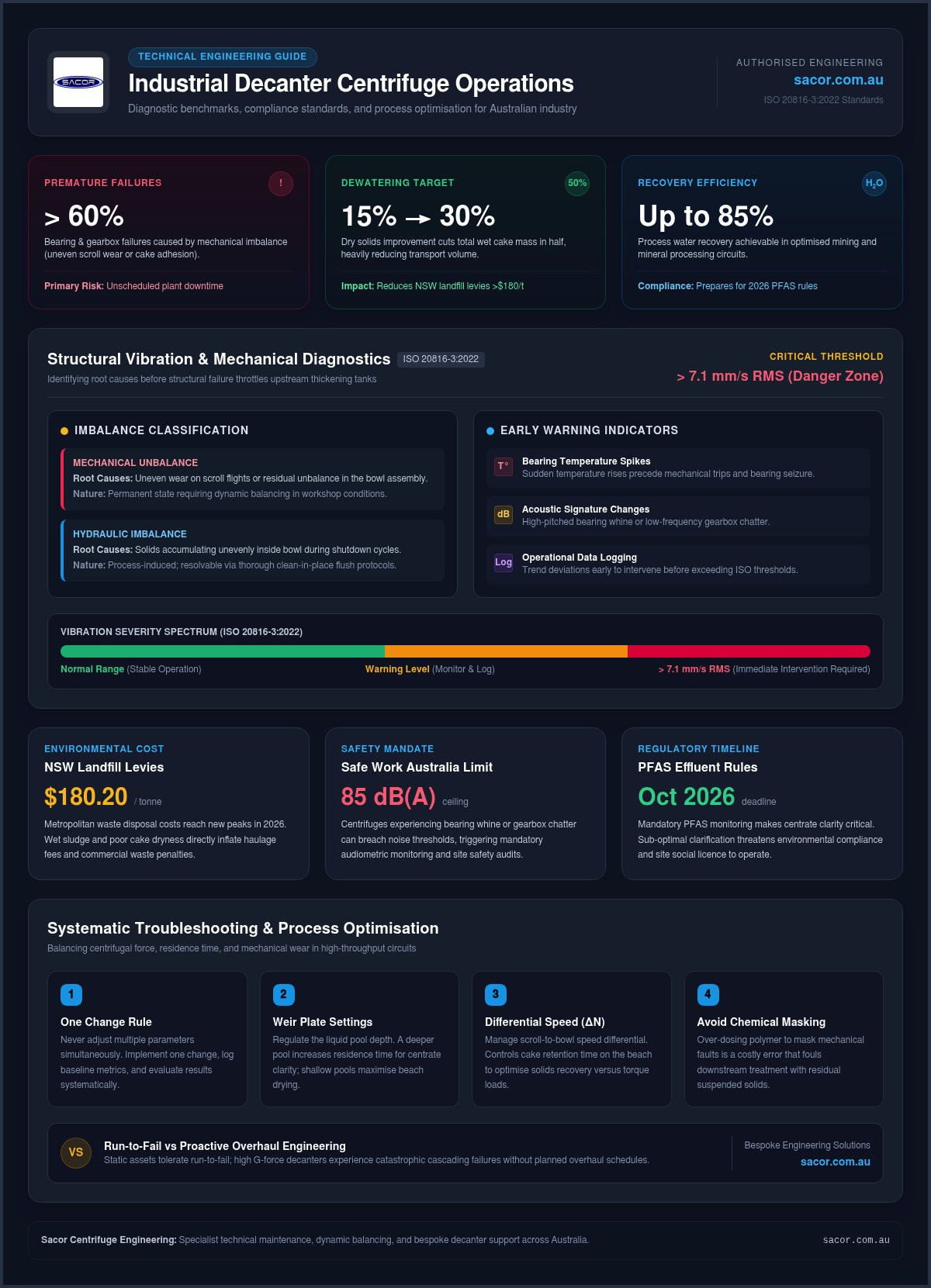
Financial losses extend well beyond the workshop invoice. Poor dewatering performance increases cake moisture, which directly inflates disposal costs. With NSW landfill levies reaching $180.20 per tonne in 2026, hauling wet sludge is an expensive oversight. Many sites attempt to mask common decanter centrifuge operating problems with excessive polymer dosing. This is a costly and temporary fix that often fouls downstream water treatment systems by introducing high levels of suspended solids and residual chemicals into the effluent stream.
The Australian Operational Context
Australian sites face unique pressures, ranging from the abrasive nature of local iron ore to the logistical hurdles of remote maintenance. Environmental factors such as extreme heat and pervasive dust accelerate the wear of seals and bearings. Furthermore, meeting strict Australian safety standards is non-negotiable. Safe Work Australia mandates a noise exposure limit of 85 dB(A); centrifuges experiencing bearing whine or gearbox chatter can quickly exceed these thresholds, triggering mandatory audiometric monitoring and site-wide safety audits. Reliability in these conditions requires a partner who understands that bespoke engineering is often the only way to ensure long-term stability.
- Water Recovery: Optimised systems can achieve up to 85% process water recovery in mining applications.
- Mass Reduction: Improving dry solids from 15% to 30% reduces total wet cake mass by half.
- Vibration Limits: Structural vibration exceeding 7.1 mm/s RMS indicates a danger zone requiring immediate intervention.
Diagnosing Mechanical Failures and Structural Vibration
Mechanical stability is the foundation of centrifugal performance. Structural vibration remains one of the most common decanter centrifuge operating problems, accounting for more than sixty per cent of premature bearing and gearbox failures in industrial environments. Identifying whether a vibration is mechanical or process-induced is the first step toward an effective diagnosis. Mechanical unbalance typically results from uneven wear on the scroll flights or residual unbalance in the bowl assembly, whereas hydraulic imbalance often occurs when solids accumulate unevenly during shutdown cycles.
Monitoring secondary indicators such as bearing temperatures and noise profiles provides critical early warning signs before a failure cascades. A sudden rise in bearing temperature or a change in the acoustic signature, such as a high-pitched whine or low-frequency rumbling, often precedes a mechanical trip. Consistent data logging allows operators to detect these trends early. For facilities managing high-speed equipment, maintaining a robust maintenance and technical support schedule ensures that minor deviations are corrected before they exceed the safety thresholds defined by ISO 20816-3:2022.
Vibration: The Silent Plant Killer
Distinguishing between mechanical and hydraulic sources of vibration is essential for site engineers. Mechanical unbalance is a permanent state requiring dynamic balancing; hydraulic issues can often be resolved through thorough cleaning or adjusting feed characteristics. If solids are allowed to settle and dry inside the bowl during a shutdown, the resulting heavy spot will cause severe vibration upon restart. Structural resonance also plays a role. If the machine’s operating speed aligns with the natural frequency of its support structure, vibration levels can escalate rapidly. Regular inspection of vibration isolators and foundation bolts is necessary to maintain the integrity of the entire system.
Wear Patterns in Abrasive Applications
Internal component wear is an inevitable reality in heavy industrial use. In the context of Australian mineral processing as of September 2026, abrasive wear is defined as the progressive loss of material from the internal surfaces of the centrifuge due to the continuous impact and sliding of hard particles like silica or iron ore. Mining tailings are particularly aggressive, quickly eroding scroll flights and discharge ports. To counter this, high-performance decanters utilise tungsten carbide hard-facing or replaceable ceramic tiles on the scroll edges. Without these protective layers, the separation geometry is lost, leading to poor cake dryness and increased torque. Monitoring these wear patterns is a technical necessity for any operation aiming to extend the intervals between major overhauls.
- Mechanical Unbalance: Requires dynamic balancing to Grade G 2.5 or G 6.3.
- Hydraulic Imbalance: Often solved by flushing the bowl or adjusting the feed rate.
- Seal Integrity: Failed seals allow process fluid to contaminate main bearings, leading to rapid failure.
Solving Process Inefficiencies: Cake Dryness and Centrate Clarity
Achieving peak performance requires a precise balance between mechanical settings and fluid dynamics. When common decanter centrifuge operating problems manifest as poor cake dryness or high centrate turbidity, the cause is often a misalignment between bowl speed and differential speed. Maximising G-force helps settle fine particles, but it also increases the energy required for solids transport. If the residence time is insufficient, the solids do not have enough time on the conical beach section of the bowl to reach optimal dryness before discharge.
Differential speed plays a critical role in managing internal torque and solids conveyance. A lower differential speed increases residence time, leading to drier cake, but it also increases the solids load within the bowl. If the solids refuse to discharge, a condition often termed scrolling issues, the gearbox torque can escalate quickly, leading to a system trip or mechanical blockage. Feed fluctuations further destabilise this equilibrium. Sudden spikes in feed concentration can overwhelm the scroll’s conveying capacity, making it difficult to maintain consistent performance without real-time adjustments to the feed rate or differential settings.
The Pond Depth and Bowl Speed Trade-off
Adjusting the eccentric weir plates is the primary method for balancing centrate clarity against cake dryness. A deep liquid pond increases residence time for clarification, which is essential for meeting strict discharge standards and reducing solids bypass. However, a deep pond reduces the length of the dry beach, often resulting in wetter cake and higher disposal costs. Operators must also consider the structural integrity of delicate flocs. Excessive bowl speeds can shear these particles, making them impossible to capture regardless of pond depth. In three-phase systems, managing the neutral zone between the two liquid phases is equally vital to prevent cross-contamination and ensure high-purity oil or water recovery.
Polymer Dosing and Feed Characteristics
Effective solid-liquid separation depends heavily on the chemical conditioning of the feed. Incorrect injection points can lead to the shearing of polymer chains, rendering the flocculant ineffective before it reaches the bowl. This is particularly challenging when dealing with an industrial decanter centrifuge Australia wide, where feed concentrations in wastewater or mining applications can vary significantly within a single shift. Monitoring the dosage rate against the actual solids load ensures that polymer is not used as a costly substitute for proper mechanical adjustment. Consistent sampling and slurry characterisation remain the most reliable ways to optimise these chemical interactions.
- G-Force Management: Standard decanters typically operate between 2,000 and 4,000 Gs to settle fine solids effectively.
- Differential Speed: Usually ranges from 1 to 50 RPM to balance cake dryness with machine throughput.
- Weir Plate Radius: Small adjustments can significantly change the volume of the liquid pond and the resulting clarity.
A Systematic Framework for Centrifuge Troubleshooting
Effective troubleshooting begins with a reliable baseline. Without comprehensive operational logs, identifying the root cause of common decanter centrifuge operating problems is nearly impossible. Operators should standardise the recording of bowl speed, differential speed, torque, and feed characteristics at regular intervals. This data provides the necessary context to distinguish between a temporary process fluctuation and a developing mechanical fault, allowing for a more precise response to performance drifts.
When separation efficiency declines, the ‘One Change at a Time’ rule must be strictly enforced. Adjusting multiple variables simultaneously, such as increasing polymer dosing while lowering bowl speed, makes it impossible to determine which action actually resolved the issue. This methodical approach ensures that process optimisation is based on empirical evidence rather than trial and error. It also prevents the introduction of new instabilities that can further complicate the diagnostic process.
Trips generally fall into three categories: electrical, mechanical, or process-related. Electrical trips often involve Variable Frequency Drive (VFD) faults or power surges; mechanical trips are typically triggered by high vibration or bearing temperatures. Process trips usually result from excessive torque due to high solids loading. Each requires a distinct diagnostic path. If an emergency stop is triggered, safety protocols dictate that the unit must reach a total standstill before any guards or inspection ports are removed. The high inertia of the bowl means rotation can continue for several minutes after the motor has de-energised.
Step-by-Step Diagnostic Sequence
A systematic inspection starts with visual and auditory checks during steady-state operation. Listen for changes in the pitch of the main bearings or the chatter of the gearbox. Physical sampling of the centrate and cake discharge reveals the immediate state of separation. A sudden increase in centrate turbidity often indicates a need for pond depth adjustment, while wet cake suggests the differential speed is too high for the current solids load. The backdrive system should also be checked to ensure the torque controller is responding dynamically to feed variations.
Preventative Maintenance as a Problem-Solving Tool
Proactive care is the most effective way to prevent unscheduled downtime. Scheduled inspections of high-wear zones, including scroll flights and discharge liners, allow for the identification of erosion before it compromises separation geometry. Integrating regular vibration analysis and oil condition monitoring provides a clear picture of internal health. Maintaining a local supply of industrial centrifuge spare parts Australia wide is essential for executing these maintenance tasks without logistical delays. If your facility is experiencing recurring performance issues, request a technical site assessment from our engineering team.
Optimising Performance with Sacor’s Engineering and Support
Off-the-shelf centrifuges often struggle with the extreme variability of Australian industrial feeds. While standard models might perform well in controlled environments, they frequently encounter common decanter centrifuge operating problems when faced with the high-density slurries and abrasive mineral sands characteristic of local operations. Sacor addresses these challenges by moving beyond generic supply. We provide customised centrifugal separation solutions that are engineered to withstand site-specific pressures, ensuring that the equipment maintains its mechanical integrity over long-term deployments.
Our engineering philosophy centres on the belief that many common decanter centrifuge operating problems are solved by better system design rather than just repairs. By assessing the unique feed characteristics and environmental conditions of a facility, we can implement modifications that prevent issues like chronic vibration or premature scroll erosion. This methodology transforms the centrifuge from a potential bottleneck into a reliable asset that contributes to the overall stability and sustainability of the plant.
Bespoke Solutions for Challenging Feeds
Reliability starts with selecting the correct materials of construction and wear protection. For highly abrasive applications, we match metallurgy and hard-facing techniques to your specific feed characteristics, whether that involves laser-clad tungsten carbide or replaceable ceramic liners. This level of customisation prevents the rapid erosion of scroll flights and discharge ports that typically leads to separation failure. Our team provides comprehensive integration support to ensure your decanter centrifuge mining Australia installation aligns perfectly with existing upstream thickeners and downstream disposal systems. This holistic approach minimises recirculating loads and maximises the recovery of process water.
Ongoing Support and Commissioning
Performance is not just a matter of design; it depends on precise commissioning and operator competency. Sacor ensures every unit is ‘dialled in’ from day one, with technical documentation and commissioning support that establishes clear performance benchmarks. We provide structured operator training that empowers your team to recognise subtle changes in noise or vibration before they escalate into significant failures. This transition from reactive troubleshooting to proactive process optimisation is essential for maintaining maximum uptime. Our national maintenance and spare parts supply network ensures that critical components are available when needed, reducing the logistical delays often associated with remote Australian sites. Our commitment to sustainable industrial practice means we focus on achieving the highest solids capture rates and the driest possible cake, directly reducing both chemical consumption and waste disposal liabilities.
Securing Long-Term Reliability in Australian Separation Circuits
Integrating systematic troubleshooting with proactive maintenance is the most effective way to address common decanter centrifuge operating problems. By establishing clear operational baselines and adhering to methodical diagnostic sequences, you can significantly reduce unscheduled downtime and mitigate the escalating costs associated with poor cake dryness. Reliability in high-throughput environments depends on this careful balance between mechanical precision and process chemistry.
Sacor provides a steady foundation for these efforts through customised engineering designed specifically for harsh industrial environments. Our proven results across the mining and wastewater sectors demonstrate that site-specific solutions outperform generic alternatives. With a national Australian support network and a robust spare parts supply, we ensure your equipment remains a high-performance asset rather than a liability. You don’t have to manage these technical challenges in isolation.
Optimise your separation process with Sacor’s expert technical support.
We look forward to helping you achieve consistent, efficient results that support both your operational goals and your commitment to sustainable industrial practice.
Frequently Asked Questions
Why is my decanter centrifuge vibrating excessively?
Excessive vibration typically originates from mechanical unbalance due to uneven solids accumulation or component wear. If the vibration velocity exceeds 7.1 mm/s RMS, the machine is in a danger zone that requires immediate attention. Common causes include worn scroll flights, damaged vibration isolators, or solids that have dried inside the bowl during a shutdown. Regular dynamic balancing to Grade G 2.5 ensures the structural integrity of the unit is maintained during high-speed operation.
What causes poor centrate clarity in a dewatering centrifuge?
Poor centrate clarity often results from an insufficient liquid pond depth or inadequate G-force. By adjusting the eccentric weir plates to create a deeper pond, you increase the residence time allowed for fine particles to settle. If clarity remains an issue, check for polymer shearing or excessive bowl speeds that might be breaking down delicate flocs. These process adjustments are essential for meeting trade waste standards and avoiding regulatory penalties.
How do I increase the dryness of my centrifuge cake?
To increase cake dryness, you must extend the residence time of solids on the bowl’s conical beach section. Lowering the differential speed is the most direct method, as it slows the transport of solids toward the discharge ports. Additionally, adjusting weir plates to create a shallower liquid pond increases the length of the dry beach. These settings must be balanced against torque limits to prevent common decanter centrifuge operating problems like scrolling blockages.
What are the signs that my centrifuge bearings need replacing?
Early warning signs of bearing failure include a change in the acoustic profile or a steady rise in operating temperatures. A high-pitched whine or low-frequency rumble often precedes a mechanical trip. If noise levels approach the 85 dB(A) workplace exposure limit, a technical assessment is required. Regular oil condition monitoring and vibration analysis provide the data necessary to schedule a replacement before a catastrophic failure damages the drive shaft or housing.
How does feed concentration affect decanter centrifuge performance?
Fluctuations in feed concentration directly impact the solids loading and torque requirements of the system. High solids concentrations increase the conveying work required by the scroll, often necessitating a higher differential speed to prevent torque trips. Conversely, low concentrations might require a deeper pond or increased polymer dosing to maintain centrate clarity. Consistent feed monitoring allows operators to adjust throughput and maintain a stable separation equilibrium across varying site conditions.
Why is my centrifuge tripping on high torque?
High torque trips occur when the solids load exceeds the conveying capacity of the scroll and gearbox assembly. This is frequently caused by a differential speed that is too low for the current feed concentration or a physical blockage in the discharge ports. Troubleshooting these common decanter centrifuge operating problems involves checking the backdrive response and ensuring that the solids are not accumulating faster than the machine can discharge them.
How often should I inspect the scroll and bowl for wear?
Inspection intervals should be determined by the abrasiveness of your specific process material. In mining applications involving silica or iron ore, high-wear zones like the scroll flights and discharge liners should be checked every 2,000 to 4,000 operating hours. For less abrasive wastewater sludges, annual inspections are generally sufficient. Monitoring the condition of tungsten carbide tiles and hard-facing is vital for preserving the internal geometry required for efficient separation.
Can polymer dosing issues cause mechanical problems in a centrifuge?
Polymer dosing issues can indirectly lead to mechanical instability by causing hydraulic imbalance. If poor flocculation allows solids to bypass the scroll and settle unevenly against the bowl wall, the resulting weight distribution causes severe vibration. Over-dosing can also create a ‘slippery’ cake that refuses to discharge, leading to high torque and scrolling issues. Correcting the injection point and dosage rate is essential for both chemical efficiency and mechanical reliability.