
With Australian mines currently holding an estimated five billion cubic metres of tailings material, the transition from traditional wet impoundments to mechanical dewatering is no longer a strategic choice but a regulatory mandate. You likely recognise the mounting pressure of the 2025 GISTM conformance deadlines and the stringent 2026 mining development and closure frameworks across Australian jurisdictions. These requirements, coupled with extreme water scarcity in many arid and semi-arid mining regions, make the high cost of maintaining legacy tailings storage facilities an unsustainable liability. This guide demonstrates how implementing a tailings dewatering centrifuge mining solution can revolutionise your site operations by producing dry, stackable cake and recovering more than 90% of process water for immediate mill reuse.
We provide a comprehensive technical analysis of decanter centrifuge performance in abrasive mineral slurries, focusing on how these systems reduce long-term operational costs and environmental risk. By the end of this guide, you will understand the specific engineering advantages of continuous centrifugal separation and how to align your tailings management strategy with Australia’s evolving safety and closure regulations. Our focus remains on delivering the reliability and precision required to transform waste management into a sustainable, results-oriented industrial practice.
Key Takeaways
- Understand how the 2026 regulatory landscape and GISTM standards are mandating a shift from traditional wet impoundments to geotechnically stable dry-stacking solutions.
- Learn how a tailings dewatering centrifuge mining system utilises high G-force to separate ultra-fine particles, producing a stackable cake and recovering over 90% of process water.
- Compare the total lifecycle costs and footprint advantages of decanter centrifuges against filter presses to optimise capital expenditure for brownfield plant expansions.
- Identify opportunities to recover residual mineral value from the centrate stream that was previously lost in conventional tailings storage facilities.
- Recognise the critical role of bespoke engineering and local technical support in ensuring equipment longevity within abrasive Australian mining environments.
The Evolving Landscape of Tailings Management in Australian Mining
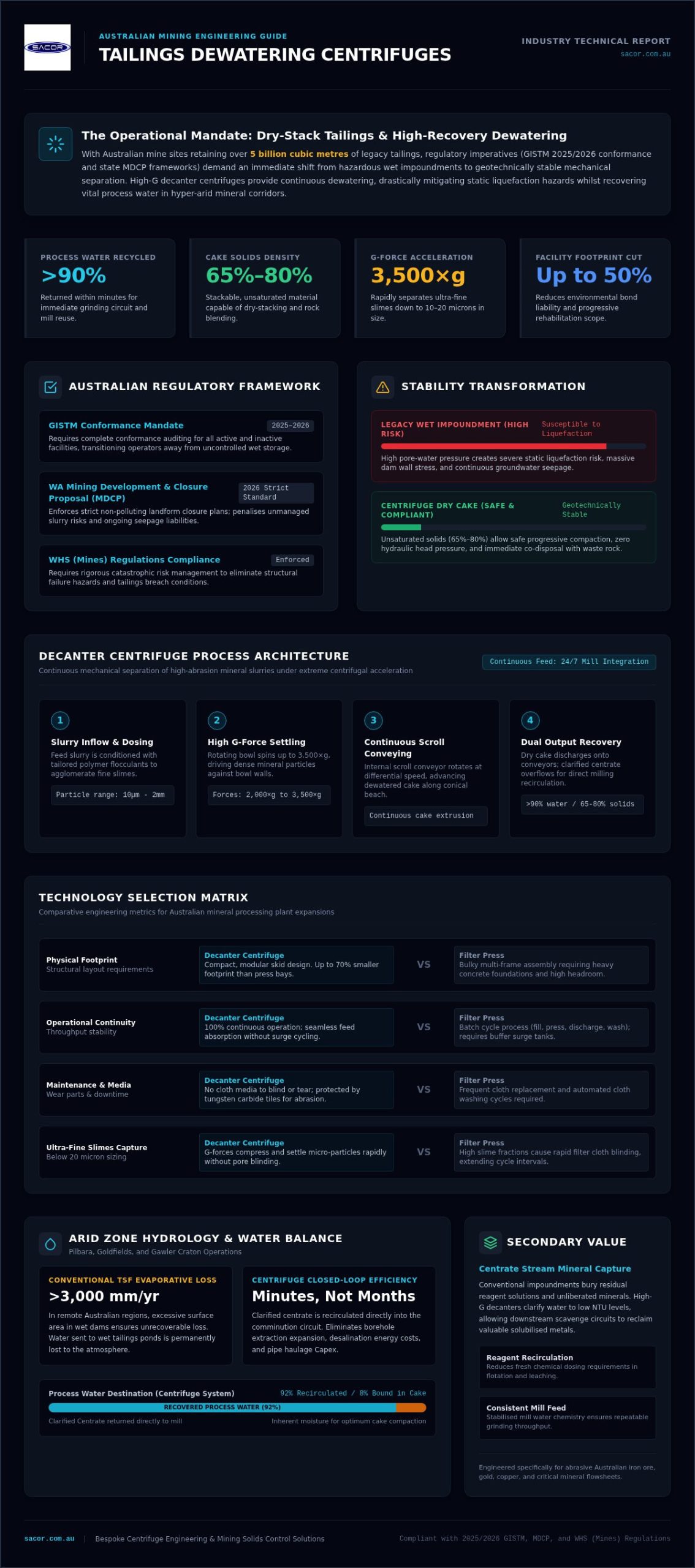
The Australian mining sector is undergoing a fundamental shift in waste management protocols. Traditional wet tailings dams, once the default for large-scale operations, are being replaced by dry stackable tailings to mitigate geotechnical risks and long-term environmental liabilities. This transition is largely driven by the Global Industry Standard on Tailings Management (GISTM), which required full conformance for all active and inactive facilities by August 2025. In 2026, the focus has shifted to independent audit reporting and meeting the rigorous Mining Development and Closure Proposal (MDCP) framework in Western Australia. Implementing a robust tailings dewatering centrifuge mining strategy allows operators to transition from high-risk slurry impoundment toward a geotechnically stable, unsaturated cake that can be safely stacked or blended with waste rock.
Meeting Stringent Australian Environmental and Safety Standards
State-based regulators and Environmental Protection Authorities (EPAs) have significantly tightened their oversight of Tailings Storage Facilities (TSFs). Reducing the moisture content of mineral waste is the most effective way to lower the risk of static liquefaction, which remains a primary cause of catastrophic dam failures globally. By utilising advanced decanter centrifuge mechanics, mines can achieve a solids concentration of 65% to 80%, depending on the slimes content. This level of dewatering is essential for:
- Minimising the physical footprint of storage facilities by up to 50%.
- Securing a social licence to operate through demonstrated environmental responsibility.
- Reducing the financial bonds required for mine closure and progressive rehabilitation.
- Ensuring compliance with the 2022 Work Health and Safety (Mines) Regulations.
Water Recovery: A Strategic Asset in Remote Operations
In arid mining corridors such as the Pilbara, Goldfields, and the Gawler Craton, water scarcity is a constant operational constraint. Annual evaporation rates in these regions often exceed 3,000 mm, meaning water lost to a traditional dam is rarely recovered. A high-efficiency centrifugal system creates a closed-loop water circuit by returning over 90% of process water to the mill within minutes. Deploying a tailings dewatering centrifuge mining solution ensures that water is treated as a strategic asset rather than a waste byproduct. This rapid recovery reduces the site’s reliance on expensive borefield expansion or desalination plants. Because the centrate is clarified to a high standard, it stabilises the water quality entering the grinding circuit, which leads to more consistent mill throughput and improved mineral recovery rates. In these remote environments, every kilolitre of recycled water represents a direct saving in operational expenditure and a reduction in supply chain vulnerability.
The Mechanics of Centrifugal Tailings Dewatering
Centrifugal sedimentation in mineral tailings is the process of using high-speed rotational forces to accelerate the separation of solid particles from a liquid carrier, significantly surpassing the speed of gravitational settling. Modern tailings dewatering centrifuge mining systems operate by generating G-forces typically between 2,000×g and 3,500×g. This intensity is necessary for capturing ultra-fine particles, often down to 10 or 20 microns, which are notoriously difficult to settle in conventional thickeners. By applying these extreme forces, the centrifuge forces solids against the bowl wall, while a clear liquid centrate is drawn from the centre of the rotation.
The efficiency of this separation is further enhanced by precise polymer dosing. Advanced flocculants are introduced to the feed to aggregate fine particles, ensuring the decanter can produce a clear centrate and a geotechnically stable cake. Recent CSIRO research on tailings management and dewatering emphasises the importance of optimising these flocculation processes to handle the complex mineralogies found in Australian base metals and precious metals circuits. Proper chemical integration prevents polymer degradation within the high-shear environment of the rotating bowl, which is vital for maintaining cake dryness.
High-Torque Performance for High-Density Slurries
Mining slurries are rarely consistent, and fluctuations in feed density can stall standard equipment. Mining-grade decanter centrifuges utilise high-torque gearboxes and Variable Speed Drives (VSD) to manage these variations. By adjusting the bowl speed and the scroll differential speed in real-time, the system compensates for varying solids concentrations. This balance ensures that the cake remains at the target moisture level, typically between 65% and 80% dry solids, without compromising the clarity of the recovered water. Consistent torque control is essential for preventing blockages during high-tonnage periods.
Wear Protection and Durability in Abrasive Environments
Australian mining environments are uniquely punishing due to the abrasive nature of materials like iron ore, gold quartz, and spodumene. Standard industrial models lack the robustness required for 24/7 mineral processing. Mining-specific designs incorporate replaceable sintered tungsten carbide tiles along the scroll conveyor flights and boron-carbide liners at the discharge ports. These features prevent catastrophic mechanical failure and extend the operational window between major overhauls, often exceeding 15,000 hours of continuous service.
Sacor focuses on delivering customised decanter centrifuge systems that prioritise high uptime and low mean time to repair (MTTR). By engineering for accessibility, site technicians can perform routine maintenance without the extensive downtime typical of more complex filtration systems. This methodical approach to durability ensures that the dewatering circuit remains a reliable component of the broader mill operation, even when processing the most abrasive mineral slurries found in remote Australian sites.
Decanter Centrifuges vs. Filter Presses: Selecting the Optimal Technology
Choosing between decanter centrifuges and plate-and-frame filter presses requires a methodical evaluation of total lifecycle costs and site-specific operational constraints. Industry benchmarks for mineral tailings dewatering, particularly within iron ore and coal circuits, indicate that solid-bowl decanter centrifuges can offer more than 30% savings in initial capital expenditure (CAPEX). While filter presses are often cited for achieving slightly lower moisture levels, centrifuges provide up to 21% annual savings in operational expenditure (OPEX). These savings are primarily achieved through continuous 24/7 operation and the elimination of the high labour costs associated with filter cloth replacement, washing, and mechanical cycle delays. For brownfield plant expansions where space is at a premium, the compact footprint and reduced civil engineering requirements of a centrifuge make it the preferred choice for integrating into existing mill structures.
Performance Comparison for Mineral Applications
The technical performance of these technologies varies significantly across different Australian mineral suites. In gold and iron ore slimes, decanter centrifuges consistently produce a cake with 65% to 80% dry solids, which is geotechnically sufficient for conveyable dry stacking or co-disposal with waste rock. While a filter press may reach 75% to 85% solids, this is achieved through intermittent batch processing that can create bottlenecks in high-throughput environments. Centrifuges excel in capturing ultra-fine fractions, ensuring a clear centrate that prevents the buildup of fines in the process water circuit. Although centrifuges have a higher specific power draw, typically ranging from 8 to 25 kWh per dry tonne, they offset this through zero wash-water demand and lower maintenance requirements compared to the 5 to 15 kWh per tonne consumed by batch-based filter systems.
The Decanter Centrifuge Advantage in Australia
In remote Australian operations, the modularity and rapid deployment capabilities of centrifugal systems provide a distinct strategic advantage. These units can be skid-mounted or containerised, allowing for fast installation at satellite pits or exploration sites without the extensive concrete foundations required for heavy filter press assemblies. Adhering to the leading practice tailings management guidelines published by the Australian Government ensures that dewatering strategies remain compliant with evolving environmental standards. By choosing a continuous separation solution, operators reduce their reliance on manual intervention and complex supply chains for consumable parts like filter cloths. For a deeper analysis of how these systems integrate into national mining infrastructure, refer to our Decanter Centrifuge Mining Australia: The 2026 Strategic Guide. This approach ensures that water recovery is maximised while maintaining the high uptime required for profitable mineral processing.
Operational Efficiency: Reducing Costs and Maximising Resource Recovery
Operational efficiency in modern mineral processing is increasingly defined by the ability to manage waste streams as potential revenue sources or cost-saving opportunities. Implementing a tailings dewatering centrifuge mining strategy significantly reduces the physical volume of waste, which in turn lowers the expenditure associated with tailings transport and disposal. By converting pumpable slurry into a geotechnically stable cake, operators can utilise standard conveyors and earth-moving equipment rather than maintaining complex, high-pressure pipeline networks. This transition reduces the energy required for pumping and eliminates the risk of pipeline bursts, which can lead to costly environmental remediation and production stoppages.
Beyond volume reduction, centrifugal separation offers the opportunity to recover residual mineral value from the centrate stream. In many Australian base metal and gold circuits, ultra-fine particles that escape primary flotation often carry significant mineralisation. Because a decanter centrifuge captures these fines more effectively than traditional thickeners, the resulting clarified liquid can be recycled or further treated to reclaim minerals that were previously lost to the tailings dam. This secondary recovery improves the overall yield of the mill and contributes directly to the project’s bottom line.
Optimising OPEX Through Smart Monitoring
Modern centrifugal systems are equipped with automated control architectures that reduce the requirement for constant manual intervention. Real-time vibration and temperature monitoring allow site engineers to identify mechanical issues before they lead to catastrophic failure, thereby extending the service life of high-capital components. Automated feed-sensing technology adjusts the differential speed and polymer dosing rates based on fluctuating feed characteristics. This precision ensures that polymer consumption is optimised, preventing the over-dosing that often occurs in manually controlled circuits. Producing a dry cake directly correlates to reduced TSF management costs by enabling progressive rehabilitation and reducing the required height of dam walls.
Sustainability and the Circular Economy in Mining
The ability to produce unsaturated, stackable material facilitates the repurposing of tailings for the circular economy. Dewatered solids are increasingly used as engineered backfill for underground voids or as raw material for construction and road-base applications. This approach aligns with the industry’s shift toward sustainable industrial practice, reducing the carbon footprint of the operation by minimising the land area dedicated to waste storage. For operators looking to apply these efficiencies to broader industrial applications, our Sludge Dewatering Centrifuge Australia: The 2026 Industrial Guide provides further insights into cross-sector separation technologies. To discuss how a customised separation circuit can lower your site’s long-term liabilities, contact our technical team for a performance evaluation.
Implementing Bespoke Dewatering Solutions for Australian Site Conditions
Every mineral deposit possesses unique physical and chemical characteristics that dictate the success of a separation circuit. Standardised, off-the-shelf equipment often fails in the mining sector because it cannot account for the high variability in slurry abrasiveness, particle size distribution, and fluctuations in feed density. A successful tailings dewatering centrifuge mining installation requires a transition from generic supply to customised engineering. Sacor works as a technical partner alongside plant engineers and metallurgists to ensure that the equipment is specifically configured for the site’s unique operational demands. This collaborative approach ensures that the centrifuge bowl geometry, scroll pitch, and drive torque are perfectly matched to the specific mineral suite, whether processing iron ore, gold, or spodumene.
Integration with existing site infrastructure is equally critical. Modern mining operations rely on sophisticated SCADA and plant control systems to monitor performance and safety. Sacor ensures that all centrifugal systems are fully compatible with these digital architectures, allowing for remote monitoring and automated adjustments. This level of technical integration supports the high uptime requirements of 24/7 mining circuits and provides the data necessary for predictive maintenance. Local commissioning by specialist engineers further ensures that the equipment is optimised for peak performance from the first day of operation.
From Feed Analysis to Commissioning
The path to a reliable dewatering solution follows a methodical, four-step process designed to eliminate technical risk:
- Step 1: Comprehensive feed characterisation and throughput target setting. We analyse the specific rheology and settling characteristics of your tailings to define precise performance benchmarks.
- Step 2: Bespoke engineering of the centrifuge bowl, scroll, and drive system. The internal components are hard-faced and configured to handle the specific abrasive profile of the mineral solids.
- Step 3: Factory acceptance testing (FAT) and site-specific modularisation. Equipment is pre-assembled on skids or in containers to simplify the on-site installation process.
- Step 4: On-site installation and performance optimisation. Sacor specialists manage the commissioning phase to ensure the system meets all recovery and moisture targets under real-world conditions.
Securing the Lifecycle of Your Investment
Maintaining high-capital equipment in remote Australian regions requires a proactive approach to technical support. Establishing a scheduled maintenance programme is essential for preventing unplanned downtime and extending the service life of the centrifuge. Sacor supports national operations through a robust spare parts inventory and expert technical assistance, ensuring that critical components are available when needed. For a detailed look at maintaining equipment longevity, refer to our Industrial Centrifuge Spare Parts Australia: A Strategic Maintenance Guide. This commitment to local support minimises operational risk and ensures that your tailings dewatering centrifuge mining investment continues to deliver results throughout the life of the mine.
Securing Operational Longevity Through Advanced Dewatering
Transitioning to geotechnically stable dry stacking is now a fundamental requirement for Australian operators seeking to mitigate risk and meet 2026 regulatory standards. By adopting continuous centrifugal separation, sites can achieve superior water recovery and produce a stackable cake that reduces long-term environmental liabilities. This methodical approach to waste management ensures that your operation remains compliant with the Global Industry Standard on Tailings Management while simultaneously optimising mill throughput. These efficiencies allow for a more sustainable use of resources in arid regions where water acquisition costs are a primary concern.
Selecting a tailings dewatering centrifuge mining system tailored to your specific mineral suite is the most effective way to manage abrasive slurries and remote site constraints. Sacor stands as a trusted technical partner, providing custom-engineered solutions and local maintenance support that ensure high uptime and reliability for the life of your project. As Australian-owned separation specialists, we focus on delivering precision results that stand up to the country’s harshest mining conditions. Partner with Sacor for your bespoke mining dewatering solutions to secure the performance and expert support your operation requires. We’re ready to help you navigate the complexities of modern tailings management with quiet assurance and proven expertise.
Frequently Asked Questions
What are the primary benefits of using a centrifuge for tailings dewatering in Australia?
The primary benefits include high-volume water recovery and the production of geotechnically stable, dry-stackable solids. In arid Australian mining regions, recovering over 90% of process water directly at the mill reduces the reliance on expensive borefields or desalination plants. Additionally, these systems offer a compact footprint compared to traditional thickeners, allowing for easier integration into existing brownfield sites while significantly reducing the physical area required for tailings storage.
How does a decanter centrifuge handle abrasive mineral tailings?
Mining-grade decanter centrifuges are specifically engineered with advanced wear protection to withstand abrasive mineral slurries like iron ore and gold quartz. Sacor’s systems utilise replaceable sintered tungsten carbide tiles along the scroll conveyor flights and boron-carbide liners for solids discharge ports. This robust design prevents catastrophic mechanical failure and ensures the equipment can operate continuously for 15,000 to 20,000 hours before requiring major mechanical overhauls or component replacements.
Can a centrifuge achieve the same cake dryness as a filter press?
While plate-and-frame filter presses can achieve slightly higher solids concentrations of 75% to 85%, decanter centrifuges consistently produce a cake with 65% to 80% dry solids. This level of dryness is sufficient for conveyable dry stacking and co-disposal with waste rock. The key advantage of a centrifuge is its continuous processing capability, which eliminates the batch delays, cloth washing requirements, and high labour costs inherent in filter press operations.
What are the typical maintenance requirements for a mining centrifuge?
Typical maintenance involves scheduled inspections of high-torque gearboxes, lubrication of main bearings, and monitoring of wear components like the scroll tiles. Modern automated systems also include real-time vibration and temperature monitoring to identify potential issues before they cause downtime. Unlike filter presses, centrifuges don’t require frequent cloth replacements or high-pressure washing, which simplifies the maintenance schedule and reduces the total labour hours required by site technicians.
Is it possible to recover process water for reuse in the mill using a centrifuge?
Recovering process water is a core function of a tailings dewatering centrifuge mining system, often returning more than 90% of free water to the milling circuit. The high G-forces generated within the centrifuge produce a clarified centrate that is free of ultra-fine particles, which prevents the buildup of slimes in the process water tank. This immediate return of high-quality water stabilises the grinding circuit and reduces the project’s overall water footprint.
How do decanter centrifuges help in meeting ESG and TSF safety standards?
Centrifuges help operators meet Global Industry Standard on Tailings Management (GISTM) requirements by significantly reducing the moisture content and liquefaction risk of stored waste. By transitioning from wet slurry impoundment to dry stackable cake, mines can reduce their storage footprint by up to 50% and curtail seepage pathways. These safety improvements are essential for securing a social licence to operate and meeting the stringent 2026 Western Australian closure proposal frameworks.
What factors influence the CAPEX and OPEX of a tailings dewatering system?
CAPEX is influenced by the required throughput capacity, modularisation needs, and the complexity of the initial civil installation. OPEX is primarily driven by specific electrical power draw, which typically ranges from 8 to 25 kWh per dry tonne, and the consumption of polymeric flocculants. However, centrifuges often provide lower total lifecycle costs than filter presses because they eliminate the recurring expense of filter cloths and the high labour costs of batch processing.
Does Sacor provide on-site technical support for remote Australian mines?
Sacor provides comprehensive on-site technical support, installation, and commissioning services for mining operations across Australia. Our specialists work directly with your plant engineers to optimise the performance of the tailings dewatering centrifuge mining circuit and ensure seamless integration with site SCADA systems. We maintain a national inventory of critical spare parts and provide scheduled maintenance programmes to minimise operational risk and ensure the long-term reliability of your dewatering investment.