
In the current Australian regulatory environment, every litre of industrial waste sent to landfill represents a failure of resource recovery that directly impacts your bottom line. With the Water Services Regulations 2025 now in full effect and the October 2026 PFAS monitoring mandates tightening the margin for error, industrial operators can’t afford to view separation as a simple disposal cost. You likely recognise that traditional two-phase systems often leave valuable oils or solids trapped in the discharge stream, which increases disposal volumes and sacrifices potential revenue. This guide provides the technical and operational roadmap required to master the three phase centrifuge Australia market demands in 2026. By understanding these systems, you can optimise resource recovery and maintain strict compliance with evolving environmental standards. We will examine the critical engineering differences between standard decanters and three-phase systems, alongside strategies for reducing waste volumes and securing long-term equipment reliability through local technical support.
Key Takeaways
- Understand the fundamental operational shift from standard two-phase decanting to simultaneous liquid-liquid-solid separation to maximise resource recovery in complex process streams.
- Learn how to evaluate the technical specifications of a three phase centrifuge Australia industries utilise to achieve high-purity oil recovery while significantly reducing waste disposal volumes.
- Identify strategic applications across the Australian energy and food processing sectors, with a focus on optimising tallow production and oil-water-solids separation.
- Master the selection criteria for your plant by comparing adjustable impeller technology against alternative separation methods to ensure optimal liquid clarity and throughput.
- Recognise the value of custom-engineered solutions and local lifecycle support in maintaining equipment reliability and meeting stringent 2026 environmental discharge standards.
3-Phase Centrifuges: Vital for Australian Industry
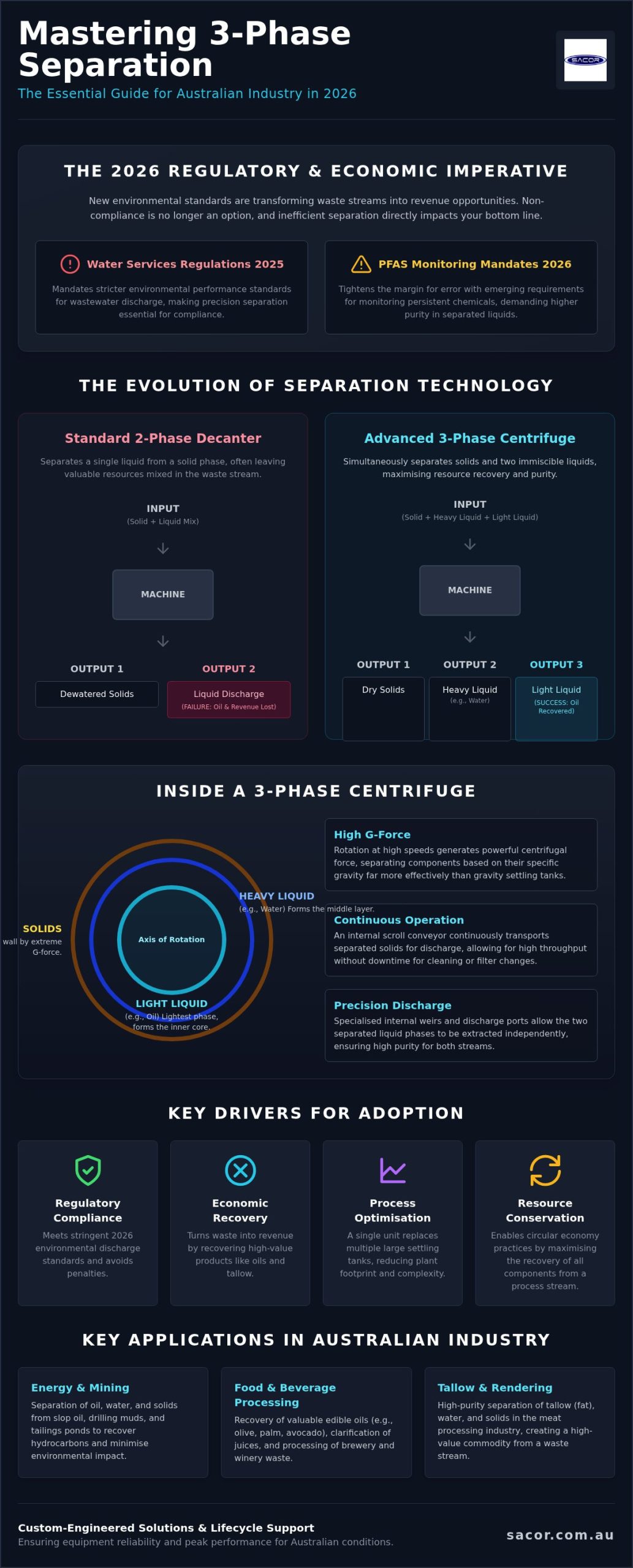
A three-phase centrifuge is a precision-engineered high-speed device designed for the simultaneous separation of two immiscible liquid phases and one solid phase. While standard decanter centrifuges focus on liquid-solid separation, the three-phase variant introduces a sophisticated internal architecture to isolate a light liquid phase, such as oil, from a heavy liquid phase, such as water, while concurrently dewatering solids. In the 2026 Australian industrial environment, this technology has transitioned from a niche requirement to a strategic necessity. Processing plants across the country are moving away from traditional disposal models toward circular economy practices where waste streams are viewed as untapped revenue sources. Implementing a three phase centrifuge Australia wide allows operators to recover high-purity products that would otherwise be lost to tailings or costly waste discharge.
The Liquid-Liquid-Solid Separation Mechanism
Effective separation relies on the differing densities of the components within the feed material. As the bowl rotates at high speeds, centrifugal force drives the heavy solids to the bowl wall while the two liquid phases form concentric layers based on their specific gravity. Understanding how decanter centrifuges work provides the foundation for this process, though three-phase systems utilise a specialised internal weir and discharge port configuration to extract the two liquids separately. The light liquid phase is typically discharged through a paring disc or overflow, while the heavy liquid exits via a separate set of ports. High G-force application is critical for Australian feedstocks to ensure maximum clarity in both liquid phases and the driest possible cake discharge.
Drivers for Three-Phase Adoption in 2026
Several factors are accelerating the adoption of these systems in the current market. The Water Services (Wastewater Environmental Performance Standards) Regulations 2025 and emerging PFAS monitoring requirements across Australian jurisdictions have made precision separation essential for meeting discharge limits. Beyond compliance, the economic imperative to recover high-value edible oils, tallow, or hydrocarbons from waste streams provides a direct offset to operational costs. Modern plant designs also prioritise a reduced footprint, where a single three-phase unit replaces multiple large gravity separators or settling tanks. This shift ensures that separation is no longer just a waste management step but a core component of process efficiency and resource conservation.
Technical Mechanics: How Three-Phase Separation Optimises Recovery
The efficiency of a three-phase centrifuge depends on its ability to maintain a continuous, balanced process under high mechanical stress. Unlike batch processes, these systems handle a steady feed stream, utilising an internal scroll conveyor to transport separated solids toward the conical end of the bowl. This scroll rotates at a slightly different speed to the bowl, creating the necessary conveying motion to discharge dewatered solids. In the context of a three phase centrifuge Australia operators often rely on to manage complex streams, this continuous action is fundamental to maintaining high throughput without the downtime associated with manual cleaning or filter replacements.
To achieve precise liquid phase clarity, advanced units incorporate adjustable impeller technology. This allows plant managers to modify the pond depth and the interface between the light and heavy liquid phases while the machine is in operation. This adjustability is a critical feature for Australian sites where feed characteristics, such as oil-to-water ratios, often fluctuate. By fine-tuning the discharge diameter of the heavy phase, the system ensures that the recovered light phase remains free of contamination. Torque control systems further enhance this process by managing fluctuating solid loads. By monitoring the resistance on the scroll, the system automatically adjusts the differential speed to prevent blockages and maintain consistent cake dryness.
Bowl and Scroll Dynamics for Australian Feed
Bowl geometry is a primary engineering consideration for local applications. A higher length-to-diameter ratio increases the residence time of the material within the centrifugal field, which is vital for difficult-to-separate emulsions. Differential speed must be carefully calibrated; excessive speed can lead to turbulence that disrupts liquid clarity, while insufficient speed may cause the bowl to overload. Given the often corrosive or abrasive nature of Australian industrial fluids, high-grade duplex stainless steel is a non-negotiable requirement for construction. This material choice ensures the equipment withstands the high G-forces, often exceeding 3,000 x g, required to achieve ultra-clean liquid discharge and robust reliability. For those looking to integrate these technical advantages, exploring custom-engineered separation solutions can ensure the equipment matches specific site requirements.
Automation and Control Systems
Modern automation has redefined separation efficiency on remote or automated Australian sites. Variable Frequency Drive (VFD) systems provide real-time process optimisation by adjusting bowl and scroll speeds instantly to match changing feed conditions. Integrated sensors monitor vibration, temperature, and phase interface levels, providing a predictive maintenance layer that helps prevent unexpected downtime. These smart controls allow for high-precision operation with minimal human intervention, making them ideal for facilities where technical staff may not be permanently stationed on-site. This level of control ensures that the separation process remains stable, even when the incoming feed is inconsistent.
Key Industrial Applications Across the Australian Landscape
Industrial separation in Australia has moved beyond simple waste management; it’s now a critical component of resource recovery. The strategic use of a three phase centrifuge Australia wide allows operators to extract maximum value from streams that were previously considered unsalvageable. In the energy sector, these systems are essential for oil-water-solids separation, where they manage the complex emulsions encountered during drilling and exploration. By recovering high-value hydrocarbons from oily sludge pits, companies can offset remediation costs while meeting strict environmental discharge standards. This transition from waste handling to resource recovery is a fundamental shift in 2026 industrial strategy.
Mining applications also benefit from this technology, particularly in solvent extraction (SX) circuits and tailings treatment. The ability to separate organic and aqueous phases while removing fine solids ensures product purity and reduces the volume of liquid waste requiring storage. This efficiency is vital for maintaining the sustainability of large-scale Australian mining projects. For more comprehensive insights into the energy context, consult our Energy Sector Centrifuge Equipment: The 2026 Australian Strategic Guide.
Energy and Oil: Produced Water and Sludge Treatment
Handling heavy oil-water emulsions is a persistent challenge in Australian exploration. Three-phase centrifuges provide the mechanical force necessary to break these emulsions, producing clean water that meets 2026 regulatory discharge standards and recovered oil that’s ready for processing. This is particularly important in sensitive environments where produced water must be treated to high standards before reuse. These systems effectively transform hazardous sludge into manageable dry solids and reusable hydrocarbons.
Food and Agriculture: Maximising Yield in Rendering and Edible Oils
In the food processing and agricultural sectors, yield optimisation is the primary driver for centrifuge adoption. Rendering plants use three-phase technology to recover high-purity tallow and fats from animal by-products, ensuring the highest possible grade for the final product. Hygiene is a non-negotiable factor; equipment must feature food-grade stainless steel and Clean-in-Place (CIP) capabilities to prevent contamination. For specific insights into these applications, see the Agriculture Separation Equipment Australia: The 2026 Strategic Guide. By integrating these systems, Australian processing plants can significantly increase their output while reducing waste volumes.
Selecting the Right Three-Phase System for Your Plant
Specifying a three phase centrifuge Australia wide requires a methodical evaluation of the process stream’s physical properties. Feed composition, specifically the ratio of solids to liquids and the density differential between the two liquid phases, dictates the mechanical configuration. While three-phase decanter centrifuges excel in handling high-solids feeds, typically ranging from 5% to 40% by volume, alternative technologies like disc stack separators are better suited for polishing applications where solids content is minimal. For a broader understanding of general selection frameworks, refer to our Industrial Decanter Centrifuge Australia: The 2026 Comprehensive Guide.
Pilot testing is a critical step for Australian industrial projects. Bench-scale analysis allows for the precise determination of settling velocities and emulsion stability, which prevents costly miscalculations during full-scale implementation. This data-driven approach ensures the chosen system delivers the promised resource recovery and process efficiency. Every site has unique feed characteristics, and testing confirms that the equipment can handle the specific variability of your process stream.
Sizing and Capacity Considerations
Calculating the required G-force is the starting point for sizing. Finer particles or liquids with narrow density margins require higher centrifugal force to achieve effective separation. Bowl diameter directly influences throughput capacity; larger diameters allow for higher flow rates but must be balanced against the increased mechanical load. Decision-makers should weigh the initial CAPEX against long-term OPEX. A slightly larger, more efficient unit often pays for itself through reduced polymer consumption and lower waste disposal costs over its lifecycle.
Operational Robustness for Remote Australian Sites
For those operating a three phase centrifuge Australia-wide, reliability in remote locations is often the deciding factor in equipment selection. High-wear components must be protected with tungsten carbide tiles or specialised hard-facing to withstand abrasive Australian ores or grit-heavy wastewater. Modular designs are also essential, facilitating easier transport to site and simplifying on-site maintenance. Accessing local technical support and a domestic inventory of spare parts is vital to minimising downtime. Ensuring your equipment is backed by Australian-owned technical support provides the security needed for high-stakes industrial operations.
Sacor Australia: Custom Three-Phase Solutions and Lifecycle Support
Sacor operates as an Australian-owned technical partner, moving beyond the role of a standard equipment vendor. When implementing a three phase centrifuge Australia industrial sites require a level of customisation that generic, off-the-shelf models cannot provide. Our approach centres on bespoke engineering, where the equipment is tailored to the specific feed characteristics and operational goals of the client’s facility. This ensures that the system doesn’t just function, but excels in recovering high-value products and reducing waste discharge volumes. Local commissioning and intensive operator training are integral to this partnership, as they empower on-site teams to maintain peak performance and react effectively to process variations.
Lifecycle management is particularly critical for high-capital equipment in the Australian market. A proactive maintenance schedule, backed by domestic expertise, protects the initial investment and prevents the catastrophic costs associated with unplanned downtime. By integrating local technical support with a deep understanding of Australian site conditions, Sacor ensures that every installation remains a reliable asset for years to come. For a detailed look at maintaining these systems, our Industrial Centrifuge Spare Parts Australia: A Strategic Maintenance Guide provides essential frameworks for long-term reliability.
The Sacor Engineering Process
The process begins with a comprehensive feed analysis to determine the precise settling velocities and phase densities of the material. This data informs the custom configuration of the bowl and scroll, ensuring the residence time and G-force are optimised for the specific application. Integration with existing plant SCADA and control systems is a priority, allowing for seamless data exchange and real-time monitoring of the separation process. Every unit is engineered to meet or exceed Australian safety and industrial standards, ensuring compliance while maintaining the highest levels of operational efficiency.
Comprehensive Support and Spare Parts
Managing the logistics of spare parts for remote Australian operations is a core strength of Sacor’s service model. We maintain a domestic inventory of critical components to ensure that technical support is available when it’s needed most. This local presence eliminates the delays often associated with international shipping and ensures maximum equipment uptime for our partners. Maintaining this level of responsiveness is vital for high-stakes industries like mining and energy where every hour of lost production has a significant financial impact. To discuss your specific separation requirements, contact Sacor Australia for a tailored three-phase separation consultation.
Advancing Resource Recovery with Strategic Separation Technology
The shift toward a circular economy has transformed industrial separation into a vital financial and environmental strategy. Mastering the mechanical nuances of liquid-liquid-solid separation allows your facility to reclaim valuable products while meeting the rigorous 2026 discharge standards. Securing a high-performance three phase centrifuge Australia wide ensures that your plant meets both production targets and environmental mandates through precise G-force application and automated torque control.
Sacor stands as a trusted technical partner, providing the quiet assurance that comes from deep domain expertise. As an Australian-owned and operated specialist, we deliver custom-engineered solutions for the mining, energy, and food sectors, backed by comprehensive national maintenance and spare parts support. This local presence is essential for maintaining equipment reliability and minimising downtime on remote sites. Optimise your separation process with Sacor Australia’s three-phase expertise and drive your process efficiency forward. We’re ready to help you achieve superior separation results.
Frequently Asked Questions
What is the primary difference between a two-phase and a three-phase centrifuge?
A two-phase centrifuge separates solids from a single liquid phase, whereas a three-phase system simultaneously separates solids and two immiscible liquids of different densities. This makes the three phase centrifuge Australia industries utilise ideal for oil recovery from wastewater. The internal architecture of a three-phase unit includes dual liquid discharge ports and a specialised weir, allowing for the continuous extraction of both light and heavy liquid phases alongside the dewatered cake discharge.
Can a three-phase centrifuge handle high-solids concentrations?
Three-phase decanter centrifuges are specifically engineered to handle high-solids feeds, typically ranging from 5% to 40% by volume. Unlike disc stack separators, which require low-solids input to prevent clogging, the horizontal decanter design uses an internal scroll conveyor to continuously discharge dewatered solids. This capability ensures that process streams with significant sediment or sludge loads can be processed efficiently without the need for extensive pre-filtration or frequent downtime associated with manual cleaning cycles.
How do I determine if my liquid-liquid mixture is suitable for three-phase separation?
Suitability depends primarily on the density difference between the two immiscible liquids and the stability of any existing emulsions. For effective separation, there must be a distinct specific gravity differential, typically at least 3% to 5%, to allow the centrifugal field to isolate the phases. Bench-scale testing and feed analysis are essential steps in determining whether a three phase centrifuge Australia based facilities require can achieve the desired clarity and recovery rates for a specific process stream.
What maintenance is typically required for a three-phase centrifuge on a remote site?
Maintenance for remote operations focuses on proactive component monitoring and the replacement of high-wear items such as tungsten carbide tiles and seals. Scheduled inspections of the bowl, scroll, and gearbox are critical to prevent unexpected mechanical failure. Using a modular design allows for easier component swaps on-site. Sacor provides national technical support and manages a domestic inventory of spare parts to ensure that remote facilities can maintain maximum equipment uptime without long international lead times.
Are three-phase centrifuges energy-efficient compared to other separation methods?
Three-phase centrifuges are highly energy-efficient when compared to thermal separation or multi-stage gravity settling systems. By utilising Variable Frequency Drives (VFDs) and high-efficiency motors, these units optimise power consumption based on real-time feed characteristics. The ability to achieve high-purity separation in a single pass reduces the total energy footprint of the plant by eliminating the need for secondary polishing stages or large-scale heating of process fluids to break emulsions before they enter the separator.
Does Sacor provide on-site commissioning for three-phase systems in Australia?
Sacor provides comprehensive on-site commissioning services across the country to ensure every system is correctly integrated into the existing plant infrastructure. Our technical team oversees the initial start-up, fine-tunes the control parameters for specific site conditions, and delivers intensive operator training. This hands-on approach ensures the equipment operates to its design specification from day one, providing plant managers with the confidence that their resource recovery and process efficiency targets will be met reliably.
What materials of construction are used for corrosive industrial feeds?
High-grade duplex or super-duplex stainless steel is typically utilised for the bowl and scroll of centrifuges handling corrosive industrial feeds. These materials offer superior resistance to pitting and stress corrosion cracking, which is essential for the long-term reliability of equipment in the mining and energy sectors. Wear-prone areas are further reinforced with replaceable tungsten carbide components, ensuring the machine can withstand the abrasive nature of Australian ores and chemically aggressive process fluids over a long service life.
Can I upgrade an existing two-phase decanter to a three-phase system?
Upgrading an existing two-phase decanter to a three-phase system is generally not a simple field modification due to the fundamental differences in internal architecture. A three-phase unit requires a specific bowl design with dual discharge ports and a specialised internal weir system to handle the second liquid phase. In most cases, it’s more cost-effective and technically sound to procure a purpose-built three-phase system that is custom-engineered to match the specific feed and throughput requirements of your process facility.