
Selecting a decanter centrifuge supplier Australia is less about purchasing a piece of heavy machinery and more about securing the long-term viability of your industrial process. Many plant managers find that generic equipment often fails to handle the unique feed characteristics found in local mining or wastewater applications, which leads to excessive downtime and inflated operational costs. You likely recognise that when a system underperforms, the financial impact extends far beyond the initial capital expenditure through increased waste disposal fees and lost throughput.
This guide demonstrates how to identify a high-performance partner with the technical precision required to optimise your separation results and reduce total cost of ownership. By focusing on bespoke engineering and robust local support, you can transform your dewatering outcomes and establish a more sustainable industrial practice. We will explore the essential criteria for evaluating technical proficiency, the importance of readily available spare parts, and how a collaborative partnership ensures your equipment remains a reliable asset for years to come.
Key Takeaways
- Understand how high-speed centrifugal force and specific bowl geometry work together to produce dry cake solids and optimise your dewatering process.
- Partner with a technically proficient decanter centrifuge supplier Australia that provides pilot trials and lab testing to ensure equipment matches your specific feed characteristics.
- Evaluate the necessity of two-phase or three-phase systems to ensure your configuration aligns with your recovery goals and process throughput requirements.
- Prioritise total lifecycle value over initial purchase price by securing a partner that offers nationwide spare parts coverage and technical maintenance support.
- Learn how custom-engineered separation solutions reduce waste disposal costs and support more sustainable industrial operations across remote Australian sites.
Optimising Industrial Processes with Decanter Centrifuge Technology
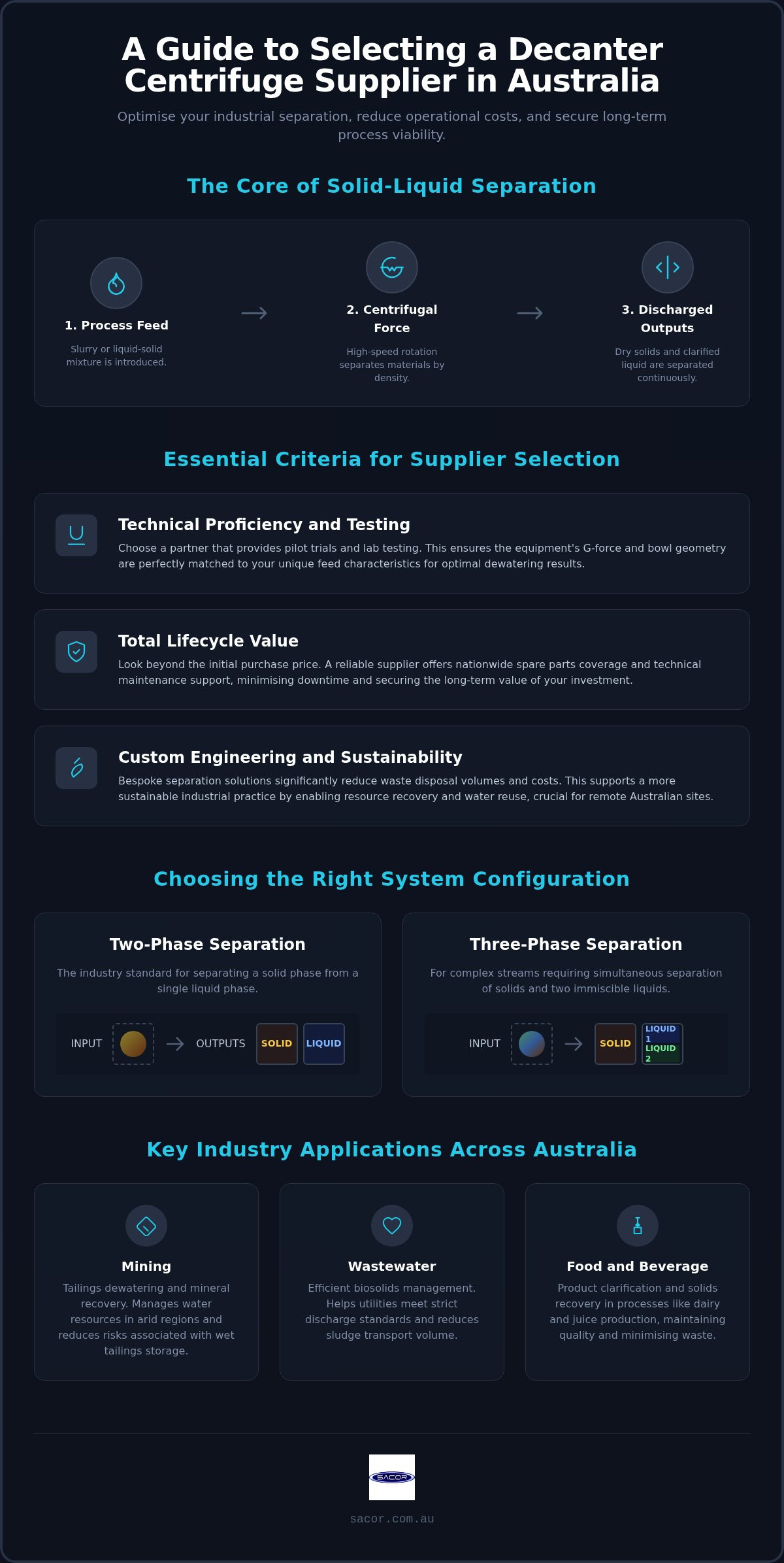
Decanter centrifuges serve as the fundamental cornerstone of modern solid-liquid separation across Australia’s industrial landscape. These systems utilise Decanter centrifuge technology to apply high-speed centrifugal force, which accelerates the sedimentation process far beyond the capabilities of gravity-based settling or traditional filtration. By subjecting the feed material to thousands of Gs, the equipment forces heavier solid particles against the bowl wall while the clarified liquid remains in the centre for discharge. This mechanical precision allows for continuous operation, which is vital for maintaining the high throughput required in large-scale Australian projects where downtime is not an option.
Engaging a technically proficient decanter centrifuge supplier Australia is about more than sourcing equipment; it’s about driving operational efficiency through improved separation. High-performance systems significantly reduce the volume of waste generated, which translates directly into lower transport and disposal costs. Beyond simple waste reduction, these units enable the recovery of valuable resources from process streams, such as minerals in mining or oils in the energy sector. This focus on efficiency aligns with a broader commitment to environmental responsibility, as more effective separation reduces the physical footprint of tailings dams and minimises the chemical load on local ecosystems. Selecting a specialised decanter centrifuge supplier Australia ensures that your facility benefits from equipment tailored to these specific operational and environmental demands.
The Role of Separation in Modern Australian Industry
Modern Australian industries are increasingly adopting circular economy principles to improve sustainability and resource security. Centrifugal systems support these goals by facilitating the reuse of process water and the reclamation of valuable by-products that would otherwise be discarded. The industry is witnessing a decisive shift from traditional filtration methods to high-efficiency centrifugal systems because centrifuges offer a smaller footprint, lower polymer consumption, and drier cake solids. A decanter centrifuge represents the most versatile mechanical solution for achieving high-volume, continuous separation of solids from liquids within a single process step.
Key Industry Applications Across Australia
The versatility of this technology makes it essential for several core Australian sectors that face unique geographical and regulatory challenges:
- Mining: Systems are used for tailings dewatering and mineral recovery, which allows sites to manage water resources more effectively in arid regions and reduces the risks associated with wet tailings storage.
- Wastewater: High-torque centrifuges provide efficient biosolids management, which helps utilities meet strict discharge standards while reducing the volume of sludge for transport and land application.
- Food and Beverage: In dairy and juice processing, these units ensure product clarification and maximum recovery of solids, which maintains high quality and reduces process waste in competitive markets.
Key Technical Specifications for Australian Industrial Operations
Achieving optimal results in solid-liquid separation requires a precise alignment between equipment specifications and the unique characteristics of the feed material. Choosing the right decanter centrifuge supplier Australia involves scrutinising the mechanical limits of the hardware, particularly the relationship between G-force and bowl geometry. High Relative Centrifugal Force (RCF) is essential for capturing fine particles; however, the conical angle of the bowl must also be engineered to facilitate the efficient transport of solids. This balance is what determines the final dryness of the cake and the clarity of the centrate. Technical precision is non-negotiable.
Operators must decide between two-phase and three-phase systems based on their specific recovery goals. A two-phase system focuses on the separation of solids from a single liquid phase, while a three-phase configuration allows for the simultaneous separation of two immiscible liquids of different densities, such as oil and water, alongside the solid discharge. Advanced automation and control systems now play a vital role in maintaining this performance. By integrating programmable logic controllers (PLCs), these systems automatically adjust the scroll differential speed to compensate for changes in feed consistency, which ensures consistent throughput without manual intervention. For those seeking deeper technical insights into these configurations, our Industrial Decanter Centrifuge Australia: The 2026 Comprehensive Guide provides an exhaustive analysis of modern mechanical standards.
Throughput and Separation Efficiency
Matching bowl speed and scroll differential to specific feed characteristics is the only way to maximise efficiency. Custom-engineered systems are particularly effective in wastewater applications where solid loadings fluctuate significantly throughout the day. High-performance centrifuges utilise Centrifuge Thickening and Dewatering principles to maintain a stable “pond depth” within the bowl, which prevents solids from washing out into the liquid discharge. This level of control is a hallmark of a technically proficient decanter centrifuge supplier Australia that understands the nuances of local process engineering.
Robustness and Material Selection
The abrasive nature of many Australian mineral feeds necessitates the use of premium materials for all wear-prone components. High-grade stainless steel provides the necessary corrosion resistance, while tungsten carbide tiles or flame-sprayed coatings on the scroll flights are essential for longevity in harsh environments. Equipment destined for remote industrial sites must be built for durability, as the cost of unplanned maintenance in these regions is prohibitive. For energy and oil applications, ensuring that systems carry valid explosion-proof ratings, such as ATEX or IECEx, is a critical safety requirement that cannot be overlooked. You can discuss these specific material requirements with Sacor’s engineering team to ensure your equipment is fit for purpose.
Choosing a Decanter Centrifuge Supplier: Beyond the Equipment
Procuring high-capital separation equipment is a decision that impacts plant performance for decades. A reputable decanter centrifuge supplier Australia must act as a seasoned technical partner rather than a mere equipment vendor; they should possess the domain expertise to interrogate your process flow and identify potential bottlenecks before any hardware arrives on site. This collaborative approach ensures that the selected system isn’t just a standard model, but a precisely configured solution designed to meet your specific recovery targets and environmental obligations. Relying on a partner who understands the nuances of local site conditions is the only way to guarantee long-term reliability.
Risk mitigation starts in the laboratory. The critical role of pre-purchase lab testing and pilot trials cannot be overstated, as these steps provide empirical data on how your specific feed material responds to centrifugal force. Without this stage, you’re essentially guessing at polymer dosages, torque requirements, and cake dryness. A technically proficient decanter centrifuge supplier Australia provides the facilities to test representative samples, which allows for the fine-tuning of bowl speeds and scroll differentials under controlled conditions. This rigour ensures that when the system is commissioned, it delivers the promised results from day one without costly post-installation adjustments.
The Value of Custom Engineering and Design
Off-the-shelf centrifuges often fail to meet specific Australian process targets because they’re designed for average conditions rather than the high-solids loadings or extreme temperatures found in local industry. Collaborative design involves working closely with your plant engineers to integrate the centrifuge system seamlessly into existing infrastructure, which minimises installation costs and avoids piping conflicts. For operators in the resource sector, our Decanter Centrifuge Mining Australia: The 2026 Strategic Guide explores how custom configurations handle the unique challenges of mineral processing and tailings management.
Assessing Supplier Credibility and Track Record
When evaluating potential partners, you should examine their portfolio of successful Australian industrial projects. A supplier’s track record in similar applications, whether in wastewater treatment or beverage clarification, demonstrates their ability to handle the complexities of local site conditions and regulatory frameworks. Local commissioning is another essential requirement; having an engineering team on-site ensures the equipment is calibrated to the actual feed conditions rather than theoretical models. The best suppliers provide bespoke solutions tailored to unique feed characteristics. This commitment to local support and full technical documentation provides the assurance that your investment is protected by a partner who understands the high stakes of Australian industrial operations.
Maximising Lifecycle Value: Maintenance and Parts Support
The initial capital expenditure for a high-performance centrifuge system represents only a fraction of its total cost of ownership (TCO). A strategic decanter centrifuge supplier Australia understands that the true value of the equipment is realised through sustained uptime and peak performance over several decades of service. High operational costs frequently stem from reactive maintenance strategies that ignore the subtle signs of mechanical wear until a failure occurs. By prioritising a long-term partnership with a supplier that offers comprehensive maintenance and technical support services, plant managers can significantly reduce the risk of catastrophic failure and ensure their separation processes remain cost-effective throughout the equipment’s lifecycle.
Effective lifecycle management requires more than just occasional repairs; it demands a structured approach to asset health. Scheduled maintenance contracts provide the framework for regular inspections, which allow technicians to identify and rectify minor issues before they impact throughput. This proactive stance is particularly critical for industrial centrifuges operating in remote or challenging Australian environments where the cost of unplanned downtime is magnified by logistics and labour availability. Providing site staff with technical support and advanced operator training further enhances this value, as competent operators can detect process deviations early and maintain the equipment within its optimal design parameters.
Reliable Spare Parts Supply in Australia
Local availability of critical components is the primary factor in minimising industrial downtime across the country. Common wear parts, such as tungsten carbide scroll tiles, high-precision bearings, and specialised seals, must be held in local stock to avoid the lengthy delays often associated with global supply chains. Our Industrial Centrifuge Spare Parts Australia: A Strategic Maintenance Guide explains why using non-OEM components on high-precision centrifugal equipment introduces unacceptable risks to mechanical balance and structural integrity. Maintaining a reliable supply of genuine parts ensures that your system continues to operate at its original engineering specifications.
Preventative Maintenance and Performance Audits
Regular vibration analysis and condition monitoring serve as the first line of defence against mechanical degradation. These tools allow for the early detection of bearing wear or bowl imbalance, which prevents the secondary damage that often follows a high-speed mechanical failure. Performance audits complement this mechanical monitoring by identifying throughput bottlenecks and optimising polymer consumption, which ensures the system continues to meet the standards outlined in our Sludge Dewatering Centrifuge Australia: The 2026 Industrial Guide. You can contact Sacor to discuss a tailored maintenance contract that protects your capital investment and ensures continuous operational reliability across your site.
Sacor: Delivering Customised Centrifugal Separation Solutions
Sacor stands as the premier decanter centrifuge supplier Australia for organisations requiring more than just a standard equipment vendor. Our engineering-led approach prioritises the design of a complete process solution that integrates naturally into your existing operations. We understand that every industrial site has unique feed characteristics and throughput requirements; therefore, we move beyond off-the-shelf offerings to provide bespoke systems. It’s our focus on precision engineering from the initial design phase through to national technical support that ensures our clients achieve maximum efficiency and a reduced environmental footprint. This commitment to sustainable practice is a core component of our service, as we frame our work as a contribution to responsible resource management within Australian industry.
A Partner for Australia’s Toughest Industrial Sectors
Our team possesses deep domain expertise across the mining, food and beverage, energy, and wastewater treatment sectors. Sacor’s systems are specifically engineered to reduce operational costs by producing drier cake solids and clearer centrates, which directly lowers waste disposal fees and resource recovery costs. As an Australian-owned and operated specialist, we maintain a steady conviction that our technology and technical proficiency speak for themselves. This local ownership means our engineering teams are intimately familiar with the geographical and regulatory challenges of remote Australian sites. We provide a level of partnership that global vendors often struggle to match, ensuring that technical documentation and commissioning support are always aligned with local standards.
Get Started with a Custom Separation Analysis
Engaging Sacor involves a methodical progression from initial consultation to a full bespoke engineering solution. We begin with a thorough analysis of your separation challenges, often involving the lab testing and pilot trials discussed earlier in this guide. This rigour ensures that the final configuration is perfectly matched to your process goals, supporting long-term reliability and maximum equipment uptime. Our technical team works alongside your site engineers to integrate these systems without disrupting existing workflows. We invite you to Consult with Sacor regarding your centrifuge requirements to discover how our technically proficient team can optimise your industrial separation outcomes and provide a robust foundation for your future processing needs.
Optimising Your Industrial Separation Strategy
The selection of a decanter centrifuge supplier Australia is a strategic decision that determines the long-term efficiency and environmental responsibility of your industrial operations. By prioritising bespoke engineering and local technical support, you ensure that your equipment handles specific feed characteristics with precision while minimising waste disposal costs. We’ve explored the critical role of technical specifications, the value of pre-purchase trials, and the necessity of a robust maintenance framework in maintaining continuous throughput.
Sacor provides a steady, grounded conviction that your separation challenges require more than a generic solution. As an Australian-owned and operated specialist, we offer custom-engineered separation solutions backed by national maintenance and spare parts coverage. Our engineering-led approach ensures your facility benefits from maximum reliability and reduced operational overheads; it’s a commitment to performance that stands up to the most demanding site conditions.
Partner with Sacor for your industrial decanter centrifuge solutions and take the next step toward a more efficient, sustainable processing future. We look forward to working alongside you to achieve your recovery goals.
Frequently Asked Questions
What is the role of a decanter centrifuge supplier in the commissioning process?
A decanter centrifuge supplier Australia manages the integration of the equipment into the existing plant infrastructure to ensure it operates to design specifications from day one. This involves on-site installation, technical calibration of bowl speeds and scroll differentials, and performance verification against project throughput targets. The supplier provides full technical documentation and commissioning support to guarantee that the system is safe, compliant, and ready for continuous industrial operation.
How do I determine if my Australian site requires a two-phase or three-phase centrifuge?
The choice depends on whether your process requires the separation of a solid from a single liquid or the simultaneous separation of two immiscible liquids of different densities. A two-phase system is standard for sludge dewatering where the goal is a dry cake and a clear centrate. In contrast, a three-phase system is essential for energy and oil applications where oil, water, and solids must be recovered as distinct streams.
What are the most common spare parts needed for an industrial decanter centrifuge?
High-wear components that require regular inspection include tungsten carbide scroll tiles, main bearings, and specialised seals. Maintaining a local stock of these parts is critical for minimising downtime in remote Australian industrial sites. Other frequently replaced items include drive belts and discharge bushings. Using genuine OEM parts is vital to maintain the mechanical balance and structural integrity of high-speed centrifugal equipment over its entire service life.
Can a decanter centrifuge be customised for high-abrasion mining tailings?
Bespoke engineering allows for the integration of advanced wear protection specifically designed for abrasive mineral feeds. This includes the use of high-grade stainless steel for the bowl and the application of flame-sprayed coatings or replaceable tungsten carbide tiles on the scroll flights. These customisations extend the lifespan of the equipment in harsh mining environments, which reduces the frequency of major overhauls and ensures consistent performance during tailings dewatering.
How does a decanter centrifuge reduce waste disposal costs for Australian businesses?
Centrifuges reduce disposal costs by producing drier cake solids, which significantly lowers the total weight and volume of waste destined for transport or landfill. Higher separation efficiency also allows for the recovery of valuable process water or by-products that would otherwise be discarded. For many industrial operators, the reduction in waste volume and the associated transport fees provide a rapid return on investment while supporting broader corporate sustainability goals.
What maintenance is required to ensure the longevity of an industrial centrifuge?
Longevity depends on a structured preventative maintenance program that includes regular vibration analysis, lubrication of high-speed bearings, and condition monitoring of the drive system. Performance audits are also necessary to identify throughput bottlenecks and ensure the centrifuge operates within its design parameters. Scheduled maintenance contracts with a technically proficient decanter centrifuge supplier Australia provide the expertise needed to detect subtle mechanical deviations before they escalate into catastrophic failures.
Do you provide on-site operator training for new centrifuge installations?
Technical support services include comprehensive on-site operator training to ensure that site staff can safely and efficiently manage the new installation. Training covers the fundamental principles of centrifugal separation, the use of automated control systems, and basic troubleshooting techniques. Competent operators are essential for maintaining equipment uptime and detecting process changes early, which protects the capital investment and ensures the system delivers consistent results across its lifecycle.
How do Australian environmental regulations impact the choice of dewatering equipment?
Strict Australian discharge standards for wastewater and biosolids necessitate the use of high-efficiency separation technology that can consistently meet water quality targets. Regulations often dictate the required dryness of solids for landfill disposal or land application, which influences the technical specifications of the centrifuge bowl and G-force capabilities. Choosing compliant equipment helps businesses avoid regulatory penalties and demonstrates a commitment to sustainable industrial practice within the local resource and utility sectors.