
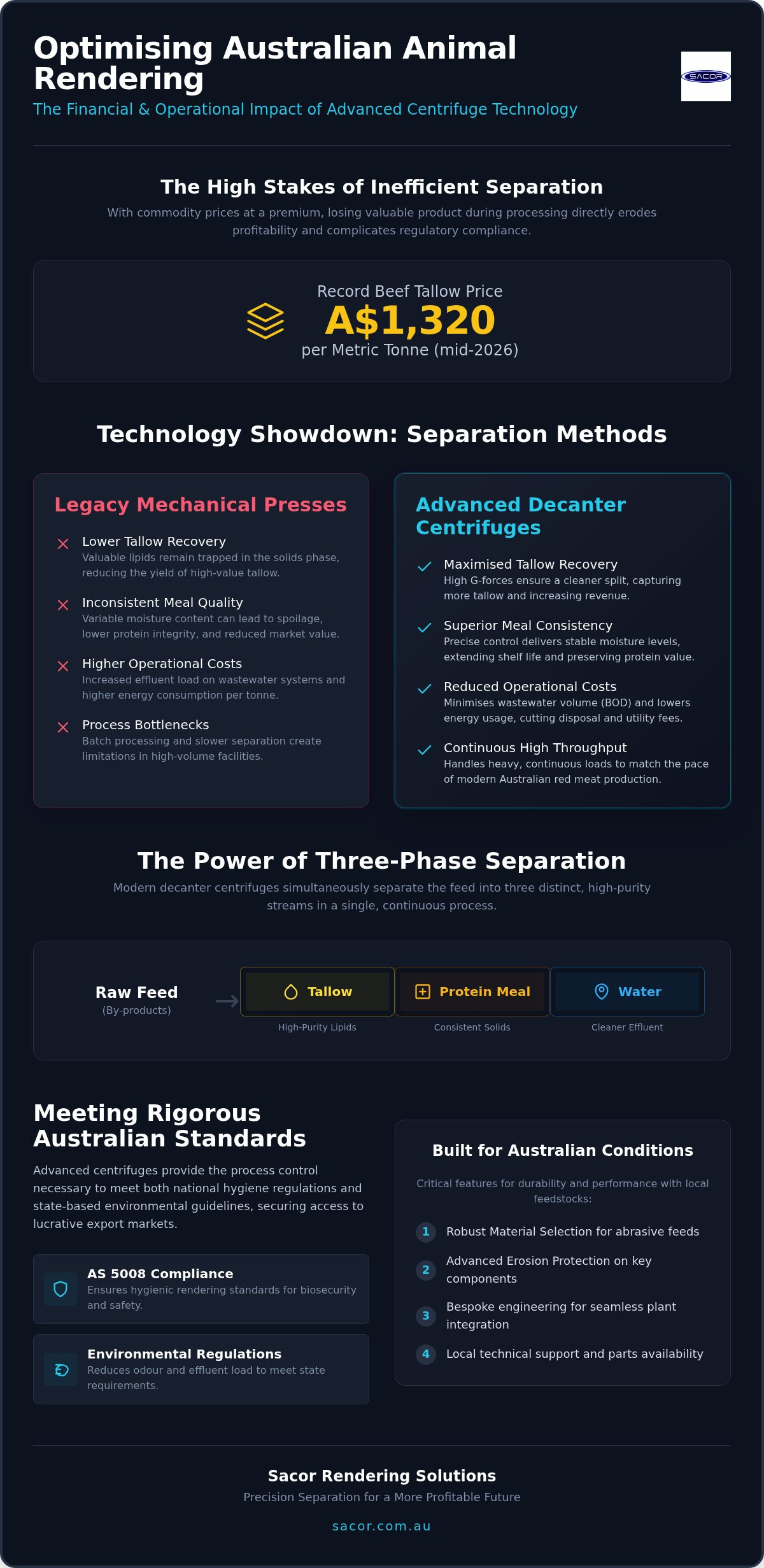
With beef tallow prices reaching a record A$1,320 per metric tonne in mid-2026, the financial impact of inefficient separation has become impossible to ignore for local processors. You likely recognise that losing high-value lipids to the solids phase or struggling with inconsistent moisture content in meal products doesn’t just erode your margins; it complicates compliance with the Australian Standard for the Hygienic Rendering of Animal Products (AS 5008). This guide demonstrates how implementing an advanced animal rendering centrifuge Australia facilities can rely on will maximise tallow recovery and enhance meal quality while significantly lowering your long-term operational costs.
We will examine the methodical transition from legacy mechanical presses to high-performance decanter systems, focusing on how precision separation reduces energy consumption per tonne of throughput and minimises effluent discharge volumes. By aligning your facility with these technical advancements, you can secure a more sustainable, high-precision extraction process that meets the rigorous export standards of the current A$1.5 billion national industry. This strategic overview provides the technical clarity required to optimise by-product value and maintain a competitive edge in a high-stakes market.
Key Takeaways
- Understand how high-speed centrifugal separation maximises tallow recovery and clarity to capitalise on record-high commodity prices in the Australian market.
- Compare the technical performance of an animal rendering centrifuge Australia wide against traditional screw presses to ensure consistent protein retention and moisture content.
- Discover the operational benefits of three-phase separation technology for simultaneously recovering high-purity tallow while reducing wastewater volumes and disposal fees.
- Identify critical material selection criteria and erosion protection requirements necessary to withstand the abrasive nature of Australian bone and mineral feedstocks.
- Learn how bespoke engineering and local technical support facilitate the seamless integration of advanced separation systems into existing rendering plant configurations.
The Role of Centrifugal Separation in Australian Rendering
The animal rendering process serves as a critical pillar of Australia’s agricultural circular economy, converting raw by-products into refined tallow and high-protein meal. This transformation is no longer a simple disposal method; it’s a high-precision extraction sector where the quality of the final output dictates access to lucrative international markets. For Australian processors, the margin between profit and loss often rests on the efficiency of their separation technology. Integrating an advanced animal rendering centrifuge Australia wide allows facilities to recover the highest possible percentage of lipids while maintaining the structural integrity of protein solids.
Efficient separation directly influences the facility’s financial health. With beef tallow prices reaching record highs in mid-2026, every litre of oil recovered from the solids phase contributes directly to the bottom line. Conversely, poor separation results in nutrient-rich waste that increases the organic load on wastewater treatment systems, leading to higher disposal fees and potential regulatory friction. Modern centrifugal systems act as the primary safeguard for these assets, ensuring that neither fat nor protein is downgraded due to process inconsistency.
Critical Drivers for Process Optimisation
Optimising a rendering plant requires a methodical focus on three primary outputs: tallow clarity, meal stability, and effluent quality. High-speed centrifugal separation achieves these goals by applying thousands of G-forces to the feed material, which forces a cleaner split than traditional pressing methods. Key operational priorities include:
- Maximising Tallow Recovery: Reducing the residual fat content in the meal to increase the volume of high-value tallow available for sale.
- Consistent Meal Moisture: Ensuring the protein phase maintains a specific moisture profile to prevent spoilage and extend shelf life during transport.
- Reducing Organic Load: Lowering the biological oxygen demand (BOD) in wastewater streams by capturing more solids during the primary separation phase.
Regulatory Compliance in Australia
Operating a rendering facility in Australia involves strict adherence to the Australian Standard for the Hygienic Rendering of Animal Products (AS 5008). This standard governs everything from heat penetration to the prevention of cross-contamination, ensuring that Australian products remain safe for global animal feed and industrial markets. Effective separation plays a vital role in biosecurity by ensuring that all phases of the by-product are processed according to validated temperature and time parameters. Additionally, state-based environmental guidelines require rigorous management of odour and effluent. A well-engineered animal rendering centrifuge Australia based operators utilise helps meet these obligations by providing a closed-loop system that contains vapours and produces a cleaner water phase for discharge or further treatment.
How Decanter Centrifuges Optimise Rendering Yields
Decanter centrifuges operate on the principle of accelerated sedimentation, using high-speed rotation to generate forces thousands of times greater than gravity. This mechanical advantage allows for the near-instantaneous separation of materials with different densities. In the context of a high-throughput facility, this continuous processing capability is essential. Australian red meat production rose by 3.4 per cent to 777,232 tonnes in the June 2026 quarter alone. Such volumes require separation technology that can handle heavy loads without the bottlenecks associated with traditional batch processing or older pressing methods.
Precision control over G-force is a defining feature of modern centrifugal systems. Operators can fine-tune the rotational speed to ensure maximum tallow recovery without causing protein degradation. If the centrifugal force is too aggressive, it can shear delicate protein structures, which lowers the quality and market value of the final meal. Conversely, insufficient force leaves valuable fat trapped in the solids. By maintaining this balance, a high-performance animal rendering centrifuge Australia processors rely on ensures that every kilogram of feedstock is processed to its highest potential value, meeting the rigorous Australian rendering industry standards for product consistency.
The Three-Phase Separation Process
A three-phase separation system performs three distinct tasks simultaneously, ensuring a streamlined process flow. The oil phase recovers high-purity tallow, which is the primary revenue driver for most rendering operations. At the same time, the liquid phase clarifies stickwater by removing suspended fines that would otherwise increase the organic load in wastewater streams. The final phase involves the continuous discharge of dry solids. These solids are then directed to the drying stage for meal production. This integrated approach ensures that no part of the raw material is wasted, supporting both profitability and environmental responsibility.
Improving Tallow Clarity and Quality
The quality of recovered tallow is primarily judged by its moisture and impurities (M&I) levels and its free fatty acid (FFA) content. Rapid centrifugal separation is superior to settling tanks because it limits the time fats spend at elevated temperatures, which directly prevents the formation of FFAs. Specific bowl geometries and adjustable weir plates allow for the optimisation of the liquid ring depth within the centrifuge. This precision reduces the M&I levels in the primary stage, which often eliminates the need for extensive downstream polishing. For plants aiming to refine their output, integrating custom-engineered decanter centrifuge systems can lead to a measurable increase in tallow clarity and overall marketability.
While traditional screw presses have served the industry for decades, the shift toward precision centrifugal technology is driven by the need for higher yields and lower moisture content. A screw press relies on physical compression to squeeze oil from the solids. This method is inherently limited by the mechanical tolerance of the equipment and often leaves a higher percentage of residual fat in the meal. In contrast, an animal rendering centrifuge Australia based facilities implement uses centrifugal force to achieve a more complete separation. This transition allows processors to capture more high-value tallow while producing a meal with consistent nutritional profiles.
The impact on downstream processing is equally significant. Centrifuges typically produce a drier solids cake than a press. Because there is less water to evaporate, the dryer load is reduced, leading to substantial energy savings and lower thermal stress on the protein. This efficiency is critical for maintaining the integrity of meat and bone meal, ensuring it meets the stringent requirements of the Australian Standard AS5008 for Hygienic Rendering of Animal Products.
Yield and Product Quality Comparison
Centrifuges produce tallow with significantly lower levels of moisture and impurities. Traditional presses often require extensive secondary filtration or settling to reach acceptable clarity, whereas a decanter often delivers a finished product in a single pass. This clarity is a direct result of the high G-forces that separate even the finest suspended solids from the oil phase. By retaining more protein in the solids phase and less fat, the resulting meal achieves a better balance of nutrients. This consistency is highly valued in the pet food and livestock feed sectors where protein levels must remain within strict ranges.
Total Cost of Ownership (TCO) Analysis
Evaluating the long-term costs reveals that the operational savings of centrifugal systems are compelling. Screw presses are high-wear machines; the constant friction between the screw and the cage necessitates regular, expensive parts replacement. A high-performance animal rendering centrifuge Australia wide operates with less internal friction, focusing wear on specific, protected areas like the scroll tips. Automation also plays a role. Modern centrifugal systems require less manual oversight, adjusting automatically to fluctuations in feed consistency. This reliability is vital for high-throughput Australian operations where downtime directly impacts the seasonal processing capacity and overall plant profitability.
Selecting an Animal Rendering Centrifuge for Australian Sites
Evaluating feedstock characteristics is the first step in selecting the correct equipment. Australian rendering operations frequently process a diverse species mix, including beef, sheep, and poultry, each presenting unique fat profiles and bone densities. Temperature control is equally vital; the feed must be maintained at a level that ensures lipid fluidity without compromising protein quality. A high-performance animal rendering centrifuge Australia facilities install must be configured to handle these fluctuations in viscosity and solids concentration to maintain consistent throughput across the processing cycle.
Material selection is often the most overlooked factor in plant longevity. The abrasive nature of bone fragments and mineral content in Australian feedstocks can cause rapid erosion of internal components if the unit isn’t properly protected. Standard industrial units often fail prematurely because they lack specific reinforcement for the scroll and bowl. Specifying advanced tungsten carbide tiles for scroll protection is a non-negotiable requirement for high-throughput sites. These tiles provide a sacrificial wear surface that can be replaced, which significantly extends the service life of the primary equipment and prevents catastrophic failure.
Drive system technology also requires careful consideration during the procurement phase. Variable Frequency Drives (VFD) offer precise control over bowl speed and differential speed, allowing for real-time adjustments as feed characteristics change. In contrast, hydraulic drives provide high torque at low speeds, which is beneficial for heavy start-up loads or particularly thick slurries. Custom engineering ensures that the chosen drive system aligns with existing site-specific power constraints and space limitations, ensuring the unit fits within the existing plant footprint without requiring extensive structural modifications.
Engineering for Durability and Reliability
Reliability in a rendering environment depends on the unit’s ability to resist both chemical corrosion and physical wear. High-grade stainless steel construction is essential for all wetted parts to prevent degradation from fatty acids and aggressive cleaning chemicals. Design features such as easy-access ports for internal inspections and clean-in-place systems reduce maintenance downtime. For plants looking to upgrade their current capacity, sourcing an animal rendering centrifuge Australia wide involves choosing a partner who provides comprehensive maintenance and technical support services to ensure long-term equipment health.
Integration and Automation
Successful integration requires matching the centrifuge capacity to the output of upstream cookers and the input requirements of downstream dryers. A mismatch here creates bottlenecks that reduce the efficiency of the entire plant. Modern PLC control systems allow for real-time process monitoring, enabling operators to track torque, vibration, and temperature from a central station. This level of automation is essential for meeting Australian safety standards for high-speed rotating equipment, providing automated shutdown protocols that protect both the staff and the machinery in the event of a process deviation.
Maximising ROI with Sacor Rendering Solutions
Sacor operates with the quiet assurance that technical expertise and local presence are the most reliable drivers of plant performance. In a sector where downtime is measured in lost commodity value, having a partner that understands the specific nuances of the Australian market is essential. Our approach to deploying an animal rendering centrifuge Australia wide focuses on bespoke engineering rather than off-the-shelf equipment. This ensures that the system we install is precisely calibrated to your site’s specific feed characteristics, energy constraints, and throughput requirements.
The investment in centrifugal technology is a commitment to long-term facility viability. We don’t just supply a machine; we provide a comprehensive separation strategy designed to integrate seamlessly with your existing infrastructure. This collaborative framing allows us to address the unique challenges of Australian renderers, from fluctuating seasonal volumes to the high mineral content of local feedstocks. By aligning our technology with your operational goals, we transform rendering from a disposal necessity into a high-precision profit centre.
Custom Engineering and Design Expertise
Optimising a facility requires a methodical evaluation of the entire process flow. We work alongside your team to evaluate existing agriculture separation equipment Australia wide, identifying bottlenecks where precision centrifugal force can replace less efficient mechanical methods. By integrating advanced industrial decanter centrifuge Australia technology into your plant, we help reduce total operational costs and energy waste. Our designs account for the abrasive bone and mineral content found in Australian by-products, ensuring that the material selection and erosion protection are sufficient for the long-term demands of your specific species mix.
Lifecycle Support and Technical Reliability
The return on investment for high-capital industrial equipment is realised through sustained operational uptime. Proactive maintenance programmes are central to our service model, moving beyond reactive repairs to a structured schedule of inspections and tuning. Because we are Australian-owned and operated, our clients benefit from national support during installation, commissioning, and long-term servicing. This local focus eliminates the delays often associated with international vendors and ensures that technical authority is always within reach.
Reliability is further supported by our extensive inventory of industrial centrifuge spare parts Australia. We maintain critical components locally to ensure that if a wear part requires replacement, the disruption to your rendering operation is minimal. This strategic access to parts, combined with our technical support services, provides the steady conviction that your separation process will remain consistent and profitable. By choosing a partner committed to the long-term success of the Australian rendering industry, you secure an animal rendering centrifuge Australia based solution that is as robust as the market it serves.
Securing Long-Term Performance in Australian Rendering
The shift toward precision separation technology represents a fundamental evolution in how the industry handles animal by-products. By implementing a high-performance animal rendering centrifuge Australia based processors can capitalise on record commodity prices while ensuring rigorous adherence to the Australian Standard for the Hygienic Rendering of Animal Products. This strategic transition from legacy pressing methods to advanced decanter systems effectively reduces energy consumption and minimises the environmental impact of effluent discharge across your facility.
Sacor supports this transition through custom engineering tailored to the specific feedstocks and space constraints of your industrial site. Our commitment to your facility’s success is backed by expert technical support, national commissioning services, and an extensive inventory of centrifuge spare parts maintained within Australia to prevent costly operational delays. Contact Sacor for a customised animal rendering separation solution to begin the process of plant optimisation. We look forward to partnering with you to achieve a more efficient and sustainable rendering operation.
Frequently Asked Questions
What is the primary benefit of using a centrifuge in an animal rendering plant?
The primary benefit is the significant increase in tallow recovery and clarity compared to traditional mechanical pressing. By applying high G-forces, the system extracts residual fats that remain trapped in the solids during screw pressing. This results in a higher volume of premium-grade tallow and a drier solids cake. Implementing an animal rendering centrifuge Australia wide allows facilities to capitalise on high commodity prices while reducing the energy required for downstream drying.
Can a decanter centrifuge separate tallow, water, and solids in one step?
Yes, a three-phase decanter centrifuge is specifically engineered to separate tallow, water, and solids in a single, continuous operation. The process uses density differentials to split the feedstock into a light liquid phase (oil), a heavy liquid phase (stickwater), and a solid phase (meal). This integrated approach streamlines the production line, reduces the need for secondary settling tanks, and ensures that each component is processed at its optimal temperature for maximum quality.
How does a centrifuge improve the quality of meat and bone meal (MBM)?
Centrifuges improve meal quality by ensuring a consistent moisture profile and reducing residual fat levels. Lower fat content in the meal prevents rancidity and spoilage during storage, which is critical for meeting export standards. Additionally, the precise control over centrifugal force prevents protein shearing and degradation. This results in meat and bone meal (MBM) with higher protein density and better nutritional value, making it more attractive to pet food and livestock feed manufacturers.
What is the typical maintenance schedule for a rendering centrifuge in Australia?
Maintenance schedules are determined by operational hours and the specific abrasiveness of the feedstock processed at your site. A standard programme includes daily lubrication and vibration monitoring, with more comprehensive internal inspections every six to twelve months. Because Australian rendering often involves high bone and mineral content, scroll tip wear and bearing health are the primary focus. Sacor provides structured maintenance and technical support services to help operators maintain 24/7 uptime and prevent unscheduled shutdowns.
Are centrifuges suitable for both wet and dry rendering processes?
Centrifuges are highly effective in both wet and dry rendering applications. In wet rendering, they are the primary separation tool for the cooked slurry, handling the three-phase split efficiently. In dry rendering, they are typically utilised as a polishing step to remove fine solids and moisture from the tallow after the primary press. Modern systems are versatile enough to be integrated into either process flow to enhance overall resource recovery and product clarity.
How do centrifuges help rendering plants meet Australian environmental standards?
Compliance with the Australian Standard AS 5008 is significantly easier when using centrifugal separation to reduce organic load in wastewater. By capturing a higher percentage of suspended solids and fats during the primary separation phase, the biological oxygen demand (BOD) of the effluent is significantly lowered. This efficiency reduces the cost of downstream wastewater treatment and ensures that discharge meets the strict environmental guidelines set by state regulatory authorities across the country.
What material protections are necessary for centrifuges handling abrasive rendering feeds?
Handling abrasive rendering feeds requires the use of advanced wear protection, such as tungsten carbide tiles on the scroll tips. These tiles provide a sacrificial surface that resists the erosion caused by bone fragments and minerals. Additionally, all wetted components should be constructed from high-grade stainless steel to prevent corrosion from fatty acids. When sourcing an animal rendering centrifuge Australia based plants must prioritise these material specifications to ensure the long-term reliability and durability of the equipment.
How do I determine the correct centrifuge capacity for my rendering facility?
Determining the correct capacity involves a methodical analysis of your peak hourly throughput, feed viscosity, and the species mix being processed. A unit that is undersized will lead to poor separation clarity, while an oversized unit results in unnecessary energy consumption. Sacor provides custom design and engineering services to evaluate these variables. We collaborate with your plant engineers to ensure the selected centrifuge matches your specific cookers, dryers, and site-specific power constraints.