
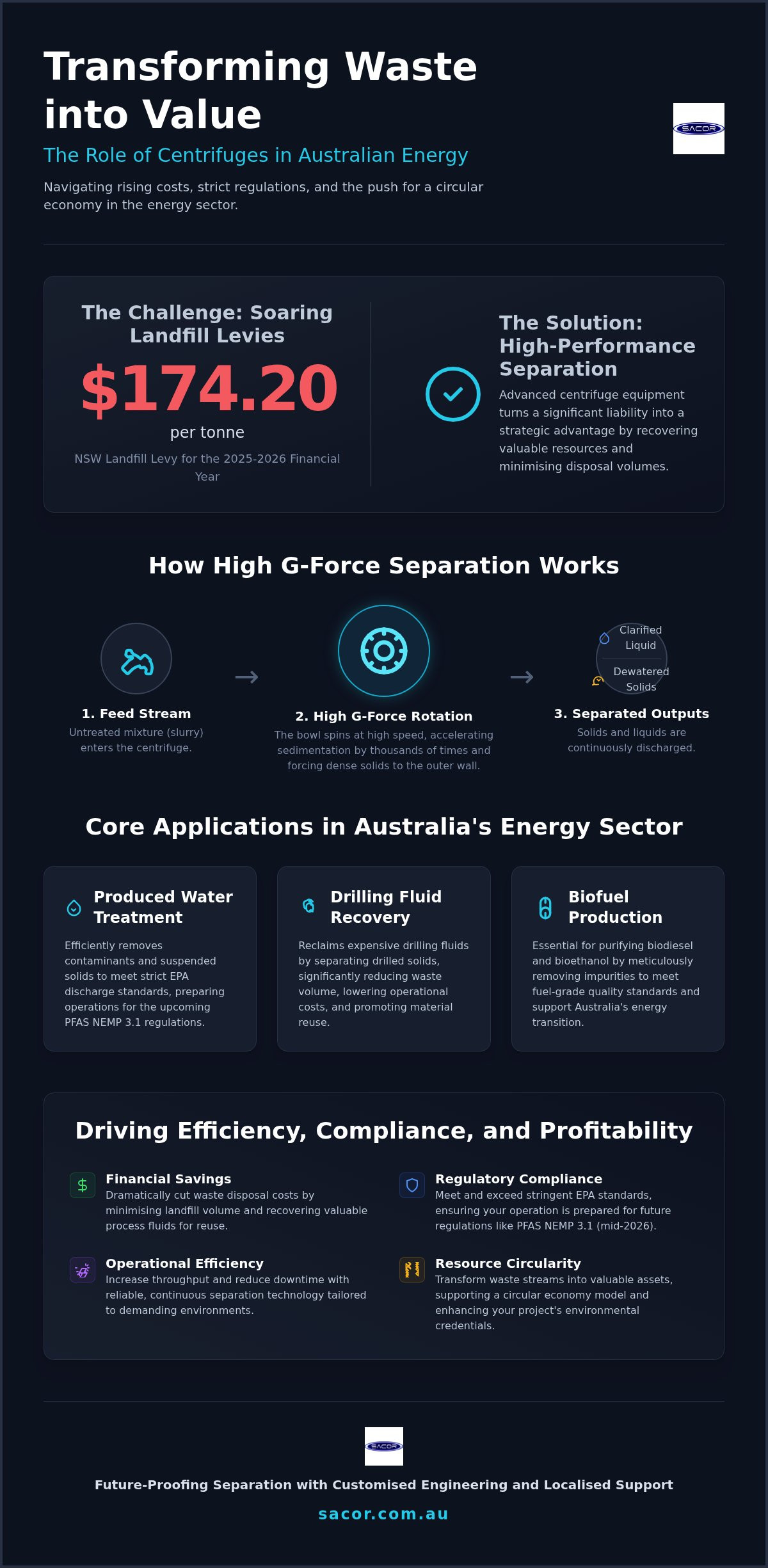
With landfill levies in New South Wales reaching $174.20 per tonne for the 2025-2026 financial year, the cost of industrial waste disposal has shifted from a standard line item to a significant strategic liability. Plant managers and engineers across the country understand that managing produced water and tailings is no longer just a matter of operational throughput; it’s a complex challenge of regulatory compliance and cost containment. Integrating high-performance energy sector centrifuge equipment into your process flow is the most effective way to address these pressures while securing long-term project viability.
This guide explores how advanced centrifugal separation technology optimises resource recovery, ensures strict adherence to updated EPA standards, and reduces operational overheads across the Australian energy landscape. We’ll examine the technical configurations necessary for high-volume separation, the implications of the PFAS NEMP 3.1 on water treatment, and the role of localised maintenance in ensuring equipment reliability in remote environments. By prioritising precision and performance, your operation can transform waste streams into valuable recovered assets while meeting the highest environmental benchmarks.
Key Takeaways
- Understand how the transition from waste disposal to resource recovery is driving the adoption of high-efficiency energy sector centrifuge equipment to improve circularity in Australian operations.
- Learn the mechanical principles of high G-force sedimentation and how decanter centrifuge designs effectively manage high-volume feed streams in demanding environments.
- Identify strategies to mitigate rising landfill levies and meet stringent EPA standards through the precise treatment of produced water and drilling fluids.
- Discover the essential criteria for selecting separation technology based on specific solids concentrations and throughput requirements for remote energy sites.
- Recognise the value of a partnership-based approach that combines customised engineering with localised maintenance support to ensure long-term equipment reliability.
The Critical Role of Centrifuge Equipment in the Australian Energy Sector
The Australian energy sector is undergoing a fundamental transformation as operators balance traditional production with the rapid expansion of alternative fuels. This shift has elevated the requirement for high-efficiency energy sector centrifuge equipment from a peripheral utility to a core strategic asset. Modern industrial separation focuses on resource recovery and circularity rather than simple waste disposal. This allows companies to reclaim valuable fluids and reduce the volume of material destined for landfill. Efficiency is the priority. By reclaiming drilling fluids or treating produced water at the source, plants can significantly lower their environmental impact while maintaining high output.
Inefficient separation directly impacts operational expenditure through inflated waste management costs and increased downtime. It’s a costly oversight. With landfill levies in New South Wales reaching $174.20 per tonne in the 2025-2026 period, the financial incentive to minimise waste through mechanical dewatering is undeniable. By understanding How Decanter Centrifuges Work, engineers can better appreciate how these systems use high G-forces to accelerate sedimentation. These systems provide a robust solution for both offshore gas projects and onshore mining exploration, ensuring that solids are removed with precision before disposal or reuse.
Meeting Australian Environmental and EPA Standards
The regulatory environment for industrial discharge is becoming increasingly stringent, particularly with the release of the PFAS National Environmental Management Plan (NEMP) 3.1 in mid-2026. This updated framework demands higher precision in managing contaminants within produced water and tailings. Decanter Centrifuge Systems enable operators to pursue “zero discharge” objectives by effectively separating solids from liquid streams. This capability significantly reduces the environmental footprint of energy production. This level of control ensures compliance with state-based regulations while protecting the surrounding ecosystem from hazardous runoff.
From Fossil Fuels to Biofuels: A Versatile Technology
As Australia’s alternative energy infrastructure grows, centrifugal technology is proving essential for the production of biodiesel and bioethanol. These processes require the meticulous removal of impurities and contaminants to meet fuel-grade quality standards. Sacor Australia provides specialised energy sector centrifuge equipment designed to handle the specific feed characteristics of biomass and organic oils. By adapting proven separation principles to the biofuels sector, we support a transition that maintains high performance while advancing national sustainability targets. This versatility ensures that our Energy and Oil Separation Solutions remain relevant across the entire energy spectrum. The same centrifugal principles that drive performance in energy applications are equally transformative in primary industries, where agriculture separation equipment Australia operators rely on is helping convert organic waste streams into high-value recovered assets.
Technical Fundamentals: How Energy Sector Centrifuges Work
Industrial centrifugation is defined by its ability to amplify sedimentation rates through the application of high G-force. While gravity settling relies on natural density differences over time, energy sector centrifuge equipment accelerates this process by several thousand magnitudes. This mechanical intervention is essential for separating fine particles that would otherwise remain suspended in viscous fluids. The core mechanics involve a solid bowl rotating at high speeds, which forces heavier solids against the internal wall. An internal scroll conveyor rotates at a slightly different speed to continuously discharge these solids, while the clarified liquid exits through the opposite end.
Efficiency depends on three primary variables: fluid viscosity, particle density, and required throughput. High viscosity acts as a resistance to particle movement, requiring higher G-forces to achieve clarity. In energy applications, where feed characteristics can fluctuate rapidly, the ability to adjust bowl speed and scroll differential is vital for maintaining consistent output quality. This level of control allows operators to handle high-volume streams without sacrificing the precision of the separation.
Two-Phase vs. Three-Phase Separation Explained
Determining the correct configuration depends on the number of phases present in the raw feed. Two-phase systems are standard for simple solid-liquid separation, such as dewatering coal tailings or processing industrial sludge. However, energy sector streams often contain two immiscible liquids, typically oil and water, alongside solid contaminants. This requires a more sophisticated mechanical approach to ensure each component is recovered or disposed of correctly.
Three-phase centrifuges are engineered to handle these complex mixtures simultaneously. They utilise a modified bowl design that allows for the separate discharge of the light liquid phase (oil) and the heavy liquid phase (water) while removing solids. Specifying Three-Phase Centrifuge Systems is necessary for oil recovery projects where maximum purity of the reclaimed hydrocarbon is the primary objective. This configuration is a critical component for operations aiming to reduce waste volumes while maximising the value of recovered resources.
The Engineering Behind High-Performance Decanters
The performance of a decanter is heavily influenced by its bowl geometry. A longer bowl increases the residence time, allowing finer particles more opportunity to reach the bowl wall before the liquid is discharged. This is particularly important for energy feeds where particle sizes are inconsistently distributed. The relationship between the length and diameter of the bowl, often referred to as the L/D ratio, is a key metric in engineering a system for specific site conditions.
The internal scroll manages the dryness of the discharged solids, known as the cake. In abrasive energy environments, these components are often constructed from hardened materials or coated with tungsten carbide to resist wear. Reliability is non-negotiable. Using high-grade duplex stainless steel ensures the energy sector centrifuge equipment can withstand the corrosive nature of produced water and chemical additives. This robust construction minimises the risk of unplanned downtime in remote Australian locations.
Primary Applications: Produced Water, Drilling Fluids, and Beyond
The application of energy sector centrifuge equipment extends across the entire production lifecycle, from initial drilling to final fuel refining. In large-scale operations, managing produced water remains the most significant volume-based challenge. High-capacity decanters are used to remove suspended solids and oil traces, ensuring the water meets strict environmental standards for discharge or reinjection. Similarly, drilling fluid recovery relies on precise separation to maintain mud properties. By reclaiming water-based drilling fluids, major Australian sites have achieved reuse rates between 40% and 60%. This significantly lowers the demand for fresh water and reduces disposal costs in remote locations.
Protecting downstream infrastructure is another critical application for centrifugal technology. Crude oil dehydration and desanding processes use high G-force to remove water and abrasive particles that would otherwise damage pumps and refineries. For legacy waste management, slop oil treatment allows operators to recover valuable hydrocarbons from waste pits and lagoons. This process transforms a hazardous environmental liability into a refined, sellable asset while reducing the overall volume of waste requiring expensive remediation. These systems are essential for maintaining the operational integrity of high-capital energy assets.
Optimising Produced Water for Reuse or Discharge
In the water-scarce environments of remote Australia, every litre of recovered water represents a saving in operational logistics and environmental impact. Centrifuges are used to strip oil and fine silt from produced water streams, enabling the water to be reused for dust suppression or cooling processes. For operations seeking to meet BS&W standards and protect reservoir permeability, a dedicated produced water treatment centrifuge strategy is essential for achieving compliance and long-term cost efficiency. This integration is most effective when paired with a broader industrial decanter centrifuge Australia strategy. By achieving high clarity in the liquid phase, operators can confidently meet the stringent discharge limits set by state-based EPA authorities, avoiding the penalties associated with non-compliance.
Biofuel Clarification and Biodiesel Washing
The transition toward renewable energy has increased the demand for high-purity biofuel clarification. During the transesterification process, centrifuges are used to separate glycerine from biodiesel with high precision. This step is vital for removing fine catalysts and organic impurities that would otherwise compromise fuel-grade quality. Efficient separation improves the overall yield of the plant and reduces the volume of wash water required for purification. Sacor supports this growing sector by providing specialised energy sector centrifuge equipment that handles the specific viscosities and chemical characteristics of bio-based feedstocks.
Selection Criteria for Remote Energy Operations
Selecting energy sector centrifuge equipment for remote Australian sites involves more than matching technical specs; it requires a deep understanding of logistical isolation and environmental variables. Feed characteristics, specifically solids concentration and liquid densities, dictate the mechanical torque and G-force requirements. Matching bowl size to peak flow rates is essential to prevent bottlenecks during periods of high production. For temporary projects or exploration sites, skid-mounted units offer the necessary mobility, whereas permanent installations are better suited for long-term production facilities. Modern systems in 2026 prioritise automation and integrated control panels, allowing plant managers to monitor performance and adjust differential speeds remotely. This is critical when on-site technical expertise is limited by distance.
Durability and Maintenance in Harsh Australian Climates
Remote energy operations face extreme heat, abrasive dust, and the demand for continuous 24/7 operation. Reliability is built on a foundation of proactive planning and robust engineering. Access to industrial centrifuge spare parts Australia is a non-negotiable requirement to prevent weeks of downtime caused by international shipping delays or supply chain disruptions. We recommend a scheduled maintenance strategy over reactive repairs to ensure operational continuity in the Pilbara or the Surat Basin. This approach allows for the replacement of wear components, such as seals and bearings, before they reach a failure point. It protects the high-value internal components of the centrifuge from catastrophic damage.
Total Cost of Ownership (TCO) Analysis
A thorough TCO analysis balances the initial capital investment against long-term energy and chemical efficiencies. High-performance dewatering significantly reduces the volume of waste material, which directly lowers transport and disposal costs for a sludge dewatering centrifuge Australia. While off-the-shelf units may have a lower purchase price, customised engineering often provides a superior ROI by optimising the machine for specific feed characteristics. This precision leads to drier cake discharge and clearer centrate, reducing the need for secondary treatment and expensive polymer additives. Investing in a system designed for your specific throughput requirements ensures the lowest cost per cubic metre of treated fluid over the equipment’s lifecycle.
To discuss a customised configuration for your site, contact our engineering team for a technical consultation.
Future-Proofing Separation with Sacor Australia
Sacor Australia establishes itself as a seasoned technical authority within the national energy landscape, providing more than just industrial machinery. We operate on a partnership model that prioritises long-term operational success over simple transactions. Selecting high-performance energy sector centrifuge equipment involves a methodical progression from initial feed analysis to customised engineering. This ensures that every system is purpose-built to handle the specific densities, viscosities, and solids concentrations of your site. By anchoring our innovation in practical outcomes, we help operators achieve the circularity targets that are now essential for maintaining a social licence to operate in 2026.
Our commitment to sustainable industrial practice is reflected in our national support network. From our base in Mandurah, we provide national supply and installation coverage, ensuring that even the most remote projects have access to specialist expertise. This presence is vital for mitigating the risks associated with equipment downtime. By integrating precision separation into your core processes, your operation can effectively manage the rising costs of waste disposal while maximising the recovery of valuable resources. We view our role not merely as a vendor, but as a trusted partner working alongside you to solve complex industrial challenges.
Customised Engineering for Unique Feed Streams
A “one size fits all” approach inevitably fails in the complex applications of the energy sector. Feed characteristics are rarely static. Site conditions can shift rapidly, requiring equipment that is precisely calibrated to specific throughput and clarity requirements. Sacor’s engineering process involves a detailed assessment of your unique feed streams to determine the optimal bowl geometry and scroll configuration. For instance, major Australian mining sites have utilised our technology to achieve drilling fluid reuse rates of 40% to 60%, significantly reducing their environmental footprint. Operators managing high-density mud systems can further reduce operational costs by implementing a dedicated barite recovery centrifuge Australia strategy to reclaim weighting agents and maintain stable fluid rheology. This level of performance is only possible through bespoke engineering that accounts for real-world variables.
Installation, Commissioning, and Ongoing Technical Support
Seamless integration into existing plant infrastructure is critical for maintaining production schedules. Our team provides full technical documentation and commissioning support to ensure that every system operates at peak efficiency from day one. We don’t just install the equipment; we provide the training necessary for on-site personnel to manage and optimise the separation process. To protect your capital investment, we offer a comprehensive centrifuge maintenance service Australia. This structured approach to asset health ensures consistent reliability and extends the operational life of your energy sector centrifuge equipment, providing peace of mind in high-stakes environments.
Securing Operational Excellence in the Australian Energy Landscape
The integration of advanced separation technology is no longer a luxury for Australian operators; it’s a fundamental requirement for maintaining profitability and compliance. As landfill levies rise and environmental standards like the PFAS NEMP 3.1 become more stringent, the ability to recover resources and reduce waste volumes is essential. High-performance energy sector centrifuge equipment provides the precision needed to handle complex feed streams while protecting downstream assets from wear and contamination.
Achieving these results requires a partnership with a technical authority that understands the logistical challenges of remote Australian sites. Sacor offers customised engineering tailored to your specific application, backed by national supply and a robust maintenance network to ensure long-term reliability. By prioritising precision separation today, you position your operation for a sustainable and efficient future. Access to local technical support and a consistent supply of industrial centrifuge spare parts Australia ensures your equipment remains a high-performing asset for years to come.
Discuss your energy sector separation requirements with Sacor Australia to ensure your plant is equipped for the challenges of 2026 and beyond.
Frequently Asked Questions
What is the primary difference between a decanter centrifuge and a disc separator in the energy sector?
The primary difference lies in the solids-handling capacity and the level of G-force generated. Decanter centrifuges are designed for feed streams with high solids concentrations, such as coal tailings or sludge dewatering. Disc separators are utilised for polishing liquids with very low solids content, typically less than 1%. While decanters provide continuous discharge of heavy solids, disc separators offer higher centrifugal force to remove extremely fine particles and separate liquid phases with minimal density differences.
How does a three-phase centrifuge improve oil recovery in oilfield operations?
A three-phase centrifuge improves oil recovery by simultaneously separating two immiscible liquid phases and one solid phase in a single pass. In oilfield operations, this allows for the immediate reclamation of hydrocarbons from produced water or slop oil. By precisely adjusting the pond depth and differential speed, operators can maximise the purity of the recovered oil. This efficiency reduces the need for secondary chemical treatment and lowers the total volume of waste requiring disposal.
Can centrifuge equipment handle the abrasive solids found in drilling fluids?
Modern energy sector centrifuge equipment is specifically engineered to handle abrasive solids through the use of advanced wear protection. Components such as the scroll flights and discharge ports are often reinforced with tungsten carbide tiles or hard-faced coatings. This robust construction is essential for processing drilling muds that contain high concentrations of sand and silt. These features ensure the equipment maintains performance levels even when subjected to the high-wear environments typical of Australian drilling operations. For operations using weighted muds, understanding how to optimise barite recovery centrifuge Australia configurations is essential for reclaiming valuable weighting agents and reducing mud replacement costs.
What are the typical maintenance requirements for a centrifuge on a remote Australian energy site?
Maintenance on remote Australian sites focuses on proactive lubrication, vibration monitoring, and regular inspection of wear components. Given the isolation, it’s vital to maintain a local inventory of critical spare parts such as bearings and seals. Scheduled service intervals typically include checking the gearbox oil levels and inspecting the scroll for signs of erosion. These routine actions prevent minor wear from escalating into catastrophic failures, ensuring the centrifuge remains operational in harsh, 24/7 environments.
How do centrifuges help energy companies comply with Australian EPA discharge regulations?
Centrifuges assist in EPA compliance by removing suspended solids and oil traces from industrial wastewater to meet specific discharge thresholds. This is particularly relevant for managing produced water under the 2026 PFAS NEMP 3.1 guidelines. By achieving high clarity in the liquid phase, companies can safely discharge treated water or reuse it for on-site processes. This mechanical separation reduces the reliance on evaporation ponds and minimises the risk of environmental contamination and subsequent regulatory penalties.
Is it possible to customise a centrifuge for specific fluid densities or temperatures?
Customisation is a standard part of the engineering process for energy sector centrifuge equipment. Systems can be calibrated to handle specific fluid densities by adjusting the bowl geometry and motor torque. For high-temperature applications, such as processing heavy crude or bitumen, centrifuges can be equipped with specialised seals and insulation. This bespoke approach ensures that the equipment operates at peak efficiency regardless of the thermal or physical characteristics of the feed stream.
What is the expected lifespan of industrial centrifuge equipment in the energy sector?
The expected lifespan of high-quality industrial centrifuge equipment is typically between 15 and 25 years when supported by a consistent maintenance regime. While wear components like seals and bearings require periodic replacement, the core structural elements such as the stainless steel bowl and frame are designed for long-term durability. Investing in robust engineering and localised technical support ensures the asset continues to deliver a high return on investment throughout its extended operational life in the energy sector. The same principles of durability and precision that define high-performance energy centrifuges are equally critical when evaluating agriculture separation equipment Australia producers depend on to manage organic waste streams and recover valuable by-products across remote primary industry sites.