
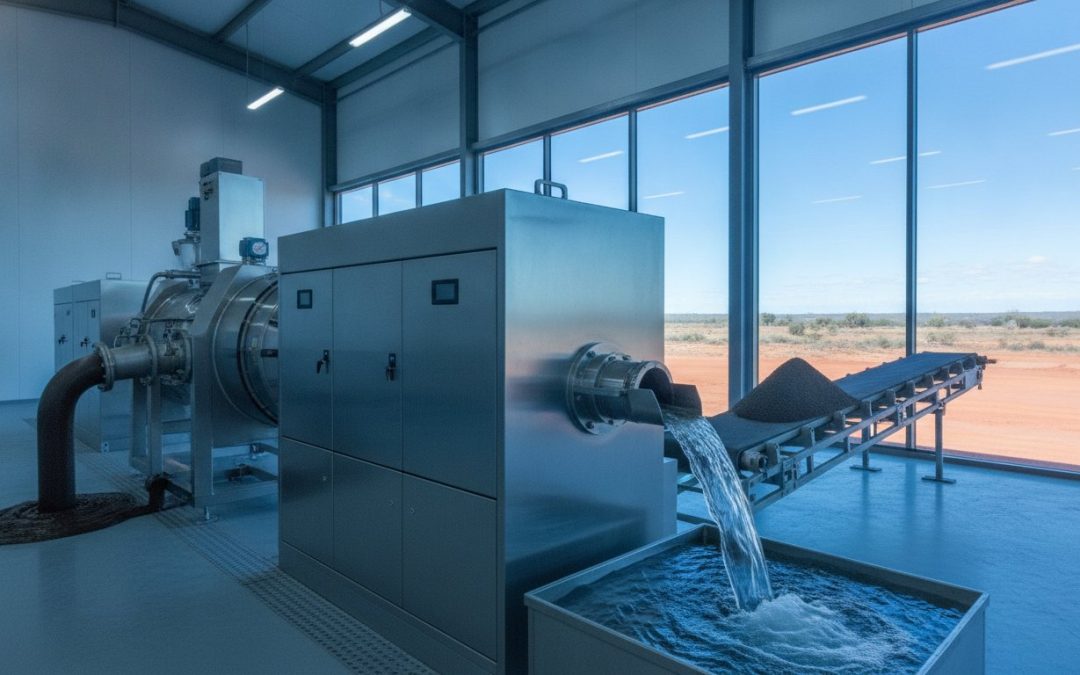
With landfill levies in prominent industrial states reaching A$174.20 per tonne for the 2025-2026 financial year, the financial penalty for transporting water-heavy waste has never been more severe. Industrial operations across the country are facing a tightening regulatory squeeze as PFAS limits and biosolids purification standards become significantly more demanding. You likely already know that hauling wet sludge is an inefficient use of your operational budget, yet achieving the required dryness often feels like a constant battle against equipment downtime and rising chemical costs.
This 2026 guide explores how an advanced sludge dewatering centrifuge Australia provides the technical precision needed to optimise your separation processes and ensure long-term regulatory compliance. We will detail how modern decanter technology reduces disposal volumes by up to 30 per cent, automates complex workflows to lower labour requirements, and establishes the robust maintenance frameworks essential for remote Australian sites. By the end of this article, you will understand how to leverage these systems as strategic tools for both cost control and environmental stewardship.
Key Takeaways
- Understand how high-performance decanter technology reduces waste volume to mitigate the impact of rising state landfill levies and haulage fees.
- Explore the mechanical principles of centrifugal G-force and how continuous discharge systems outperform traditional batch-based separation methods.
- Evaluate the performance benchmarks of a sludge dewatering centrifuge Australia against belt and screw presses to determine the best fit for your site’s cake dryness requirements.
- Identify sector-specific applications, particularly within the Australian mining and wastewater industries, where precision separation is critical for regulatory compliance.
- Learn the strategic importance of custom engineering design and pilot feed analysis to ensure your system is optimised for your specific industrial waste characteristics.
Understanding Sludge Dewatering Centrifuges in the Australian Context
Sludge dewatering is the mechanical process of separating liquid from solid waste streams to produce a stackable, dry cake and a clarified liquid effluent. In the Australian industrial landscape, this isn’t merely a waste management step; it’s a critical financial and environmental strategy. Implementing a high-performance sludge dewatering centrifuge Australia allows sites to significantly reduce the mass of their waste. This volume reduction is vital because of the immense distances and high haulage costs associated with transporting wet sludge to disposal facilities. As the industry shifts towards a waste-to-value model, the focus has moved from simple disposal to extracting reusable resources from process streams.
The decanter centrifuge has emerged as the primary technology for this task because it offers continuous, high-volume separation that batch systems cannot match. These systems are now essential in sectors ranging from municipal wastewater to heavy mining, where they help operators meet the “polluter pays” obligations that define modern Australian environmental law.
Why Dewatering Efficiency Matters for Your Bottom Line
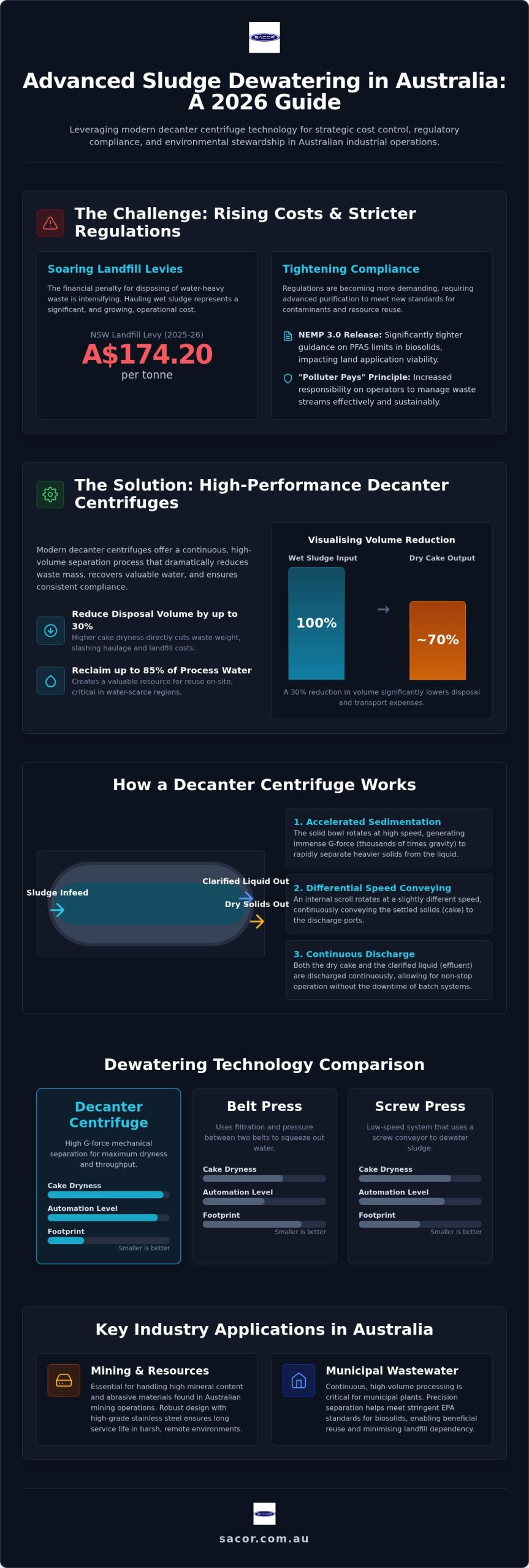
The financial impact of dewatering efficiency is most visible in disposal fees. With metropolitan landfill levies in Victoria at A$169.79 per tonne and New South Wales reaching A$174.20 per tonne for 2025-2026, every percentage point of moisture removed directly improves project margins. A higher cake dryness reduces the total weight and volume of waste, which slashes the number of truck movements required for disposal.
Beyond disposal, water recovery provides a secondary economic benefit. In water-scarce regions, the ability to reclaim up to 85 per cent of process water for reuse on-site reduces the reliance on expensive mains water or limited groundwater allocations. This efficiency also ensures compliance with strict EPA standards. With the March 2025 release of NEMP 3.0, the guidance for PFAS limits in biosolids has tightened significantly. High-performance separation is now a prerequisite for meeting these contaminant thresholds and ensuring that biosolids remain viable for beneficial reuse on farmland.
The Core Components of a Decanter Centrifuge
A decanter centrifuge consists of three primary elements: the solid bowl, the internal scroll or conveyor, and the drive system. The bowl rotates at high speeds to create the centrifugal force necessary for accelerated sedimentation. Inside, the scroll rotates at a slightly different speed to continuously push the settled solids toward the discharge ports.
These components must be precisely engineered to handle varying sludge densities and abrasive materials. Because Australian sites often deal with high mineral content or saline environments, using high-grade stainless steel for all wetted parts is essential. This material choice prevents corrosion and ensures the equipment maintains its structural integrity over a long service life, even in the most demanding remote locations. Reliable drive systems allow for fine-tuning of the differential speed, which gives operators the flexibility to adapt to changing feed characteristics without stopping production.
The Mechanics of High-Performance Centrifugal Separation
Centrifugal separation relies on the density difference between solids and liquids to achieve effective waste reduction. High-performance sludge dewatering centrifuge Australia systems use rapid rotation to amplify gravity by thousands of times. This process, known as accelerated sedimentation, forces heavier solids to the bowl wall while the clarified liquid remains in the centre. Unlike batch systems that require frequent stop-start cycles, a decanter operates with a continuous feed and discharge. This ensures a steady production flow. It’s essential for large-scale industrial or municipal operations that cannot afford the downtime of manual cleaning or intermittent processing.
The relationship between the bowl and the internal scroll is managed through differential speed. This speed difference determines how long solids remain in the bowl. A lower differential speed increases the residence time, which typically results in a drier cake. However, managing this requires sophisticated torque control. When feed concentrations fluctuate, the torque on the scroll increases. Modern systems automatically adjust the differential speed to maintain a consistent cake dryness while protecting the drive system from mechanical overload. This level of automation is a primary reason why centrifuges are preferred for variable waste streams.
G-Force and Its Impact on Separation Efficiency
G-force is a direct result of the bowl’s rotational speed and diameter. Higher G-force levels are often necessary when dealing with fine, biological, or greasy sludges that resist settling under normal gravity. While increasing speed improves separation quality, it also accelerates wear on the internal components. Achieving the right balance is a matter of engineering precision. Professionals often recommend customised separation solutions that match the G-force to the specific abrasive characteristics of the feed material to extend equipment longevity.
Flocculant Optimisation and Chemical Management
Effective separation often depends on chemical pre-treatment to enhance the settling rate. Flocculation is the process of binding small particles into larger ‘flocs’ for easier separation. Centrifuges often reduce total chemical consumption because the high G-force compensates for smaller floc sizes that would fail in a belt press or screw press. By optimising the interaction between polymer dosing and centrifugal force, operators can achieve high capture rates with lower polymer costs. This precision is particularly beneficial for Australian sites where chemical transport costs add a significant layer to the total operational budget. Plant managers seeking to further improve solid liquid separation efficiency through precise bowl speed control and chemical flocculation synergy will find that addressing these mechanical and chemical variables together delivers the greatest gains in throughput and cake dryness.
Comparing Dewatering Technologies: Centrifuges vs. Alternative Systems
Selecting the most effective dewatering technology requires a comprehensive evaluation of the total cost of ownership. While initial capital expenditure is a factor, the long-term operational expenses, including labour, chemical dosing, and transport, dictate the true value of the investment. A sludge dewatering centrifuge Australia often presents the most balanced solution for modern facilities seeking to minimise their environmental footprint while maximising throughput. This technology excels in its ability to produce a consistently dry cake across a wide range of feed concentrations, which is a critical requirement for offsetting the high landfill levies currently seen across the country.
Decanter Centrifuges vs. Belt Filter Presses
Belt filter presses are open systems that occupy a significant physical footprint. They typically require substantial civil engineering works to accommodate their size and drainage needs. In contrast, decanter centrifuges are compact and fully enclosed. This enclosure is a decisive advantage for municipal sites or food processing plants where odour control and hygiene are primary concerns. From a maintenance perspective, belt presses suffer from frequent belt wear and require constant washwater to prevent blinding. Centrifuges are engineered for continuous uptime and use significantly less water for cleaning cycles, making them the more sustainable choice for water-scarce regions.
Decanter Centrifuges vs. Screw Presses
Screw presses are often noted for their low energy consumption, yet this benefit comes at the cost of throughput and versatility. For high-volume industrial streams, particularly in the mining or energy sectors, the screw press often lacks the processing speed required to maintain production targets. Centrifuges offer superior versatility, handling abrasive mining slurries and soft biological sludges with equal precision. While the power draw of a centrifuge is higher, the investment is justified through significantly higher solids recovery and cake dryness. Achieving a drier cake is essential for reducing the total mass of waste. This directly lowers the haulage fees that currently dominate Australian disposal budgets.
The labour requirements of these systems also vary significantly. Belt presses often require frequent manual supervision to manage belt tracking and sludge distribution. A decanter centrifuge system is designed for full automation. Once the system is calibrated to the site’s specific feed characteristics, it manages fluctuations in feed density without operator intervention. This automated reliability allows plant managers to reallocate labour to higher-value technical tasks, further reducing the total operational cost per tonne of processed sludge. For facilities looking to move beyond basic compliance toward a proactive resource recovery model, exploring sustainable dewatering solutions Australia wide is an essential next step in evaluating the full strategic value of modern centrifugal technology.
Key Industry Applications for Sludge Dewatering in Australia
Australia’s industrial landscape requires robust separation solutions that can withstand harsh environments and diverse waste characteristics. From the arid Pilbara to urban treatment plants, the sludge dewatering centrifuge Australia serves as a versatile tool for volume reduction and resource recovery. By adapting centrifugal force to specific feed densities, operators can transform liquid waste into manageable, stackable solids. This versatility is essential for maintaining production targets while adhering to the “polluter pays” frameworks that govern modern Australian industry.
Mining and Mineral Processing Tailings
The 2025 conformance deadline for the Global Industry Standard on Tailings Management (GISTM) has fundamentally changed how major mining operators approach waste. High-performance separation is now a safety requirement to reduce the risks associated with traditional tailings dams. By implementing a decanter centrifuge mining Australia, sites can reclaim up to 85 per cent of process water. This is a critical advantage in arid regions where water scarcity directly impacts production capacity. These systems are engineered to handle high-density, abrasive slurries, producing a dry cake that significantly minimises the physical footprint of tailings storage facilities.
Municipal Wastewater and Biosolids
In the wastewater sector, the focus has shifted toward meeting the stringent contaminant limits established by the National Environmental Management Plan (NEMP) 3.0, released in March 2025. This plan introduced tighter guidance for PFAS levels in biosolids, making efficient dewatering essential for agricultural compliance. A wastewater treatment centrifuge Australia allows operators to achieve the high cake dryness required for Grade A biosolids classification. Enclosed systems also provide superior odour and noise control. This is vital for facilities located near residential areas in growing metropolitan hubs like Sydney or Melbourne.
Food, Beverage, and Agricultural Rendering
The food and energy sectors often require three-phase separation to manage complex waste streams. In rendering and animal by-product processing, centrifuges are used to separate fats, oils, and greases (FOG) from solids and water. This process maximises the yield of valuable by-products while ensuring that discharge water meets environmental standards. Maintaining hygiene is non-negotiable. These systems are designed with Clean-in-Place (CIP) capabilities, allowing for thorough internal cleaning without dismantling the equipment. This ensures compliance with Australian food safety regulations and prevents cross-contamination between batches. Facilities seeking to protect product yield and meet rigorous hygiene standards will find that a purpose-built decanter centrifuge for food processing Australia delivers the precision and automation required to move beyond traditional filtration limitations.
Explore our range of Decanter Centrifuge Systems to find a solution tailored to your sector’s specific demands.
Strategic Implementation: Commissioning and Maintaining Centrifuge Systems
Implementing a sludge dewatering centrifuge Australia requires more than just procurement; it demands a rigorous engineering approach tailored to the unique variables of the site. Successful dewatering starts with industrial decanter centrifuge Australia engineering design. This phase ensures that the system’s capacity, metallurgy, and drive configuration are perfectly aligned with the operational objectives and feed characteristics. When the design phase is neglected, even the most advanced equipment will struggle to meet performance targets or withstand the rigours of continuous industrial use.
Before any equipment is installed, conducting thorough pilot testing and feed analysis is essential. This data-driven approach allows engineers to predict how the sludge will behave under high G-force conditions. It identifies potential issues such as fluctuating solids concentrations or the presence of abrasive minerals that could accelerate wear. By validating performance through testing, operators can avoid the costly mistakes of undersized equipment or inefficient chemical dosing strategies. It’s a necessary step to ensure the chosen system delivers the promised cake dryness and capture rates.
Custom Engineering for Site-Specific Requirements
Standardised equipment often fails to meet the demands of Australian environmental extremes. Custom engineering must account for high ambient temperatures, pervasive dust, and humidity levels that can compromise electrical components and cooling systems. Scroll designs and bowl metallurgy are selected based on the abrasiveness of the feed material. For instance, tungsten carbide tiling or hard-surfacing is often applied to components handling mineral-rich slurries to prevent premature erosion. Integration into existing plant SCADA and control systems is also a priority. This allows for remote monitoring and real-time adjustments, which are vital for maintaining efficiency in unmanned or remote locations where on-site intervention is difficult. Operators in the oil, gas, and renewables sectors managing produced water and drilling waste will find that purpose-built energy sector centrifuge equipment addresses these same remote-site engineering challenges while meeting the updated PFAS and EPA compliance requirements specific to their industry.
Maintenance and Technical Support in Australia
Reliability is the cornerstone of industrial separation. A proactive maintenance schedule for a sludge dewatering centrifuge Australia is the best defence against unplanned shutdowns. This programme should include scheduled vibration analysis and bearing inspections. Vibration sensors provide early warnings of imbalance or mechanical wear, allowing for repairs during scheduled downtime rather than during peak production cycles.
Ensuring rapid access to critical spare parts is equally important for maintaining uptime. In remote Australian regions, waiting weeks for international shipping is not a viable option. A local technical support network ensures that expertise and components are available when needed. This partnership approach to maintenance helps extend the service life of the equipment and ensures that the separation process remains optimised for the life of the asset.
Contact Sacor today to discuss a customised dewatering solution for your site.
Optimising Your Industrial Separation Strategy for 2026
The transition toward more efficient sludge management is no longer optional for Australian industrial operators facing rising disposal costs and tightening environmental standards. By prioritising high cake dryness and automated process control, you can significantly reduce the financial burden of landfill levies while ensuring your site remains compliant with the latest NEMP 3.0 guidelines. Investing in a high-performance sludge dewatering centrifuge Australia provides the mechanical precision needed to handle variable waste streams with minimal chemical consumption and maximum water recovery.
Achieving these results requires a partner who understands the specific challenges of the local landscape. Sacor delivers bespoke engineering for unique process feeds and maintains a comprehensive spare parts inventory to ensure your operations remain consistent. Our specialised Australian technical support team is ready to help you transition from simple waste disposal to a strategic resource recovery model. Request a Technical Consultation with Sacor’s Engineering Team to begin optimising your separation efficiency. We look forward to working alongside you to achieve your operational and sustainability goals.
Frequently Asked Questions
What is the primary difference between a decanter and a centrifuge?
A decanter is a horizontal centrifuge specifically engineered for the continuous separation of solids from a liquid feed. While “centrifuge” is a broad category including disc stack separators, the decanter uses an internal screw conveyor to discharge solids while the machine is running. This design allows for high-volume processing without the need for the batch cleaning cycles common in other centrifugal equipment.
How does a sludge dewatering centrifuge improve operational efficiency?
A sludge dewatering centrifuge Australia improves efficiency by maximising volume reduction. By producing a drier cake, it reduces the total weight of waste destined for disposal, which directly lowers the haulage fees associated with Australian landfill levies. Automation also reduces the need for manual operator intervention, allowing for consistent performance even when feed concentrations fluctuate during a production cycle.
What are the typical maintenance requirements for industrial centrifuges in Australia?
Proactive maintenance for industrial centrifuges involves scheduled vibration analysis, bearing inspections, and regular lubrication. Operators must also monitor the wear on the internal scroll, particularly when processing abrasive mineral slurries. Establishing a consistent maintenance schedule prevents unplanned shutdowns and extends the service life of the equipment, which is critical for maintaining production targets in remote or high-demand environments.
Can decanter centrifuges handle high-volume tailings in mining operations?
Decanter centrifuges are specifically engineered to handle high-volume mining tailings and abrasive slurries. These systems often feature tungsten carbide protection on high-wear areas to withstand the density of mineral solids. By dewatering tailings before storage, mining operators can reclaim up to 85 per cent of process water and reduce the physical footprint of their tailings storage facilities.
What level of cake solids percentage can I expect from a sludge centrifuge?
The expected cake solids percentage depends on the specific characteristics of the feed material. For municipal biological sludge, a centrifuge typically achieves between 18 and 30 per cent solids. In mineral or inorganic applications, the percentage can be significantly higher. Conducting a pilot feed analysis before installation is the most reliable way to determine the exact performance benchmarks for your site’s waste stream.
How do centrifuges compare to belt filter presses regarding energy consumption?
While centrifuges generally have a higher power draw than belt filter presses, they offer a lower total cost of ownership through reduced washwater consumption and labour requirements. The enclosed design also prevents odour issues and eliminates the need for frequent belt replacements. The energy investment is often justified by the superior cake dryness achieved, which provides greater savings in transport and disposal fees.
Are spare parts for decanter centrifuges readily available for remote Australian sites?
Sacor maintains a comprehensive inventory of critical spare parts within Australia to ensure rapid dispatch to remote sites. We recognise that equipment downtime in isolated locations can be costly, so we prioritise the availability of bearings, seals, and scroll components. Our national technical support network is structured to provide the expertise needed to minimise operational interruptions regardless of your site’s location.
Does Sacor provide installation and commissioning services for new centrifuge systems?
Sacor provides full installation and commissioning services as part of our end-to-end separation solutions. Our engineering team works alongside your site personnel to integrate the sludge dewatering centrifuge Australia into your existing plant infrastructure and SCADA systems. This ensures that the equipment is calibrated correctly from day one to meet your specific performance and environmental compliance targets.