
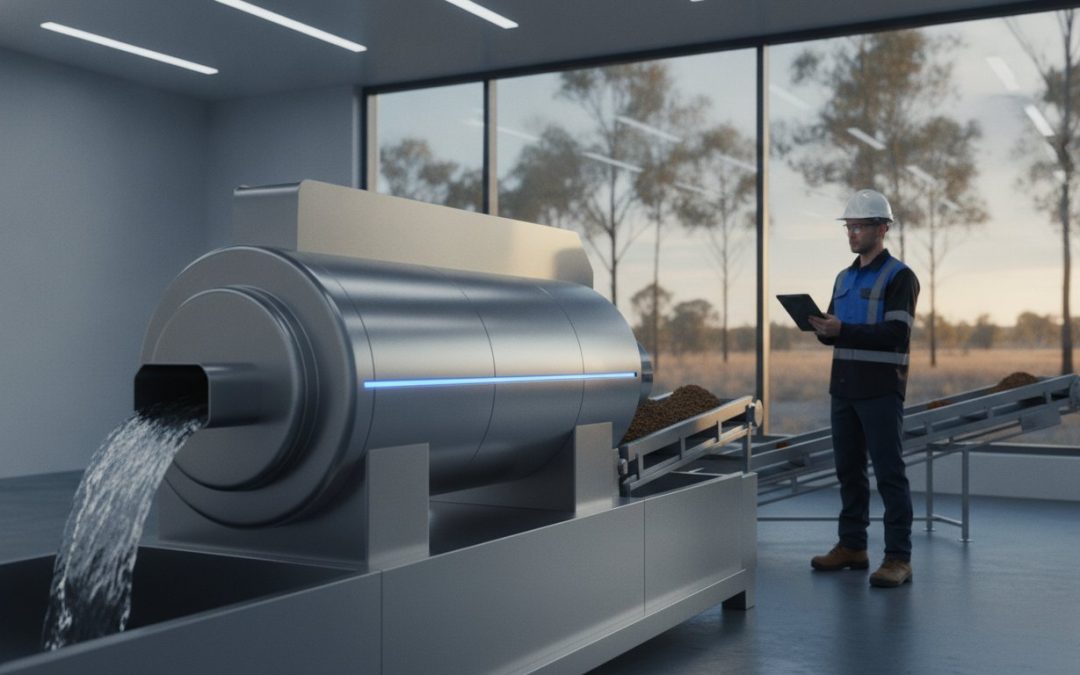
By 2026, the decanter centrifuge has transitioned from a standard piece of separation hardware into a critical strategic asset for any facility facing the “polluter pays” reality. Plant managers across the country recognise that legacy dewatering methods can’t keep pace with the 2025 mandate for the Global Industry Standard on Tailings Management or the tightening Health Regulations impacting facilities nationwide. You’re likely feeling the pressure of rising transport costs and the urgent need for better nutrient recovery to meet modern environmental targets. Implementing a high-performance wastewater treatment centrifuge Australia wide is now the primary method for facilities to reclaim up to 85% of process water and significantly reduce disposal volumes.
This strategic guide explores how advanced decanter technology is revolutionising operational efficiency through maximised cake dryness and automated, continuous operation. We’ll examine the technical specifications required to ensure long-term reliability in harsh Australian conditions and how these systems help you navigate the complexities of PFAS monitoring and biosolids reuse. You’ll gain a clear understanding of how to future-proof your infrastructure while maintaining a steady, grounded focus on sustainable industrial practice and cost-effective waste management.
Key Takeaways
- Understand how escalating landfill levies and the national shift toward circular economy models are making high-performance dewatering a critical financial priority for Australian industrial facilities.
- Evaluate the mechanical superiority of a wastewater treatment centrifuge Australia wide, focusing on how continuous sedimentation delivers superior cake dryness while reducing chemical consumption.
- Learn how to maximise existing plant capacity by integrating compact decanter systems that offer a significantly smaller footprint than traditional belt filter presses.
- Discover the strategic role of customised separation solutions in optimising the treatment train, from primary clarification to advanced sludge thickening before anaerobic digestion.
- Identify the essential engineering steps for a successful deployment, including why site-specific feed characterisation and pilot testing are vital for long-term system reliability.
The Evolving Landscape of Wastewater Treatment in Australia
Australia’s industrial landscape in 2026 is defined by a decisive move towards zero-waste operations. This transition isn’t merely a response to corporate social responsibility; it’s a strategic necessity as landfill levies continue to climb across every state and territory. For plant managers, the focus has shifted from simple disposal to sophisticated resource recovery. High-performance separation technology, specifically the wastewater treatment centrifuge Australia requires for modern throughput, plays a central role in this evolution. By reclaiming up to 85% of process water in sectors like mining and food processing, these systems support national sustainability targets while protecting the country’s finite water resources.
Regulatory Pressures and Environmental Standards
Industrial operators now face the most stringent environmental standards in the nation’s history. The 2026 Australian guidelines for biosolids management have set a higher bar for nutrient recovery and contaminant monitoring, particularly regarding the presence of PFAS. Compliance is no longer optional. The Environment Protection and Biodiversity Conservation Act ensures that significant environmental penalties await those who fail to meet discharge quality standards. Understanding the decanter centrifuge operating principle is essential for engineers who must guarantee consistent effluent quality under these rigorous new frameworks. Modern facilities are adopting the “polluter pays” principle, where the responsibility for treating pollutants at the source rests entirely with the producer, making precision separation a non-negotiable requirement.
The Economic Burden of Sludge Management
The financial reality of sludge management is simple: the wetter the waste, the higher the cost. Transport and disposal fees are calculated by weight and volume. This means every percentage point of moisture left in the sludge cake represents a direct hit to the operational budget. Traditional dewatering methods, such as belt filter presses or legacy drying beds, often struggle to achieve the dryness levels required to offset rising landfill charges and transport fuel costs. Investing in a high-performance sludge dewatering centrifuge Australia wide offers a clear path to long-term ROI. While the initial capital expenditure is a significant consideration, the reduction in disposal volumes and chemical consumption typically results in a system that pays for itself through sustained operational savings. Facilities that prioritise cake dryness today are better positioned to weather the economic volatility of the coming decade.
Ultimately, the shift toward mechanical dewatering is no longer a matter of preference but a requirement for survival in a resource-constrained market. As we move deeper into 2026, the ability to separate solids with precision will define which facilities thrive and which struggle under the weight of mounting waste costs.
The Mechanics of Decanter Centrifuges in Wastewater
A decanter centrifuge is a horizontal process device engineered for continuous solid-liquid separation through the application of high centrifugal force. While traditional sedimentation relies on gravity to settle particles over time, this technology accelerates the process by spinning the slurry at high speeds, creating forces thousands of times greater than gravity. For any wastewater treatment centrifuge Australia wide, the ability to handle fluctuating feed concentrations is a critical performance metric. Precision engineering ensures that even when the incoming sludge consistency varies, the discharge quality remains consistent, allowing plants to maintain steady operational rhythms without constant manual adjustment.
From Feed to Cake: The Separation Process
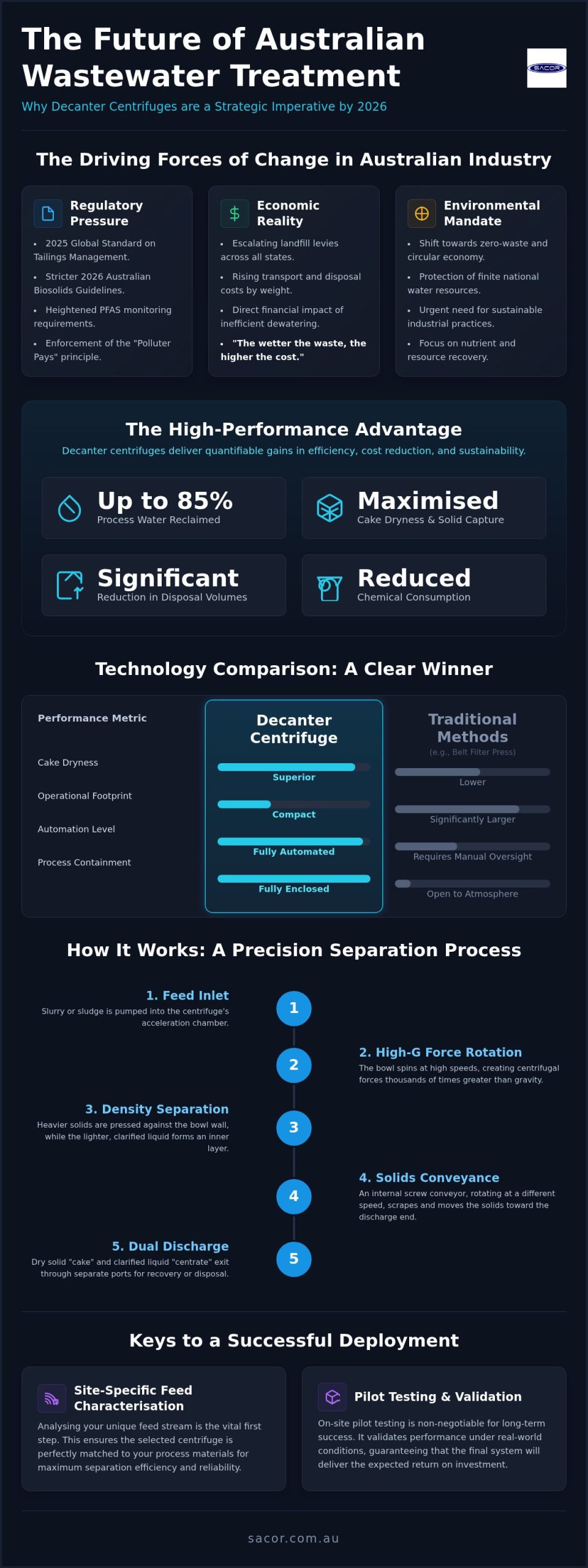
The separation journey begins when the slurry enters the centrifuge through a stationary feed pipe into the acceleration chamber. Once the material reaches the rotating bowl, centrifugal force creates distinct layers based on density. The heavier solids are instantly projected against the internal wall of the bowl, while the clarified liquid, or centrate, forms an inner ring. An internal screw conveyor, which rotates at a slightly different speed to the bowl, continuously scrapes these accumulated solids toward the conical end of the device. This mechanical action ensures the solids are compressed and discharged as a dewatered cake. This level of precision is essential for facilities aiming to comply with the Australian biosolids management guidelines, as it directly influences the quality and stability of the final output.
Key Components of a Modern Decanter System
The durability of a system depends heavily on its solid bowl design, which must withstand the immense internal pressures of high-speed rotation. Drive systems have also evolved to become more energy-efficient, using advanced torque control to adapt to changing sludge densities in real time. This adaptability prevents blockages and reduces power consumption during periods of lower throughput. Material selection is another non-negotiable factor for reliability in Australian industrial applications. High-grade stainless steel and specialised hard-surfacing on the conveyor flights protect the equipment from the corrosive chemicals and abrasive grit typically found in municipal and industrial wastewater streams. If you’re looking to optimise your facility’s performance with these technical advantages, considering customised decanter centrifuge systems can provide the specific engineering required for your site’s feed characteristics.
By focusing on these mechanical foundations, operators can achieve the high solids recovery and centrate clarity necessary for modern resource recovery. The result is a more reliable treatment process that reduces waste volumes and lowers the total cost of ownership over the equipment’s lifecycle.
Comparing Dewatering Technologies: Why Centrifuges Prevail
Selecting the appropriate dewatering technology requires a clinical assessment of long-term operational costs and performance reliability. While belt filter presses were once the industry standard, the wastewater treatment centrifuge Australia relies on today provides a superior level of process control. Centrifuges consistently deliver higher cake dryness compared to belt presses, which often struggle with the variable feed characteristics of industrial streams. This performance gap is particularly evident when handling greasy or oily sludge, which tends to blind filter cloths and require frequent, resource-intensive cleaning cycles. By contrast, centrifugal separation remains unaffected by these characteristics, maintaining throughput without the need for manual wash-down intervals.
Throughput and Performance Benchmarks
Centrifuges achieve significantly higher solids capture rates, often exceeding 95% with the correct polymer dosing. This efficiency ensures that the centrate returned to the head of the plant is of high quality, reducing the secondary treatment load. Cake dryness is defined as the percentage of solid matter remaining in the sludge after the dewatering process is complete. By maximising this metric, facilities can drastically reduce the weight and volume of material destined for disposal. Adhering to the National Biosolids Management Guidelines becomes simpler when the output is consistently dry and stable, facilitating easier transport and reuse in agricultural or industrial applications.
Footprint and Installation Flexibility
Space is a premium in many existing Australian treatment plants. The compact, horizontal design of a decanter centrifuge requires a significantly smaller physical footprint than a belt press of equivalent capacity, which can lower civil engineering and building costs during a plant upgrade. Because the process is entirely enclosed, concerns regarding odour and aerosol emissions are virtually eliminated. This makes the technology ideal for sites located near residential areas or sensitive environments. Modern systems are designed for seamless integration with existing industrial decanter centrifuge Australia infrastructure, allowing for a phased approach to facility modernisation without extensive downtime.
Automation is the final differentiator for the modern plant manager. Centrifuges are designed for continuous, 24/7 operation with minimal operator intervention, using advanced sensors to adjust to feed variations in real time. While maintenance cycles require specialised technical support, the overall labour requirement is lower than that of legacy systems that need constant monitoring. When evaluating the total cost of ownership, the combination of reduced disposal fees, lower chemical consumption, and automated operation makes centrifugal technology the most economically viable choice for the 2026 industrial landscape.
Strategic Applications Across the Treatment Train
Decanter centrifuges serve as versatile assets throughout the entire treatment train rather than being confined to the final dewatering stage. In primary clarification, these systems efficiently remove grit and heavy solids early in the process, which protects downstream equipment from premature wear and blockages. For facilities utilising anaerobic digestion, sludge thickening represents a critical intervention point. By reducing the volume of sludge before it enters the digester, operators can maximise hydraulic retention times and improve gas production. This multi-stage utility is a hallmark of the wastewater treatment centrifuge Australia requires for resilient infrastructure. Much of the robustness found in these systems stems from decanter centrifuge mining Australia technology, where equipment must withstand extreme abrasive loads and continuous duty cycles in the harshest environments.
Digester Optimisation and Nutrient Recovery
The shift towards a circular economy in Australia has transformed how we view sewage and industrial effluent. Centrifuges facilitate the recovery of valuable phosphorus and nitrogen, which are increasingly sought after for beneficial reuse in the agricultural sector. By removing non-organic solids with high precision, these systems increase active digester capacity and ensure the resulting biosolids meet the highest quality grades for land application. For municipal operators managing large volumes of organic waste, understanding the full capabilities of a biosolids dewatering centrifuge is essential for turning this waste stream into a secondary revenue source while simultaneously meeting environmental compliance targets. It’s a methodical approach to resource conservation that aligns with the long-term sustainability goals of modern Australian industry, ensuring that nutrients are returned to the soil rather than lost to landfill.
Effluent Polishing and Water Reclamation
In drought-prone regions across the country, water reclamation is a strategic priority for industrial and municipal operators alike. Centrifuges are often deployed for effluent polishing to remove micro-solids that might otherwise foul sensitive downstream membrane systems or ultraviolet disinfection units. This ensures that secondary effluent reaches the strict standards required for irrigation or industrial cooling applications. By maintaining high clarity in the centrate, facilities can reliably contribute to sustainable water management and reduce their reliance on expensive potable supplies. If your facility requires this level of operational precision to meet reclamation targets, exploring our wastewater treatment separation solutions will help you identify the most effective configuration for your specific site requirements.
By integrating centrifugal technology at multiple points in the process, plants can achieve a level of operational flexibility that traditional methods cannot match. The result is a more resilient facility capable of adapting to changing regulatory demands and resource recovery opportunities.
Implementing High-Performance Centrifuge Solutions
Successful deployment of a wastewater treatment centrifuge Australia wide depends on rigorous preliminary analysis. Implementation starts long before the equipment arrives on site; it begins with comprehensive feed characterisation. We conduct detailed laboratory analysis of the slurry’s particle size distribution, solid-liquid density, and chemical composition to determine the optimal separation parameters. Pilot testing on-site provides the empirical data needed to validate performance benchmarks before a significant capital investment is finalised. This methodical approach ensures the selected configuration matches your facility’s actual throughput requirements and handles the specific seasonal variations common in Australian industrial streams. Operators in the food and beverage sector can find additional guidance on yield protection and product recovery in our dedicated overview of decanter centrifuge for food processing Australia applications.
Custom Engineering for Site-Specific Requirements
Off-the-shelf solutions rarely meet the complexities of modern wastewater management. Performance is maximised when bowl geometry and scroll pitch are precisely tailored to the specific sludge types encountered at your location. In remote regions or mining sites, modular systems are often the most practical choice, allowing for rapid deployment and easier relocation if process requirements change. Engineering teams must also ensure that all control systems and drive motors are matched to Australian power standards and environmental conditions. This includes robust cooling systems for high-ambient temperatures and enclosures that protect sensitive electronics from dust and moisture. Integrating these units into existing plant-wide SCADA systems allows for seamless automation and real-time performance monitoring, which is essential for 24/7 autonomous operation.
Lifecycle Support and Maintenance
Uptime is the most critical metric for any industrial separation process. Reliability isn’t just about the initial build quality; it’s sustained through a disciplined schedule of preventative maintenance. Sacor’s commitment to the Australian market is anchored by our Western Australian base, which ensures that technical support and comprehensive spare parts are always within reach. Accessing local components eliminates the long lead times associated with international shipping, which can otherwise cause costly operational disruptions. We believe in a partnership model that includes thorough training for site personnel, empowering your team to monitor centrifuge performance effectively and identify potential issues before they escalate. This proactive approach to lifecycle management ensures your sludge dewatering centrifuge Australia wide continues to deliver maximum cake dryness and effluent clarity for the duration of its service life.
By focusing on these implementation pillars, facilities can move beyond simple equipment procurement toward a strategic separation partnership. The result is a robust, future-proof system that meets the 2026 standards for environmental compliance and operational efficiency.
Future-Proofing Australian Wastewater Infrastructure
The transition toward advanced mechanical separation is no longer a matter of operational preference; it’s a strategic necessity for facilities navigating the economic and regulatory pressures of 2026. By prioritising high-performance centrifugal technology, plant managers can effectively decouple their operational budgets from the volatility of rising transport and disposal costs. A correctly configured wastewater treatment centrifuge Australia wide delivers the cake dryness and centrate clarity required to meet modern nutrient recovery targets while ensuring long-term reliability in our unique industrial conditions.
Sacor provides the technical expertise and customised engineering required to transform complex waste streams into manageable assets. With expert technical support based in Western Australia and a proven track record in high-performance solid-liquid separation, we work as a long-term partner to ensure your equipment is matched to specific site feed characteristics. Partner with Sacor to optimise your wastewater treatment process today. We look forward to helping your facility achieve a new standard of operational excellence and environmental responsibility.
Frequently Asked Questions
What are the primary benefits of using a centrifuge for wastewater treatment in Australia?
The primary benefits include superior cake dryness, reduced disposal volumes, and the ability to operate continuously with minimal manual intervention. These systems are particularly effective at reclaiming up to 85% of process water in mining and industrial applications. Implementing a wastewater treatment centrifuge Australia wide allows facilities to meet strict environmental standards while lowering transport costs through significant volume reduction.
How does a decanter centrifuge compare to a belt press for sludge dewatering?
A decanter centrifuge provides higher solids capture and better cake dryness than a belt press, especially when handling oily or variable sludge. Unlike belt presses, centrifuges operate in a fully enclosed environment, which eliminates odour issues and aerosol risks. Centrifuges also require a smaller physical footprint and less wash water, making them more efficient for modern Australian treatment plants with space or water constraints.
Can a centrifuge handle variable solids concentrations in the feed stream?
Yes, modern decanter centrifuges are designed to handle significant fluctuations in feed solids without compromising discharge quality. Advanced torque control and variable speed drives allow the system to adjust the scroll speed in real time. This automated response ensures consistent cake dryness and centrate clarity even when the incoming slurry consistency changes, reducing the need for constant operator monitoring.
What is the typical lifespan of an industrial decanter centrifuge with proper maintenance?
An industrial decanter centrifuge typically has a service life of 20 to 30 years when maintained according to manufacturer specifications. Reliability depends on regular inspections and the timely replacement of wear parts like conveyor tiles and bearings. Using high-grade stainless steel and robust hard-surfacing ensures the equipment survives the abrasive and corrosive conditions common in Australian industrial wastewater streams.
How much can a centrifuge reduce sludge disposal costs for an Australian facility?
A centrifuge can reduce disposal costs by up to 30% or more by significantly increasing cake dryness and reducing total waste volume. Since transport and landfill fees are usually calculated by weight or volume, every percentage increase in solids content directly lowers operational expenditure. Facilities also save on chemical costs through more efficient polymer dosing compared to legacy dewatering equipment.
What kind of maintenance is required for a wastewater treatment centrifuge?
Routine maintenance involves regular lubrication of bearings, monitoring of vibration levels, and periodic inspection of wear-resistant surfaces on the scroll conveyor. Scheduled service intervals should include checking the drive belt tension and verifying the integrity of the seals. Accessing local technical support and spare parts for your wastewater treatment centrifuge Australia based is essential to minimise downtime during these maintenance cycles.
Are centrifuges suitable for nutrient recovery processes like struvite removal?
Centrifuges are highly effective for nutrient recovery because they provide the precise separation required to isolate mineral crystals like struvite from liquid streams. By removing these nutrients before they can form scale in pipes or tanks, facilities protect their infrastructure and produce a concentrated fertiliser product. This process supports circular economy goals by turning potential pollutants into valuable agricultural inputs.
How do I choose the right size centrifuge for my wastewater treatment plant?
Choosing the right size requires a detailed analysis of your maximum hourly throughput, feed solids concentration, and desired cake dryness. Engineers must evaluate the hydraulic capacity and solids loading rate to ensure the centrifuge isn’t undersized for peak flows. Site-specific feed characterisation and pilot testing are the most reliable methods for selecting a configuration that ensures long-term operational efficiency.