
Pushing decanter rotational speed to its absolute limit won’t rescue an unconditioned slurry; true operational efficiency demands harmonising mechanical dewatering dynamics with tailored chemical conditioning. For plant engineers, metallurgists, and operations managers across Australia, improving solid recovery in processing remains a relentless balancing act. You’ve likely experienced the frustration of watching high flocculant expenditure yield inconsistent, sloppy cake, all while uncaptured fine solids bypass mechanical dewatering units straight back into your plant’s recycle streams.
When refractory fines accumulate in the circuit, slurry viscosity rises, machinery bogs down, and abrasive wear drives up unplanned maintenance downtime. We understand how difficult it is to maintain clear centrate without sacrificing cake dryness when feed densities fluctuate across shifts. In this operational guide, you’ll discover actionable mechanical, chemical, and operational methods to maximise cake dryness, clarify liquid discharge, and enhance overall solid recovery. We examine how calibrated pond depths, precise differential scroll tuning, and strategic low-shear polymer injection work together to establish stable, predictable separation performance across challenging industrial slurries.
Key Takeaways
- Standard mass-balance auditing establishes true baseline capture rates, isolating where fine particles escape into plant recycle loops.
- Precise polymer chemistry selection and low-shear dosing prevent floc shear degradation, significantly reducing chemical expenditure and centrate turbidity.
- Balancing bowl G-force, liquid pond depth, and differential scroll speed resolves the operational trade-off between cake dryness and centrate clarity.
- A structured five-step protocol provides plant operators with a systematic method for improving solid recovery in processing under shifting feed conditions.
- Custom-engineered decanter centrifuges and disc separators deliver continuous dewatering reliability and reduced downstream disposal volumes across demanding industrial applications.
Auditing Baseline Solid Recovery Across Industrial Processing Streams
Process optimisation begins with an accurate operational baseline. Solid recovery defines the mass proportion of dry solids captured from the feed stream and discharged as dewatered cake. Achieving high recovery rates protects downstream operations; uncaptured solids bypass separation barriers and recirculate through thickeners, balance tanks, and clarified liquor circuits. Over time, these refractory fines build up, elevating slurry viscosity, accelerating mechanical wear, and driving up polymer demand. Establishing systematic protocols for improving solid recovery in processing ensures plant managers isolate real yield losses from routine feed variations.
Calculating Mass Balance and Centrate Clarity
Continuous mass-flow measurement of wet solids in operational plants can be technically challenging. Industrial operations instead rely on a standard concentration-based mass-balance calculation to audit capture efficiency across decanter centrifuge systems and gravity separators:
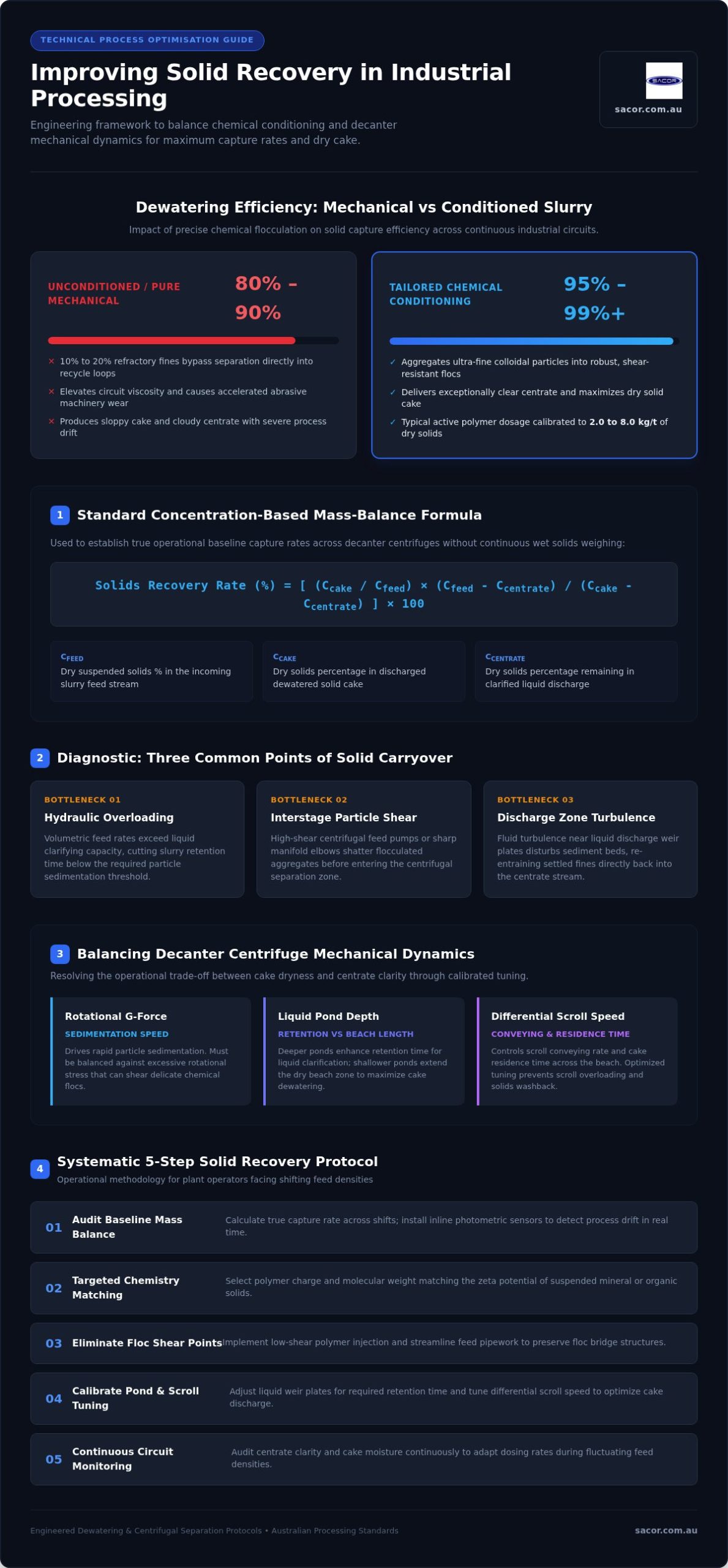
Solids Recovery Rate (%) = [(Ccake / Cfeed) × (Cfeed – Ccentrate) / (Ccake – Ccentrate)] × 100
In this equation, values represent dry suspended solids percentages across cake, feed slurry, and centrate. Implementing composite sampling across multiple shifts accounts for variable feed densities. While laboratory gravimetric testing yields verified mass fractions, inline photometric turbidity sensors installed at centrate discharge ports provide immediate, real-time indicators of process drift, warning operators long before centrate blinding occurs.
Identifying Common Points of Solid Carryover and Yield Loss
When solids escape into the liquid discharge stream, mechanical diagnostics generally trace the failure to three operational bottlenecks:
- Hydraulic overloading: Volumetric feed rates exceed the liquid clarifying capacity of the equipment, cutting slurry retention time below the threshold required for particle sedimentation.
- Interstage particle shear: Excessive velocities inside high-shear centrifugal feed pumps or sharp manifold elbows shatter flocculated aggregates before they enter the separation zone.
- Discharge zone turbulence: Fluid turbulence near liquid discharge weir plates disturbs established sediment beds, re-entraining settled fines directly into the outgoing centrate stream.
Identifying these mechanical loss vectors is essential. Without rectifying these baseline physical disruptions, any chemical adjustments aimed at improving solid recovery in processing will deliver compromised, short-lived improvements.
Optimising Coagulation and Flocculant Dosing for Enhanced Fines Capture
Chemical conditioning transforms ultra-fine colloidal particles into robust, shear-resistant flocs capable of rapid sedimentation under intense centrifugal force. While purely mechanical separation rarely captures more than 80 to 90 percent of unconditioned solids, tailored polymer conditioning routinely drives recovery beyond 95 to 99 percent. Balancing this chemistry requires precision. Under-dosing leaves fine solids suspended in the centrate, whereas over-dosing squanders expensive flocculants and blinds the cake structure, trapping unwanted moisture within the discharged solids.
Selecting Polymer Charge and Molecular Weight for Feed Slurries
Effective chemical selection begins with matching the polymer charge to the zeta potential of the suspended solids. Inorganic mineral slurries typically carry electronegative surface charges requiring cationic polyacrylamides, while organic food or biological streams demand specific ionic charge densities to neutralise repulsive forces. High-molecular-weight polymers build the long-chain bridges necessary to withstand dynamic bowl acceleration. Routine cylinder settling tests using fresh slurry samples establish the baseline active polymer demand, which commonly ranges between 2.0 and 8.0 kg per metric ton of dry solids across most continuous industrial operations.
Conditioning Residence Time and Shearing Prevention
Polymer efficiency depends heavily on where and how the chemical contacts the slurry stream. Flocculated aggregates are highly sensitive to hydrodynamic shear, meaning dosing polymer ahead of a centrifugal feed pump inevitably destroys the formed flocs before they reach the sedimentation zone. Plant operators must introduce polymer through multi-point spargers or low-shear inline mixers directly upstream of the feed pipe, or inside the centrifuge feed accelerator itself. Guidelines outlined by the US EPA on centrifuge thickening and dewatering confirm that protecting floc integrity during acceleration is fundamental to maintaining centrate clarity and low cake moisture.
For operations handling biological sludges, reviewing our detailed wastewater treatment centrifuge Australia guide provides targeted benchmarks for balancing chemical consumption against discharge compliance. Successfully improving solid recovery in processing relies on treating chemical dosing and mechanical dynamics as an integrated system. When flocculant chemistry aligns perfectly with mechanical throughput, operating teams can partner with separation specialists to audit feed conditions and fine-tune dosing architectures for maximum yield stability.
Calibrating Mechanical Variables in Industrial Decanter Centrifuge Systems
Chemical conditioning prepares the slurry, but mechanical tuning determines the final separation outcome. Modern decanter centrifuges provide multiple operational variables that allow operators to balance liquid clarity against discharge cake dryness. Optimising these settings demands a methodical approach; adjustments made to increase cake solids frequently pull fine particles back into the centrate unless compensated correctly. Operators focused on improving solid recovery in processing must master three primary mechanical levers: bowl rotational speed, differential scroll velocity, and liquid pond depth.
Balancing Bowl Speed and Centrifugal G-Force
Rotational bowl speed dictates the relative centrifugal force (RCF) applied to the incoming slurry. Standard solid-bowl decanters operate between 1,500 and 3,500 × g, with specialised high-speed compact units reaching 4,000 × g. Higher G-forces accelerate sedimentation rates, enabling the capture of sub-ten-micron fines that otherwise resist settling. Excessive bowl speed isn’t always beneficial, however. Operating above necessary acceleration limits can shatter fragile organic flocs and accelerate abrasive wear on bowl linings. Our industrial decanter centrifuge Australia guide outlines specific acceleration ranges suited to differing slurry abrasiveness and particle densities.
Adjusting Differential Speed and Scroll Conveyor Torque
Differential speed (Δn) governs how quickly the internal conveyor scrolls settled solids out of the clarifying pool and across the conical beach. In continuous processing, differential speeds typically sit between 1.0 and 20.0 RPM, most commonly running from 2.0 to 12.0 RPM relative to bowl rotation.
A lower differential speed increases solids retention time on the dry beach, promoting higher cake dryness. However, if the differential speed drops too low during high-solids feed surges, the scroll overloads, triggering high-torque trips or centrate blinding. Variable-frequency backdrive motors automatically alter Δn in direct response to gearbox torque spikes, protecting mechanical components while maintaining consistent solids conveyance.
Fine-Tuning Liquid Pond Depth via Weir Plate Settings
Adjustable weir plates on the liquid discharge end dictate the pool depth inside the cylindrical bowl section. This setting creates an inherent operational trade-off:
- Deep pond setting: Maximises hydrostatic clarification volume and liquid retention time. This configuration optimises centrate clarity and captures stubborn fine particles, but it reduces the exposed beach area, often producing wetter discharge cake.
- Shallow pond setting: Lengthens the drying beach zone, subjecting solids to prolonged centrifugal compaction. This increases cake dryness but decreases clarification residence time, elevating suspended solids in the effluent.
- Intermediate position: Selected primarily for compressible, soft slurries to minimise slippage back into the clarification zone.
Carefully balancing these mechanical parameters delivers the stability required for improving solid recovery in processing, preventing operational upsets even when feed solid concentrations shift unexpectedly.
Implementing a Systematic Protocol for Improving Solid Recovery in Processing
Achieving sustained yield gains when improving solid recovery in processing requires transitioning from reactive troubleshooting to structured process control. Rather than adjusting parameters arbitrarily during an upset, operational teams achieve reliable separation stability by adhering to a methodical five-step framework:
- Audit shift baselines: Execute multi-point composite mass-balance sampling across all operating shifts to quantify uncaptured fines.
- Calibrate chemical conditioning: Standardise active polymer dosing and dilution rates via disciplined bench-scale cylinder tests.
- Tune mechanical parameters: Incrementally align bowl G-force, liquid pond depth, and scroll differential speed to slurry solids loading.
- Inspect rotating wear assemblies: Audit scroll flight profiles, clearances, and protective tiles against engineering tolerances.
- Automate process feedback: Integrate inline instrumentation to regulate flocculant metering and scroll differential speed dynamically.
Real-Time Feed Slurry Monitoring and Rheology Control
Fluctuating feed densities destabilise dewatering circuits rapidly. Installing non-intrusive microwave or radiometric density gauges on feed lines provides continuous visibility into slurry solids concentrations. Coupling these sensors with positive displacement feed pumps governed by variable speed drives prevents sudden hydraulic surges. When feed density spikes, automated systems modulate dilution water and active polymer ratios instantly, preserving chemical dispersion and steady rheology before slurry enters the separation bowl.
Routine Wear Inspection on Scroll Flights and Discharge Ports
Mechanical degradation directly undermines separation efficiency. As abrasive industrial slurries scour rotating assemblies, the radial clearance between the scroll flights and the bowl wall gradually widens. This physical gap allows settled solids to slip backward into the pool rather than discharging, driving up centrate turbidity. Maintenance crews should systematically inspect tungsten carbide tiles on feed accelerator nozzles, flight tips, and solids discharge ports. Reviewing the industrial centrifuge spare parts strategic guide assists maintenance teams in benchmarking wear tolerances and scheduling component refurbishments before separation efficiency collapses.
Dynamic Automation and Closed-Loop Differential Drive Control
Modern separation circuits rely on dynamic backdrives that continuously link scroll differential speed to gearbox torque and motor load. When heavy solids loading increases rotational resistance, programmable logic controllers (PLCs) elevate differential speed instantaneously, clearing the bowl to pre-empt mechanical overload trips. Maintaining detailed digital logs of these torque responses helps process engineers identify cyclical feed variations across plant cycles. To upgrade your circuit controls or establish baseline audits, contact Sacor for technical support and maintenance services to evaluate your continuous separation infrastructure.
Selecting Engineered Centrifugal Solutions for High-Solids Applications
Industrial feed streams containing ultra-fine or abrasive solids eventually surpass the operational capabilities of standard off-the-shelf separation hardware. When slurry particle distributions skew heavily toward sub-sieve fractions, improving solid recovery in processing demands equipment custom-engineered for specific rheological properties. Decanter centrifuge systems remain the primary workhorse for heavy slurries requiring continuous high-tonnage cake discharge. Conversely, disc separator systems utilise concentric conical disc stacks to provide massive equivalent clarification areas, making them ideal for polishing low-concentration liquid streams that demand extreme centrate clarity.
Evaluating Two-Phase vs Three-Phase Centrifuge Configurations
Two-phase decanter systems deliver continuous dewatering across mineral tailings, wastewater sludges, and industrial effluents where the objective is separating suspended solids from a single carrier liquid. Our decanter centrifuge mining Australia guide details how heavy-duty configurations manage severe tonnage and abrasive fines in demanding processing circuits. In contrast, three-phase centrifuge systems address multiphase feed stocks, simultaneously separating two immiscible liquids of differing densities, such as oil and water, alongside a concentrated dry solids discharge in a single continuous pass. This configuration eliminates intermediate settling stages across energy recovery and food processing facilities.
Custom Engineering and Ongoing Lifecycle Support Across Australia
Selecting the correct mechanical configuration is only the initial step; long-term performance requires continuous operational alignment. Sacor delivers custom-engineered separation solutions tailored to specific slurry rheology, throughput volumes, and wear factors across Australian industrial sites. Our engineering team conducts thorough slurry evaluations to specify optimal bowl geometries, beach angles, and tungsten carbide wear protection before deployment.
On-site technical support forms a central pillar of reliable plant operation. Factory-trained service specialists assist operating teams with installation, commissioning, and on-site process tuning to lock in target cake dryness and clarity metrics from day one. Backed by a comprehensive national inventory of OEM-grade spare parts and structured lifecycle maintenance agreements, operations maintain dependable throughput while systematically improving solid recovery in processing across every shift.
Maximising Operational Recovery and Plant Throughput
Delivering consistent dewatering performance requires aligning mechanical dynamics with disciplined chemical conditioning. Auditing shift baselines, calibrating differential scroll torque, and monitoring wear clearances protect circuits from refractory fines accumulation while lowering overall chemical expenditure. Successfully improving solid recovery in processing transforms uncaptured fine solids into drier discharge cake, clarifying effluent streams and reducing downstream water treatment and disposal burdens.
Achieving these operational gains long term demands separation technology engineered specifically for challenging slurries. Sacor delivers custom-engineered decanter centrifuges and disc separators built for rigorous Australian industrial environments across mining, wastewater, energy, and food processing sectors. Backed by nationwide on-site commissioning, process testing, and structured lifecycle maintenance support, our team helps plant managers establish stable, predictable throughput. Consult with Sacor to optimise your processing recovery and dewatering efficiency and secure dependable operational performance across every shift.
Frequently Asked Questions
What is an acceptable percentage for solid recovery in industrial processing?
In modern industrial processing, acceptable solid recovery typically falls between 95% and 99% for chemically conditioned slurries. Unconditioned mechanical operations often manage only 80% to 90%, allowing excessive fines to escape into effluent streams. Target percentages depend on downstream regulatory discharge limits and the material value of the solids. Consistently maintaining recovery above 95% prevents fine particles from recirculating and blinding upstream thickeners.
How does polymer overdosing negatively impact solid recovery?
Overdosing polymer coats particles with excess unreacted polymer chains, causing steric hindrance that weakens floc structural integrity. Rather than producing clean separation, surplus chemical elevates centrate viscosity and creates a slimy, gelatinous cake that traps water. Over-conditioned slurries also smear against bowl walls, increasing torque drag and blinding drainage channels. This outcome wastes expensive reagents while simultaneously lowering cake dryness and centrate clarity.
What mechanical adjustments should be made first when centrate becomes cloudy?
Operators should first check and deepen the liquid pond depth via the adjustable weir plates. A deeper liquid pool expands clarifying volume and increases hydraulic retention time, allowing uncaptured fines to settle before exiting over the weir. If cloudiness persists, slightly increasing differential scroll speed clears settled solids faster to prevent pool crowding, or bowl rotational speed can be increased to apply greater centrifugal sedimentation force.
Can decanter centrifuges recover fine particles smaller than 10 microns?
Decanter centrifuges can capture particles smaller than 10 microns, but success requires adequate chemical flocculation or extreme centrifugal forces. Without polymer conditioning, particles under 10 microns have settling velocities too low for standard 2,000 to 3,000 × g decanters to separate efficiently. For unconditioned sub-micron fines or low-solids slurries where chemical additives aren’t permissible, disc stack separators operating above 5,000 × g provide the required clarification surface area.
How does feed slurry temperature affect industrial separation efficiency?
Higher feed slurry temperatures lower the dynamic viscosity of the liquid carrier, accelerating particle settling velocities according to Stokes’ Law. Warmer operating temperatures generally assist in improving solid recovery in processing by facilitating faster liquid-solid displacement under centrifugal force. However, elevated temperatures can also alter polymer chain hydration and degrade delicate biological flocs. Process teams must calibrate chemical dosages whenever seasonal or operational feed temperatures change significantly.
Why does scroll conveyor flight wear lead to reduced solid recovery?
Scroll flight wear expands the radial clearance between the conveyor blades and the internal bowl wall. This widening gap permits compacted solids to slip backward into the clarifying pool rather than being conveyed up the beach toward the cake discharge ports. Unconveyed solids accumulate, re-entrain into the liquid pool, and elevate centrate turbidity. Regular dimensional inspections ensure wear tiles are replaced before mechanical slippage undermines plant recovery targets.
What is the operational difference between high-G clarification and cake dewatering?
High-G clarification prioritises centrate clarity by using deep pond settings and rapid rotational speeds to capture maximum solid mass. Cake dewatering focuses on mechanical moisture expression, utilising shallow pond depths and extended beach contact to yield dry solids. Balancing these competing objectives is the core challenge in improving solid recovery in processing, requiring operators to tune differential speed and chemical dosing so neither clarity nor cake dryness is compromised.