
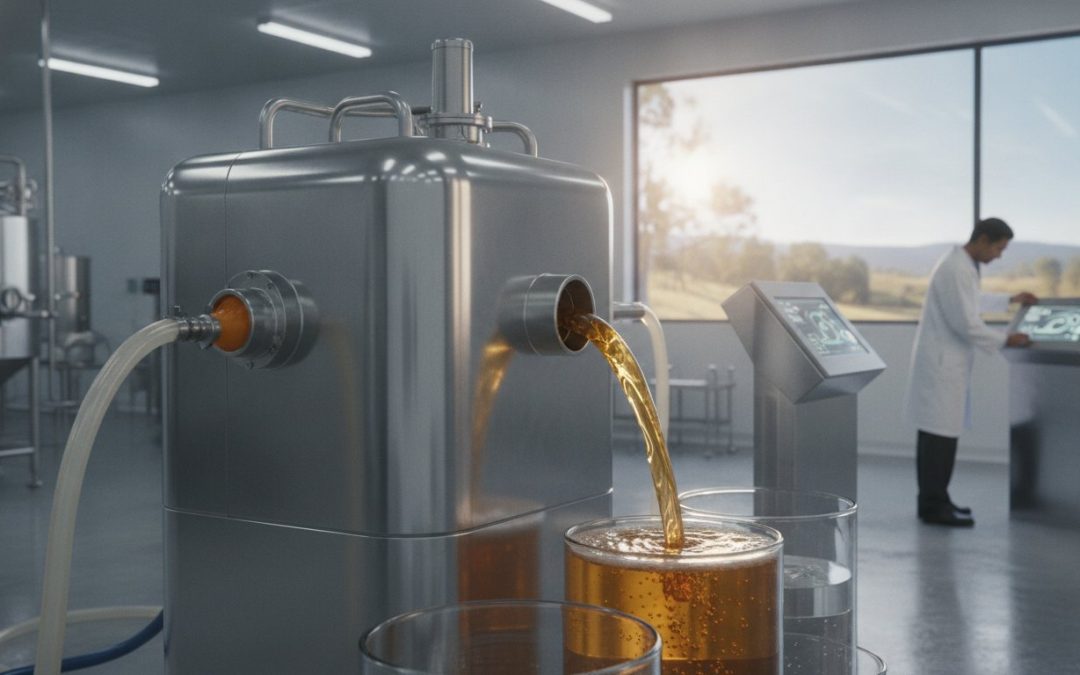
Traditional filtration methods often sacrifice the very biological integrity that Australian consumers demand in premium juice products. While filter presses have long been the industry standard, they frequently result in high waste volumes and a noticeable loss of flavour due to slow processing times. Most plant managers accept frequent downtime for filter cleaning as an unavoidable cost, yet this inconsistency often leads to varying product turbidity. Integrating a juice clarification centrifuge into your production line offers a superior alternative that prioritises both precision and efficiency.
By adopting industrial centrifugal separation, you can achieve a consistent, high-clarity end product while significantly reducing operational overheads. This article explores how modern decanter and disc stack systems optimise juice clarity and increase yield from raw materials. We’ll examine the technical benefits of automation, the role of high-speed centrifugation in maintaining flavour integrity, and how these solutions support sustainable waste management for Australian beverage processors. You’ll gain a clear understanding of how to balance G-force and residence time to outperform traditional filtration and meet the latest compositional requirements of the Food Standards Code.
Key Takeaways
- Learn how centrifugal separation overcomes the limitations of traditional filtration by maximising liquid recovery and reducing product waste.
- Understand how a juice clarification centrifuge utilises precise G-force control to achieve consistent turbidity levels across various fruit and vegetable varieties.
- Evaluate the long-term financial benefits of automated separation, including lower operational expenditure and reduced environmental impact compared to consumable-heavy filter presses.
- Discover the technical criteria for selecting between decanter centrifuges and disc separator systems based on specific pulp content and particle size requirements.
- Gain insights into integrating customised engineering solutions into existing production lines to ensure seamless installation and ongoing technical support within the Australian market.
The Role of Juice Clarification Centrifuges in Industrial Processing
Industrial juice clarification is a sophisticated mechanical separation process designed to refine raw liquids by removing unwanted particulate matter. For Australian beverage processors, the primary objective is to achieve a stable, clear liquid that meets consumer expectations for appearance and mouthfeel. This process relies on the application of intense centrifugal force to accelerate the sedimentation of solids that would otherwise remain suspended in the liquid. By utilising a juice clarification centrifuge, plants can process vast volumes of raw product with a level of precision that gravity settling or basic straining cannot match. This technology is essential for handling the high throughput required in modern beverage facilities where efficiency directly correlates with profitability.
Speed is a critical factor in maintaining the biological integrity of the product. Suspended solids, residual yeasts, and cellular debris must be removed as quickly as possible after extraction to prevent enzymatic browning and the development of off-flavours. Rapid separation ensures that the juice retains its natural colour and vibrant flavour profile, which are often compromised when the product sits in holding tanks for extended periods. This immediate clarification effectively halts the degradation processes, allowing processors to deliver a fresher product to the market.
The Problem with Traditional Filtration
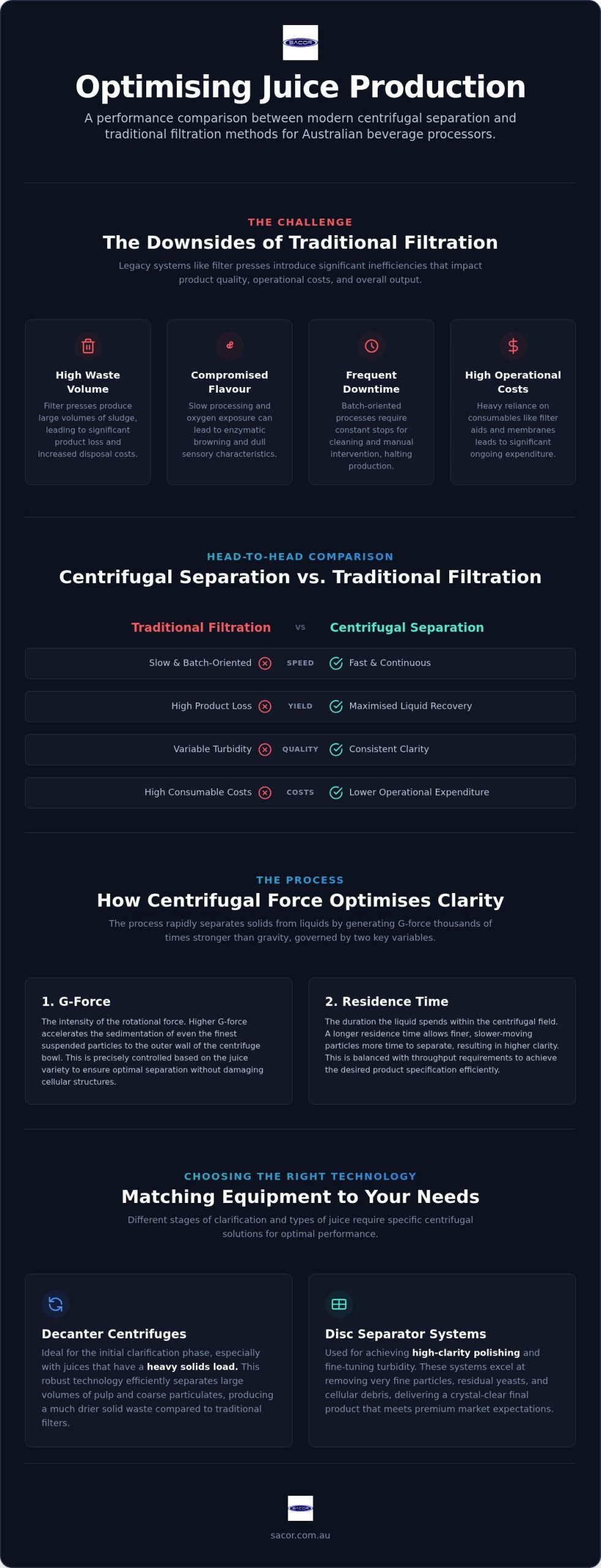
Traditional filtration systems, such as plate and frame presses or rotary vacuum filters, often struggle to keep pace with modern production demands. These methods rely heavily on consumables, including filter aids like diatomaceous earth or expensive membranes that require frequent replacement. The operational costs associated with these materials can be substantial over a single harvest season. Additionally, filtration is often a batch-oriented process that necessitates significant downtime for cleaning and manual intervention. Slow filtration stages also increase the risk of oxygen exposure, which can lead to rapid oxidation and a dulling of the juice’s sensory characteristics. For large-scale operations, these bottlenecks represent a significant risk to both quality and output.
The Advantage of Continuous Centrifugal Separation
Industrial separation solutions provide a continuous alternative to the stop-start nature of batch filtration. Modern systems allow for a seamless transition from extraction to clarification, ensuring the production line remains active without the need for constant manual resets. Juice clarification is a high-G process that separates solids based on density differentials. This mechanical approach results in a significant reduction in waste volume, as the solids discharged from the system are often much drier and more concentrated than the sludge produced by filters. This efficiency not only lowers disposal costs but also supports more sustainable plant operations. When implementing these systems, many processors rely on decanter centrifuge technology to handle heavy solids loads during the initial clarification phase. This robust equipment ensures that even the most challenging raw materials are processed into a high-quality, consistent base for further refinement.
How Centrifugal Force Optimises Beverage Clarity and Yield
The efficiency of a juice clarification centrifuge relies on the practical application of Stokes’ Law. In an industrial context, this principle dictates that the velocity of a particle falling through a liquid is proportional to the square of its radius and the density difference between the particle and the fluid. By spinning the juice at high speeds, the equipment generates a G-force thousands of times stronger than gravity. This acceleration forces suspended solids to the outer wall of the bowl almost instantaneously. Different juice varieties require specific G-force settings. For instance, clarifying a pulpy citrus juice requires a different approach than a relatively clear apple juice base to ensure the cells aren’t unnecessarily ruptured.
Residence time is another critical variable. This refers to the duration the liquid remains within the centrifugal field. If the juice moves through the bowl too quickly, finer particles won’t have time to migrate to the sediment layer, resulting in inconsistent turbidity. Managing soft solids and pectinous materials is particularly challenging because these substances are often compressible and slippery. Precise bowl speed control allows operators to manage these delicate solids without clogging the system or compromising clarity. This level of control is why a juice clarification centrifuge is superior to static settling tanks for high-volume production.
Mechanical Components of the Clarification Process
The internal architecture of the centrifuge determines its separation capability. High-performance bowl designs are engineered to maximise the settling area, which directly impacts how much liquid can be recovered from the raw feed. In a disc stack system, the discs create a massive surface area in a compact space, while in a decanter, the scroll continuously removes the separated solids. Adjustable discharge ports are vital for fine-tuning. They allow plant managers to adjust the pond depth within the bowl, which alters the clarity of the departing liquid. For those looking to upgrade their facility, exploring beverage processing separation solutions can provide the necessary technical edge to achieve these results.
Maintaining Biological Integrity
Preserving the natural characteristics of the fruit is just as important as achieving clarity. Advanced centrifugal systems are designed to minimise heat friction. Excessive heat during processing can lead to thermal degradation, dulling the flavour and altering the nutrient profile. Modern units use enclosed systems to prevent oxygen from entering the process. This hermetic design is crucial for preserving delicate aromatics and preventing oxidation. It also helps manage polyphenol oxidase activity. This enzyme is responsible for browning in many juices. By processing the liquid rapidly in an oxygen-free environment, the centrifuge helps maintain the vibrant colour and fresh taste that Australian consumers expect.
Centrifuge vs. Traditional Filtration: A Performance Comparison
Selecting the right separation technology is a strategic decision that impacts the long-term profitability of any Australian beverage plant. While traditional filter presses have been a staple in the industry, their performance often falls short when compared to the mechanical precision of a juice clarification centrifuge. The primary differentiator lies in how each system handles the liquid-solid interface. Filtration relies on a physical barrier that inevitably traps a percentage of the product within the filter cake or membrane. In contrast, centrifugal separation uses density differentials to eject solids while recovering almost every drop of saleable liquid. This leads to a more predictable and higher-quality output that isn’t dependent on the condition of a filter cloth.
Efficiency and Yield Metrics
The yield recovery from raw mash is significantly higher with centrifugal systems. While a filter press might achieve high clarity, the product loss associated with saturated filter media can reduce overall yield by several percentage points. Centrifuges are particularly effective at processing “tank bottoms”, the concentrated sediment that typically represents a significant volume of wasted product in traditional setups. By reclaiming this liquid, processors see an immediate boost in their total output. For a deeper look at specific equipment configurations, plant managers should consult an industrial decanter centrifuge Australia guide to understand how these metrics scale with different throughput requirements. Over a five-year period, the reduction in operational expenditure (OPEX) becomes clear as the costs of consumables and manual labour are phased out.
Sustainability and Waste Management
Eliminating the need for diatomaceous earth (DE) or other filter aids is a major step toward more sustainable industrial practice. DE isn’t only an ongoing expense but also presents a disposal challenge due to its volume and weight when wet. Centrifugal systems produce much drier solids, which are significantly easier to manage. These concentrated solids can often be repurposed as high-value stock feed, turning a waste stream into a secondary revenue source. This reduction in waste volume directly lowers disposal costs and simplifies environmental compliance for the facility.
Automation plays a key role in this transition. Modern centrifuges operate with minimal supervision, reducing the reliance on manual labour for cleaning and resetting batches. This automation ensures a consistent output and allows staff to focus on higher-value tasks within the facility. Additionally, the compact footprint of a centrifuge is ideal for Australian facilities where floor space is at a premium. A single unit can often replace multiple large filter banks, simplifying the plant layout and reducing the complexity of the piping infrastructure. Finding the “sweet spot” between energy consumption and throughput is essential for maximising ROI, and modern variable frequency drives make this optimisation more accessible than ever.
Selecting the Right Centrifuge for Specific Juice Varieties
Determining the optimal configuration for a juice clarification centrifuge requires a meticulous evaluation of the raw material’s physical and chemical properties. Plant managers must assess feed characteristics such as pulp percentage, liquid viscosity, and the specific gravity of suspended particles to ensure the equipment matches the production demand. Decanter centrifuges are typically deployed for high-solids “first press” clarification where they can handle solids concentrations ranging from 5% to over 50%. These robust machines provide the initial separation necessary to stabilise the liquid before it moves to secondary processing. For beverage producers aiming for a high-clarity finished product, disc stack separators serve as the final polishing stage, removing the finest haze-forming particles that decanters might miss. All equipment must be constructed from high-grade stainless steel to comply with the latest Australian food safety standards, including the compositional requirements updated in April 2026.
Citrus and Pome Fruit Requirements
Citrus processing demands specialised systems capable of managing essential oils and variable pulp volumes. Three-phase separation allows for the simultaneous recovery of juice and valuable oils while discharging solids. This is particularly relevant given recent technological advancements, such as the March 2026 launch of pulp-rich citrus clarifiers designed specifically to handle fluctuating raw material quality. Pome fruits like apples and pears present a different challenge due to high pectin levels, which increase viscosity and complicate separation. Engineering the system with precise bowl speeds ensures that pectinous materials are discharged efficiently without causing blockages. For more information on tailored setups, reviewing a food processing centrifuge Australia guide can assist in identifying the right technical specifications for these fruit varieties.
Stone Fruit and Vegetable Juice Challenges
Vegetable juices and stone fruit purees often contain fibrous debris or abrasive particles that can accelerate component wear. Custom engineering is required to protect the centrifuge while maintaining the delicate temperature control necessary for sensitive vegetable juices like leafy greens or carrot. Thermal sensitivity is a major concern; even a minor temperature rise during separation can lead to the loss of heat-labile vitamins and vibrant pigments. Seasonal throughput variations also require systems that can be easily adjusted to handle different crop cycles without sacrificing performance. To ensure your facility is equipped with the most efficient technology for your specific variety, you should consult with experts in beverage processing separation solutions who understand the nuances of the Australian harvest and industrial requirements.
Implementing Industrial Separation Solutions in Australia
Successful deployment of a juice clarification centrifuge requires more than just high-quality hardware; it necessitates a deep understanding of the local operational environment. Australian beverage processors face unique challenges, from the specific mineral content of local water supplies to the seasonal variability of fruit and vegetable crops. Integrating a centrifuge into an existing production line is a complex engineering task that involves synchronising flow rates, pressure levels, and automated control systems with upstream extraction and downstream packaging equipment. Planning for this integration early in the design phase ensures that the transition is seamless and that the facility avoids the costly delays often associated with poorly coordinated installations.
Custom Engineering and Commissioning
Generic, off-the-shelf separation systems rarely meet the precise juice clarity targets required by high-end Australian brands. These standard units often lack the flexibility to handle the specific solids loading or viscosity profiles found in local raw materials. Local technical support is indispensable during the installation phase, as it allows for real-time adjustments based on actual feed characteristics. Sacor designs bespoke centrifugal solutions for unique Australian feed characteristics. Comprehensive operator training is equally vital, empowering plant staff to manage the equipment confidently and extract maximum performance from the system from day one. This technical handover ensures that the theoretical benefits of the technology are fully realised in a practical, high-throughput environment.
Long-Term Support and Maintenance
Reliability is the cornerstone of any industrial separation strategy. Proactive maintenance is a critical component of preventing unscheduled downtime, especially during peak harvest periods when production lines must run at full capacity. A well-structured maintenance programme identifies potential issues before they escalate into mechanical failures, thereby extending the equipment’s operational lifecycle. Ensuring the availability of critical industrial centrifuge spare parts Australia wide is essential for minimising the impact of wear and tear. This local availability reduces the reliance on international supply chains and ensures that any necessary repairs are completed with minimal disruption to the production schedule.
Maintaining a robust inventory of seals, bearings, and high-wear components allows for rapid servicing and consistent performance. This local support, combined with full technical documentation, transforms the relationship between the processor and the technology provider into a true partnership. By focusing on process efficiency and reduced environmental impact, a correctly implemented juice clarification centrifuge supports the long-term sustainability and profitability of the Australian beverage sector. The goal is to create a resilient production environment where technology and expertise work in tandem to deliver superior product quality.
Optimising Your Beverage Production Strategy
Transitioning from traditional filtration to a juice clarification centrifuge represents a significant advancement in process efficiency for Australian beverage producers. By utilising mechanical separation based on density differentials, facilities can achieve superior clarity while simultaneously increasing yield from raw materials. This approach not only preserves the natural sensory characteristics of the fruit but also aligns with modern sustainability goals by reducing the volume of wet waste and eliminating the need for costly filter aids.
Success in this transition depends on a partnership with a provider that understands the nuances of the local market. Sacor offers Australian-owned technical expertise and custom engineering to ensure your system is perfectly matched to your specific plant throughput. With national maintenance and a robust supply of spare parts, we ensure your facility maintains peak performance across every harvest. Consult with Sacor for a customised beverage separation solution to refine your production capabilities and secure a competitive advantage in the premium beverage market.
Frequently Asked Questions
What is the main difference between a decanter centrifuge and a disc separator for juice?
Decanter centrifuges are primarily used for “first press” clarification where solids levels are high, typically between 5% and 50%. They utilise a horizontal bowl and scroll to continuously discharge heavy sediment. Disc separator systems are better suited for the final polishing stage, where they remove finer particles to achieve high-clarity targets. Using both in series allows a plant to maximise total liquid recovery while ensuring a stable, haze-free finished product.
Can a juice clarification centrifuge handle high-viscosity fruit pulps?
A juice clarification centrifuge is specifically engineered to manage high-viscosity materials like mango puree or nectar bases. By adjusting the bowl speed and pond depth, operators can control the residence time required for effective separation. This precision prevents the clogging often seen in traditional filters. Customised engineering ensures that even pectinous or fibrous pulps are processed efficiently, maintaining a consistent flow rate regardless of the raw material’s thickness or density.
How does a centrifuge improve the shelf life of juice products?
Centrifugal separation improves shelf life by rapidly removing suspended solids, yeasts, and bacteria that accelerate spoilage. Because these systems are typically enclosed, they prevent oxygen exposure, which is the primary cause of oxidation and nutrient degradation. By minimising the time the juice spends in the clarification stage, you reduce enzymatic browning. This results in a more stable product with a longer-lasting natural colour and flavour profile that meets Australian consumer expectations.
What are the typical maintenance requirements for an industrial juice centrifuge?
Typical maintenance involves scheduled inspections of high-wear components such as bearings, seals, and discharge ports. Regularly replacing these critical spare parts prevents unscheduled downtime and extends the equipment’s lifecycle. Sacor provides full technical documentation and national support to ensure that maintenance remains proactive rather than reactive. Following a structured service programme is essential for maintaining the balance and precision required for high-speed centrifugal operation during peak harvest seasons.
Do I need to add enzymes or flocculants when using a centrifuge for clarification?
While enzymes are sometimes used to reduce viscosity in pome fruits, a centrifuge often reduces or eliminates the need for flocculants compared to traditional filtration. The intense G-force generated by the equipment is usually sufficient to separate solids based on density alone. This reduction in chemical additives supports a clean-label product strategy, which is increasingly favoured by health-conscious consumers in the Australian market. Precise mechanical separation often achieves clarity without supplemental aids.
Is a centrifuge more energy-efficient than traditional filtration systems?
Modern centrifugal systems are highly energy-efficient when measured against their total throughput and the elimination of consumables. Unlike filter presses that require constant energy for pumping through increasingly clogged media, centrifuges maintain a consistent load. Variable frequency drives allow the system to optimise power consumption based on the feed characteristics. Over a five-year period, the reduction in waste disposal costs and consumable expenditure typically results in a more favourable return on investment.
How does the system handle different seasonal fruit varieties in the same plant?
Industrial separation solutions are designed with the flexibility to handle varied seasonal throughput requirements within a single plant. Custom engineering allows for the adjustment of bowl speeds and discharge cycles to accommodate different fruit types, from stone fruits to citrus. This adaptability is crucial for Australian processors who manage multiple crops throughout the year. The system can be fine-tuned to ensure that clarity and yield remain consistent, regardless of the raw material’s specific seasonal characteristics.
What Australian food safety standards apply to industrial centrifuge equipment?
All equipment must comply with the Australia New Zealand Food Standards Code, which was recently updated in April 2026. This includes meeting stringent requirements for food-grade materials and hygienic design to prevent contamination. Processors must also adhere to the Plain English Allergen Labelling (PEAL) requirements that became mandatory in February 2026. Sacor ensures that all customised separation solutions are engineered to meet these national standards, providing full technical documentation to support plant compliance and safety audits.