

A single failed scroll bearing in a decanter system isn’t merely a mechanical breakdown; in the Australian context, it’s a logistical crisis that can halt production for weeks while awaiting international freight. You recognise that maintaining peak process efficiency requires more than just skilled engineers on the floor. It demands a sophisticated strategy for sourcing centrifuge spare parts Australia wide, accounting for our unique geographic isolation and the increasingly stringent environmental standards, such as the PFAS NEMP 3.1, which now dictate sludge dewatering performance. Relying on reactive maintenance in 2026 is a high-risk strategy that often results in inflated operational costs and avoidable stress on procurement teams.
This article provides a definitive industrial maintenance checklist to help you secure a reliable supply chain and ensure your separation systems remain operational and compliant. We’ll examine the critical wear components you must categorise, the benefits of local technical support, and how to align your inventory strategy with the latest regulatory shifts. By the end of this guide, you’ll have a clear framework to minimise unscheduled downtime and optimise the total cost of ownership for your most critical separation assets.
Key Takeaways
- Assess the significant financial risks associated with unscheduled downtime and the necessity of transitioning from reactive to strategic maintenance planning.
- Identify and categorise centrifuge spare parts Australia wide, distinguishing between high-wear consumables and critical, long-lead structural components.
- Navigate the selection process between OEM and high-quality aftermarket parts to maintain equipment integrity while managing operational budgets.
- Establish a baseline for your maintenance schedule by conducting a comprehensive audit of machine hours and specific wear indicators on decanter systems.
- Leverage technical partnership and bespoke engineering to ensure your spare parts supply is tailored to the unique demands of your site’s feed characteristics.
The Strategic Importance of Centrifuge Spare Parts in Australia
In high-throughput industrial separation, centrifuge spare parts represent the critical components required to maintain the mechanical integrity and process efficiency of heavy-duty machinery. These aren’t merely off-the-shelf items; they’re precision-engineered elements such as scroll tiles, bowl liners, and specialised seals that must endure extreme centrifugal forces. For operations in the Australian mining and energy sectors, the financial impact of unscheduled downtime is often measured in tens of thousands of dollars per hour. A single bearing failure or a worn conveyor edge can halt an entire production line, making a robust inventory of centrifuge spare parts Australia wide a fundamental requirement for operational continuity.
Proactive part replacement extends the lifecycle of a decanter centrifuge by preventing secondary damage caused by vibration or imbalance. Beyond mechanical longevity, high-quality components support environmental responsibility. By maintaining optimal separation performance, you ensure that waste streams are minimised and resource recovery is maximised. This is increasingly vital as the PFAS NEMP 3.1 regulations, published in May 2026, set stricter standards for wastewater and tailings management across the country. The global industrial centrifuge market is projected to grow to USD 11.63 billion in 2026, reflecting the critical nature of these assets in modern industry.
Why Industrial Separation Requires a Local Supply Chain
Operating in remote regions presents unique logistical challenges. Relying on international shipping for critical components introduces the risk of lengthy lead times, which can extend a minor repair into a multi-week shutdown. A reliable local supply chain provides more than just faster delivery; it offers access to technical support that understands the specific feed characteristics of Australian sites. Modern industrial decanter centrifuge Australia systems depend on precise specifications to function correctly. Local expertise ensures that the parts supplied match these requirements exactly, preventing the costly trial and error approach that often plagues procurement from overseas vendors.
Cost vs. Value in Spare Parts Procurement
A sophisticated procurement strategy looks past the initial purchase price to analyse the total cost of ownership (TCO). While cheaper, non-certified components might appear attractive on a balance sheet, they often result in higher energy consumption and reduced separation efficiency. Investing in quality centrifuge spare parts Australia helps you avoid these hidden costs.
- Extended Overhaul Intervals: Premium wear protection, such as tungsten carbide tiling, significantly increases the time between major services.
- Optimised Throughput: Precision-matched parts ensure the centrifuge operates at its design capacity without excessive vibration.
- Reduced Waste: Better sealing and scroll performance lead to drier solids and clearer centrate, lowering disposal and transport costs.
Choosing high-quality parts reduces the frequency of major overhauls. This ensures that your capital equipment remains a high-performing asset rather than a maintenance burden, directly contributing to your plant’s long-term profitability.
Identifying Critical vs. Consumable Centrifuge Components
Effective inventory management begins with a clear taxonomy of your equipment’s internal components. We categorise these parts into three functional groups: structural, wear-protection, and sealing. Structural elements, such as the bowl and the main frame, are engineered for long-term durability but require periodic non-destructive testing to ensure they can still safely withstand thousands of G-forces. In contrast, wear-protection and sealing components are consumables designed to be replaced at specific intervals. When procurement teams source centrifuge spare parts Australia wide, they must distinguish between these categories to balance immediate availability with long-term capital expenditure.
The scroll and bowl are the primary rotating assemblies within a decanter system. The bowl provides the pressure vessel for separation, while the scroll acts as a conveyor to discharge solids. Typical wear indicators include a noticeable loss in solids dryness or increased vibration levels. To combat this, specialised wear protection like tungsten carbide tiles or hard-facing is applied to the scroll flights. These materials act as a sacrificial barrier, protecting the expensive stainless steel base metal from the abrasive nature of the process fluid. Maintaining a precise balance in these rotating assemblies is critical; even minor erosion on a discharge port can create an imbalance that threatens the entire machine’s structural integrity.
High-Wear Components in Abrasive Mining Applications
In the demanding environment of decanter centrifuge mining Australia operations, wear is significantly accelerated by the presence of grit and heavy minerals. Early signs of erosion typically appear on the scroll flights and the solids discharge nozzles. If left unchecked, this erosion can lead to housing damage and reduced separation efficiency. Regular inspections of the discharge ports are essential, as these areas experience the highest velocity of abrasive particles. Identifying these wear patterns early allows for planned tile replacement rather than a full scroll rebuild, which is far more costly and time-consuming.
Seals and Bearings: The Heart of the Separation Process
High-precision centrifuge bearings differ from standard industrial variants because they must manage extreme radial loads while accommodating thermal expansion at high RPMs. Bearings are the most critical point of failure in any high-speed rotating machine. Similarly, lip seals and O-rings are vital for preventing centrate or process chemicals from contaminating the bearing housings. In wastewater and chemical processing, these seals face constant exposure to corrosive elements, necessitating regular inspection cycles. For 24/7 operations, monitoring lubrication temperature and vibration signatures provides the data needed to predict bearing fatigue. If you require a detailed assessment of your current component health, engaging with professional maintenance and technical support services can help establish a more accurate replacement schedule.
OEM vs. Aftermarket Parts: Navigating the Choice
Deciding between Original Equipment Manufacturer (OEM) components and aftermarket alternatives is a pivotal choice for plant managers. OEM parts are produced by the machine’s initial creator, ensuring a guaranteed fit based on the original design blueprints. Conversely, high-quality aftermarket parts are engineered by third-party specialists. A common misconception persists that aftermarket always equates to lower quality, yet many independent manufacturers specialise in refining original designs to overcome known field failures. When sourcing centrifuge spare parts Australia wide, the focus should remain on technical compliance and metallurgical integrity rather than the brand name alone.
Sacor evaluates every component through a rigorous technical lens to ensure total compatibility with your existing plant infrastructure. We don’t merely supply parts; we verify that each item meets the precise tolerances required for high-speed rotation. For Australian operators, using non-OEM parts requires a clear understanding of your equipment’s warranty status. While many third-party components offer equivalent or superior performance, it’s essential to partner with a supplier that provides its own robust performance guarantees to mitigate operational risk.
When to Insist on OEM Components
Certain high-stakes assemblies demand the absolute precision of OEM manufacturing. Complex engineered parts, such as high-speed rotors and sophisticated planetary gearboxes, often rely on proprietary metallurgical certifications that are difficult to replicate. In these instances, the value of OEM documentation is non-negotiable for maintaining site safety standards. Our approach involves supplying parts that either meet or exceed these original specifications, ensuring that the most critical sections of your decanter remain within their designed safety margins during peak throughput.
Benefits of High-Quality Aftermarket Solutions
Aftermarket suppliers often have the agility to improve upon original designs based on direct site feedback from challenging environments. If a specific scroll tile consistently fails in a particular abrasive application, an aftermarket engineer may redesign the component with superior wear-resistant materials. This can lead to significant cost savings and better availability for standard consumable items. Use this checklist when vetting an aftermarket centrifuge spare parts Australia supplier:
- Material Certifications: Ensure the supplier provides documented proof of metallurgical properties.
- Dimensional Accuracy: Verify that parts are manufactured to the exact tolerances of the original equipment.
- Operational Track Record: Look for suppliers with a proven history in similar Australian industrial applications.
- Technical Support: Confirm the vendor offers on-site assistance if fitment issues arise during installation.
By focusing on these criteria, you can safely integrate aftermarket solutions that enhance reliability while reducing your overall maintenance budget.
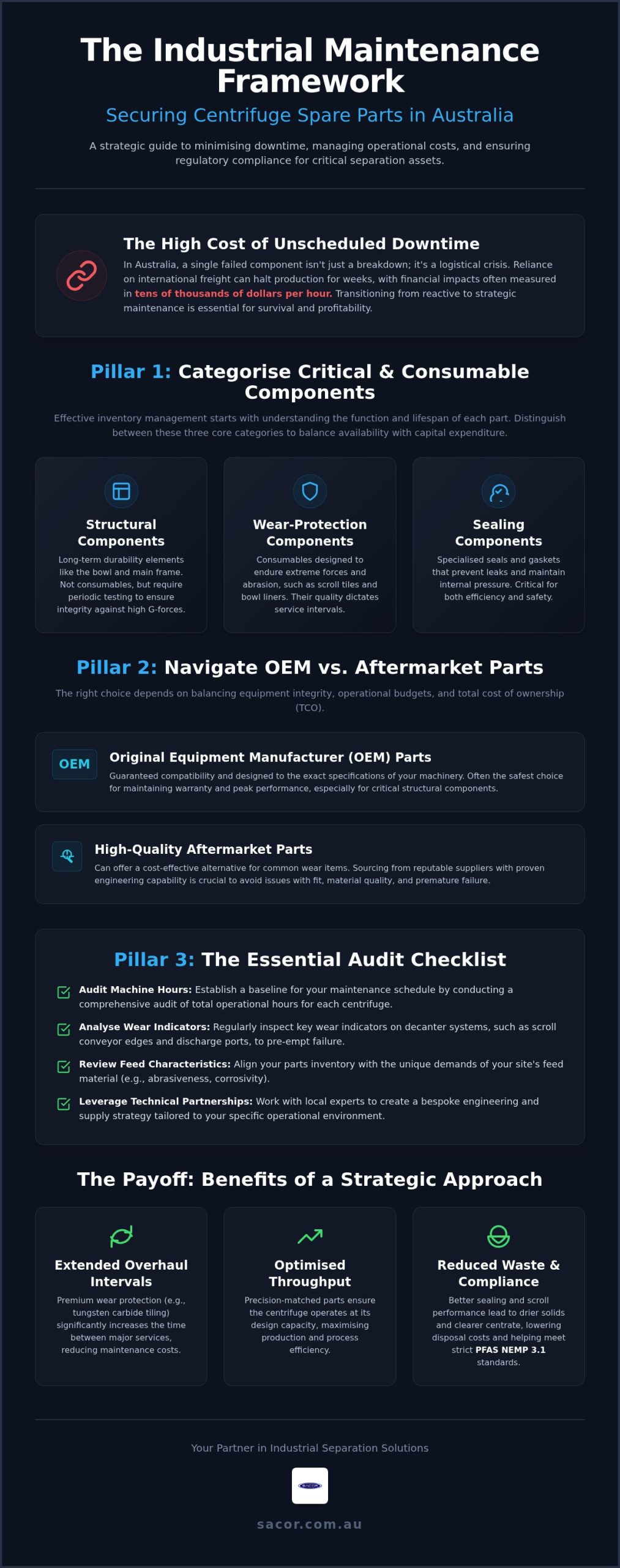
The Essential Centrifuge Spare Parts Audit Checklist
A structured audit serves as the foundation for operational resilience; it transforms maintenance from a reactive burden into a predictable strategic process. By establishing a clear baseline of machine hours and component conditions, you can anticipate failures before they compromise production. This audit should categorise your inventory into three distinct tiers: critical spares, consumables, and long-lead items. Effective management of centrifuge spare parts Australia wide relies on this data-driven approach, ensuring that capital is not tied up in redundant stock while guaranteeing that essential components are always within reach.
Step 1: Assessing Machine Condition and Wear Trends
Predictive maintenance tools, such as vibration analysis and regular oil sampling, provide the early warnings necessary to schedule repairs during planned shutdowns. In sludge dewatering centrifuge Australia applications, documenting specific wear patterns is vital; the abrasive nature of organic and inorganic solids can vary significantly between sites. A comprehensive maintenance log that tracks part longevity against different feed types allows your team to identify trends and adjust re-order points based on actual performance rather than theoretical estimates.
Step 2: Optimising On-Site Inventory Levels
Strategic inventory management requires a balance between on-site availability and supply chain speed. You must determine which components are essential for immediate recovery and which can be sourced within a 24-hour window. Your critical spares list should include high-stakes items such as scroll drive motors, main bearings, and control PLC modules. Organising these in a dedicated, centrifuge-specific store ensures rapid retrieval during a breakdown. For sensitive items like seals and high-precision bearings, storage in a climate-controlled environment is mandatory to prevent degradation from humidity or temperature fluctuations.
Finally, audit your supplier to confirm they maintain local stock and possess the technical expertise to support your specific configuration. A partner that understands the nuances of your throughput targets is far more valuable than a simple parts vendor. To ensure your facility is fully prepared for the challenges of 2026, you can engage with our team for specialised spare parts supply to identify and close hidden gaps in your current inventory strategy.
Optimising Supply Chains with Sacor’s Technical Support
Procuring high-quality components is a necessary first step, but achieving long-term reliability requires a shift from a transactional vendor relationship to a strategic technical partnership. Sacor provides this bridge. We act as a seasoned authority that integrates part supply with bespoke engineering and national on-site support. Our role extends beyond the warehouse; we ensure that every piece of centrifuge spare parts Australia we supply is precisely calibrated to meet your site’s specific throughput targets and environmental obligations. This collaborative framing implies shared goals, where our expertise in separation technology directly supports your operational uptime.
Bespoke Engineering for Specific Site Conditions
Standard components often struggle with the corrosive nature of fluids found in heavy industrial applications. Sacor modifies part specifications for energy sector centrifuge equipment by selecting superior materials such as Duplex stainless steel. This material selection is critical for maintaining structural integrity in high-salinity environments, such as those handling produced water, where standard grades would prematurely fail. By collaborating with our engineers, you can solve recurring wear issues through site-specific modifications. We address the root cause of erosion or chemical attack rather than simply replacing failed parts with identical, underperforming versions.
Ongoing Technical Support and Maintenance Contracts
Scheduled maintenance contracts offer a methodical way to manage your spare parts budget while reducing the administrative burden on your procurement team. These service agreements ensure that critical components are available exactly when needed, supported by our national installation and commissioning services. Every part we install comes with full technical documentation, verifying that the assembly meets all original design tolerances and safety standards. This structured approach to maintenance provides the quiet assurance that your separation systems will remain operational and compliant through 2026 and beyond. By anchoring our innovation in practical, real-world outcomes, we help you maintain a reliable local supply chain for all critical components.
Contact Sacor today to organise a spare parts audit for your facility.
Future-Proofing Your Industrial Separation Assets
Transitioning to a proactive maintenance model is the most effective way to mitigate the logistical risks inherent in the Australian industrial landscape. By categorising components, conducting regular audits, and choosing partners who prioritise metallurgical integrity, you ensure your decanter systems operate at peak efficiency. Relying on a robust supply of centrifuge spare parts Australia wide allows your facility to meet evolving environmental standards while protecting your bottom line from the costs of unscheduled downtime. It’s no longer enough to simply react to failures; success in 2026 requires a data-driven strategy that anticipates wear and secures the supply chain before a crisis occurs.
Sacor stands as a trusted technical partner, offering specialised mining and wastewater expertise alongside national Australian engineering support. Every component we supply is backed by comprehensive technical documentation, giving your team the precise data needed for confident maintenance decision-making. Secure your operation’s uptime with Sacor’s spare parts support and ensure your plant remains a high-performing asset throughout 2026. We’re ready to help you optimise your separation processes for long-term reliability and success.
Frequently Asked Questions
What are the most common wear parts in a decanter centrifuge?
The most common wear parts include tungsten carbide scroll tiles, solids discharge nozzles, bowl liners, and conveyor flights. These components face the highest velocity of abrasive particles during separation. In the context of centrifuge spare parts Australia wide, identifying these high-wear zones early allows for sacrificial replacement before the structural stainless steel is compromised. Regular assessment of the solids discharge ports is also vital, as erosion here can cause significant rotating imbalances.
How often should I inspect the bearings and seals on my centrifuge?
You should conduct visual inspections for seal leaks monthly, while bearings require continuous vibration and temperature monitoring for the most accurate health assessment. Major physical inspections typically occur every 2,000 to 4,000 operating hours, depending on the abrasiveness of your feed material. Using predictive data allows you to schedule maintenance before a catastrophic failure occurs, ensuring that your inventory of centrifuge spare parts Australia is used efficiently and effectively.
Can I use aftermarket spare parts without voiding my equipment warranty?
Using high-quality aftermarket parts doesn’t always void a warranty, but you must verify the specific terms of your manufacturer’s agreement. Many operators successfully integrate aftermarket components that meet or exceed original metallurgical certifications. Sacor ensures that all supplied parts are technically compliant with existing infrastructure. If your machine is out of its initial warranty period, high-quality alternatives often provide superior wear resistance tailored to your specific Australian site conditions.
What is the typical lead time for centrifuge spare parts in Australia?
Lead times vary significantly; local stock for common consumables is usually available within 24 to 48 hours. However, complex structural components or long-lead items sourced internationally can take 6 to 12 weeks to arrive in Australia. This geographic reality makes strategic inventory management and a reliable local supply chain essential. By auditing your current stock levels, you can identify which critical spares require a permanent on-site presence to avoid lengthy shutdowns.
How do I identify the correct part number for my specific centrifuge model?
To identify the correct part number, you must first locate the machine’s nameplate and record the specific serial number and model designation. This information is then cross-referenced with your original technical manual or the manufacturer’s illustrated parts list. If the manual is unavailable, Sacor’s technical team can assist by conducting a site audit to verify component specifications, ensuring that every replacement part matches the precise tolerances required for your system.
Why is vibration analysis important for managing spare parts inventory?
Vibration analysis is critical because it provides a data-driven window into the health of your rotating assemblies and bearings. By identifying abnormal frequency signatures, you can predict component failure weeks before it manifests physically. This foresight allows your procurement team to trigger the purchase of centrifuge spare parts Australia wide during planned maintenance windows. This proactive approach eliminates the need for expensive emergency freight and minimises the risk of secondary damage to the machine frame.
Does Sacor provide on-site installation for the spare parts they supply?
Yes, Sacor provides comprehensive on-site installation and commissioning services for the full range of spare parts we supply. Our national engineering team ensures that every component is installed to original specifications and balanced correctly within the rotating assembly. This service includes full technical documentation, which is essential for maintaining site safety standards and historical maintenance logs. Professional installation guarantees that new parts perform optimally from the first hour of operation.
How should I store centrifuge bearings to ensure they don’t degrade before use?
You must store centrifuge bearings in a climate-controlled environment with low humidity and stable temperatures to prevent corrosion and grease degradation. Bearings should remain in their original, sealed packaging until the moment of installation. It’s also important to store them horizontally; vertical storage can cause the internal lubricant to migrate, leading to dry spots and premature failure upon start-up. Proper storage ensures your critical spares remain in peak condition for future use.