
Every percentage point of moisture retained in your sludge cake is a direct, unnecessary tax on your operational bottom line. In an era of escalating transport levies and stringent environmental regulations, knowing how to increase cake dryness in sludge is essential for maintaining site profitability. Most plant managers recognise that inconsistent cake quality leads to spiralling disposal costs and downstream processing bottlenecks, yet achieving peak performance remains a complex technical challenge.
We understand that you’re likely facing the frustration of excessive polymer consumption with diminishing returns. This guide provides the technical framework for balancing mechanical residence time with chemical flocculation stability. You’ll discover the precise adjustments required to fine-tune your decanter centrifuge systems and reduce chemical overheads. We’ll provide a methodical overview of bowl speed optimisation, torque management, and feed characteristics, offering the technical insights needed to transform your sludge management into a streamlined, cost-effective operation.
Key Takeaways
- Reduce operational overheads by understanding the direct correlation between moisture content and Australian industrial waste levies.
- Optimise chemical conditioning through precise polymer selection, ensuring the correct ionic charge to effectively release bound water.
- Discover how to increase cake dryness in sludge by fine-tuning decanter centrifuge bowl speeds and differential torque for maximum solids compaction.
- Improve dewatering consistency by managing feed sludge variables such as temperature and solids concentration to maintain optimal fluid viscosity.
- Identify and resolve process bottlenecks through comprehensive engineering audits and custom-engineered separation solutions tailored to your site requirements.
The Economic and Operational Impact of Sludge Cake Dryness
Industrial waste management in Australia is increasingly dictated by the rising costs of disposal and the rigorous standards of environmental compliance. For plant managers and engineers, understanding how to increase cake dryness in sludge is not merely a technical preference; it’s a financial necessity. When sludge contains excess moisture, you are essentially paying to transport and dispose of water. Every tonne of wet cake incurs significant transport fees and state-based waste levies that continue to trend upwards across the country.
Achieving a drier cake directly supports your site’s environmental responsibility. By reducing the total volume of waste sent to landfill, you extend the lifespan of disposal sites and minimise the carbon footprint associated with heavy vehicle movements. This focus on efficiency aligns with sustainable industrial practices while protecting the facility’s bottom line from avoidable overheads.
Reducing Sludge Disposal and Transport Costs
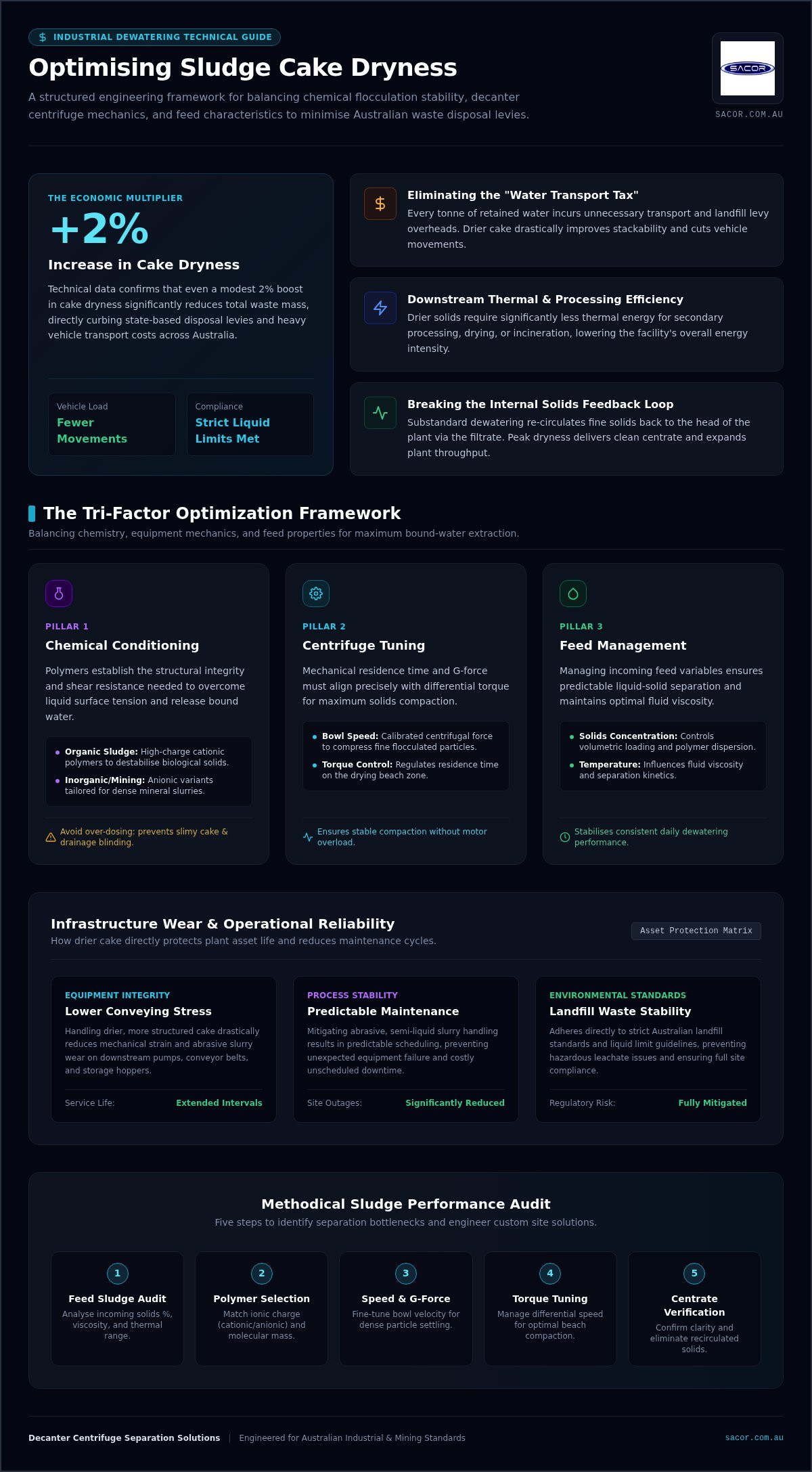
Calculating the “cost of water” involves more than just the weight of the waste. High moisture content reduces the stackability of the cake, often requiring more truck movements to clear the same volume of solids. Technical data suggests that even a 2% increase in cake dryness can yield substantial annual savings by reducing the total mass of material leaving the site. This is particularly critical when meeting Australian standards for landfill waste stability, where liquid limits are strictly monitored to prevent leachate issues.
Effective sewage sludge treatment and dewatering strategies ensure that the final product is a manageable solid rather than a semi-liquid slurry. This improvement in consistency also benefits downstream processes such as composting or incineration. Drier solids require significantly less energy for thermal drying or secondary processing, which lowers the overall energy intensity of the waste treatment cycle.
Operational Efficiency and Plant Throughput
Beyond disposal fees, the internal efficiency of your facility depends on the quality of the separation process. Poor dewatering performance places an unnecessary burden on filtrate treatment systems, often cycling fine solids back through the plant and creating a feedback loop that reduces total throughput. When you master how to increase cake dryness in sludge, you effectively break this cycle and improve the clarity of the centrate.
Optimising your sludge dewatering centrifuge Australia operations also minimises equipment wear. Handling high-volume, abrasive slurries is hard on infrastructure. Drier cake is easier to convey and store, which reduces the mechanical stress on pumps, belts, and hoppers. This results in longer service intervals and more predictable maintenance schedules, reinforcing the site’s overall reliability and operational stability.
Optimising Chemical Conditioning and Flocculation
Chemical conditioning is the fundamental precursor to successful mechanical separation. While centrifugal force provides the energy to move particles, polymers provide the structural integrity required to release bound water from the solid matrix. If you are investigating how to increase cake dryness in sludge, your first point of technical review should be the chemical stability and shear resistance of your floc. Without an optimised chemical program, even the most advanced mechanical adjustments will struggle to overcome the surface tension of the liquid phase.
The primary role of flocculants is to neutralise particle charges and create bridges between small solids, forming larger masses known as flocs. This process is essential for meeting the standards outlined in EPA biosolids and sludge dewatering guidelines, which emphasise the importance of solids concentration for both environmental safety and disposal efficiency. However, achieving peak dryness requires a delicate balance; over-dosing often leads to a “slimy” cake that traps water and blinds the drainage zones of your equipment.
Selecting the Right Polymer for Australian Sites
Selecting the correct ionic charge and molecular weight is critical for site-specific performance. Organic sludges, typical of municipal wastewater, generally require cationic polymers with high charge densities to effectively destabilise the biological solids. In contrast, inorganic mining or mineral processing sludges often respond more effectively to anionic variants. The molecular weight must be high enough to provide robust floc structure but not so high that the resulting flocs become too large and fragile for the high-shear environment of a decanter centrifuge.
Conducting regular jar tests is the only reliable method to determine optimal dosage rates as feed characteristics fluctuate. These tests must account for local water chemistry, as variations in pH and alkalinity can significantly alter the polymer’s ability to uncoil and react with the solids. Our technical team often identifies chemical imbalances during a site performance audit, which remains one of the fastest ways to recover lost efficiency and reduce polymer spend.
Dosing Systems and Mixing Energy
Precise delivery is just as important as the chemical selection itself. Uniform distribution of the polymer within the feed stream ensures that every solid particle is conditioned before it enters the centrifuge. This requires carefully managed mixing energy; the intensity must be sufficient to ensure contact but low enough to prevent the physical breakage of flocs. If the flocs are sheared before they reach the drying zone of the centrifuge, the liberated “fines” will inevitably retain more moisture and reduce the overall cake dryness.
Modern automated dosing systems offer a significant advantage by adjusting chemical flow in real-time based on feed solids concentration. This prevents the common issue of diminishing returns, where adding more polymer actually decreases performance by lubricating the solids. By maintaining a steady, optimised dosing rate, you ensure a consistent cake quality that simplifies downstream handling and transport logistics.
Mechanical Adjustments: Fine-Tuning Your Decanter Centrifuge
Mechanical adjustments represent the final, most impactful stage of process optimisation. Once chemical conditioning has formed a stable floc, the decanter’s physical settings determine the ultimate moisture content of the discharge. Understanding how to increase cake dryness in sludge requires a precise application of centrifugal physics, specifically the relationship between G-force, residence time, and the mechanical resistance of the solids matrix. Every machine has an optimal operating window where these variables align to produce peak performance.
Bowl Speed and Centrifugal Force
Bowl speed is the primary driver of solids compaction and the most direct method for overcoming the capillary forces that hold water within the sludge structure. Higher rotational speeds generate the G-force necessary to drive liquid through the solids blanket. Increased G-force compresses the sludge blanket, effectively squeezing interstitial water from the solids matrix. While maximising this force is essential for dryness, plant managers must balance rotational speed against increased energy consumption and the potential for accelerated wear on internal components.
Differential Speed and Residence Time
Differential speed, which is the difference in rotation between the bowl and the internal scroll, dictates how long the solids remain within the dewatering zone. By lowering the differential speed, you increase the residence time of the sludge on the “beach” or drying section of the centrifuge. This allows more time for liquid to drain away before the solids are discharged. This adjustment must be managed carefully by monitoring scroll torque; a differential that is too low can lead to excessive solids accumulation and potential equipment blockages. Modern automated VFD systems allow for dynamic adjustments, ensuring the machine responds instantly to fluctuations in feed concentration.
Weir Plate and Pond Depth Optimisation
The weir plate settings determine the pond depth, which directly influences the length of the drying beach. A shallower pond depth exposes more of the bowl’s conical section, providing a longer path for the solids to traverse while being stripped of moisture. This setting often involves a trade-off between cake dryness and centrate clarity. While a shallow pond produces a drier cake, it can occasionally allow more fine solids to escape in the liquid stream. Adhering to EPA biosolids and sludge dewatering guidelines ensures that these adjustments remain within regulatory standards for both waste streams. For detailed technical specifications on weir configurations, refer to our guide on industrial decanter centrifuge Australia operations.
Managing Feed Sludge Characteristics for Maximum Dewatering
While mechanical and chemical adjustments are vital, the physical properties of the feed material often dictate the upper limits of separation performance. Understanding how to increase cake dryness in sludge requires a holistic view that extends beyond the centrifuge itself to the very start of the process line. If the feed characteristics are volatile or poorly managed, even the most precise machine settings will struggle to maintain consistent discharge quality. Stability is the foundation of efficiency.
The ratio of primary to secondary (biological) sludge is a primary factor in dewatering success. Primary sludge is generally easier to dewater due to its fibrous, inorganic nature. Secondary sludge, however, consists of biological flocs that are inherently hydrophilic, meaning they trap water within the cellular structure. Increasing the proportion of primary solids in the feed blend typically results in a drier final cake. Additionally, removing abrasive grit or oversized debris through effective screening is essential. These particles don’t just cause premature wear on the scroll; they disrupt the formation of a uniform solids blanket, which is a prerequisite for maximum compaction.
Feed Consistency and Pre-Thickening
Maintaining a stable feed solids concentration is vital for preventing torque spikes and centrate carryover. Fluctuations in feed density force the centrifuge to constantly hunt for a new equilibrium, which inevitably leads to periods of suboptimal dryness. Utilising gravity thickeners or Dissolved Air Flotation (DAF) units as pre-treatment ensures the centrifuge receives a consistent, concentrated slurry. This stability allows the machine to operate at its peak design capacity. Reducing turbulence in the feed line is also critical, as high-velocity changes can shear the flocs before they enter the bowl, undoing the work of your chemical conditioning program.
Temperature and Viscosity Control
Temperature plays a significant role in separation physics, particularly in Australian climates where seasonal variations can alter sludge behaviour. Warmer sludge has lower viscosity, which reduces the internal friction of the fluid and allows solids to migrate to the bowl wall more rapidly. In some industrial applications, utilising waste heat to raise the feed temperature can significantly improve the speed and effectiveness of water release. This lower viscosity facilitates better drainage through the solids matrix on the beach section of the centrifuge, resulting in a noticeably drier discharge.
Our engineering team provides customised wastewater treatment separation solutions to help you manage these variables and ensure peak discharge quality across all site conditions.
Advanced Engineering Solutions and Performance Audits
When incremental process adjustments reach their limit, a comprehensive engineering audit is the next logical step for site optimisation. These audits move beyond day-to-day troubleshooting to identify the fundamental bottlenecks in your dewatering circuit. A professional audit is the most reliable way to identify exactly how to increase cake dryness in sludge when standard process tweaks no longer yield the desired results. By evaluating the system as a whole, from feed delivery to solids discharge, we can determine whether the solution lies in process refinement or a strategic equipment upgrade.
Steps for a Professional Dewatering Audit
A structured audit begins with baseline data collection. We analyse the current feed characteristics, centrate quality, and cake dryness to establish a performance benchmark. This is followed by a mechanical health check of your existing decanter centrifuges to ensure that internal components are performing to their original specifications. We often find that performance drift is caused by subtle mechanical wear that isn’t immediately obvious during routine inspections.
- Data Benchmarking: Analysing feed solids concentration and particle size distribution.
- Mechanical Inspection: Checking scroll clearances, bearing health, and vibration profiles.
- Chemical Programme Review: Trialing alternative flocculants or dosing points to improve floc structural integrity.
Evaluating the ROI of a centrifuge upgrade versus process optimisation is a critical part of this assessment. In many cases, custom-engineered internals can breathe new life into older machines, providing the performance of a new system at a fraction of the capital cost. This methodical approach ensures that any investment is backed by technical data and clear performance expectations.
Customisation and Maintenance for Longevity
Australian mining and industrial sites often deal with highly abrasive slurries that require specialised equipment protection. Using wear-resistant tungsten carbide tiles and custom scroll designs can significantly extend the service life of your centrifuge while maintaining peak dewatering efficiency. These customisations are designed to handle the specific rheology of your waste stream, ensuring that the machine maintains maximum G-force and residence time without premature degradation.
Reliability is built on a foundation of proactive maintenance and the availability of high-quality components. Utilising industrial centrifuge spare parts Australia ensures that your equipment remains within its tightest operating tolerances. When clearances between the scroll and the bowl wall increase due to wear, the machine’s ability to convey and compact solids diminishes, leading to wetter cake and higher disposal costs. Partnering with a technical specialist like Sacor provides access to national engineering support and the expertise required to keep your separation systems running at peak performance.
Contact Sacor to organise a dewatering performance audit for your site and discover the precise adjustments needed to lower your industrial disposal costs.
Maximising Operational Efficiency through Precision Dewatering
Achieving peak separation performance is a multifaceted challenge that requires the alignment of chemical conditioning, mechanical precision, and feed stability. By understanding how to increase cake dryness in sludge through methodical adjustments to G-force and residence time, plant managers can significantly reduce the volume of waste sent to landfill and lower associated transport levies. These improvements don’t just protect the bottom line; they reinforce a facility’s commitment to sustainable industrial practice and long-term environmental responsibility.
As an Australian-owned and operated technical authority, Sacor provides the custom engineering solutions required to solve complex separation challenges across the mining and wastewater sectors. Our national maintenance and spare parts support ensure that your systems maintain their performance and reliability throughout their service life. We invite you to optimise your dewatering process with Sacor Australia and secure a more cost-effective future for your site operations. We look forward to partnering with you to achieve measurable results and operational excellence.
Frequently Asked Questions
Why is my sludge cake still wet despite increasing the polymer dose?
Excessive polymer dosing often leads to a phenomenon where the surplus chemical acts as a lubricant rather than a flocculant, effectively trapping water within the solids matrix. This creates a “slimy” consistency that prevents effective drainage on the centrifuge beach. If you are struggling with how to increase cake dryness in sludge, it’s essential to verify that your polymer’s ionic charge and molecular weight match your specific feed characteristics through regular jar testing.
How does differential speed affect the dryness of the cake in a decanter centrifuge?
Differential speed determines the residence time of the solids within the drying zone of the bowl. By reducing the speed difference between the bowl and the scroll, you allow the sludge to remain on the “beach” for a longer duration, which facilitates more thorough liquid drainage. While a lower differential speed produces a drier cake, it also increases the torque on the scroll, requiring careful monitoring to prevent equipment blockages or mechanical overloads during operation.
What is the ideal G-force for dewatering industrial wastewater sludge?
Most industrial wastewater applications achieve optimal results within a range of 2,500 to 3,500 Gs. High G-forces are necessary to overcome the capillary forces holding water within the sludge structure, but the specific “ideal” setting depends on your solids’ shear sensitivity. Biological sludges may require lower forces to prevent floc breakage, whereas inorganic or fibrous mining sludges often benefit from higher rotational speeds to maximise solids compaction and improve the final cake dryness across the discharge.
Can I increase cake dryness without increasing chemical costs?
You can often improve results through mechanical optimisation rather than increasing your chemical spend. Adjusting the weir plates to create a shallower pond depth increases the length of the drying beach, providing more time for dewatering. Additionally, ensuring a consistent feed solids concentration prevents the centrifuge from “hunting” for equilibrium, which stabilises discharge quality. Many sites find that a professional performance audit identifies mechanical gains that allow for reduced polymer consumption.
How often should I check the wear on my centrifuge scroll to maintain dryness?
We recommend conducting a thorough mechanical inspection every six months, although high-abrasion environments like mining may require quarterly checks. As the edges of the scroll wear down, the clearance between the conveyor and the bowl wall increases, which reduces the machine’s ability to efficiently compact and transport solids. This performance drift leads to progressively wetter cake. Maintaining tight tolerances is essential for ensuring your decanter centrifuge continues to operate at its peak design efficiency.
What role does feed temperature play in the dewatering process?
Feed temperature directly influences the viscosity of the liquid phase, which is a critical factor in separation speed. Warmer sludge has lower viscosity, allowing water to migrate through the solids matrix and away from the bowl wall more easily. In Australian industrial settings, utilising waste heat to increase feed temperature can be a highly effective strategy for improving water release. This physical change speeds up the compaction process, resulting in a drier discharge.
How do I calculate the potential savings from increasing cake dryness by 5%?
Savings are calculated by measuring the reduction in total waste mass and the corresponding decrease in transport and disposal levies. For example, increasing cake dryness from 20% to 25% represents a significant reduction in the total tonnage of water being hauled away. You should factor in your current state-based waste levies and fuel costs per truck movement. Often, the reduction in disposal fees alone provides a rapid return on investment for process optimisation.
Is a decanter centrifuge better than a filter press for achieving high cake dryness?
While filter presses can sometimes achieve higher absolute dryness in specific batch applications, decanter centrifuges offer superior performance for continuous, high-volume industrial processes. Centrifuges require a smaller footprint, less operator intervention, and provide more consistent results across fluctuating feed conditions. For many Australian mining and wastewater sites, the continuous nature and automated control of a decanter centrifuge make it the more reliable choice for maintaining steady cake quality and reducing long-term operational overheads.