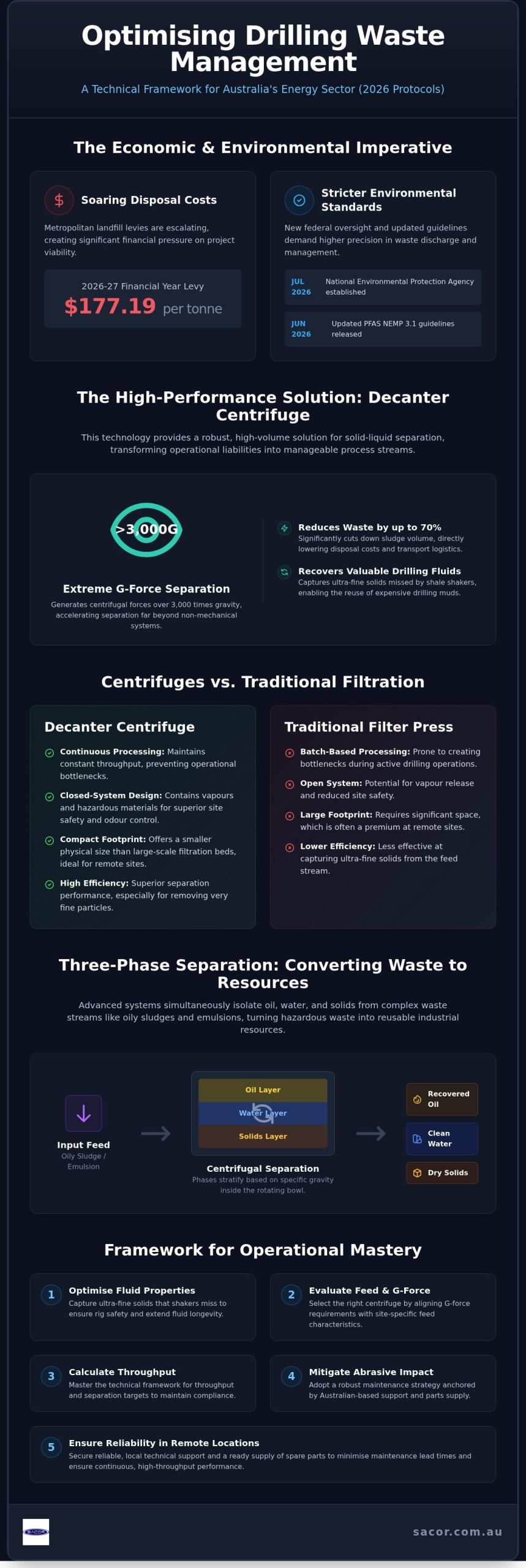
Reducing sludge disposal costs by up to 70% is no longer a theoretical goal; it’s a financial necessity in an era where metropolitan landfill levies have reached $177.19 per tonne for the 2026-27 financial year. For operators in isolated energy hubs, the challenge of managing high-volume waste is compounded by the establishment of the National Environmental Protection Agency and the updated PFAS NEMP 3.1 guidelines. You likely recognise that maintaining a compliant, cost-effective site requires more than just standard equipment. Integrating a high-performance decanter centrifuge for drilling waste management is essential for achieving the precision required to separate solids from fluids under extreme conditions.
This operational guide details how to master the technical requirements for centrifugal separation within the Australian energy sector. We provide a comprehensive framework for optimising separation efficiency, from produced water treatment to drilling fluid recovery. By following these 2026 protocols, you can ensure a reduced environmental footprint through cleaner discharge and secure the reliable technical support necessary to minimise maintenance lead times in remote locations. We’ll examine the specific configurations required for high-G force separation and the logistical strategies that support continuous, high-throughput performance.
Key Takeaways
- Optimise drilling fluid properties by capturing the ultra-fine solids that traditional shale shakers cannot remove, thereby ensuring rig safety and fluid longevity.
- Implement three-phase separation technology to simultaneously recover oil, water, and solids, effectively converting hazardous waste streams into reusable industrial resources.
- Learn to evaluate feed characteristics and G-force requirements to select a decanter centrifuge for drilling waste management that aligns with specific site-based performance indicators.
- Mitigate the operational impact of abrasive solids on internal components by adopting a maintenance strategy anchored by Australian-based technical support and local spare parts supply.
- Master the technical framework for calculating throughput and separation targets to maintain compliance with strict 2026 environmental discharge regulations.
The Role of Centrifugal Separation in Australian Oil and Gas
The industrial decanter centrifuge serves as the primary mechanism for high-volume solid-liquid separation within the Australian energy sector, providing a robust solution for processing complex feed streams. Unlike passive sedimentation tanks, this equipment employs high-speed rotation to generate centrifugal forces that can exceed 3,000 times the force of gravity. This acceleration of the settling process allows operators to achieve throughput levels that are physically impossible for non-mechanical systems. Within the context of local energy processing, the application of decanter centrifuge technology is essential for both the recovery of expensive drilling fluids and the treatment of produced water. By effectively removing fine solids, these systems enable the reuse of drilling muds, which directly reduces the volume of hazardous waste destined for disposal.
Australian operators prioritise high-efficiency separation to mitigate the rising costs of waste management across the country. While the financial pressures of landfill levies vary, the broader economic trend necessitates a significant reduction in waste volume to maintain project viability. A well-configured decanter centrifuge for drilling waste management transforms a significant operational liability into a manageable process stream. It’s a strategic investment that addresses both economic pressures and the logistical challenges of operating in isolated regions where waste transport is difficult.
Meeting Australian Environmental Standards
The regulatory landscape for the energy sector underwent a fundamental shift on 1 July 2026 with the establishment of the National Environmental Protection Agency. This new federal oversight, combined with the updated PFAS NEMP 3.1 guidelines released in June 2026, necessitates a higher standard of discharge precision. Advanced separation technology ensures that produced water and waste streams meet these updated environmental protection protocols. Achieving these technical benchmarks allows companies to align their field operations with corporate ESG goals, demonstrating a commitment to sustainable resource management through cleaner discharge.
Centrifuges vs. Traditional Filtration Systems
Decanter centrifuges are preferred for oilfield operations over filter presses due to their continuous processing capability. Unlike batch-based filtration, a decanter centrifuge for drilling waste management maintains constant throughput, which is vital for preventing bottlenecks during active drilling. The closed-system design also provides superior site safety and odour control, as it contains volatile vapours and hazardous materials within the housing. In remote site environments where space is at a premium, a compact centrifuge unit offers a smaller physical footprint than large-scale filtration beds while delivering higher separation efficiency for fine particles.
Three-Phase Centrifuge Systems: Separating Oil, Water and Solids
Three-phase separation represents a technical evolution over standard two-phase models, providing the capability to isolate hydrocarbons from water and solids simultaneously. While two-phase units are effective for basic solid-liquid separation, a three-phase system is required when the feed contains significant oil content. This capability is vital when deploying a decanter centrifuge for drilling waste management in environments where oily sludges or complex emulsions are prevalent. Within the rotating bowl, the highest density solids are forced against the wall, while the water and oil phases stratify into distinct layers based on their specific gravities.
Precision is maintained through adjustable impeller technology. This feature allows site engineers to modify the pond depth and liquid discharge pressure without stopping the machine, which is essential when the oil-to-water ratio of the feed fluctuates during a project. Solids are discharged continuously via the internal scroll conveyor, ensuring the process flow remains uninterrupted. For particularly fine particles that resist mechanical settling, polymer dosing is often integrated. This chemical assistance flocculates the solids, enhancing the overall recovery rate and ensuring the liquid phases remain clear of contaminants.
Optimising Produced Water Treatment
In Australian energy projects, managing produced water requires meeting strict parts per million (ppm) targets for residual hydrocarbons. Three-phase systems are engineered to achieve these levels by stripping oil from high-volume water streams, often reaching oil-in-water concentrations suitable for safe reinjection or environmental discharge. For oilfield water management, three-phase separation is the mechanical process of isolating hydrocarbons to meet regulated discharge limits, typically targeting below 30 ppm depending on the specific site approval and local environmental protocols.
Crude Oil De-sludging and Recovery
Recovering valuable hydrocarbons from lagoon sludges and tank bottoms provides a clear economic return by turning hazardous waste into a refined product. Centrifugal force separates the heavy silt and water from the crude oil, significantly reducing the volume of material that requires expensive transport and disposal. This precision at the source improves the quality of the recovered oil and lowers operational overheads across the project lifecycle. Implementing high-efficiency three-phase centrifuge systems ensures that these recovery processes remain consistent even under varying feed characteristics and high-solids loading.
Drilling Fluid Management and Solids Control
Maintaining the integrity of drilling mud is a critical factor in rig safety and operational efficiency. While shale shakers effectively remove large cuttings, they can’t capture fine silt or Low Gravity Solids (LGS). If these microscopic particles remain in the system, they increase mud viscosity and lead to higher pump pressures. This buildup causes accelerated wear on downhole components and reduces the rate of penetration. A decanter centrifuge for drilling waste management provides the precision required to remove these contaminants, ensuring the fluid retains its designed rheological properties throughout the drilling programme.
Operators typically employ two distinct centrifugal strategies depending on the mud type. In unweighted mud systems, the centrifuge operates at maximum bowl speed to strip as many solids as possible from the fluid. Conversely, in weighted mud systems, the objective shifts to selective separation. The machine is calibrated to recover heavy weighting agents while discarding the lighter, undesirable drill solids. This technical balance is essential for long-duration Australian drilling campaigns. The economic benefits of fluid recovery accumulate significantly as the depth of the well increases.
Barite Recovery and Fluid Re-use
In weighted systems, Barite represents a substantial portion of the fluid’s total cost. Efficient recovery involves running the centrifuge at a specific speed that allows the heavy Barite particles to be returned to the active system while the finer drill solids are rejected. This selective removal prevents the system from becoming overloaded with fines, which would otherwise require expensive dilution or complete fluid replacement. By maintaining the correct mud density through mechanical recovery rather than constant chemical addition, operators can substantially lower the overall cost-per-metre of the drilling operation. It’s a methodical approach that ensures the most expensive components of the mud system are preserved.
Waste Volume Reduction on Remote Sites
Many remote Australian energy projects now operate under “dry site” or zero liquid discharge mandates. In these isolated hubs, liquid waste discharge is strictly prohibited, requiring all waste to be transported off-site in a solid state. Centrifuges are indispensable in this context because they achieve the high cake dryness necessary for standard landfill disposal. By extracting the maximum amount of liquid for re-use, the centrifuge reduces the total volume of waste solids. This efficiency directly decreases the frequency of heavy vehicle movements required for waste removal. It lowers transport costs and reduces the logistical burden on remote site infrastructure.
Operational Reliability and Maintenance in Remote Australia
Maintaining mechanical integrity in remote Australian energy hubs requires a rigorous approach to wear management and proactive servicing. The abrasive nature of local ores and silicates poses a constant threat to the internal components of a decanter centrifuge for drilling waste management. These particles can rapidly erode scroll flights and bowl liners, leading to a loss in separation efficiency and increased vibration. Because these systems often operate at forces exceeding 3,000G, even minor component wear can escalate into a catastrophic failure if left unaddressed. Proactive maintenance schedules are therefore essential for ensuring continuous uptime in high-stakes drilling campaigns.
By 2026, the integration of remote monitoring and diagnostic tools has become standard for proactive oilfield operations. These systems allow engineers to track real-time vibration, bearing temperatures, and torque levels from centralised control centres. This data-driven approach enables the identification of process variances before they cause equipment damage. For projects in isolated regions, this foresight is invaluable, as it allows for the coordination of service intervals and part replacements during planned downtime rather than in response to a breakdown.
Wear Protection and Material Engineering
High-wear areas within the centrifuge are typically protected using tungsten carbide tiles and specialised hard-facing to extend the service life of the scroll. Material selection must also account for the corrosive properties of high-salinity produced water and the aggressive chemicals used in modern drilling fluids. Choosing the correct alloys prevents pitting and stress-corrosion cracking in the bowl assembly. Precise scroll balancing is the fundamental requirement for maintaining mechanical integrity during high-speed operation in remote environments where on-site vibration analysis is limited.
Australian Technical Support and Commissioning
Successful deployment begins with professional on-site commissioning to ensure the centrifuge is correctly integrated into the existing plant infrastructure. Local engineering expertise is vital for troubleshooting real-time process variances and optimising the machine for specific site conditions. Accessing Industrial centrifuge spare parts Australia is a critical factor for maintaining uptime, as it eliminates the long lead times associated with international procurement. For operators seeking to secure their project’s operational continuity, consulting with an Australian technical partner ensures that both parts and expertise are available whenever required.
Selecting the Right Centrifuge for Your Energy Project
Choosing the correct decanter centrifuge for drilling waste management requires a methodical evaluation of site-specific variables rather than a generic catalogue-based approach. The primary technical framework must account for the feed’s physical properties; specifically its viscosity, particle size distribution, and density. These factors dictate the required bowl speed and G-force necessary to achieve target separation. For instance, high-density solids in a low-viscosity fluid require different configurations than fine silts in a viscous mud system. Failing to match the machine to these characteristics often results in poor centrate quality or excessive equipment wear.
Calculating the required throughput is essential for meeting oilfield KPIs and maintaining project schedules. Operators must determine the precise balance between residence time and centrifugal force to ensure clarity in the centrate while achieving the cake dryness discussed in previous sections. Evaluating the total cost of ownership (TCO) is equally critical. This assessment should go beyond the initial capital expenditure to include power consumption, polymer requirements, and long-term maintenance costs. High-efficiency drives and optimised bowl designs can significantly lower these ongoing expenses, providing a more sustainable financial outcome over the project’s lifecycle.
Bespoke Engineering and Process Design
Off-the-shelf solutions often fail to meet the specific demands of Australian energy projects, where extreme ambient temperatures and unique mineralogies are common. Collaborating with specialised engineers ensures that centrifuge specifications are matched to the existing plant infrastructure and process flow. This bespoke approach prevents integration bottlenecks and ensures the system operates at peak efficiency from day one. For a deeper analysis of these technical considerations, refer to our Energy sector centrifuge equipment strategic guide.
Future-Proofing Your Separation Infrastructure
Scalability is a vital consideration for expanding energy projects where throughput requirements are expected to increase over time. Selecting a system that can be easily upgraded or reconfigured allows for greater operational flexibility as site conditions evolve. Integrating advanced automation and control systems is also essential for 2026 operations, enabling autonomous operation on unmanned or remote sites. These systems provide real-time data that supports the proactive maintenance strategies required for remote reliability. Sacor remains committed to delivering sustainable and efficient industrial separation solutions that support the long-term goals of the Australian energy sector.
Optimising Operational Performance for 2026 and Beyond
Mastering centrifugal separation is a strategic pillar for maintaining profitability and compliance in the Australian energy sector. The effective integration of a decanter centrifuge for drilling waste management allows operators to significantly reduce disposal volumes. It’s the most reliable method for meeting the rigorous 2026 standards for produced water discharge. Achieving these outcomes requires bespoke engineering solutions calibrated for the abrasive and corrosive conditions found on remote sites. Standard equipment often falls short when faced with the unique mineralogies of the Australian landscape.
Sacor provides the technical expertise and infrastructure required for these complex operations. Our specialist Australian engineering team delivers proven results in high-volume produced water treatment. We ensure your site remains compliant and efficient. We back our technology with comprehensive national spare parts and maintenance support to eliminate lead-time risks. You can contact Sacor to discuss your customised oil and gas separation requirements at any time. Strengthening your infrastructure now prepares your project for the evolving regulatory and economic landscape of the future.
Frequently Asked Questions
What is the difference between a two-phase and a three-phase centrifuge?
Two-phase centrifuges separate solids from a single liquid phase, while three-phase centrifuges separate solids and two immiscible liquid phases, such as oil and water, simultaneously. In energy applications, three-phase systems are essential for recovering hydrocarbons from oily sludges. Sacor provides both configurations, ensuring the equipment matches the specific fluid dynamics of the site. Selecting the correct phase capability is the first step in optimising recovery rates and meeting discharge standards.
How does a decanter centrifuge handle abrasive solids in drilling mud?
Centrifuges handle abrasive solids through the use of advanced material engineering, including tungsten carbide tiles and specialised hard-facing on the scroll flights. These protective layers prevent the rapid erosion of internal components caused by high-velocity contact with silicates and ores. Maintaining a decanter centrifuge for drilling waste management requires regular inspection of these wear zones to ensure mechanical integrity. This protection allows the machine to operate at high G-forces while processing challenging Australian drilling fluids.
What are the typical maintenance requirements for a centrifuge on a remote site?
Scheduled maintenance focuses on bearing lubrication, vibration analysis, and the inspection of wear-protected components. On remote sites, proactive servicing is vital to prevent unplanned downtime that can halt drilling operations. Sacor supports these requirements through national maintenance contracts and the supply of critical spare parts. Technicians also monitor the scroll’s balance and the integrity of the gearbox to ensure the system remains reliable under continuous, high-speed operational loads. Consistent monitoring is the key to long-term performance.
Can centrifuges be used for produced water treatment to meet environmental standards?
Yes, high-efficiency three-phase centrifuges are specifically designed to strip residual hydrocarbons from produced water to meet strict parts per million targets. These systems ensure that water discharge or reinjection remains compliant with the 2026 National Environmental Protection Agency guidelines. By removing both solids and oil, the centrifuge produces a clear water phase that aligns with corporate sustainability goals and local environmental protection protocols across the Australian energy sector. This mechanical precision is essential for modern site management.
How do I determine the correct centrifuge size for my oil and gas process?
Sizing is determined by calculating the required residence time based on the feed’s viscosity, particle size distribution, and desired throughput. Engineers evaluate these characteristics to select a bowl diameter and length that provide sufficient clarification area. It’s essential to match the machine’s hydraulic capacity with the project’s peak flow rates to prevent bottlenecks. Sacor collaborates with plant managers to design bespoke solutions that integrate seamlessly with existing site infrastructure and specific project-based performance indicators.
What is the impact of G-force on oil-water separation efficiency?
Higher G-force increases the settling velocity of particles and the separation speed of immiscible liquids with different densities. In oil-water separation, increased centrifugal force allows for the capture of finer droplets that would otherwise remain emulsified in the water phase. This leads to a cleaner centrate and higher oil recovery rates. However, the force must be balanced against energy consumption and component wear to ensure the total cost of ownership remains sustainable for the operator.
Are spare parts for industrial centrifuges readily available in Australia?
Sacor maintains a comprehensive inventory of industrial centrifuge spare parts within Australia to support national operations. This local availability is critical for minimising lead times and avoiding the logistical delays associated with international shipping. Accessing domestic parts ensures that maintenance can be performed promptly, keeping remote energy projects on schedule. Reliability is significantly enhanced when operators can source high-quality components and technical support from a trusted partner with a national service and maintenance footprint.
How does polymer dosing improve centrifuge performance in oilfield applications?
Polymer dosing introduces chemical flocculants that bind fine, suspended solids into larger clusters, or flocs, which are easier for the centrifuge to capture. This process is particularly effective for removing ultra-fine particles that might otherwise bypass the mechanical separation of a decanter centrifuge for drilling waste management. Improved flocculation results in a clearer centrate and a drier cake discharge. It’s a precise method for enhancing separation efficiency when dealing with complex, high-viscosity, or high-solids feed streams.