
The most affordable industrial centrifuge on your tender list often proves to be your most expensive liability over its operational lifespan. When evaluating the industrial centrifuge cost Australia wide, procurement teams frequently focus on the initial capital expenditure while overlooking the variables that actually dictate long-term profitability. You likely recognise that a separation system represents a decades-long commitment, yet the pressure to minimise upfront costs can lead to unforeseen complications during commissioning or excessive polymer consumption that inflates your annual budget.
This guide provides a comprehensive framework to justify your investment to stakeholders by looking beyond the sticker price to the total cost of ownership. We’ll examine how custom engineering reduces energy demands, why a local spare parts inventory is non-negotiable for remote Australian sites, and how to calculate the true lifecycle value of your separation technology. By the end of this guide, you’ll have the clarity needed to select a partner who understands the unique rigours of the Australian industrial landscape and provides the technical documentation required for a seamless integration.
Key Takeaways
- Understand how material selection, such as the choice between 316 stainless steel and Duplex alloys, impacts both the initial capital outlay and the long-term corrosion resistance of the system.
- Calculate the true industrial centrifuge cost Australia wide by looking beyond the sticker price to account for energy efficiency, polymer consumption, and G-force requirements.
- Differentiate between the operational capabilities of decanter centrifuges and three-phase systems to ensure the selected technology aligns with your specific process outcomes.
- Recognise the importance of local technical documentation and compliance with AS/NZS electrical standards to avoid costly delays during site commissioning and integration.
- Discover how bespoke engineering and professional commissioning protect your high-capital investment and ensure optimal performance from the first day of operation.
Understanding the Investment: Factors Influencing Industrial Centrifuge Cost
Determining the industrial centrifuge cost Australia requires a departure from traditional procurement models. Unlike commodity equipment, these systems are engineered to manage specific hydraulic loads and solid-liquid ratios. The baseline price is dictated by the complexity of the separation task and the scale of the operation. Smaller units designed for pilot projects differ significantly from high-capacity decanters used in large-scale mining or wastewater treatment. Precision is paramount. Every design choice impacts the final investment.
The Scale of Industrial Separation
Industrial scale centrifuges are fundamentally different from laboratory equipment. They must withstand continuous operation under extreme centrifugal force. Off-the-shelf units rarely meet the specific performance metrics required for Australian industrial sites. Custom-engineered solutions carry a higher initial investment because they’re designed with specific bowl diameters and length-to-diameter ratios to optimise residence time. These dimensions directly influence the G-force capability and the clarity of the centrate. They’re critical drivers of the final quote. Larger bowls require more substantial frames and more powerful drive systems, which adds to the capital outlay.
Materials and Durability
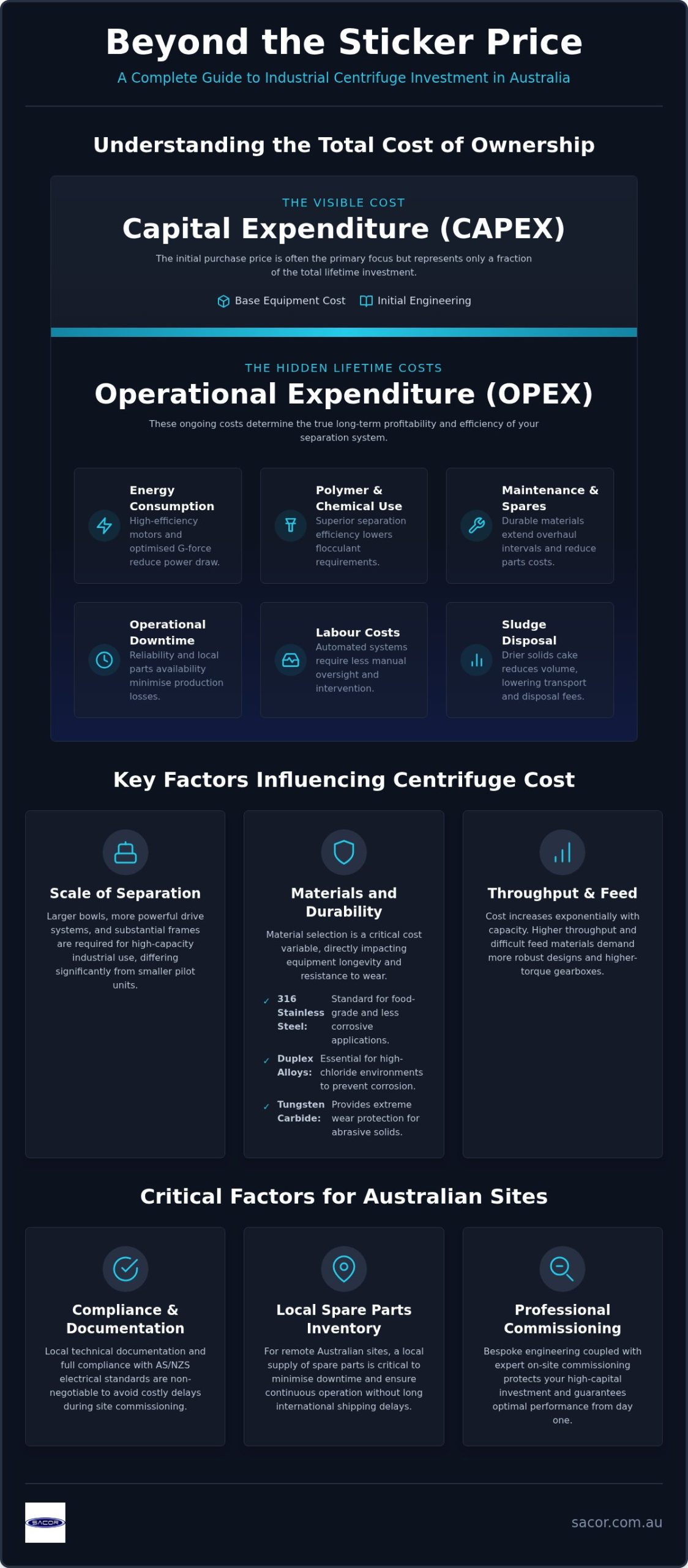
Material selection represents one of the most significant variables in the total investment. While 316 stainless steel is a standard for many food processing separation solutions, abrasive mining applications often necessitate Duplex alloys or specialised wear protection. These materials provide the robustness needed to prevent premature erosion of the scroll and bowl. Sintered carbide tiles are often necessary for the conveyor. The selection of high-grade alloys and protective coatings directly determines equipment longevity and maintains structural integrity in harsh Australian environments.
- Corrosion resistance: High-chloride environments require Duplex steel to prevent pitting and stress corrosion cracking.
- Wear protection: Tungsten carbide tiling protects the conveyor in high-solids applications, extending the interval between major overhauls.
- Sanitary standards: Food-grade finishes ensure compliance with health regulations but increase manufacturing complexity and cost.
Throughput and Feed Characteristics
The exponential cost curve becomes evident when throughput requirements increase. Doubling the capacity doesn’t simply double the price. It often requires a shift to more robust frame designs and higher-torque gearboxes. Feed characteristics, such as particle size distribution and viscosity, also play a role. Difficult materials that resist separation require more sophisticated engineering to achieve the desired dryness of the solids cake. This complexity naturally influences the overall project budget. Engineering for high solids concentration demands a more powerful scroll drive to manage the increased torque requirements.
CAPEX vs. OPEX: Breaking Down the Total Cost of Ownership
The initial capital expenditure (CAPEX) for a separation system is often the primary focus of procurement, yet it represents only a fraction of the lifetime investment. This “Iceberg Effect” means that while the purchase price is visible, the substantial costs of energy, chemicals, and maintenance remain submerged. When calculating the industrial centrifuge cost Australia, plant managers must account for these ongoing operational expenditures (OPEX) to avoid long-term budget blowouts. A cheaper machine that consumes excessive polymer or requires frequent part replacements quickly becomes a financial burden.
Operating Expenditure (OPEX) Drivers
Energy consumption is a primary driver of operational costs. High-efficiency motors and precisely calibrated G-force requirements reduce power draw over thousands of operational hours. Chemical costs also fluctuate based on equipment performance. A system that achieves superior separation efficiency reduces the volume of flocculants and polymers required to treat the feed. This efficiency doesn’t just save on chemical spend; it also lowers the transport and disposal costs for the resulting sludge cake. Drier solids mean less weight to haul across vast Australian distances, which directly improves the sustainability of the operation.
Maintenance intervals and the availability of spare parts are critical for high-stakes industries. Automated control systems now play a vital role in reducing labour costs and operational errors. These systems monitor vibration, temperature, and torque in real-time, allowing for predictive maintenance rather than reactive repairs. The relationship between centrifuge speed and wear is direct. Running a machine at its absolute limit increases the frequency of overhauls. It’s often more cost-effective to specify a unit that reaches separation targets at moderate speeds, thereby extending the life of the bearings and tiles.
Maximising ROI Through Efficiency
Choosing a high-efficiency decanter over a lower-cost alternative frequently results in a shorter payback period. While the upfront price is higher, the cumulative reduction in daily running costs creates a far more favourable lifecycle value. For a deeper look at specific performance metrics and engineering standards, refer to our Industrial Decanter Centrifuge Australia guide. Process optimisation ensures the machine operates at its peak efficiency, protecting both the asset and the bottom line.
The longevity of your equipment is tied to the quality of ongoing care. Investing in professional Maintenance and Technical Support Services ensures that the system remains calibrated for changing feed characteristics over its lifespan. This proactive partnership prevents the catastrophic downtime that can cripple production schedules in remote locations. Reliability isn’t just a technical spec; it’s the ultimate measure of your return on investment.
Selecting Technology: How Process Requirements Dictate Price
The specific nature of your process fluid dictates the internal configuration of the machinery. While a standard decanter centrifuge remains the versatile workhorse for most solid-liquid separation tasks, moving to a three-phase system introduces additional complexity. These units separate two immiscible liquids and a solid simultaneously, requiring specialised discharge ports and adjustable impellers. This technical sophistication naturally shifts the industrial centrifuge cost Australia procurement teams must budget for. Similarly, disc separators are engineered for high-clarity requirements in the beverage and oil sectors, where removing microscopic particles at high speeds demands a different tier of precision engineering.
Industry-Specific Cost Factors
In the mining sector, handling high-density tailings or abrasive mineral ores requires significant investment in wear protection. This includes tungsten carbide tiling and specialised scroll hardening to withstand the constant erosion of mineral particles. For detailed sector-specific engineering insights, consult our guide on Decanter Centrifuge Mining Australia. Conversely, municipal and industrial wastewater plants focus on sludge dewatering efficiency. The price point here is often tied to the volume of throughput and the dryness of the final cake, which determines disposal costs.
Food and beverage applications introduce a different set of requirements. Compliance with stringent hygiene standards adds to the manufacturing complexity. Clean-In-Place (CIP) systems, mirror-polished surfaces, and food-grade seals are mandatory for these applications to ensure process integrity. Custom features such as explosion-proof ratings (ATEX or IECEx) are also critical for hazardous environments like oil refineries or chemical plants. These certifications require specialised enclosures and electrical components, which influence the final quote but are essential for site safety and regulatory compliance.
System Complexity and Automation
Integrating Variable Frequency Drives (VFD) and Programmable Logic Controller (PLC) systems adds a layer of precision to the operation. These components allow for the fine-tuning of bowl and scroll speeds to match fluctuating feed characteristics in real-time. While automation increases the initial investment, it provides the control necessary to optimise performance and protect the equipment from torque overloads. Precision is mandatory.
Remote monitoring capabilities are particularly valuable for remote Australian sites. They allow for off-site technical support and performance tracking, which reduces the need for on-site specialists. This capability adds value by lowering long-term operational risk and ensuring the machine operates within its design parameters. High-quality automation ensures that the industrial centrifuge cost Australia is balanced by a reduction in manual labour and a decrease in the likelihood of catastrophic failure due to human error.
Beyond the Sticker Price: Australian Site Integration and Commissioning
The final industrial centrifuge cost Australia based projects face is heavily influenced by the logistical and regulatory realities of the continent. Moving several tonnes of precision-engineered machinery from a metropolitan hub to a regional processing facility involves more than simple freight. It requires specialised heavy haulage, route planning, and often, oversized load permits that vary between states. These logistical overheads must be accounted for early in the budgeting process to avoid last-minute capital shortfalls. Professional installation ensures the system is calibrated for the specific hydraulic conditions of your facility, protecting the asset from day one.
Australian Regulatory and Technical Compliance
Safety and electrical compliance in Australia are governed by rigorous AS/NZS standards. Ensuring that a centrifuge system meets these requirements involves detailed technical documentation and, in many cases, specific engineering audits before the machine is energised. Local engineering support is critical here. They ensure that control systems and safety interlocks align with domestic regulations, preventing costly delays during the final site inspection. Commissioning at remote locations also introduces travel and accommodation expenses for specialised technicians, which can extend the timeline and budget if not managed by a partner with a national presence.
Local Support and Spare Parts
The true cost of a separation system is often revealed during its first unscheduled stop. Relying on overseas vendors for critical components can result in lead times of several weeks, leading to catastrophic production losses. Maintaining a local industrial centrifuge spare parts inventory acts as a vital financial safeguard. It ensures that wear items like bearings, seals, and tiles are available for immediate dispatch, minimising downtime and protecting the plant’s output. Reliability is a function of availability.
Technical support that understands the specific environmental conditions of Australian sites, from high ambient temperatures to dust ingress, provides a level of reliability that offshore suppliers cannot match. Structuring maintenance contracts with a local partner allows you to stabilise annual operational costs and ensures the asset is serviced by those who understand its history. Professional commissioning and operator training are the final steps in this integration. Investing in staff competency ensures that the machine is operated within its design limits, preventing the premature wear that often stems from improper calibration. To ensure your system is integrated with technical precision and backed by national support, consider our Maintenance and Technical Support Services for your next project.
Partnering for Long-Term Value: The Sacor Approach to Separation Solutions
The industrial centrifuge cost Australia based facilities encounter is ultimately a reflection of how well the technology matches the application. Off-the-shelf units often fall short when faced with the unique feed characteristics of Australian mining or wastewater projects. Sacor prioritises bespoke engineering to ensure that every system is optimised for its specific role. This custom design approach is the most effective way to manage costs, as it prevents the inefficiencies of over-specification or the operational failures of under-specification. We treat every project as a unique engineering challenge that requires a steady, grounded conviction in the technology’s capability.
Our commissioning process ensures that the equipment performs to its design specifications from the first day of operation. This phase is critical for establishing the baseline efficiency that will dictate your OPEX for years to come. By focusing on precision during installation, we help reduce energy draw and chemical consumption, which lowers the environmental impact of your industrial processes. Our Western Australian base serves as a hub for national support and a specialised spare parts inventory. This local presence ensures that maintenance is proactive rather than reactive, protecting your investment from the high cost of downtime in remote locations.
Tailored Separation Technology
Sacor collaborates directly with plant engineers to ensure that the separation technology matches the physical and chemical properties of the feed. This results-oriented partnership focuses on achieving the desired cake dryness and centrate clarity with minimal resource input. We’ve established ourselves as a technical authority in sludge dewatering centrifuge Australia solutions, providing systems that are engineered for high-capacity municipal and industrial wastewater plants. We don’t just supply a product; we work alongside you to push the boundaries of process efficiency while meeting your specific site requirements.
Securing Your Investment
The first step in achieving a reliable separation process is a detailed technical assessment. To provide an accurate cost estimate, we require data on feed concentration, particle size, and desired throughput. This information allows our engineering team to draft a customised quote that reflects the true requirements of your site. Providing accurate feed data is the most effective way to ensure that your capital expenditure aligns with your operational goals. It’s the foundation of a successful procurement process.
Securing a high-capital asset requires a partner who provides more than just hardware. It requires a commitment to long-term performance and technical documentation that simplifies compliance with Australian standards. Contact the Sacor team today to organise a consultation and begin the process of optimising your separation system for maximum efficiency and lifecycle value. We’re ready to help you justify the investment to your stakeholders through proven engineering and reliable local support.
Optimising Your Separation Strategy for 2026 and Beyond
Navigating the complexities of industrial centrifuge cost Australia requires a shift from viewing equipment as a single purchase to managing it as a long-term operational asset. Successful procurement hinges on balancing initial capital expenditure with the sustained efficiencies of custom engineering and reliable site integration. By prioritising dewatering performance and energy optimisation, you ensure that your separation system contributes to both your bottom line and your broader environmental objectives. The true value of an industrial decanter is found in its ability to maintain peak performance under the specific conditions of your site.
Sacor provides the technical expertise necessary to bridge the gap between complex process requirements and real-world outcomes. Our Western Australian based technical support team ensures that every system is backed by national commissioning expertise and a comprehensive spare parts inventory. We invite you to Request a Custom Centrifuge Quote from Sacor Australia to begin a detailed assessment of your specific process targets. Partnering with a specialist who understands the unique rigours of the Australian landscape is the most effective way to secure the performance and longevity of your high-capital investment.
Frequently Asked Questions
How much does a decanter centrifuge cost in Australia?
The total investment for a decanter centrifuge varies significantly based on scale, material of construction, and technical specifications. When evaluating the industrial centrifuge cost Australia wide, procurement teams must look beyond the initial invoice. Factors such as hydraulic capacity, solids loading, and required G-force dictate the baseline price. Sacor provides custom-engineered solutions that ensure the capital outlay aligns with the specific performance targets of your facility.
What are the main factors that influence the price of an industrial centrifuge?
Price is primarily driven by bowl size, G-force capability, and the materials required for chemical or abrasive compatibility. Specialised alloys like Duplex steel or wear-resistant tungsten carbide tiling add to the initial capital outlay. Automation levels, such as PLC integration and VFD drives, also play a major role in the final quote. These components provide the precision control necessary to optimise performance and protect the equipment from torque overloads.
Is it more cost-effective to buy a new or used centrifuge for mining operations?
Buying new is generally more cost-effective for mining operations due to the high-wear nature of mineral processing and the lack of warranty on used assets. Used equipment often carries hidden costs related to refurbishing or the lack of site-specific engineering. A new, custom-engineered system ensures the machine is matched to your specific tailings characteristics, reducing the risk of catastrophic failure and ensuring long-term reliability for your project.
How do polymer costs affect the total operating cost of a centrifuge?
Polymer consumption represents a substantial portion of annual OPEX, often exceeding the initial capital cost over the equipment’s lifespan. High-efficiency centrifuges are designed to maximise solids recovery with minimal chemical dosing. Precise control over bowl speed and differential torque allows for lower flocculant usage. This efficiency directly reduces the ongoing operational budget and improves the environmental profile of your separation process by minimising chemical waste and associated disposal costs.
What are the typical maintenance costs for an industrial decanter?
Maintenance costs are dictated by the abrasiveness of the feed and the frequency of scheduled service intervals. Budgeting for routine bearing replacements, seal kits, and scroll re-tiling is essential to prevent unscheduled downtime. Maintenance contracts with a local partner like Sacor help stabilise these costs and ensure that specialised spare parts are available for immediate dispatch. Proactive servicing protects your high-capital investment and maintains the equipment’s structural integrity over decades.
Does a three-phase centrifuge cost significantly more than a two-phase system?
Three-phase centrifuges involve a higher capital investment because they feature more complex internal components for simultaneous liquid-liquid-solid separation. The addition of adjustable impellers and dual discharge ports increases manufacturing complexity. This technology is essential for applications like oil recovery or food processing where two immiscible liquids must be separated from a solid stream in a single pass. The increased functionality provides a broader range of high-value process outcomes.
What hidden costs should I budget for during the installation phase?
Hidden costs frequently arise from site-specific integration, such as electrical upgrades to meet AS/NZS standards and heavy-lift logistics for remote locations. You should also budget for technical documentation, safety audits, and operator training. These variables can influence the industrial centrifuge cost Australia based projects face during commissioning. Professional installation ensures the system is correctly calibrated from day one, which prevents the far higher cost of premature equipment failure.
How can I calculate the ROI for upgrading to a more efficient centrifuge?
ROI is calculated by comparing the reduction in annual OPEX, including energy, polymer, and disposal costs, against the capital investment. A more efficient centrifuge produces drier cake solids, which significantly lowers transport and disposal fees across the country. When these savings are aggregated over a 10-year period, the payback period for a high-performance system is often much shorter than anticipated, especially when factoring in reduced downtime and energy savings.