
Effective solid-liquid separation systems can recover up to 90% of process water, yet many industrial operations continue to lose significant revenue through saturated sludge and contaminated centrate. To improve solid liquid separation efficiency, plant managers must look beyond basic maintenance and address the specific mechanical and chemical variables that dictate throughput. You’re likely already feeling the strain of rising disposal costs and the increasingly rigid Australian environmental standards that demand cleaner discharge and more responsible waste management. These challenges often stem from inconsistent feed characteristics or outdated equipment configurations that haven’t been calibrated for your current production volumes.
This guide provides the technical strategies and mechanical adjustments required to maximise throughput and achieve the cake dryness necessary for a sustainable bottom line. We’ll examine how precise bowl speed control, chemical flocculation synergy, and proactive system monitoring work together to reduce your operational expenditure. By the end of this article, you’ll understand how to refine your separation processes to produce a higher quality output while simultaneously extending the service life of your decanter centrifuges and separators. This methodical approach ensures your facility remains compliant, cost-effective, and operationally robust.
Key Takeaways
- Establish measurable baselines using KPIs such as cake dryness and centrate clarity to identify exactly where your current process is losing value.
- Fine-tune mechanical parameters, including bowl speed and differential speed, to achieve the optimal balance between high-volume throughput and component longevity.
- Discover how precise chemical pretreatment and temperature management can significantly improve solid liquid separation efficiency across diverse industrial feed types.
- Implement a predictive maintenance framework using vibration and torque analysis to prevent costly equipment downtime and maintain consistent output quality.
- Understand the advantages of site-specific engineering audits and pilot testing when configuring bespoke separation solutions for high-stakes applications.
Benchmarking Current Separation Performance
You cannot manage what you do not measure. To improve solid liquid separation efficiency, an operation must first quantify its current state through rigorous benchmarking and mass balance analysis. This process begins in the laboratory. You need to determine the specific gravity and particle size distribution of your slurry using standardised hydrometer testing or laser diffraction. While some operators assume larger particles are inherently easier to manage, the interaction between particle size and liquid viscosity often dictates the performance of industrial solid bowl centrifuges. By quantifying these characteristics, you can identify if your current equipment is fundamentally suited to the feed or if it requires recalibration to handle finer particulates.
Defining Your Efficiency KPIs
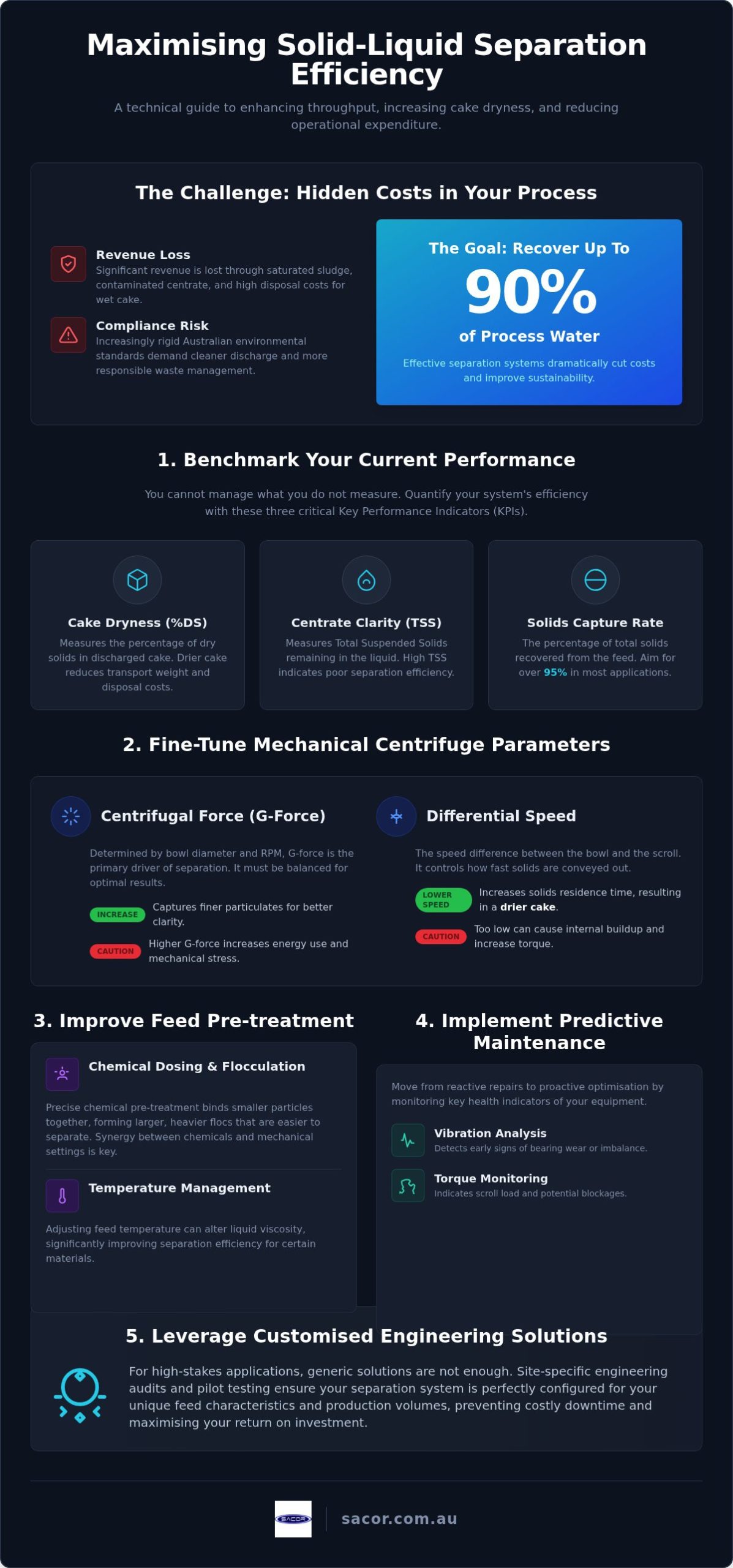
Performance is measured through three critical metrics that define the success of your separation process. First, Total Suspended Solids (TSS) in the centrate indicates how much solid material remains in the liquid after processing. High TSS levels often suggest that the residence time within the bowl is insufficient or the centrifugal force is too low. Second, the percentage of dry solids (%DS) in the discharged cake determines your disposal costs and handling requirements. Drier cake reduces transport weight and prevents environmental leaching. Finally, calculate the capture rate, which is the percentage of total solids recovered from the feed. If your capture rate sits below 95% in a mining or wastewater application, your system is likely losing valuable material or increasing the burden on downstream treatment stages.
Identifying Process Bottlenecks
Bottlenecks often appear when the feed volume exceeds the original design capacity of the separation system. You should evaluate if upstream inconsistencies, such as sudden spikes in feed concentration or flow rate, are overwhelming your decanter. It’s also necessary to perform a cost-benefit analysis comparing the value of ‘lost’ solids against the expenditure required for system optimisation. If your centrate contains valuable minerals or if wet cake is driving up transport costs, the return on investment for mechanical adjustments becomes clear. Identifying these friction points allows for a targeted approach to system refinement, ensuring that adjustments are made where they will have the greatest impact on your operational expenditure.
Optimising Mechanical Centrifuge Parameters
Achieving peak performance from a decanter centrifuge requires more than just high-speed rotation. To improve solid liquid separation efficiency, operators must meticulously calibrate the mechanical variables that govern sedimentation and solids transport. While foundational advanced solid-liquid separation techniques often involve chemical or electrical enhancements, the primary gains in industrial settings come from refining bowl speed, differential speed, and pond depth. These adjustments ensure that the machine is tuned to the specific rheology of the feed material.
The Role of Centrifugal Force (G-Force)
G-force is the primary driver of the separation process. It’s determined by the bowl’s diameter and its rotational speed (RPM). Matching this force to the density of your specific particles is essential for efficient settling. Engineers must balance high G-forces with the resulting increase in energy consumption and mechanical stress on the bearings. Over-speeding a bowl can lead to premature fatigue without providing a proportional gain in clarity if the particles have already reached their terminal settling velocity. Precision in this setting ensures that even fine particulates are captured without unnecessary power draw.
Scroll and Differential Speed Adjustments
The differential speed, which is the relative difference between the bowl and the scroll, dictates how quickly solids are conveyed out of the machine. A lower differential speed increases the residence time of the solids on the ‘beach’ of the centrifuge, which generally leads to a drier cake. This adjustment must be monitored closely alongside torque levels. If the scroll isn’t removing solids fast enough, internal buildup can cause a trip or excessive wear on the scroll flights. Regular monitoring of these trends is a core part of the maintenance and technical support services we provide to ensure long-term reliability and output quality.
Pond Depth and Residence Time
Pond depth is controlled by adjusting the weir plates at the liquid discharge end. A deeper pond increases the residence time for the liquid phase, which results in a clearer centrate. Conversely, a shallower pond increases the length of the dry beach, allowing more time for the solids to dewater before discharge. Modifying these mechanical settings is often the most cost-effective way to improve solid liquid separation efficiency without requiring significant capital expenditure on new infrastructure. If you notice ‘short-circuiting’, where the feed slurry bypasses the separation zone and exits directly into the centrate, it’s often a sign that the weir plates or feed pipe position require adjustment to maintain laminar flow entry.
Improving Feed Characteristics and Pretreatment
While mechanical adjustments establish the operational framework, the physical and chemical state of the feed material often dictates the ultimate performance limit. To improve solid liquid separation efficiency, industrial operators must prioritise feed homogenisation and chemical pretreatment. Utilising macerators or grinders to reduce oversize particles ensures a consistent particle size distribution, which prevents internal scroll blockages and reduces mechanical vibration. Additionally, integrating pH adjustment systems can alter the zeta potential of suspended solids, reducing the electrostatic repulsion between particles and allowing them to agglomerate more effectively before they enter the centrifuge bowl.
Advanced Flocculation Strategies
Selecting an appropriate polymer requires a precise understanding of the slurry’s ionic charge. Cationic polymers are typically required for organic solids, whereas anionic variants are preferred for mineral-heavy tailings. The injection point is equally critical. Adding polymer too far upstream can subject the formed flocs to excessive shear forces within the pumps, causing them to shear before they reach the separation zone. Conversely, injecting too close to the centrifuge entry may result in inadequate mixing, leading to wasted chemical and poor centrate clarity. Given that the price of aluminium-based flocculants has shown an annual volatility of 18-22%, precise dosing is not merely a technical requirement but a financial necessity to control operational expenditure.
Viscosity and Temperature Control
Temperature management is a frequently overlooked variable in Australian industrial environments, yet it significantly impacts settling velocity. According to the principles of fluid dynamics, increasing the feed temperature reduces the liquid’s viscosity, which in turn reduces the drag force acting on settling particles. This allows for faster separation and higher throughput. Maintaining a consistent temperature can be challenging in regions with extreme diurnal temperature shifts, but implementing heat exchangers can stabilise the process. For more information on energy-efficient methods for thermal management, explore our guide on sustainable dewatering solutions Australia. Stabilising these feed characteristics ensures that the centrifuge remains in a steady state, directly contributing to a more reliable and cost-effective separation outcome.
Implementing a Predictive Maintenance Framework
Mechanical degradation is often the silent killer of throughput. To improve solid liquid separation efficiency, industrial plants must move beyond reactive repairs and adopt a predictive maintenance framework. This involves the continuous monitoring of physical and electrical signatures to identify wear before it manifests as a catastrophic failure. By standardising cleaning-in-place (CIP) protocols, operators can prevent ‘cake hardening’ during downtime, which otherwise leads to severe bowl imbalances and increased startup torque. Consistent maintenance ensures that the precision engineered into the system is maintained throughout its operational life.
Vibration and Balance Monitoring
Vibration analysis serves as the first line of defence against mechanical fatigue. High-resolution sensors mounted on the bearing housings detect early-stage wear or bowl out-of-balance conditions that are imperceptible to the human ear. A centrifuge operating out of balance experiences uneven centrifugal forces, which directly compromises separation precision and accelerates the degradation of the drive assembly. Establishing a routine re-balancing schedule for high-speed units ensures that the machine maintains its design performance levels while protecting the long-term integrity of the rotating assembly. This practice is particularly vital in mining and wastewater applications where feed variability can lead to inconsistent internal loading.
Wear Part Management
The scroll is the most vulnerable component in any sludge dewatering centrifuge Australia. Abrasive slurries gradually erode the scroll flights, increasing the gap between the scroll and the bowl wall. This loss of tolerance allows solids to ‘slip’, forcing the machine to run at higher speeds or higher torque to maintain the same level of dryness. Utilising tungsten carbide tiles or specialised hard-surfacing on these critical wear points significantly extends the time between overhauls. Managing your inventory of centrifuge spare parts Australia ensures that critical components are available for scheduled replacements, preventing the extended lead times that often occur with imported equipment.
Monitoring motor amperage and torque trends provides a clear window into the internal health of the centrifuge. A steady increase in torque at a constant feed rate often indicates internal buildup or a reduction in scroll conveying efficiency. By analysing these electrical signatures alongside physical inspections, plant managers can schedule maintenance during planned shutdowns rather than responding to emergency breakdowns. This proactive approach sustains high throughput and protects the plant’s bottom line. For comprehensive assistance with system health checks, our Maintenance and Technical Support Services provide the expertise required to keep your separation equipment running at peak performance.
Leveraging Customised Engineering Solutions with Sacor
Many industrial facilities struggle to reach their throughput targets because they rely on generalised equipment designed for a median feed profile. To truly improve solid liquid separation efficiency, the machinery must be engineered to match the specific chemical and physical properties of your local slurry. Off-the-shelf solutions often lack the flexibility required to handle the high-abrasion ores or complex organic loads common in Australian sectors. Sacor addresses this gap by conducting site-specific engineering audits and pilot testing, ensuring that every mechanical component is calibrated to your real-world conditions rather than theoretical averages.
Bespoke System Design
The engineering of an industrial decanter centrifuge Australia requires a deep understanding of material science and fluid dynamics. We customise the metallurgy of our systems to withstand the corrosive or abrasive nature of Australian ores, utilising high-grade duplex stainless steels and specialized coatings where necessary. Bowl geometry is another critical variable; we adjust the length-to-diameter ratio to suit your specific liquid-to-solid concentration, ensuring optimal residence time and clarified centrate. These bespoke units are designed for seamless integration with your existing plant PLC systems, allowing for automated control that responds dynamically to feed changes. This level of precision reduces the risk of process upsets and ensures that your separation targets are met consistently, regardless of upstream variability.
Long-Term Technical Support
Engineering excellence does not end at the point of installation. Sustaining peak performance over the equipment lifecycle requires a structured approach to maintenance and technical troubleshooting. Sacor provides comprehensive maintenance contracts that include regular health checks, vibration monitoring, and the rapid supply of spare parts. By partnering with a technical authority, you gain access to expert troubleshooting for complex process issues, such as unexpected changes in flocculation behaviour or sudden drops in cake dryness. This ongoing collaboration ensures that your system continues to improve solid liquid separation efficiency as your production requirements evolve. Our commitment is to work alongside you as a trusted partner, providing the reliability and technical depth required for high-stakes industrial operations. To begin the process of refining your facility’s output, organise a technical separation audit for your site today. This methodical assessment identifies exactly where mechanical or chemical adjustments can deliver the greatest reduction in your operational expenditure.
Advancing Your Industrial Separation Strategy
Achieving peak performance in industrial separation is a methodical process that integrates mechanical precision with chemical intelligence. By establishing clear KPIs and refining parameters like G-force and differential speed, you create a robust framework to improve solid liquid separation efficiency. We’ve explored how proactive feed management and predictive maintenance protect your equipment from the abrasive realities of high-volume processing. These strategies collectively reduce operational expenditure while ensuring your facility meets the most stringent environmental standards.
As specialists in decanter centrifuge mining Australia applications, Sacor provides the technical expertise and national support required to sustain these gains. Our customised systems are engineered specifically for Australian conditions, backed by local centrifuge spare parts Australia availability and dedicated maintenance services. We don’t just supply equipment; we partner with you to solve complex separation challenges through engineering audits and pilot testing.
Maximise your separation efficiency with Sacor’s expert engineering solutions. With a commitment to reliability and sustainability, we’re ready to help you transform your waste streams into clear value.
Frequently Asked Questions
What is the most common cause of poor solid-liquid separation efficiency?
Inconsistent feed characteristics and a lack of upstream homogenisation are the most frequent culprits. If the solids concentration or particle size varies significantly, the centrifuge cannot maintain a steady state. Operators often neglect the impact of this variability on the residence time within the bowl. Addressing these fluctuations through maceration or buffer tanks is a primary way to improve solid liquid separation efficiency without requiring a complete system overhaul or capital expenditure.
How does bowl speed affect the dryness of the discharged cake?
Higher bowl speeds increase the centrifugal force, which accelerates the sedimentation of finer particles. While this can lead to a more compact solids layer, it doesn’t always guarantee a drier cake if the residence time on the discharge beach is insufficient. You must balance the rotational speed with the differential speed to ensure the solids have enough time to dewater before exiting the machine. Over-speeding can also increase energy consumption and mechanical wear.
Can I improve efficiency without buying new equipment?
Significant gains are possible through mechanical calibration and chemical optimisation. Adjusting the weir plate settings to modify pond depth or fine-tuning the differential speed can yield immediate improvements in dryness and centrate clarity. Additionally, reviewing your polymer selection and dosing points often reveals opportunities to enhance floc stability. These operational refinements allow you to improve solid liquid separation efficiency using your existing decanter centrifuge systems while avoiding the high costs of new infrastructure.
What role does polymer dosing play in centrifugal separation?
Polymers act as flocculants that bind fine particulates into larger, heavier flocs. This increases the settling velocity of the solids, allowing the centrifuge to capture material that would otherwise remain suspended in the centrate. Precise dosing is essential; over-dosing leads to ‘slimy’ cake and blinded filter media, while under-dosing results in poor recovery rates and high TSS levels. Selecting the correct ionic charge for your specific slurry is critical for achieving optimal floc stability.
How often should a decanter centrifuge be serviced to maintain efficiency?
Service intervals depend on the abrasiveness of the feed, but a comprehensive mechanical audit should occur every 2,000 to 4,000 operating hours. High-wear applications, such as mining tailings or wastewater biosolids, may require more frequent inspections of the scroll flights and tungsten carbide tiles. Regular vibration analysis and torque monitoring help identify when a service is required before a mechanical failure occurs. This proactive approach ensures the system maintains its design efficiency and extends equipment life.
Why is centrate clarity just as important as cake dryness?
Centrate clarity is vital because high levels of suspended solids can contaminate downstream processes or lead to environmental non-compliance. While drier cake reduces disposal costs, poor clarity often means you’re losing valuable product or recirculating solids back through the treatment plant. This creates an unnecessary burden on secondary processes and increases energy use. A balanced approach ensures that neither the liquid nor the solid phase compromises the overall mass balance of the industrial separation process.
How do Australian environmental regulations impact separation requirements?
Australian standards, such as those governed by state EPAs, impose strict limits on the quality of discharged wastewater and the stability of mine tailings. These regulations often mandate specific Total Suspended Solids (TSS) levels in the centrate to prevent groundwater contamination. Meeting these requirements necessitates high-performance separation equipment that can consistently deliver clear centrate. This pressure forces facilities to prioritise efficiency as a core part of their environmental compliance and long-term sustainability strategy.
What is the difference between a two-phase and three-phase centrifuge for efficiency?
A two-phase centrifuge separates solids from a single liquid, whereas a three-phase system separates solids and two immiscible liquids, such as oil and water, simultaneously. Three-phase units are more complex but offer higher efficiency for specific applications like oil recovery or food processing. Choosing the correct configuration prevents cross-contamination between phases and eliminates the need for secondary separation stages. This streamlines the process and ensures that all output phases meet the required purity standards for reuse.