
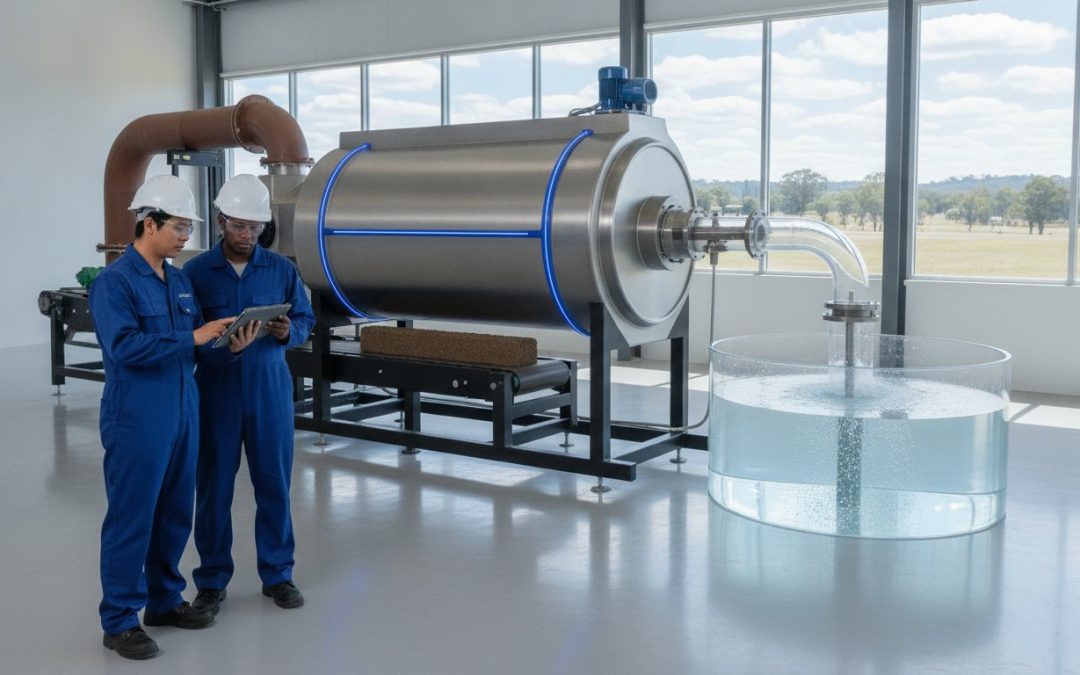
The commencement of the NSW Development Coordination Authority on 1 July 2026 marks a definitive shift in how industrial operators must manage water discharge and environmental compliance. For many facilities, the escalating costs of sludge disposal and the complexity of meeting updated SA Water technical guidelines mean that legacy systems are no longer commercially or environmentally sustainable. By implementing high-performance sustainable dewatering solutions Australia wide, industrial operators can transition from basic regulatory compliance to a proactive strategy for operational efficiency.
You understand that managing tailings and industrial waste is one of the most significant overheads in modern processing, especially as transport and disposal fees continue to rise. This article explains how advanced centrifugal technology is redefining these processes by prioritising resource recovery and mechanical precision. We will explore the latest shifts toward energy-efficient electric systems and demonstrate how modern decanter centrifuges can recover up to 85% of process water for immediate reuse, helping you lower costs and meet the rigorous environmental standards of the 2026 industrial landscape.
Key Takeaways
- Learn how modern mechanical separation eliminates the need for expansive settling ponds while supporting circular economy objectives in industrial water management.
- Evaluate the shifting regulatory landscape and the technical criteria that define sustainable dewatering solutions Australia wide to ensure long-term site compliance.
- Compare the operational advantages of decanter centrifuges over traditional filter presses to identify opportunities for reducing labour requirements and maintenance overheads.
- Discover how site-specific feed analysis and the integration of variable frequency drives (VFDs) maximise water recovery and produce drier cake solids for lower transport costs.
- Identify the role of customised engineering and proactive lifecycle support in maintaining peak separation efficiency across complex Australian industrial streams.
What Defines Sustainable Dewatering Solutions in Australia Today?
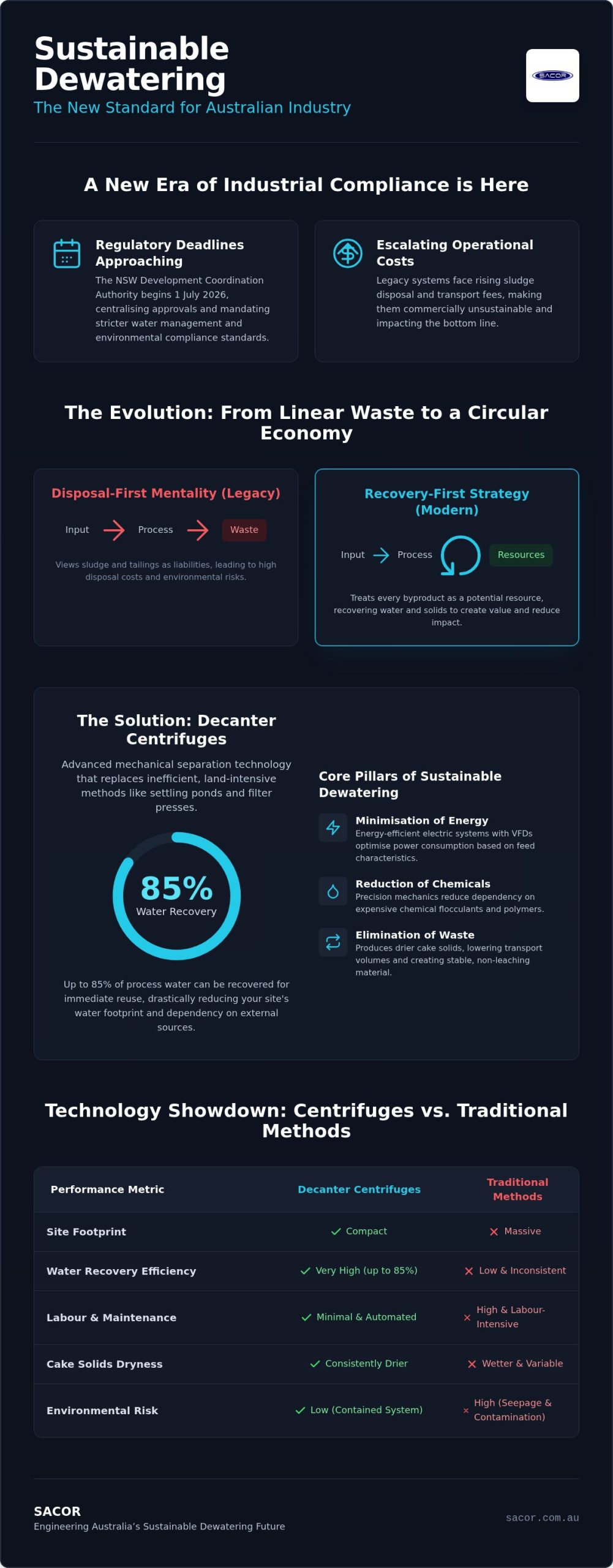
Industrial water management in Australia has evolved beyond the simple removal of liquid from solids. In 2026, the adoption of sustainable dewatering solutions Australia is defined by a rigorous focus on three core pillars: the minimisation of energy consumption, the reduction of chemical flocculant dependency, and the elimination of unnecessary waste. This transition represents a fundamental move from a “disposal-first” mentality to a “recovery-first” strategy, where every byproduct is viewed as a potential resource. It’s a change driven by the necessity to maintain operational viability in a landscape of rising disposal fees and stricter oversight.
Boards and plant managers are increasingly aligning equipment upgrades with Environmental, Social, and Governance (ESG) targets. Mechanical efficiency is no longer just an operational metric; it’s a key component of sustainability reporting. In 2026, implementing sustainable dewatering solutions Australia wide means choosing equipment that offers measurable reductions in carbon intensity while maximising the recovery of high-value materials from waste streams. By integrating decanter centrifuges into a circular economy framework, companies can transform tailings and sludge into reusable process water or dry cake solids suitable for land application or secondary industrial use. This shift ensures that resource recovery is embedded into the site’s lifecycle rather than treated as an afterthought.
The Impact of Water Scarcity on Industrial Operations
Australia’s climate variability makes water a high-risk commodity for industrial sectors. Closed-loop water systems have become the industry standard because they mitigate the volatility of raw water costs and availability. Recovering treated process water through high-efficiency separation is often more cost-effective than sourcing external water, especially when factoring in the long-term infrastructure required for water transport. High-performance centrifugal systems allow sites to maintain production levels while significantly reducing their total water footprint. This mechanical approach provides a reliable, consistent supply of recycled water that is independent of seasonal rainfall or municipal restrictions.
Meeting Australian Environmental Regulatory Standards
The regulatory landscape in 2026, including the updated SA Water Technical Guideline TG 0875.35 and the centralisation of approvals under the NSW Development Coordination Authority, demands greater transparency in water management. Modern sludge dewatering techniques must now demonstrate a clear reduction in the risk of groundwater contamination. Producing drier cake solids is a critical part of this compliance, as it lowers the volume of waste transported and ensures that any stored solids are stable and non-leaching. This reduces the liability associated with tailings dam management and aligns with the broader push toward zero-waste industrial operations. Sustainable dewatering is defined as a precise balance of energy efficiency and maximum resource recovery.
The Role of Decanter Centrifuges in Sustainable Separation
While many providers in the Australian market focus on civil wellpoint pumping and groundwater management, true industrial sustainability requires a more sophisticated approach to mechanical separation. Decanter centrifuges represent the most effective sustainable dewatering solutions Australia can deploy for complex industrial waste streams. By utilising centrifugal force that can reach thousands of times the strength of gravity, these systems replace the need for massive, land-intensive settling ponds. This transition not only preserves the local landscape but also mitigates the risk of groundwater seepage and environmental contamination associated with legacy storage methods.
The compact footprint of a centrifuge offers a distinct advantage over traditional belt or filter presses. A centrifuge typically requires significantly less floor space, which reduces the capital expenditure needed for civil works and housing infrastructure. Beyond the physical footprint, precision mechanical separation allows for a drastic reduction in chemical polymer consumption. Modern decanter systems enable operators to fine-tune bowl and scroll speeds to match specific feed characteristics, often reducing the volume of expensive flocculants required by up to 15 to 20 per cent compared to less precise methods. If you are looking to improve your plant’s operational efficiency, exploring customised separation systems is a practical starting point.
Maximising Solid-Liquid Separation Efficiency
The primary driver behind achieving drier cake solids is the application of high G-force. When solids are processed to a higher dry-matter content, the total volume of waste requiring transport is reduced, which directly lowers transport-related carbon emissions and disposal fees. This aligns with the latest national biosolids data, which emphasises the importance of efficient treatment processes in supporting Australia’s circular economy. Higher separation efficiency ensures that more process water is recovered for immediate reuse, reducing the site’s reliance on external water sources. For a more detailed technical breakdown, you may refer to our industrial decanter centrifuge Australia comprehensive guide.
Energy Optimisation in Modern Centrifuge Systems
Energy efficiency in 2026 is defined by the integration of variable frequency drives (VFDs) and advanced power-back technology. These systems are designed to recover kinetic energy from the braking of the centrifuge bowl and feed it back into the plant’s electrical grid, significantly lowering the carbon intensity of the dewatering process. This mechanical approach is far more sustainable than energy-intensive thermal drying methods, which rely on high heat and significant power consumption to achieve similar moisture reduction. By focusing on mechanical precision rather than thermal force, industrial operators can achieve substantial lifecycle energy savings while maintaining the robust performance required for heavy-duty Australian mining and processing applications.
Comparing Dewatering Technologies: Centrifuges vs. Traditional Methods
Selecting the most appropriate technology requires looking beyond initial capital expenditure. While filter presses remain a common choice, they often demand significant manual labour for plate cleaning and cloth replacement, which increases operational overheads and safety risks. In contrast, decanter centrifuges offer a continuous, fully automated operation that requires minimal operator intervention. This reduces the headcount needed on-site and eliminates the downtime associated with batch processing. When evaluating sustainable dewatering solutions Australia-wide, businesses must adopt a Total Cost of Ownership (TCO) approach. This perspective accounts for energy consumption, maintenance intervals, and the long-term environmental liability of the waste streams produced.
Passive evaporation ponds were once the default for remote Australian sites, but they’re increasingly incompatible with Australia’s national water policy. These ponds occupy vast land areas, lose valuable water to the atmosphere, and pose significant seepage risks to local aquifers. Mechanical dewatering through centrifugation provides a more responsible alternative by recovering high-quality water for immediate reuse and minimising the site’s physical footprint. For those in the primary sector, our decanter centrifuge mining Australia guide provides further context on transitioning from legacy ponds to modern mechanical systems.
Footprint and Site Integration
Modern industrial sites are frequently space-constrained, especially when expanding existing facilities to meet 2026 production targets. Centrifuge systems are inherently modular and compact, allowing for easier integration into existing process flows without the need for extensive civil modifications or large-scale concrete foundations. This high power-to-size ratio reduces the overall environmental disturbance during the installation phase. Modular units can be deployed rapidly, which is critical for projects responding to the updated state-based discharge regulations coming into effect this year. The ability to scale capacity by adding modular units ensures that the dewatering system grows with the site’s requirements.
Chemical and Flocculant Reduction
Traditional dewatering methods frequently rely on high doses of chemical polymers to achieve effective separation. These additives carry a significant environmental cost and can complicate the final disposal or beneficial reuse of the resulting cake solids. Advanced centrifuge bowl designs use high G-force to achieve separation with substantially lower chemical inputs. This results in a cleaner centrate, or liquid phase, which simplifies any necessary downstream treatment. By reducing the chemical load in the system, operators ensure that the recovered water meets the strict quality standards required for industrial reuse, further supporting the site’s circular economy goals and reducing the total volume of chemicals stored on-site.
Implementing Sustainable Dewatering Practices on Site
Successfully deploying sustainable dewatering solutions Australia wide requires a move away from “set and forget” operational models. The process begins with a comprehensive feed analysis to characterise the specific particle size distribution, viscosity, and solid-liquid ratio of the waste stream. By understanding these variables, engineers can calibrate equipment to operate at the precise torque and speed required for the job. This site-specific optimisation ensures that the system doesn’t waste energy through unnecessary high-speed rotation when a lower centrifugal force would achieve the same result. It’s a methodical approach that balances mechanical performance with resource conservation. Plant managers seeking to improve solid liquid separation efficiency will find that addressing these mechanical and chemical variables is the most direct path to maximising throughput and cake dryness.
Maintaining this efficiency over the long term depends on a rigorous maintenance schedule and the use of real-time monitoring. Modern industrial centrifuges are equipped with sensors that detect subtle changes in slurry density, allowing the system to adjust automatically to maintain consistent cake dryness. Regular technical audits prevent efficiency drops that often go unnoticed, such as worn scroll tiles or degraded seals that can lead to increased power draw. Training site personnel is equally vital; operators must be empowered to prioritise resource recovery outcomes rather than just throughput volume. When a team understands the relationship between bowl speed and water clarity, they’re better equipped to manage the system as a strategic asset.
Optimising Throughput for Energy Efficiency
Energy waste often occurs when a system is over-processing a stream that has already reached its optimal dryness. By matching the centrifuge speed to the specific requirements of the solids, operators can significantly reduce the total kilowatt-hours consumed per tonne of dry solids produced. Automated control systems utilise real-time sensor data to adjust bowl speed and torque, ensuring that energy consumption is strictly limited to the level required for the current feed density. This level of precision is particularly valuable on remote Australian sites where power costs are high and energy reliability is a critical operational factor.
Resource Recovery: Turning Waste into Revenue
A “recovery-first” strategy transforms the dewatering station into a profit centre. In mining operations, high-efficiency separation allows for the recovery of valuable minerals from tailings that were previously lost to evaporation ponds. Similarly, in food and beverage processing, three-phase centrifuges can separate oils and fats from wastewater streams for sale into biofuel production markets. These practices align with the technical principles detailed in our guide to the sludge dewatering centrifuge Australia market. By capturing these resources, companies reduce their environmental footprint while creating new revenue streams from materials once classified as waste. To discuss how these technologies can be integrated into your specific site requirements, you can contact our technical team for a consultation.
Sacor: Engineering Australia’s Sustainable Dewatering Future
Sacor understands that the 2026 industrial shift requires more than just high-quality hardware. It requires a partner capable of navigating the complex intersection of mechanical performance and environmental responsibility. As a provider of sustainable dewatering solutions Australia wide, we focus on delivering systems that are purpose-built for the specific challenges of the local mining, food processing, and wastewater sectors. Our approach is grounded in the belief that true efficiency is achieved only when equipment is matched precisely to the site’s unique operational parameters. This commitment to customised engineering ensures that our clients don’t just meet their discharge requirements; they actually exceed their internal resource recovery targets.
Partnering with Sacor means moving beyond the traditional vendor-client relationship into a collaborative technical alliance. We work closely with plant managers and engineers to identify bottlenecks in existing processes where mechanical separation can provide the greatest environmental and financial returns. By prioritising the recovery of high-value materials and the recycling of process water, we help our clients lower their total cost of ownership while adhering to the tightening regulatory standards seen across the country. Our objective is to provide the technical authority and reliable equipment needed to turn waste management into a strategic advantage.
Customised Separation Solutions
Standardised, off-the-shelf equipment rarely delivers the precision needed to meet modern sustainability targets. At Sacor, our process begins with a detailed consultation to align our technology with your site’s specific ESG key performance indicators. We evaluate the unique characteristics of your feed material to determine the optimal configuration for our decanter centrifuge systems. This consultative design process ensures that every component, from bowl geometry to drive systems, is selected to maximise water recovery and minimise energy draw. By focusing on these site-specific variables, we help our partners reduce their environmental footprint while simultaneously lowering the transport and disposal costs associated with drier cake solids.
Lifecycle Support and Technical Expertise
Maintaining peak separation efficiency requires a commitment to the entire lifecycle of the equipment. Sacor supports long-term sustainability by providing proactive maintenance programs and a robust supply of spare parts from our Australian-based technical hubs. We believe that repairing and maintaining high-quality machinery is fundamentally more sustainable than frequent replacement. Our team of specialists works alongside site managers to conduct regular performance audits, ensuring that systems continue to operate at their designed efficiency levels for years. This local technical expertise provides a significant advantage for national operations, as it ensures rapid response times and a deep understanding of Australian regulatory conditions. To discuss a bespoke strategy for your facility, you can contact Sacor to speak with one of our senior engineers.
Securing Operational Resilience Through Mechanical Efficiency
The 2026 industrial landscape requires a fundamental shift in how we perceive waste and water management. By moving from legacy disposal methods to high-performance mechanical separation, operators can achieve the precise balance between regulatory compliance and commercial viability. This transition depends on the adoption of sustainable dewatering solutions Australia wide, where decanter centrifuges serve as the cornerstone of resource recovery and energy optimisation.
Success in this new era requires more than just high-quality hardware; it demands a partnership grounded in technical authority and long-term reliability. Sacor provides the specialist Australian engineering support and custom-designed separation systems necessary to handle the most complex industrial streams. Our commitment to lifecycle maintenance and a robust spare parts supply ensures that your facility maintains peak performance as environmental standards continue to evolve.
Consult with Sacor on sustainable separation for your site to begin refining your resource recovery strategy. We look forward to helping you build a more efficient and responsible industrial future.
Frequently Asked Questions
What makes a dewatering solution “sustainable” in an industrial context?
A sustainable solution is defined by its ability to minimise energy consumption, chemical usage, and waste generation while maximising resource recovery. It moves beyond simple liquid removal to prioritise the circular economy by reclaiming process water for immediate reuse. In the context of sustainable dewatering solutions Australia, this also includes meeting strict environmental discharge standards and reducing the carbon intensity of transport by producing the driest possible cake solids.
How do decanter centrifuges help Australian mines meet ESG targets?
Decanter centrifuges provide a measurable way to reduce a site’s environmental impact through mechanical precision. By replacing large-scale tailings ponds with compact centrifugal separation, mining operations can significantly lower their land footprint and groundwater contamination risks. These systems enable high-volume water recovery and the capture of fine minerals, directly supporting corporate ESG goals focused on water stewardship, waste reduction, and the responsible management of industrial byproducts.
Can sustainable dewatering actually reduce our operational costs?
Modern dewatering systems lower operational overheads by reducing the volume and weight of waste destined for disposal. Drier cake solids translate directly to fewer truck movements and lower gate fees at landfill or processing facilities. Additionally, recovering up to 85% of process water reduces the expense of sourcing and treating raw water. These savings, combined with lower chemical flocculant requirements, ensure that the equipment delivers a favourable total cost of ownership.
What is the difference between mechanical dewatering and passive dewatering?
Mechanical dewatering uses high-speed centrifugal force or pressure to achieve rapid separation, whereas passive dewatering relies on gravity and evaporation in large ponds. Mechanical systems offer a significantly smaller footprint and much faster processing times, typically measured in minutes rather than months. Unlike passive ponds, mechanical methods allow for the immediate recovery of clean water and prevent the loss of valuable resources to the atmosphere or the ground.
How does drier cake solids contribute to a lower environmental footprint?
Drier cake solids contain less liquid, which reduces the total mass of waste that needs to be transported and managed. This leads to a substantial reduction in fuel consumption and associated carbon emissions from heavy vehicle movements. Furthermore, producing stable, dry solids minimises the risk of leaching and groundwater contamination at disposal sites. This ensures compliance with 2026 Australian regulations that demand more secure and responsible waste handling practices.
Is it possible to recover minerals or oils during the dewatering process?
It’s entirely possible to capture valuable resources using specialised three-phase centrifuge systems. These machines separate solids, water, and a third liquid phase, such as oils or fats, in a single continuous process. In mining, this allows for the reclamation of fine minerals from tailings, while in food processing, it enables the recovery of fats for biofuel production. This transforms a traditional waste stream into a secondary revenue source.
How often should dewatering equipment be serviced to maintain efficiency?
Maintaining peak separation efficiency requires a structured preventative maintenance program rather than a reactive approach. Technical audits should be conducted every six to twelve months to check for wear on critical components like scroll tiles and seals. Regular servicing prevents the gradual increase in power draw and chemical consumption that occurs as equipment degrades. Australian-based technical support ensures that spare parts and specialist engineering are available to prevent prolonged downtime.
Why is water recovery so critical for Australian industrial sites in 2026?
Water recovery is essential due to increasing scarcity and the tightening of state-based discharge regulations, such as the updated NSW and SA Water guidelines. Raw water is becoming more expensive and harder to source, making recycled process water a strategic asset for operational continuity. By implementing sustainable dewatering solutions Australia wide, industrial sites can insulate themselves from water-related risks while ensuring they meet the stringent environmental compliance standards required for modern project approvals.