
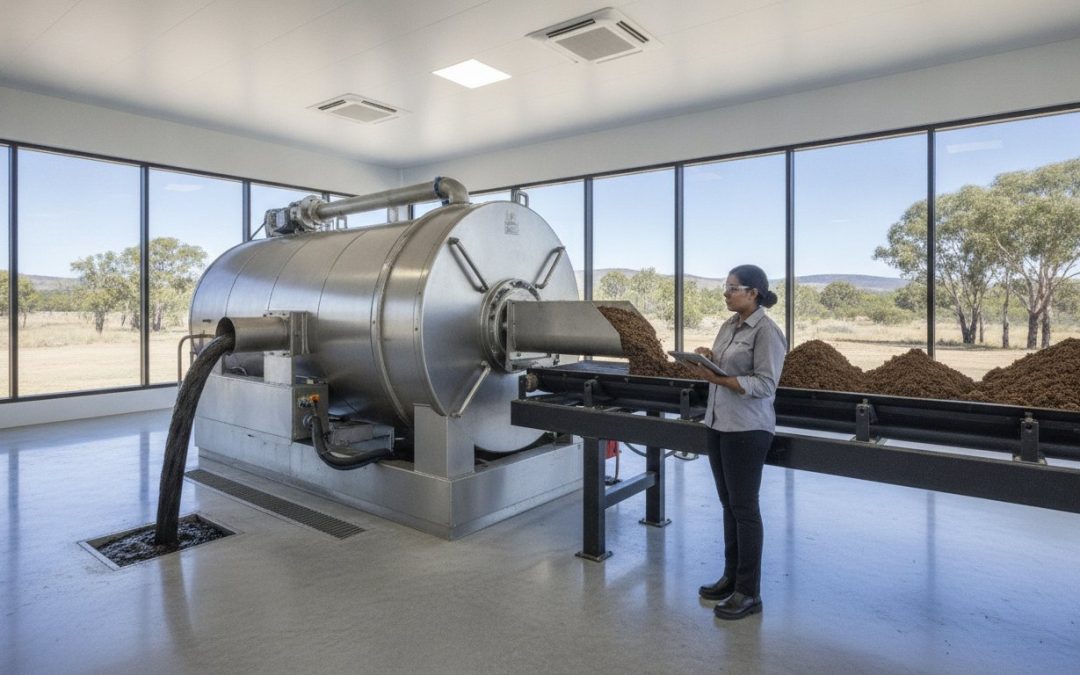
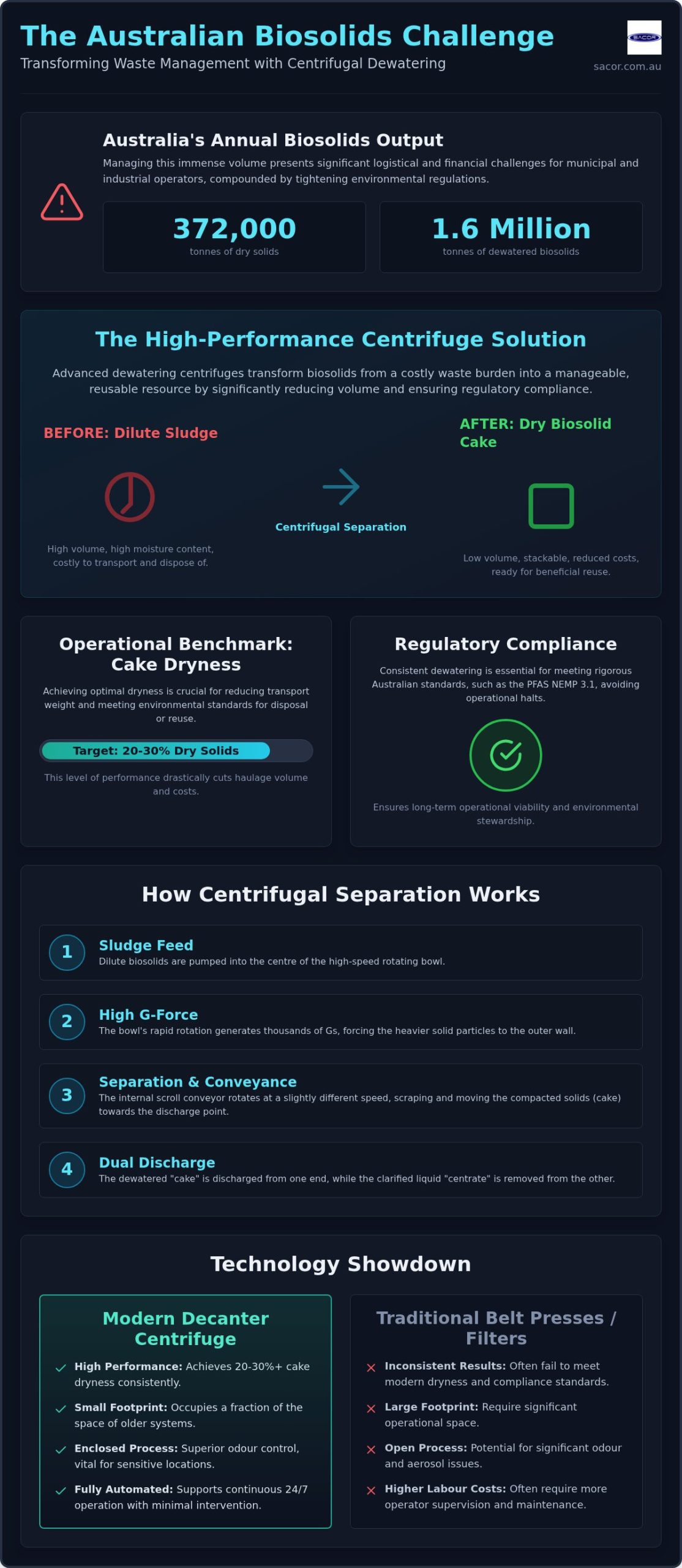
Australia produces approximately 372,000 tonnes of dry solids every year, which translates to a massive 1.6 million tonnes of dewatered biosolids requiring transport and disposal. For Australian municipal and industrial operators, the financial burden of managing this volume is compounded by tightening environmental regulations like the PFAS National Environmental Management Plan (NEMP) 3.1. Choosing a high-performance biosolids dewatering centrifuge is no longer just a technical preference; it’s a critical strategy for maintaining operational viability. You likely understand that traditional methods often fail to deliver the consistency needed to satisfy modern environmental standards or reduce haulage costs effectively.
This guide explains how advanced centrifugal technology transforms biosolids management from a costly waste burden into a streamlined resource recovery process. We’ll examine how achieving cake dryness levels of 20% or higher significantly reduces disposal fees while lowering polymer consumption through automated, continuous operation. By the end of this article, you’ll have a clear framework for selecting and optimising dewatering systems that ensure long-term compliance and cost efficiency within the Australian regulatory landscape.
Key Takeaways
- Understand how a high-performance biosolids dewatering centrifuge reduces sludge volume to significantly minimise transport requirements and ongoing disposal costs.
- Discover why achieving 20-30% cake dryness is the operational benchmark for meeting Australian environmental standards and optimising resource recovery.
- Evaluate the long-term financial advantages of prioritising low polymer consumption and automated operation over initial capital expenditure.
- Learn how bespoke engineering and local technical support ensure consistent solids capture and reliability across diverse Australian wastewater applications.
Understanding Biosolids Dewatering in the Australian Wastewater Sector
Biosolids are the nutrient-rich organic materials collected during the wastewater treatment process that undergo stabilisation to ensure they are safe for beneficial reuse. In Australia, managing these materials is a high-stakes operational challenge for both municipal authorities and heavy industrial sites. The primary objective of a biosolids dewatering centrifuge is to separate the liquid phase from the solid matter, creating a manageable product from what was previously a dilute sludge. Because transport costs and landfill levies are calculated by weight and volume, effective dewatering directly protects the facility’s bottom line.
Current Australian standards, including the PFAS National Environmental Management Plan (NEMP) 3.1, impose rigorous criteria on the moisture content and chemical stability of biosolids intended for reuse. These regulations mean that inconsistent dewatering isn’t just a cost issue; it’s a compliance risk that can halt operations. As environmental oversight tightens, the focus has shifted from simple disposal to sophisticated resource recovery, requiring technology that can handle variable feed characteristics with precision.
The Role of Dewatering in Resource Recovery
Effective dewatering transforms liquid sludge into a stackable “cake” that is easier to handle and transport. This physical change is essential for the circular economy. High moisture content makes land application for agriculture logistically impossible and environmentally risky. By achieving a higher solids concentration, operators can reduce the number of truck movements required for disposal. This reduction directly lowers the carbon footprint of the wastewater facility and ensures the material meets the physical requirements for agricultural spreading or industrial composting.
Why Centrifuges Are the Preferred Industry Standard
Modern facilities are increasingly moving away from older belt presses and vacuum filters in favour of the decanter centrifuge. This shift is driven by the need for higher performance and smaller equipment footprints. A biosolids dewatering centrifuge provides a fully enclosed process, which is a significant advantage for sites located near residential or sensitive areas where odour control is paramount. These systems offer high throughput while occupying a fraction of the space required by traditional presses.
Reliability is another key factor. These machines support the continuous operation required by industrial wastewater treatment centrifuges, ensuring that solids management doesn’t become a bottleneck for the entire plant. Unlike batch processes, centrifugal separation allows for automated, 24-hour processing with minimal operator intervention. This consistency is vital for industrial and mining wastewater applications where feed characteristics can fluctuate rapidly and require a robust, adaptable solution.
The Mechanics of Centrifugal Separation: From Sludge to Cake
The operation of a biosolids dewatering centrifuge relies on the principle of accelerated sedimentation. By rotating the machine bowl at high velocities, the system generates centrifugal forces many thousands of times greater than gravity. This G-force acts on the suspended solids within the sludge, driving them against the inner wall of the bowl. The liquid phase, or centrate, remains closer to the centre and is discharged through adjustable weirs. Technical resources like the EPA fact sheet on Centrifuge Thickening and Dewatering highlight that this mechanical separation is significantly faster and more efficient than gravity-based thickening or traditional filtration methods.
Inside the bowl, an internal screw conveyor, known as the scroll, rotates at a slightly different speed to the bowl itself. This differential speed is the critical variable for controlling the dryness of the final product. By fine-tuning the relationship between the bowl and the scroll, operators can manage the residence time of the solids. A lower differential speed increases the time the biosolids spend under G-force, which generally results in a drier cake. This level of control allows the machine to adapt to varying sludge types, from primary sludge to more challenging waste activated sludge (WAS).
Solid Bowl Design and Structural Integrity
The bowl functions as the primary separation chamber where the high-stakes mechanical work occurs. Because biosolids often contain grit and corrosive elements, the structural integrity of this component is paramount. High-grade duplex stainless steel is typically used to prevent corrosion, while tungsten carbide tiles or hard-facing are applied to the scroll flights to resist abrasion. These materials ensure that the machine maintains its balance and performance over thousands of hours of operation. Protecting these surfaces is essential for avoiding the vibration issues that can plague lower-quality equipment.
Automated Control Systems and Process Stability
Modern systems utilise sophisticated control logic to maintain process stability despite fluctuations in feed concentration. Sensors monitor the torque on the scroll drive in real-time. If the solids loading increases, the control system automatically adjusts the differential speed to prevent blockages and maintain consistent cake dryness. Integrating these units with a facility’s SCADA system allows for remote monitoring and data logging, which is essential for long-term performance optimisation. For those seeking a system tailored to specific Australian site conditions, exploring customised decanter centrifuge systems can provide the necessary technical assurance and reliability.
Evaluating Performance: Cake Dryness and Solids Capture
Performance evaluation of a biosolids dewatering centrifuge hinges on two primary metrics: Total Solids (TS) and the Capture Rate. Total Solids measures the percentage of dry matter in the final discharged cake, while the Capture Rate indicates the efficiency of solids removal from the feed stream. Within the broader landscape of Biosolids in Australia, achieving a cake dryness between 20% and 30% is widely considered the gold standard. This range ensures the material is stackable and legally compliant for agricultural reuse or cost-effective transport to landfill. However, reaching these figures requires a calculated balance. If you prioritise maximum throughput speed, the residence time within the bowl decreases, which frequently leads to a wetter cake or a dirtier centrate.
The trade-off between volume and quality is a constant consideration for plant managers. High-speed rotation generates the necessary G-force for separation, but the material must remain in the machine long enough for the water to be squeezed from the solid matrix. Monitoring the centrate quality is just as important as measuring the cake dryness. A poor capture rate means that solids are being returned to the head of the plant, which increases the biological load on the treatment process and creates a cycle of inefficiency that can eventually lead to process failure.
The Impact of Feed Characteristics
The physical and chemical nature of the incoming sludge dictates the machine’s ultimate performance limits. Primary sludge, which consists of heavier, discrete particles, dewaters relatively easily and often reaches the higher end of the dryness spectrum. In contrast, secondary or biological sludge contains cellular water and high volatile solids, making it significantly more difficult to compress. Conducting a thorough feed analysis is a prerequisite for predicting machine requirements and setting realistic performance targets. Without understanding the ratio of primary to secondary solids, operators risk undersizing their equipment or failing to meet moisture content standards during peak loading periods.
Optimising Chemical Usage
Chemical conditioning is the most significant variable in the dewatering process. Polyelectrolytes, or polymers, are used to bridge small particles into larger, stable flocs that can withstand the high G-forces of the centrifuge. While energy efficiency is a common topic of discussion, polymer costs often exceed energy costs over the lifecycle of the machine. Precise dosing is therefore essential for maintaining a sustainable operating expenditure (OPEX). Over-dosing leads to slimy cake and unnecessary expense, while under-dosing results in poor solids capture and centrate quality issues. Modern automated systems now use real-time sensors to adjust polymer feed rates based on the actual solids loading, ensuring the system remains optimised without constant manual intervention.
Strategic Planning: Selecting a Biosolids Dewatering System
Selecting the correct biosolids dewatering centrifuge involves a complex assessment of both current operational demands and long-term facility goals. Engineers must match the machine’s hydraulic capacity to peak flow rates while simultaneously ensuring it can handle the maximum solids loading anticipated during seasonal fluctuations. Performance dictates the bottom line. While the purchase price is significant, the true cost of ownership is defined by operating expenditure (OPEX), which includes power consumption, maintenance intervals, and the chemical dosing requirements discussed in previous sections.
Site infrastructure must be prepared to support these high-performance units effectively. This includes ensuring an adequate power supply for the main and back drives, as well as providing high-quality wash water for the automated cleaning cycles. Solids handling systems, such as conveyors or pumps, must be sized to match the centrifuge’s discharge rate to prevent back-ups. Compliance with Australian Standards for wastewater equipment ensures that the installation is robust, safe, and compatible with existing plant architecture.
Future-Proofing Your Wastewater Infrastructure
Planning for population growth or industrial expansion requires a scalable approach to dewatering. Modular installations offer a flexible alternative to traditional fixed-plant designs, allowing operators to add capacity as demand increases without requiring a complete facility overhaul. This flexibility is a core component of modern industrial decanter centrifuge Australia strategies, where the emphasis is on adaptable, long-term infrastructure. Choosing a system that can be easily integrated into future plant upgrades protects the initial investment and ensures continuous service.
Environmental and Regulatory Considerations
Meeting EPA requirements for biosolids classification is essential for maintaining beneficial reuse pathways. The centrifuge must consistently produce a product that meets specific moisture and stability criteria to avoid being reclassified as waste, which would dramatically increase disposal costs. In urban or sensitive locations, noise and vibration mitigation become critical design factors. High-speed equipment must be housed and mounted to minimise community impact. Comprehensive technical documentation is also required for regulatory audits, providing proof of performance and environmental compliance.
To ensure your facility meets these rigorous standards, you can consult with our engineering team for a bespoke dewatering solution tailored to your site requirements.
Partnering with Sacor for Advanced Centrifugal Solutions
Sacor positions itself as a technical partner rather than a mere vendor, delivering engineered outcomes for Australia’s most demanding wastewater challenges. Our commitment to the biosolids dewatering centrifuge sector is built on a foundation of quiet assurance and proven results. We recognise that Australian industrial and municipal operators don’t just need a machine; they need a reliable system that reduces operational costs while satisfying stringent environmental compliance. By focusing on precision engineering and national support, we ensure that our separation solutions contribute to sustainable industrial practices across Australia.
Custom Engineering and Site Integration
A successful dewatering installation begins with a thorough analysis of site-specific variables. We collaborate closely with facility engineers to integrate our decanter centrifuge systems into existing plant architectures, ensuring that hydraulic flows and solids loading are perfectly balanced. This bespoke approach extends to the automation logic, which we tailor to match the specific feed characteristics of the site. Our commissioning services are rigorous, designed to guarantee that the equipment meets its performance benchmarks from the first hour of operation. Our extensive work with mining separation equipment provides us with the expertise to handle the most abrasive and difficult sludge types found in the Australian market.
Lifecycle Support and Maintenance
Maintaining equipment uptime is critical for any wastewater facility where a process bottleneck can have significant downstream consequences. Sacor offers structured maintenance programs that move beyond reactive repairs to focus on long-term asset health. By conducting regular technical audits and performance monitoring, we help operators identify potential issues before they lead to failure. We understand the logistical challenges of operating in Australia, which is why we maintain a comprehensive stock of local spare parts. This local inventory, combined with direct access to our Australian-based technical specialists, ensures that support is always available when it’s needed most. This steady, grounded approach to service allows our partners to focus on their core operations with the conviction that their biosolids dewatering centrifuge is performing at its peak.
Optimising Your Long-Term Biosolids Strategy
Effective sludge management in the Australian context requires a shift from simple waste disposal to a disciplined resource recovery mindset. Achieving the 20% to 30% cake dryness benchmark is essential for reducing haulage costs and maintaining compliance with evolving environmental standards. As we’ve examined, the performance of a biosolids dewatering centrifuge depends on precise engineering that accounts for specific feed characteristics and automated control logic. Prioritising long-term operational efficiency over initial capital costs ensures that your facility remains viable and sustainable in a tightening regulatory environment.
Sacor is an Australian owned and operated business with a national technical support network dedicated to custom industrial separation. We provide the expertise and local spare parts necessary to ensure your equipment delivers consistent uptime and reliability. If you’re looking to enhance your facility’s performance and lower your total cost of ownership, you can consult with a Sacor engineer about your biosolids dewatering requirements. We look forward to helping you achieve your operational and environmental goals through proven centrifugal technology.
Frequently Asked Questions
What is the typical cake dryness achieved by a biosolids dewatering centrifuge?
A high-performance biosolids dewatering centrifuge typically achieves a cake dryness between 20% and 30% total solids. The exact percentage depends on the ratio of primary to secondary sludge and the volatile solids content of the feed. While municipal sites often target the lower end of this range for cost efficiency, industrial applications may require higher dryness to satisfy specific disposal or reuse protocols.
How does a centrifuge compare to a belt filter press for sludge dewatering?
Centrifuges offer superior odour control and a significantly smaller equipment footprint compared to traditional belt filter presses. Because the process is fully enclosed, it’s better suited for sensitive urban environments or indoor installations. While belt presses might have lower initial power requirements, centrifuges generally produce a drier cake and require less operator intervention due to their high level of automation and continuous processing capabilities.
What chemicals are required for effective biosolids dewatering?
Effective separation relies on polyelectrolytes, commonly known as polymers, which act as flocculants to group fine particles into larger masses. These chemicals are essential for maintaining a high solids capture rate under the intense G-forces generated by the machine. Selecting the correct polymer grade and ensuring precise dosing is critical for controlling operational expenditure and preventing the discharge of solids back into the centrate.
Can a centrifuge handle fluctuating solids concentrations in the feed?
Modern decanter systems are designed to handle variable feed concentrations through automated control logic. Sensors monitor the torque on the internal scroll drive and adjust the differential speed in real-time to compensate for changes in solids loading. This capability ensures a consistent output even when the incoming sludge concentration fluctuates, which is common in industrial wastewater and mining applications with irregular production cycles.
What are the maintenance requirements for a decanter centrifuge in wastewater?
Routine maintenance involves scheduled lubrication of the main bearings and periodic inspections of the wear protection components. High-abrasion biosolids can wear down the tungsten carbide tiles on the scroll flights over time, so regular monitoring is necessary to prevent performance degradation. Vibration analysis is also a standard part of a preventative maintenance program to ensure the machine remains balanced and safe during high-speed operation.
How does dewatering help with environmental compliance in Australia?
Dewatering ensures that biosolids meet the moisture content standards required by state EPA guidelines and the PFAS National Environmental Management Plan (NEMP) 3.1. By reducing the volume of waste, operators minimise the environmental risks associated with transport and land application. Consistent performance from a biosolids dewatering centrifuge provides the verifiable data needed for regulatory audits and helps maintain the material’s classification for beneficial reuse pathways.
What is the difference between thickening and dewatering?
Thickening is a preliminary process that increases solids concentration to approximately 4% to 6%, primarily to reduce the volume of liquid sludge for further treatment or digestion. Dewatering is a more intensive mechanical process that removes enough water to transform the material into a stackable, non-liquid cake with 20% or more total solids. While thickening improves process efficiency, dewatering is the final step required before transport or reuse.
Can biosolids dewatered by a centrifuge be used for agriculture?
Biosolids dewatered by a centrifuge are frequently used in agriculture as a nutrient-rich soil conditioner, provided they meet specific stabilisation and moisture requirements. In Australia, nearly 85% of all biosolids are beneficially used, with the majority applied to broadacre crops and forestry. The high G-force separation helps ensure the final product is physically manageable for spreading equipment and meets the dryness standards set by regional agricultural departments.