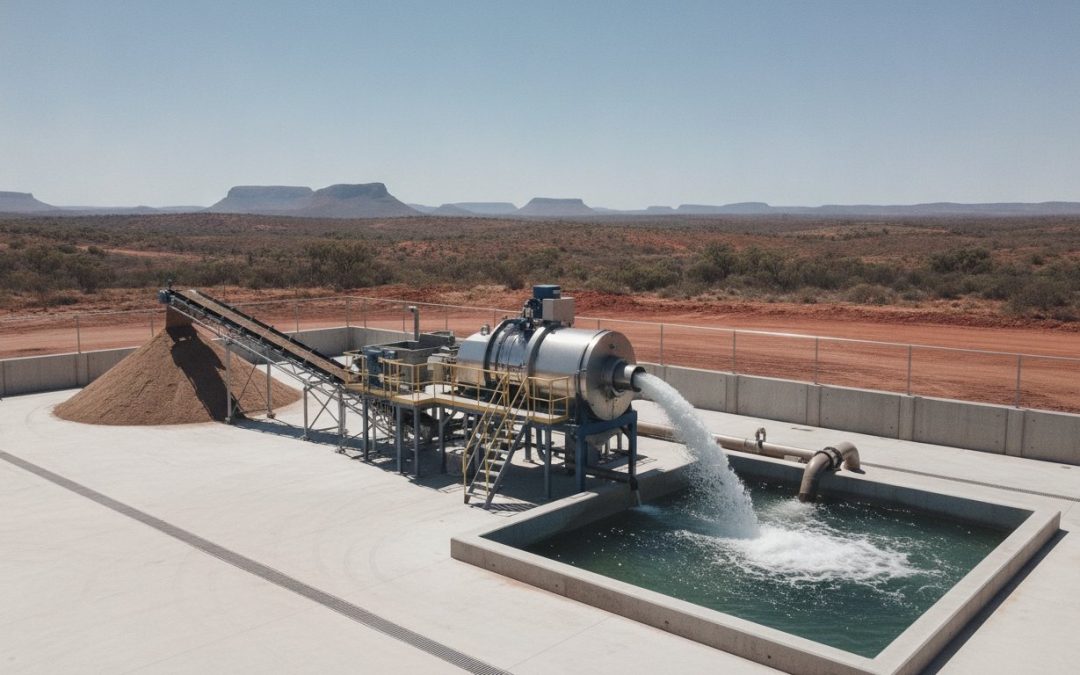
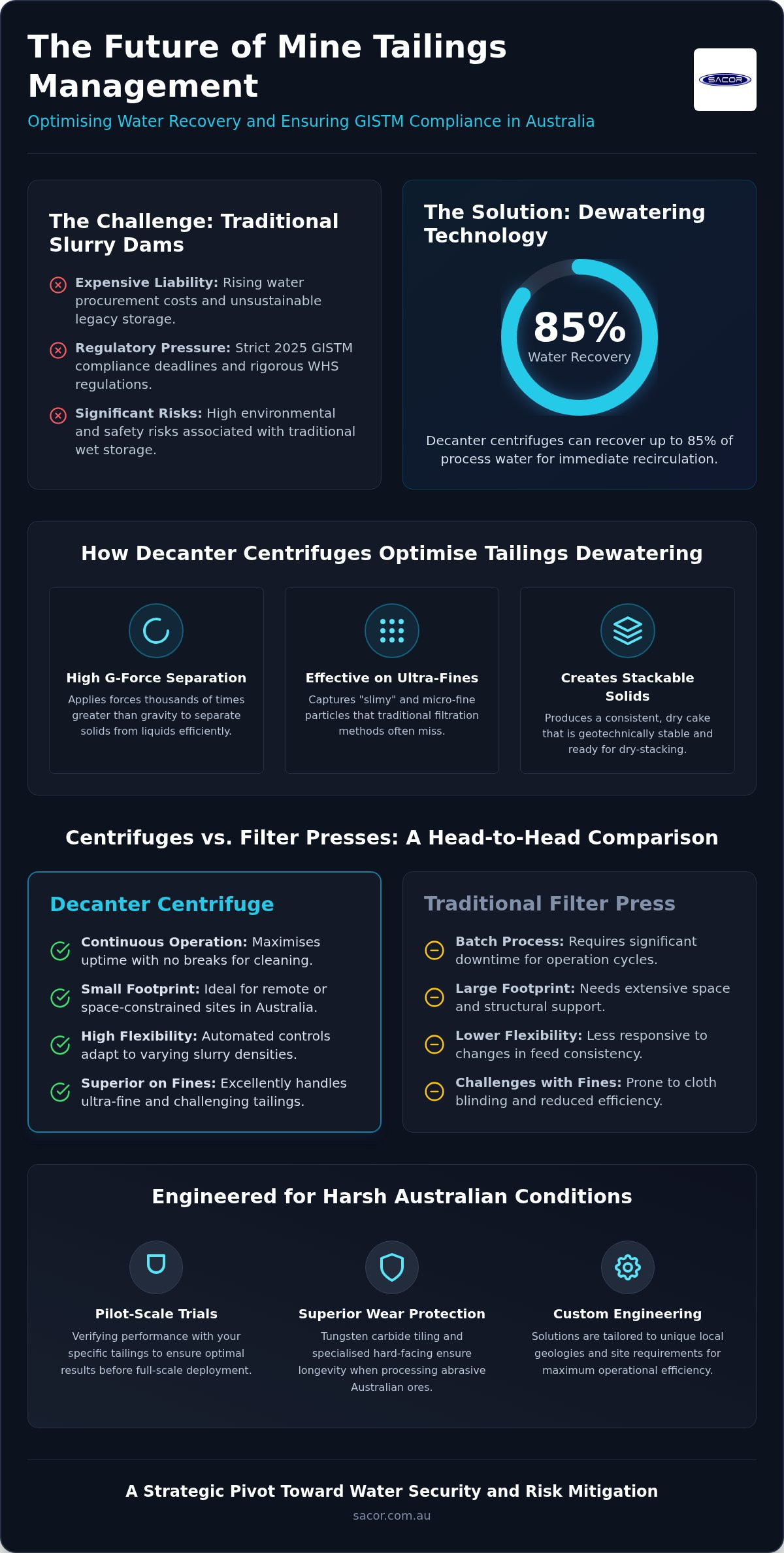
With decanter centrifuge systems now capable of recovering up to 85% of process water from tailings, the traditional slurry dam is fast becoming an expensive liability for Australian mine sites. Operators nationwide recognise that rising water procurement costs and the 2025 GISTM compliance deadlines have made legacy storage methods unsustainable. We understand the logistical strain of limited TSF space and the regulatory rigour required under current Work Health and Safety (Mines) Regulations. This article demonstrates how a tailings dewatering centrifuge solution provides a technical pivot toward water security and risk mitigation for mining operations across Australia.
You’ll discover how specific decanter centrifuge technology optimises water recovery and ensures GISTM compliance for mining operations of any scale. We will outline the path to achieving stackable tailings, maximising process water reuse, and significantly reducing the environmental and safety risks associated with traditional slurry management.
Key Takeaways
- Understand the transition from legacy Tailings Storage Facilities to dry-stacking and how to meet GISTM compliance deadlines for Australian mining operations.
- Learn how high-G force centrifugal separation effectively dewaters ultra-fine and “slimy” tailings that often bypass traditional filtration methods.
- Evaluate why a tailings dewatering centrifuge Western Australia offers superior operational flexibility and a smaller footprint compared to traditional filter presses on remote sites.
- Discover the importance of pilot-scale trials and custom engineering in ensuring equipment longevity when processing abrasive minerals in unique local geologies.
The Evolution of Tailings Management in Western Australia
Western Australia’s mining landscape is undergoing a fundamental shift in how waste streams are processed and stored. For decades, the industry relied on traditional Tailings Storage Facilities (TSFs) to manage wet slurry. This approach is no longer compatible with modern safety or environmental expectations. The “Tailing storage facilities in Western Australia: Code of practice,” updated in July 2025, reflects a regulatory environment that demands higher standards of stability and risk management. Implementing a tailings dewatering centrifuge Western Australia solution is now a primary strategy for sites looking to move toward dry-stacking.
The management of tailings, the materials left over after mineral extraction, involves navigating complex geotechnical challenges. By removing water at the plant rather than in the dam, operators can significantly reduce their hazard profile and extend the life of existing storage assets.
GISTM Compliance and Risk Mitigation
The Global Industry Standard on Tailings Management (GISTM) has set a high bar for the industry. International Council on Mining and Metals (ICMM) members face a strict compliance deadline of August 2025. This standard requires a rigorous approach to safety that legacy wet dams often struggle to meet. Mechanical dewatering allows for the creation of geotechnically stable solids. Transitioning to a tailings dewatering centrifuge Western Australia system is not just a regulatory hurdle; it’s a strategic move toward operational resilience. This shift directly lowers the risk of catastrophic failure and ensures operations comply with the Work Health and Safety (Mines) Regulations 2022.
Water Recovery as a Strategic Asset
In the arid regions of the Pilbara and the Goldfields, water is a finite resource that dictates production pace. The cost of procuring fresh water often outweighs the operational investment in recovery technology. Centrifuge systems can recover up to 85% of process water. This allows it to be recirculated back into the plant immediately. Rapid recovery cycles maintain consistent plant uptime and reduce the reliance on external bores. Beyond the financial benefits, efficient water management is a key component of a site’s social licence to operate. Regional communities expect mining companies to demonstrate genuine environmental stewardship by minimising their water footprint through innovative separation solutions.
How Decanter Centrifuges Optimise Tailings Dewatering
Decanter centrifuges represent a significant technical leap over traditional gravity-based thickening. While conventional thickeners rely on the natural settling rates of particles, centrifugal separation applies forces thousands of times greater than gravity. This is particularly effective when dealing with ultra-fines and “slimy” tailings that often remain in suspension in standard TSFs. A high-performance tailings dewatering centrifuge Western Australia wide allows sites to process these challenging streams into a manageable, stackable cake. This mechanical acceleration ensures that even particles only a few microns in size are captured and removed from the process water.
The ability to manage fluctuating slurry densities is a core advantage of this technology. Mining operations rarely provide a perfectly consistent feed; variations in ore grade and plant throughput often lead to spikes in solids concentration. Centrifuges adapt to these changes through automated control systems that adjust torque and bowl speed in real time. This ensures the discharged solids maintain a consistent moisture content regardless of the incoming feed conditions. By achieving this level of precision, mines can align their operations with the Tailing storage facilities in Western Australia: Code of practice, which emphasises the importance of predictable tailings characteristics for site safety.
The Solid Bowl Mechanism Explained
Continuous operation is what distinguishes decanter centrifuges from batch-style filtration. The solid bowl rotates at high speeds to settle solids against the bowl wall, while an internal scroll conveyor continuously removes the dewatered cake. This eliminates the downtime associated with filter cloth cleaning or plate opening. For abrasive Australian ores like iron ore or gold, wear protection is critical. Sacor systems incorporate tungsten carbide tiling and specialised hard-facing on the scroll to ensure longevity in high-throughput environments. Adjustable pond depths and differential speeds allow plant engineers to fine-tune the clarity of the centrate and the dryness of the cake for their specific mineralogy.
SADEC and Delta Canter Technology
The SADEC two-phase range is engineered for standard dewatering duties where the primary goal is clear water recovery and a dry solid discharge. For more complex mineral processing involving hydrocarbons or chemical solvents, the Delta Canter three-phase systems provide simultaneous separation of two liquid phases and one solid phase. These units are built for 24/7 industrial mining environments, featuring robust drive systems and high-torque gearboxes. If your site requires a bespoke approach to separation, you can explore our mining separation solutions to find a configuration that matches your specific throughput requirements.
Chemical optimisation plays a supporting but vital role in this process. While the centrifuge provides the mechanical force, the precise application of flocculants can enhance separation efficiency and reduce energy consumption. Modern centrifuge controls integrate dosing systems that respond to feed quality. This ensures that polymer usage is minimised while water clarity is maximised. This synergy between mechanical force and chemical assistance is what makes the decanter centrifuge the most resilient choice for modern tailings management.
Centrifuges vs. Filter Presses: Choosing the Right Technology
Selecting a dewatering technology requires a meticulous balance between mechanical performance and site-specific constraints. While filter presses are often cited for achieving high cake dryness, they frequently fall short in the volatile conditions of a working mine. A tailings dewatering centrifuge Western Australia solution provides the operational flexibility needed to handle variable feed densities without the constant manual intervention required by batch-style filtration. This capability is critical when plant throughput fluctuates or ore characteristics change unexpectedly. Centrifuges maintain a continuous process flow, ensuring that the separation cycle is never interrupted by the need to open plates or clean filter cloths.
Performance metrics must consider both cake dryness and water clarity. Decanter centrifuges excel in producing a consistent centrate, which is vital for immediate recirculation into the plant. In the Australian context, where labour costs for maintenance and operation are high, the automated nature of centrifugal separation offers a distinct advantage in long-term OPEX. While some filtration technologies may require extensive chemical dosing or manual oversight, the centrifuge operates as a self-regulating system that adjusts to feed variations in real time. Operators seeking to reduce dewatering costs in mining through system optimisation and advanced centrifugal separation will find that the automated, low-maintenance nature of decanter technology delivers measurable OPEX reductions. For a comprehensive overview of how these systems fit within the evolving 2026 regulatory landscape, the decanter centrifuge mining Australia strategic guide outlines the key compliance and operational considerations for modern mine sites.
Footprint and Infrastructure Comparison
Centrifuges occupy a significantly smaller footprint than filter press installations. A system capable of processing up to 300m³ per hour typically requires approximately 50m², whereas a comparable filter press array involves extensive structural steel and civil engineering. This compact design allows for modular, plug-and-play deployment. It’s an ideal choice for space-constrained sites or existing plants where retrofitting is necessary. Scalability is also simplified. Adding additional centrifuge units as production increases requires minimal expansion of the surrounding infrastructure, allowing for a phased approach to capital investment.
Australian Mineral Case Studies
Iron ore and coal fines present unique challenges due to their abrasive nature and high volume. Centrifuges equipped with advanced wear protection manage these high-throughput streams reliably, maintaining performance where other technologies might suffer from cloth blinding or mechanical fatigue. In the mineral sands sector of Western Australia, the separation of ultra-fine clays from valuable minerals is a primary concern. Decanter technology handles these “slimy” tailings with high efficiency, ensuring that water is recovered and the waste material is made geotechnically stable for dry stacking.
Gold operations benefit from the rapid recovery of process water, which often contains expensive reagents. By recirculating this water immediately through a closed-loop tailings dewatering centrifuge Western Australia system, sites reduce reagent consumption and improve their overall environmental footprint. This immediate recovery is far more efficient than allowing water to sit in a TSF, where evaporation and seepage can lead to significant losses of both water and chemical assets.
Operational Success on Remote Australian Mine Sites
Remote mining in the Pilbara or the North Eastern Goldfields demands more than just robust machinery; it requires a comprehensive support ecosystem. While the technical capability of a decanter is proven, its success on a remote site depends on meticulous preparation and reliable lifecycle support. A tailings dewatering centrifuge Western Australia project must begin with a clear understanding of the site’s unique slurry characteristics to avoid costly operational setbacks. Reliability in these environments is not a product of the machine alone, but of the engineering rigour applied before the first bolt is tightened.
The Pilot Trial Process
Success is built on data rather than assumptions. We follow a structured validation process to ensure the equipment matches the site’s specific metallurgical requirements:
- Step 1: Characterising the tailings feed through a detailed analysis of Particle Size Distribution (PSD) and mineralogy to understand settling behaviour.
- Step 2: Bench-top testing allows for the precise selection of flocculants and coagulants tailored to the specific chemistry of the process water.
- Step 3: On-site pilot unit testing provides real-world performance data, accounting for variable feed densities and ambient temperature fluctuations.
- Step 4: Scaling results to full-plant design ensures that the final installation meets throughput targets with a high degree of confidence.
Maintenance and Technical Support
Scheduled maintenance is the primary defence against catastrophic mechanical failure in high-speed rotating equipment. Centrifuges processing abrasive iron ore or mineral sands require regular inspection of wear components such as tungsten carbide scroll tiles and discharge ports. Local technical expertise based in Mandurah ensures that specialised technicians are available to assist with major overhauls or complex troubleshooting. Maintaining a critical inventory of spare parts on-site, including bearings and seals, is essential for minimising unplanned downtime in regional WA. This proactive approach to asset management ensures the equipment remains a reliable part of the plant’s water recovery circuit.
Modern systems incorporate PLC-based automation and remote monitoring to reduce the burden on site-based personnel. This allows plant engineers to track vibration, temperature, and torque from a central control room or an off-site office. De-manned operations are increasingly common on remote sites, where reducing the number of staff required for routine monitoring improves safety and lowers operational overheads. If you are planning a dewatering project, you can access our maintenance and technical support services to ensure your equipment maintains peak performance throughout its lifecycle.
Custom Engineering for Western Australian Conditions
Off-the-shelf separation equipment often fails to account for the unique geologies and harsh operating environments found across the Pilbara and Goldfields. A generic machine may perform adequately in a laboratory, but it frequently struggles when faced with the high clay content or extreme abrasiveness of local ores. Implementing a tailings dewatering centrifuge Western Australia solution requires an engineering approach that prioritises bespoke configuration over mass-produced specifications. By tailoring the metallurgy of wear components and the torque capacity of drive systems, we ensure that each installation is fit for the specific mineralogical challenges of the site.
Collaborative design is the cornerstone of a successful implementation. Our team works directly with plant engineers to understand the nuances of the existing process flow before proposing a technical solution. This partnership extends beyond the initial sale, encompassing the full lifecycle of the equipment from commissioning to eventual decommissioning. We view our role as a technical partner rather than a simple vendor, providing the steady expertise required to maintain high-capital industrial assets in remote locations.
Bespoke System Integration
Designing for Western Australian conditions means accounting for ambient temperatures that regularly exceed 45°C. Every tailings dewatering centrifuge Western Australia installation we deliver is engineered with cooling systems and enclosures capable of maintaining performance in high-heat and high-dust environments. Integration also extends to the digital layer. We ensure that centrifuge control systems are fully compatible with existing plant SCADA architectures, allowing for seamless data exchange and remote monitoring. Customised feed and discharge configurations are designed to fit within the physical constraints of existing plant layouts, minimising the need for expensive structural modifications.
Securing Your Operation’s Future
The regulatory landscape for tailings management is becoming increasingly stringent, with a clear move toward dry-stacking and zero-discharge targets. Future-proofing your operation requires technology that can adapt to these changing standards while improving the mine’s overall ESG profile. Efficient mechanical dewatering demonstrates a commitment to resource conservation and risk reduction, which is essential for maintaining a social licence to operate in regional Australia. By recovering water at the source, mines can significantly reduce their environmental footprint and operational risk. You can take the first step toward a more resilient waste management strategy by contacting Sacor for a technical tailings assessment. Our specialists provide the detailed analysis needed to transition from traditional slurry storage to a modern, compliant, and water-secure operation.
Advancing Mining Sustainability through Technical Precision
The transition from legacy slurry storage to geotechnically stable dry-stacking is no longer optional. It’s a strategic necessity driven by the August 2025 GISTM deadlines and the critical need for water security in arid regions. Decanter technology offers a resilient alternative to traditional filtration, providing the operational flexibility to manage ultra-fine particles and fluctuating feed densities within a compact footprint. Implementing a robust tailings dewatering centrifuge Western Australia solution ensures your site meets modern safety standards while maximising process water recovery.
Successful implementation relies on more than just high-performance equipment; it requires a partnership rooted in Australian-owned and operated technical expertise. We provide the engineering rigour needed to integrate the specialised SADEC and Delta Canter ranges into complex plant circuits, backed by comprehensive maintenance and spare parts support. Enquire about a customised tailings dewatering solution for your site to begin optimising your waste management strategy. We look forward to helping you build a more efficient and compliant future for your mining operations.
Frequently Asked Questions
What is the primary advantage of a centrifuge over a tailings dam?
The primary advantage is the immediate conversion of wet slurry into geotechnically stable solids and clear process water. This removes the need for massive wet storage footprints and mitigates the risk of catastrophic dam failure. By processing waste at the plant, you reduce the environmental liability and hazard profile of the site significantly compared to traditional gravity settling methods.
How do decanter centrifuges handle highly abrasive mineral tailings?
Decanter centrifuges manage abrasive minerals like iron ore or gold through advanced wear protection. We use tungsten carbide tiling on the scroll and specialised hard-facing on the discharge ports to withstand high-velocity particle impact. These features ensure the internal components maintain their structural integrity during continuous, high-throughput mineral processing operations.
Can centrifuges recover enough water to justify the investment in Western Australia?
Yes, recovering up to 85% of process water provides a clear financial return in arid mining regions. A tailings dewatering centrifuge Western Australia solution reduces the heavy costs associated with bore water procurement and desalination. Rapid recirculation also ensures plant uptime isn’t dictated by the slow settling rates found in traditional storage facilities.
What is the typical footprint required for a mining-scale centrifuge system?
A mining-scale centrifuge system capable of processing 300m³ per hour typically requires a footprint of approximately 50m². This is considerably smaller than the infrastructure required for equivalent belt or filter press arrays. The compact nature of the system allows for modular installation on existing concrete pads or within space-constrained plant layouts.
How does GISTM compliance affect tailings dewatering requirements?
GISTM compliance requires ICMM members to adopt safer tailings management practices by August 2025. This standard prioritises the reduction of dam failure risks, which is best achieved through mechanical dewatering. Transitioning to dry-stacking via centrifugation ensures your operation meets these international safety benchmarks and the local Work Health and Safety (Mines) Regulations 2022.
What flocculants are typically used for centrifugal tailings separation?
Anionic polyacrylamides are the most common flocculants used to enhance solids capture and centrate clarity. The specific choice of polymer depends on the particle size distribution and the ionic charge of the tailings slurry. Bench-top testing is essential to ensure the chemical dosing is optimised for the specific mineralogy of your site.
How often do mining centrifuges require major maintenance?
Major overhauls typically occur every 12 to 24 months, depending on the feed’s abrasiveness and the total hours of operation. Monthly inspections of high-wear areas are standard practice to prevent unplanned downtime. Maintaining a local inventory of critical spare parts ensures that these scheduled maintenance events are completed without long delays.
Can centrifuges be retrofitted into existing mineral processing plants?
Centrifuges are highly suitable for retrofitting because of their plug-and-play modularity and minimal civil engineering requirements. They can be integrated into existing mineral processing circuits with little disruption to the main plant. This flexibility allows operators to upgrade their tailings management strategy without the need for a complete plant redesign.