
The strongest business case for dewatering equipment starts with a measured site baseline, not an assumed saving. For Australian operators, the challenge is to turn process performance into a defensible investment case when benefits are difficult to quantify before equipment selection and site testing.
That uncertainty is understandable. Throughput, feed characteristics, cake handling, energy use, maintenance and site integration can all affect results, while different separation options may not be directly comparable. A decision based on capital cost alone can miss important operating and lifecycle requirements.
This guide sets out a practical framework for assessing the business case for dewatering equipment against your operating data. It explains which performance measures and cost categories to include, how to compare process options consistently, and which assumptions need validation through testing and site assessment. The aim is a transparent case that links equipment selection to measurable operational outcomes, while recognising that a decanter centrifuge is one option to assess against the feed, process objectives and operating context.
Key Takeaways
- Build a business case for dewatering equipment around documented site performance, process objectives and risks, rather than assumed benefits.
- Involve operations, engineering, maintenance, finance, environment and procurement so requirements are clear before equipment selection.
- Compare options using consistent feed conditions, operating hours, capacity needs and output measures.
- Include integration, commissioning, operator training, maintenance and downstream cake handling when assessing lifecycle implications.
- Validate technical fit and financial assumptions with site data and process testing before seeking approval or finalising an equipment decision.
Why build a business case for dewatering equipment around your process?
A dewatering investment should address a documented operating need, not rely on general claims about equipment savings. Feed composition, throughput targets, site constraints and downstream requirements shape what a system can achieve, so the case needs to reflect conditions at your facility. A high-level overview of Dewatering can help establish the process context; the investment decision, however, depends on site-specific evidence.
A dewatering equipment business case is a documented comparison of current process performance with proposed changes, including expected costs, operational outcomes and risks. It gives operations, engineering, maintenance, finance, environment and procurement a shared basis for evaluating the need, assessing alternatives and deciding what must be validated before approval.
A measured baseline is more useful than an unverified savings claim because it shows where the process is constrained today and which outcomes matter at your site. For example, improving solids capture may have limited value if cake handling or a downstream process remains the actual bottleneck. Keep confirmed operating issues separate from benefits that depend on equipment selection, testing or integration.
Which operating problems can justify a dewatering investment?
Start with the conditions that affect reliable production and material handling. These may include limits on solids handling, variable feed characteristics, inconsistent cake properties or a downstream bottleneck. Record the current demands on labour, consumables, maintenance and waste handling from site records rather than assuming a new system will reduce them.
For each issue, note its operational consequence and the evidence supporting it. For example, distinguish recorded downtime or handling requirements from proposed outcomes that still need testing. This keeps the case credible and shows where process trials or additional data are needed.
What evidence should the business case include?
Build a baseline covering throughput, solids capture, cake characteristics and operating hours. For each indicator, record the measurement period, sample conditions and data source, along with known gaps or feed changes. Consistent records make later comparisons more defensible and help prevent differences in operating conditions from being mistaken for equipment performance.
Link each proposed benefit to an accountable owner and a measurable indicator. Operations might track throughput, maintenance might record service requirements, and finance might review documented cost inputs. Define who will verify each measure and what evidence is required. Check assumptions about capacity, performance and costs against your operating data before treating projected outcomes as established.
How dewatering equipment affects lifecycle costs and process performance
A sound investment assessment looks beyond acquisition cost to the resources needed to install, operate and maintain the equipment throughout its working life. Separate capital expenditure from ongoing operating costs, then compare options using equivalent feed conditions, throughput requirements and measurement boundaries. Otherwise, different assumptions can make one option look more favourable without showing how it would perform at your site.
Purchase price alone cannot establish lifecycle value because it excludes costs and process outcomes that determine how equipment performs in operation. Include commissioning, integration with existing processes and operator training in the assessment scope, even if these are planned or delivered separately. They affect implementation and should not be obscured within a single equipment figure.
Which costs belong in a dewatering equipment assessment?
Use separate categories so decision-makers can see what is included and what still needs estimating or confirmation:
- Capital and implementation: equipment acquisition, installation, commissioning and process integration.
- Routine operation: energy, labour and consumables, assessed using relevant site records and operating assumptions.
- Maintenance: planned servicing, wear parts and planned downtime, with assumptions checked against maintenance history and supplier information.
- Downstream handling: cake transport, water management and any effects on subsequent process steps, where applicable.
Keep one-off implementation requirements distinct from recurring costs. This makes it easier to compare alternatives over the same assessment period and identify inputs that need validation, rather than presenting uncertain estimates as established results.
How can process performance translate into business value?
Connect performance measures to actual site requirements. Solids capture and cake characteristics matter in relation to how material is handled, transported or processed next. Assess throughput and availability against the plant’s operating constraints and production profile, not as isolated equipment claims. If a downstream step cannot accept the expected output, an improvement at the dewatering stage may not benefit the overall process.
Assess water recovery, waste reduction and environmental outcomes against documented site priorities and measurement methods. Treat each as a potential benefit until operating data or process testing supports it. For a consistent comparison, apply the same feed conditions, operating hours, capacity needs and output measures to each option, including a decanter centrifuge where it suits the application.
For an application-specific overview of centrifugal separation solutions, consider how feed characteristics, throughput targets and site conditions shape the assessment.
How to compare dewatering options without overstating payback
Projected payback remains uncertain until the assumptions behind it are tested. A business case for dewatering equipment should show what is measured, what is estimated and what still needs validation, rather than present a forecast as a guaranteed outcome. Compare each option on the same basis: feed conditions, operating hours, capacity requirements and output measures.
A decanter centrifuge, filter press or thickener may warrant assessment depending on the process objective and site context. There is no universal winner. Document why each option is included or excluded, considering feed variability, required solids separation, operating practices, site interfaces and downstream handling. If the evidence does not establish fit, record the uncertainty and identify what testing could resolve it.
Use consistent criteria to compare options
Structure the comparison so reviewers can trace each conclusion back to site evidence. Use the same operating assumptions for every option and define the measurement boundary, including which process stages and costs are in scope. The example below is a template: populate it with facility data and clearly mark unverified inputs.
| Criterion | Site evidence | Assumptions and risks | Validation status |
|---|---|---|---|
| Feed and capacity | Feed records, variability and required throughput | Changes in feed may affect achievable performance | Confirm with representative samples or testing |
| Operating profile | Operating hours and production requirements | Planned hours may differ from actual utilisation | Check against operating records |
| Output and handling | Solids separation, cake characteristics and downstream needs | Handling benefits depend on the receiving process | Measure under comparable conditions |
| Lifecycle inputs | Energy, labour, maintenance and disposal records | Future requirements may vary with use and upkeep | Review with operations and maintenance |
Test how the case changes when assumptions about throughput, energy use, labour, maintenance or disposal change. Show the effect of each variation and identify which inputs have the greatest influence. This helps reveal where better data or a process trial could materially affect the decision.
Present uncertainty as part of the decision
Prepare conservative, expected and upside scenarios, with the assumptions for each clearly stated. Do not label the upside as a forecast unless evidence supports it. Note measurement gaps, unverified inputs and operational changes that could alter results, such as shifts in feed or utilisation. Agree decision thresholds with finance and operations based on site priorities; a generic payback rule may not reflect the facility’s constraints.
Before approval, assign owners to validate key assumptions and record what evidence could change the recommendation. Decision-makers can then see both the potential value and the conditions it depends on.
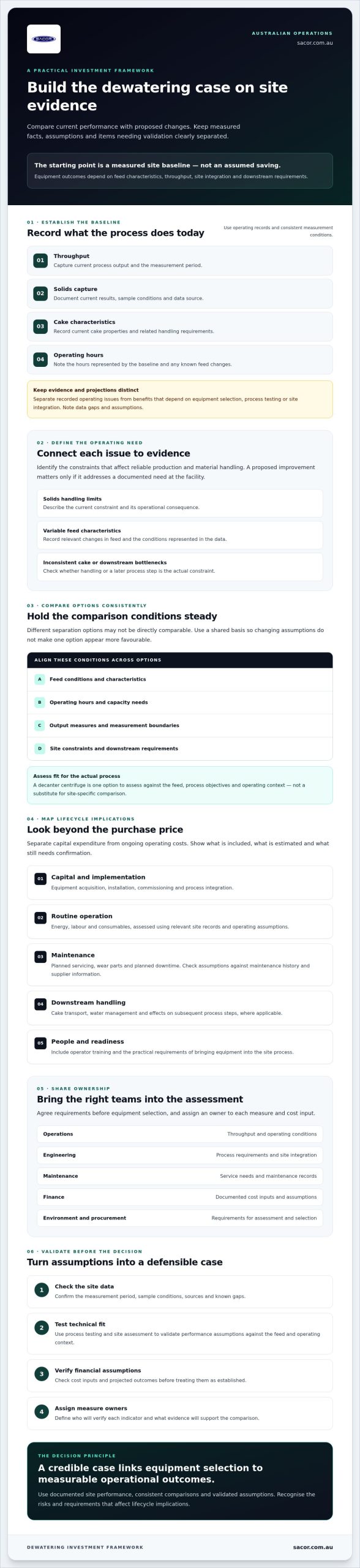
A practical framework for preparing and validating the investment case
Turn the evidence into a decision pathway with clear owners and validation points. A business case for dewatering equipment is more robust when technical fit, site readiness and financial assumptions are assessed together, rather than treated as separate workstreams.
- Measure the baseline. Record current process outcomes, operating conditions, labour requirements, maintenance events and downstream constraints. Note data sources, measurement periods and limitations.
- Define requirements. Agree target throughput, separation outcomes, operating hours, cake-handling needs and site interfaces with relevant stakeholders.
- Assess suitable options. Compare process alternatives against the same feed conditions and requirements. Document the technical reasons for including or excluding each option.
- Validate assumptions. Use bench testing or pilot work where performance depends on feed behaviour. Request supplier input on design assumptions and ask site engineering to review interfaces and implementation requirements.
- Review and approve. Update costs, risks and scenarios using validated evidence, then present unresolved assumptions and agreed decision criteria to approvers.
What site data should be collected before seeking proposals?
Compile available information on feed composition, variability, flow, solids loading and operating conditions. Add current process outcomes, labour requirements, maintenance history and downstream constraints. Flag seasonal variation, sampling limitations and data quality gaps so technical stakeholders can judge whether the baseline represents normal operation. This information helps suppliers assess process fit without treating incomplete records as definitive.
How can teams validate assumptions before approval?
Bring operations, engineering, maintenance, environment and finance into the review. Ask suppliers to document design assumptions, exclusions, required site interfaces and commissioning scope. Determine which uncertainties need process testing, supplier clarification or engineering review. Agree in advance how acceptance criteria will be assessed and how post-commissioning performance will be measured and reported, including who owns the data and review.
Check implementation risks alongside expected process outcomes. Confirm operator needs, maintenance planning, site access and integration requirements before approval, and assign an owner to each open item. This creates a traceable link between the evidence, the proposed equipment and the conditions required for a sound decision.
Sacor supplies industrial separation systems matched to feed characteristics, throughput targets and site conditions. Its dewatering equipment information can be considered alongside installation, commissioning and ongoing support requirements when developing an implementation plan.
Turn the dewatering business case into a supported equipment decision
A defensible business case for dewatering equipment should lead to a selection that fits documented site priorities, not simply the option with the most attractive headline performance or purchase price. Use the evidence gathered to weigh process fit, implementation requirements and lifecycle support together. The table below provides a starting point; confirm each potential advantage and trade-off against site data and supplier documentation.
| Decision criterion | Potential advantage | Potential trade-off or check |
|---|---|---|
| Fit with feed and process objectives | A customised design may align equipment performance with feed characteristics and throughput targets. | Confirm assumptions against representative feed data and required outputs. |
| Site integration | Early review of interfaces can support a more coordinated installation plan. | Identify site modifications, dependencies and responsibilities before approval. |
| Commissioning and operator preparation | Defined commissioning activities and technical documentation can help teams prepare for start-up. | Clarify scope, operator requirements, acceptance criteria and how results will be recorded. |
| Lifecycle support | Maintenance planning, spare-parts access and technical support can inform operational readiness. | Check what support is included, what is excluded and how ongoing requirements will be managed. |
What should procurement confirm before selecting a supplier?
Compare proposals against the same operating requirements and evaluation criteria. Confirm equipment scope, stated process assumptions, exclusions, technical documentation and responsibility for commissioning. Review maintenance requirements, spare-parts planning and available technical support as lifecycle considerations, not details to defer until after purchase. For sector context, consult Sacor’s mining dewatering centrifuge guidance and its wastewater treatment centrifuge guidance.
How should the team move from approval to operation?
Assign project responsibilities and establish integration milestones before work begins. Prepare operators for the equipment and operating procedures, and organise commissioning documentation so the handover captures the agreed baseline and post-start-up measurement methods. This makes it possible to compare actual operation with the assumptions in the approved case and identify where adjustments or further review may be needed.
Use operating feedback to refine maintenance planning and parts requirements. Sacor’s guidance on industrial centrifuge spare-parts planning can help inform that review.
Make your next equipment decision evidence-led
A defensible business case for dewatering equipment connects measured process needs with whole-of-life costs, site requirements and risks. Compare options using consistent assumptions, and treat projected payback as uncertain until key performance and cost inputs have been validated against operating data.
Keep the decision grounded in site priorities: confirm technical fit, downstream requirements and implementation needs, then agree how results will be measured after commissioning. This gives operations, engineering, maintenance and finance a shared basis for assessing the investment.
Sacor supplies customised separation solutions matched to feed characteristics, throughput targets and site conditions. Equipment supply can include technical documentation and commissioning support, while maintenance, spare-parts supply and technical support can also be considered across the equipment lifecycle.
Use the FAQ below to check common considerations, then contact Sacor to discuss an equipment assessment shaped around your process.
Frequently Asked Questions
What is a business case for dewatering equipment?
A business case for dewatering equipment is a documented assessment of whether an investment can meet defined process and commercial objectives. It compares measured current performance with proposed outcomes, lifecycle costs, implementation requirements and risks. Separate verified evidence from estimates, assign owners to key assumptions and state what remains uncertain. A forecast is not a guaranteed result; the case should explain how uncertainties will be investigated and managed before and after approval.
How do you calculate the return on investment for dewatering equipment?
Calculate return using site-specific inputs: baseline operating costs, proposed capital and integration costs, expected operating changes, maintenance requirements and the evaluation period. Estimate financial benefits only from measured results or validated assumptions, then compare net benefits with the investment using your organisation’s agreed method. Test conservative, expected and upside scenarios to show how results change if inputs shift. Actual returns depend on the process and site, so avoid generic savings claims or standard payback periods.
What costs should a dewatering equipment business case include?
Include more than equipment acquisition. Depending on the project, assess engineering, installation, commissioning, integration, energy, labour, consumables, planned maintenance, spare parts and downstream handling. Add relevant costs for cake transport or water management where these affect the operation. Distinguish supplier-quoted amounts from estimates and internal assumptions, and include only categories that apply to your process. Site requirements and project scope determine the actual figures, so a generic cost range will not establish your case.
Can dewatering equipment reduce operating costs?
It may reduce selected operating costs if the new equipment changes measurable process requirements, but savings depend on feed characteristics, operating conditions, integration and maintenance. Compare the proposed process with a documented baseline, accounting for any new energy, labour, consumable or service requirements. Identify how each anticipated reduction will be measured and who will verify it. Validate assumptions using site data and agreed commissioning criteria; no technology should be treated as delivering universal savings.
Is a decanter centrifuge suitable for every dewatering application?
No. Suitability depends on feed characteristics, throughput targets, separation objectives, site conditions and operating requirements. Assess a decanter centrifuge alongside relevant alternatives rather than making it the default choice. Review representative process data and document the design assumptions used to assess fit, including the required output and any downstream constraints. A technical comparison should explain why each option is included or excluded for the specific application, without assuming one technology outperforms others across all industries.
What happens if actual equipment performance differs from the business case?
Compare actual results with the original design basis, acceptance measures and operating conditions agreed before procurement and commissioning. Check whether the feed, operating settings, site integration or measurement methods differ from the assumptions used in the case. Document findings and corrective actions, then revisit the financial model using updated evidence. The appropriate response depends on the equipment scope and supplier commitments, so do not assume a particular remedy or outcome without reviewing the agreed terms.
How can a site validate dewatering equipment performance before investing?
Start by collecting representative feed and operating data, defining target outputs, reviewing site interfaces and documenting how results will be measured. Depending on the application, consider whether bench testing, pilot work or other supplier-supported validation is appropriate before approval. Confirm what evidence is available, what remains an assumption and who will assess it. Any proposed test or performance commitment should be explicitly discussed and confirmed, rather than presumed to be available or included.
What should be included in a dewatering equipment proposal?
Check that the proposal states the equipment scope, design basis, feed assumptions, capacity requirements, technical documentation, site interfaces and commissioning responsibilities. Review exclusions alongside any maintenance, spare-parts and technical-support arrangements relevant to the equipment lifecycle. Compare proposals against consistent operating requirements and acceptance measures so differences in scope are clear. Confirm whether each service or commitment is explicitly included in the supplier’s offer; do not assume support, testing or performance guarantees are part of the proposal.
Contact Sacor to discuss a dewatering equipment assessment for your process.