
A centrifuge ROI case based on purchase price alone can be misleading. To understand how to calculate centrifuge ROI, start with costs and process results your site can verify, not a generic payback period or an untested estimate. Without a credible operating baseline, it’s difficult to substantiate savings in labour, energy, waste handling or material recovery.
The equipment price is only one part of the lifecycle investment. Installation, commissioning, energy use, maintenance and operating assumptions all affect the business case. Measure process benefits against the existing method using consistent boundaries and comparable operating conditions.
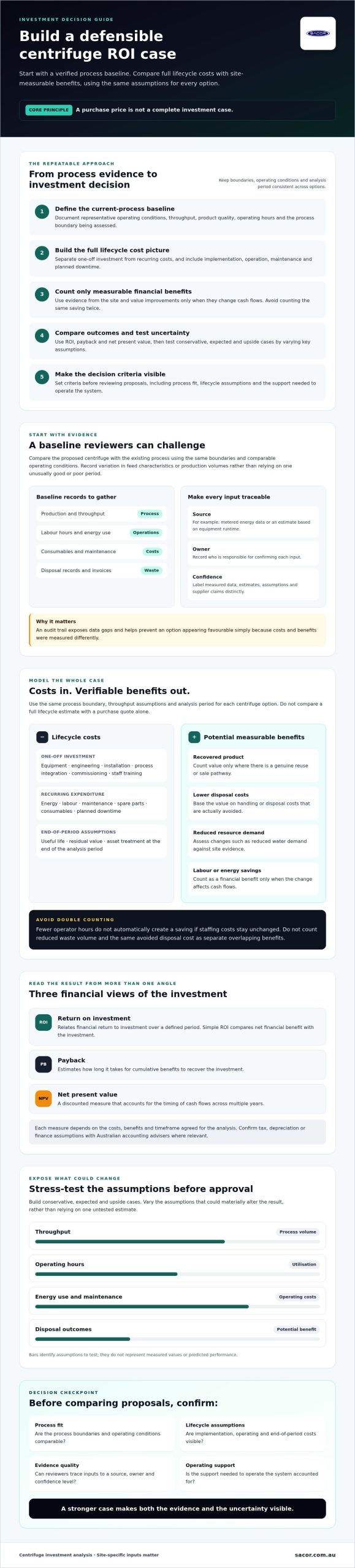
This guide sets out a repeatable approach for building a model with site-specific inputs. You’ll learn how to define the baseline, calculate lifecycle costs and quantify measurable benefits, then compare centrifuge options using the same assumptions. The result is an investment case that decision-makers can review, with uncertainties made visible. If tax, depreciation or finance treatment affects your analysis, confirm those assumptions with your Australian accounting advisers.
Key Takeaways
- Learn how to calculate centrifuge ROI using a repeatable sequence that separates verified annual benefits from incremental operating costs.
- Include commissioning, staff training, maintenance, spare parts and planned downtime when comparing options across the analysis period.
- Use payback and net present value alongside ROI to assess investment outcomes from more than one financial perspective.
- Test conservative, expected and upside cases by varying throughput, operating hours, energy use, maintenance and disposal outcomes.
- Set decision criteria before reviewing proposals, including process fit, lifecycle assumptions and the support needed to operate the system.
Why centrifuge ROI starts with a process baseline, not a quote
A centrifuge proposal can describe equipment scope and expected performance, but it can’t establish the return for your site without a documented picture of the process it may replace or improve. To calculate centrifuge ROI credibly, compare the proposed system with the current process using the same boundaries for throughput, product quality, operating hours and analysis period. This gives decision-makers a consistent reference, rather than comparing a supplier estimate with an undocumented status quo.
Define those boundaries before modelling benefits. If feed characteristics or production volumes vary, record the conditions for each comparison and account for seasonal or operational differences. Separate measured site data from estimates, assumptions and supplier claims. Label each input with its source and confidence level. An early process and site assessment can help identify which operating assumptions need further validation.
What does centrifuge ROI measure?
Return on investment (ROI) expresses financial return relative to investment over a defined period. Simple ROI compares net financial benefit with the investment, while payback estimates how long it takes for cumulative benefits to recover that investment. Discounted measures account for the timing of cash flows, which matters when evaluating costs and benefits across multiple years. Each measure depends on the costs, benefits and timeframe agreed for the analysis.
An operational improvement counts as a financial benefit only when it changes cash flows. Fewer operator hours, for example, don’t automatically create a saving if staffing costs remain unchanged. Likewise, reduced waste volume should be valued through the disposal or handling costs it actually avoids, not counted again as a separate, overlapping “waste reduction” benefit.
Build a defensible current-process baseline
Build the baseline from representative records, not a single unusually good or poor operating period. Gather production and throughput data alongside labour hours, energy use, consumables, maintenance and disposal records. Compare periods with similar operating conditions, and note changes in feed characteristics, product quality or operating hours that could affect the results.
For each input, record its source, who is responsible for confirming it and a confidence rating. Distinguish metered energy consumption from an estimate based on equipment runtime, for example, and verified disposal invoices from projected charges. This audit trail makes assumptions visible, highlights data gaps and gives reviewers a basis for challenging or updating the model. It also prevents one centrifuge option from appearing more favourable simply because its benefits and the existing process’s costs were measured differently.
Which centrifuge costs and benefits belong in the ROI model?
A credible model compares the full cost of implementing and operating a centrifuge with benefits that can be verified at the site. Include relevant costs within the same process boundary, throughput assumptions and analysis period for each option. This avoids comparing a complete lifecycle estimate for one system with a purchase quote for another.
Account for full lifecycle costs
Separate one-off investment from recurring expenditure. Initial costs may include equipment, engineering, installation, integration with the existing process, commissioning and staff training. Record each item consistently, including site work or production interruption required to bring the system into operation.
Across the operating period, model energy, labour, maintenance, spare parts, consumables and planned downtime. Base maintenance assumptions on expected intervals and replacement parts, and account for any production impact while servicing takes place. State the assumed useful life, residual value and how the asset will be treated at the end of the analysis period. These choices can materially affect the comparison, so document them rather than leaving them implicit. The guide to writing a business case for equipment investment also highlights the value of setting out costs and benefits clearly for review.
Measure benefits without overstating them
Build benefits from auditable evidence, such as invoices, weighbridge records, production logs or energy data. Potential benefit categories include recovered product with a genuine reuse or sale pathway, lower disposal costs, reduced water demand, and labour hours that translate into an actual reduction in expenditure or a demonstrable increase in productive capacity.
Link each benefit to one operational change and count it once. If lower disposal charges already capture the value of reduced waste volume, don’t add that same volume again as a separate financial benefit. Count recovered material at its realised value only where the site can use or sell it. Environmental and compliance improvements may be important decision factors, but keep them separate from financial returns unless the site can evidence a monetary effect.
- Cost: Include commissioning, maintenance and parts, not only equipment acquisition.
- Benefit: Connect each claimed saving or recovery to a record and a measurable process change.
- Comparison: Apply identical operating assumptions and timeframes to every option.
This evidence-led structure makes the model easier to check and update as operating conditions change. Reviewing feed characteristics, throughput targets and site conditions early can also sharpen the assumptions. Include centrifuge process fit with Sacor in that evaluation.
How to calculate centrifuge ROI, payback and net present value
Once the inputs are defined, calculate the investment in a consistent sequence. Keep the analysis period and process boundary the same for every centrifuge option, and show which figures are measured, estimated or awaiting confirmation. This makes the result easier to audit and update as operating data improves.
- 1. Validate the baseline. Confirm current process costs, production conditions and the operating period against site records.
- 2. Set the investment amount. Total the initial equipment and implementation costs included in the model.
- 3. Calculate annual net benefit. Subtract incremental annual operating costs from verified annual benefits.
- 4. Project cash flows. Apply the annual net benefit across the selected period, adjusting for changes where benefits or costs vary by year.
- 5. Calculate decision measures. Report ROI and payback, then use discounted measures if cash-flow timing affects the decision.
Use ROI and payback formulas consistently
For cumulative simple ROI, first calculate the net return over the chosen period: total verified benefits less incremental operating costs and the initial investment. Then divide that net return by the initial investment and multiply by 100:
Simple ROI (%) = (net return over chosen period ÷ initial investment) × 100
State whether the result is annual or cumulative. Don’t describe annual net benefit divided by investment as cumulative ROI. It’s an annual measure and doesn’t show the full project-period return. Use a worksheet populated with site data rather than unsupported industry benchmarks.
Where annual net benefits are stable and positive, estimate simple payback using:
Simple payback (years) = initial investment ÷ annual net benefit
This shortcut assumes benefits arrive evenly. If cash flows vary, build a year-by-year schedule and identify when cumulative net cash flow recovers the initial investment. Include the timing of commissioning, maintenance costs and any ramp-up assumptions where relevant.
When to add NPV and IRR
Net present value (NPV) accounts for the time value of money by discounting future net cash flows to today’s value, then subtracting the initial investment:
NPV = sum of discounted future net cash flows − initial investment
Internal rate of return (IRR) is the discount rate at which NPV equals zero. It can help compare investment alternatives, but it doesn’t replace operational analysis. The result still depends on credible throughput, cost and benefit assumptions. Confirm the discount rate and any tax or depreciation treatment with your Australian finance or accounting advisers before presenting the case.
How to test centrifuge ROI assumptions before approving investment
A single ROI result can conceal how strongly the case depends on uncertain inputs. Before approval, test whether the investment still meets your organisation’s criteria when operating conditions differ from the expected case. This makes uncertainty visible in the decision instead of burying it in one headline figure.
Run a simple sensitivity analysis
Start by changing one material assumption at a time and recording its effect on ROI and payback. Test throughput, operating hours, energy use, maintenance requirements and disposal outcomes. Then combine reasonable changes into three clearly labelled scenarios:
- Conservative: Use cautious assumptions where evidence is limited, such as lower throughput or higher maintenance requirements.
- Expected: Use the most supportable inputs based on current site data and validated operating expectations.
- Upside: Include favourable outcomes only where there is a credible operational basis for them.
Keep an audit trail for each variable. A working comparison can record the assumption, evidence source and effect on the investment result:
- Throughput: Use site production records or representative process data, then assess the change in annual net benefit.
- Energy use: Use measured consumption or a clearly labelled estimate, then assess the effect on operating costs.
- Maintenance: Record documented service and parts assumptions, then assess changes to lifecycle costs and downtime.
- Disposal outcome: Use invoices or other site records, then assess the value of any evidenced cost reduction.
Identify thresholds where the project no longer meets its approval criteria, such as a minimum acceptable ROI or maximum payback period. Use figures from your organisation’s decision rules, not an assumed industry benchmark.
Address uncertainty with evidence
Projected savings remain estimates until supported by site conditions. Label assumptions, assign confidence levels and, where practical, validate uncertain performance through representative trials or operating data. A supplier specification can inform the assessment, but it isn’t proof of an outcome under your feed characteristics, throughput and site conditions. Keep demonstrated results separate from projected results in the model.
Summarise remaining risks in distinct categories. Operational risk covers variability in feed or production conditions; data uncertainty identifies estimates that lack strong site evidence; and implementation risk captures assumptions about integration, commissioning, training or planned downtime. Review maintenance and spare-parts assumptions against the site’s intended lifecycle plan, using this industrial centrifuge maintenance guide as a reference.
A robust approach to how to calculate centrifuge ROI makes these limitations reviewable before capital is committed. For a technical discussion about process fit and the assumptions relevant to your site, discuss your centrifuge application with Sacor.
Turn the centrifuge ROI calculation into a practical investment decision
A sound ROI model supports a decision, but doesn’t make it on its own. Before comparing vendor proposals, agree on the criteria that matter to your operation, including process fit, lifecycle cost, support requirements and the organisation’s financial thresholds. Apply the same criteria to each option so the preferred choice reflects both the evidence and the site’s operating needs.
Create a decision-ready ROI summary
Condense the analysis into a one-page summary that decision-makers can review alongside the detailed model. State the preferred option, current-process baseline, analysis period and calculation method, then identify the main assumptions, data sources and sensitivity results. Make material risks and unresolved information visible rather than presenting a single return figure without context.
Assign an owner and a next step to each material assumption that still needs validation. For example, the operations team might confirm expected operating hours, while finance reviews the treatment of investment cash flows. Keep three types of outcome distinct:
- Operational: Process fit, throughput and product-quality requirements.
- Financial: Investment, ongoing costs, benefits and scenario results.
- Sustainability: Resource or waste outcomes, recorded separately unless a financial value is evidenced.
Move from financial case to process assessment
Technical review connects the model’s assumptions to the conditions a system must handle. Prepare representative feed characteristics, throughput targets, site conditions and operating data, and note any variability that could affect performance. Broader equipment context is available in this industrial decanter centrifuge guide. If the application is mining, consult the mining decanter centrifuge guide for sector-specific context.
Discuss installation, commissioning, maintenance and spare-parts planning as part of the system’s lifecycle, not as details to resolve after the financial case is approved. Sacor supplies customised centrifuge systems and related technical support, with solution design informed by feed characteristics, throughput targets and site conditions. These discussions can help clarify process fit and refine the inputs used to calculate centrifuge ROI, without treating projected benefits as guaranteed results.
Bring your process requirements and ROI assumptions to Sacor’s technical team for discussion. Discuss your centrifuge process requirements as a step towards a more informed investment decision.
Build your next centrifuge investment case on evidence
A defensible centrifuge investment case starts with a verified picture of the existing process, then compares options using consistent operating assumptions and a clearly defined analysis period. Knowing how to calculate centrifuge ROI means looking beyond the initial investment: include lifecycle costs, measurable benefits and the sensitivity of returns to changes in site conditions.
Use the calculation alongside payback and, where cash-flow timing matters, discounted measures such as net present value. Make uncertainty visible by documenting data sources, testing scenarios and assigning owners to unresolved assumptions. This gives decision-makers a transparent basis for weighing financial returns alongside operational and sustainability considerations.
Sacor tailors separation solutions to feed characteristics, throughput targets and site conditions. Equipment supply can include technical documentation and commissioning support, while maintenance, spare-parts supply and technical support can inform lifecycle planning. These inputs can support a grounded assessment of process fit without presuming a particular financial outcome.
Bring your operating requirements and assumptions into a technical discussion. Discuss your centrifuge process requirements with Sacor and take the next step towards an investment decision built around your site.
Frequently Asked Questions
How do you calculate ROI for a centrifuge?
Calculate centrifuge ROI by comparing the net financial return over a stated period with the initial investment. Subtract incremental operating costs from verified benefits to find annual net benefit, then total net benefits across the analysis period, subtract the initial investment and divide by that investment. Multiply by 100 for a percentage. State whether the result is annual or cumulative, and use consistent process boundaries and assumptions across options.
What costs should be included when calculating centrifuge ROI?
Include initial equipment and implementation costs, then forecast operating costs across the chosen analysis period. Depending on the project, these may include engineering, installation, integration, commissioning, staff training, energy, labour, maintenance, spare parts, consumables and planned downtime. Record assumptions about useful life and residual value too. Include only costs relevant to the defined process boundary, and apply the same categories and timeframes when comparing centrifuge options.
How do you calculate the payback period for a centrifuge?
When annual net benefits are stable and positive, estimate simple payback by dividing the initial investment by annual net benefit. The result is the number of years required to recover the investment under those assumptions. If benefits or costs vary over time, model cash flows by period and track cumulative net cash flow instead. This shows when the investment is recovered without assuming benefits arrive evenly.
What is the difference between centrifuge ROI and net present value?
ROI expresses net return relative to the investment, usually as a percentage over a specified period. Net present value (NPV) adjusts future cash flows for the time value of money using a chosen discount rate, then subtracts the initial investment. ROI provides a proportional return measure, while NPV shows value in monetary terms at today’s date. Confirm discount-rate, tax and depreciation assumptions with your Australian finance or accounting advisers.
Can a centrifuge ROI calculation include reduced disposal costs?
Yes. Include reduced disposal costs when site records support the expected change and the saving affects actual expenditure. Use evidence such as disposal invoices, weighbridge records or documented waste volumes, and compare equivalent operating periods and throughput. Attribute the saving to one measurable change. If lower disposal charges already reflect reduced waste volume, don’t count that same reduction again as a separate financial benefit.
How do you account for centrifuge maintenance in an ROI model?
Forecast maintenance as a lifecycle operating cost, using the planned maintenance schedule, expected spare parts and site-specific service assumptions. Include production impacts from planned servicing where these affect output or cash flow. Record the evidence behind each input and distinguish confirmed maintenance requirements from estimates. Review assumptions across the full analysis period, since excluding parts, servicing or downtime can make a centrifuge option appear more financially attractive than it is.
How much data do I need to calculate centrifuge ROI?
There’s no fixed amount of data that suits every site. Gather enough representative records to describe normal throughput, operating hours, labour, energy, consumables, maintenance and disposal outcomes, while capturing relevant seasonal or feed variability. Use comparable periods and identify data sources, owners and confidence levels. Where records are incomplete, label estimates clearly and test their effect on returns rather than presenting uncertain inputs as measured results.