
A centrifuge can run within its rated speed and still pose a serious hazard if imbalance, vibration or a developing fault goes unnoticed. Effective centrifuge safety procedures for plant operators rely on more than a start-up check: they require disciplined verification before operation, attentive monitoring while the machine runs and careful maintenance over its service life.
Plant teams understand the consequences of missed checks, from mechanical damage and unplanned downtime to severe injury around high-energy rotating equipment. The challenge is applying consistent controls to complex balance and vibration conditions while keeping operations efficient and aligned with applicable Australian safety requirements.
This guide sets out the essential checks and operating practices to help operators manage high-speed industrial centrifuges safely. It covers pre-start inspections, loading and balance, vibration monitoring, safe shutdown, fault response, training and maintenance. Sacor-supplied systems include technical documentation to support safe operation, while professional maintenance and technical support help plant teams keep equipment operating within safe parameters. Use the checklist to strengthen day-to-day controls, support equipment reliability and build a practical foundation for zero-incident operation.
Key Takeaways
- Use a structured pre-start inspection to identify visible damage, loose fasteners and mounting concerns before operation.
- Learn how vibration changes and unusual noise can signal developing mechanical issues that need prompt assessment.
- Apply centrifuge safety procedures for plant operators as a continuous cycle of preparation, monitoring and maintenance.
- Understand how wear in tiles, liners and discharge ports can affect mechanical integrity and safe operation.
- Use equipment-specific technical documentation and qualified maintenance support to guide safe operating and maintenance decisions.
Understanding the Risks: Why Centrifuge Safety is Paramount
A decanter centrifuge turns rotational speed into substantial stored energy. If a rotating assembly fails, components can be released at high velocity, putting operators and nearby equipment at risk. The consequences may include severe injury, extensive mechanical damage and production disruption. Understanding the forces involved helps plant teams treat safety checks as essential controls, not routine paperwork.
For centrifuge safety procedures for plant operators to work in practice, operators need to recognise early warning signs, follow equipment-specific instructions and act within site procedures. The hazards of catastrophic failure illustrate why high-speed rotating equipment requires effective containment and disciplined operation.
The Mechanics of High-Speed Rotation
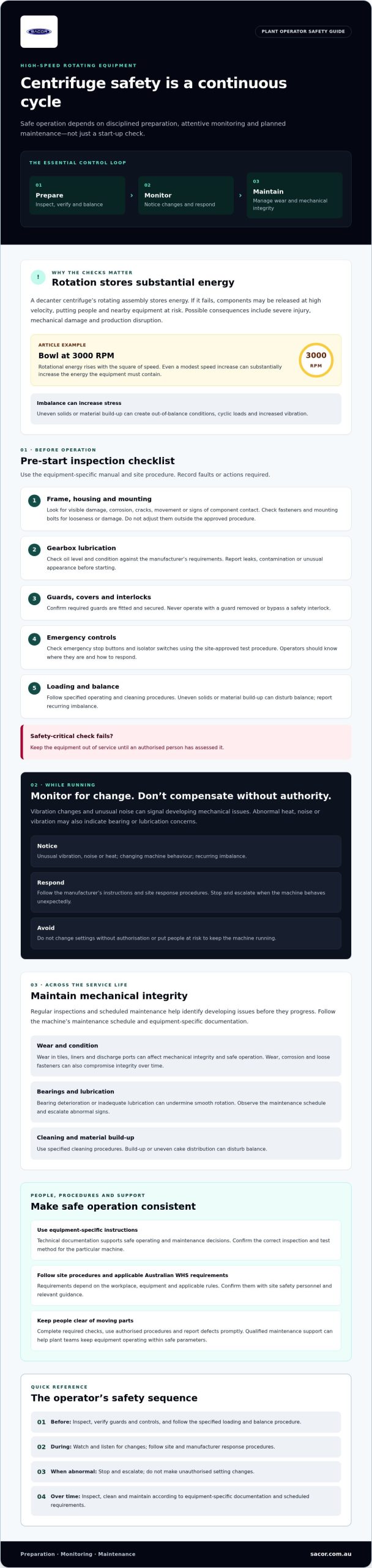
Kinetic energy is the energy stored in a moving object; in a bowl rotating at 3000 RPM, it is rotational energy determined by the bowl’s moment of inertia and angular speed. Because rotational energy increases with the square of speed, even a modest rise in operating speed can substantially increase the energy the equipment must contain.
Centrifugal force drives separation, while G-force describes the acceleration experienced relative to gravity. The bowl, drive train, supports and housing must withstand the forces specified for that particular machine. An out-of-balance condition, caused by uneven solids or material build-up, creates cyclic loads that can increase vibration and stress components. Operators should respond to abnormal vibration or noise according to the manufacturer’s instructions and site response procedures, rather than attempting to compensate by changing settings without authorisation.
Common Causes of Centrifuge Incidents
Several operating and maintenance conditions can contribute to incidents. Material build-up or uneven cake distribution can disturb balance; bearing deterioration or inadequate lubrication can undermine smooth rotation. Wear, corrosion or loose fasteners may also compromise mechanical integrity over time. Regular inspections and scheduled maintenance help identify developing issues before they progress.
- Build-up and uneven distribution: Follow the specified cleaning and operating procedures, and report recurring imbalance.
- Bearing and lubrication issues: Observe the maintenance schedule and escalate abnormal heat, noise or vibration.
- Guarding and interlocks: Keep guards in place and never bypass a safety interlock to maintain production.
Operator Responsibility and Australian WHS Expectations
Australian work health and safety expectations for heavy machinery centre on managing risk through suitable controls, instruction and equipment-specific procedures. Exact requirements depend on the workplace, equipment and applicable rules, so site teams should confirm these with their safety personnel and relevant guidance. Operators contribute directly by completing required checks, keeping clear of moving parts, using authorised procedures and reporting defects promptly. Stop and escalate when a machine behaves unexpectedly; don’t put people at risk to keep it running.
Pre-Operational Safety Checklist: The First Line of Defence
A consistent pre-start check can reveal developing defects before the centrifuge reaches operating speed. Follow the machine-specific manual and site procedure, and record any fault or action required. If a safety-critical item fails inspection, keep the equipment out of service until an authorised person assesses it.
Use this checklist as a prompt, not a substitute for the instructions supplied for the particular machine. Confirm that the correct inspection and test method applies before carrying it out.
- Frame and housing: Check for visible damage, corrosion, cracks, movement or signs of contact between components. Inspect fasteners and mounting bolts for looseness or damage; don’t tighten or adjust them outside the approved procedure.
- Gearbox lubrication: Check the level and condition of the oil against the manufacturer’s requirements. Note leaks, contamination or an unusual appearance, and report concerns before starting.
- Guards and covers: Confirm all required guards are fitted and secured. Never operate with a guard removed or an interlock bypassed.
- Emergency controls: Check emergency stop buttons and isolator switches using the site-approved test procedure. Make sure operators know their locations and how to respond if they’re needed.
Mechanical and Structural Integrity Checks
Inspect accessible surfaces for corrosion, stress cracking, damaged welds or other changes that could affect structural integrity. Check drive-belt condition and tension, and motor alignment, where applicable to the machine design and only as directed by its manual. Confirm feed and discharge lines are clear, secure and free from visible leaks or blockages. Don’t reach into lines or moving parts; use the required isolation procedure before any intervention.
Safety System Verification
Before start-up, confirm vibration sensors are active and that their calibration status is current under the site’s maintenance process. Check that control-panel interlocks respond as specified, using the approved test method rather than defeating a safeguard. Verify that the “bowl at rest” indicator operates and gives a clear status. If an indicator or interlock is faulty or uncertain, don’t rely on it; report the issue and follow the site’s isolation and escalation procedures.
Close out the checks by recording defects and confirming they’ve been assessed before the machine is released for operation. These centrifuge safety procedures for plant operators work best when checks are consistent, documented and matched to the equipment’s technical documentation. Sacor-supplied systems include documentation to support safe operation, and plant teams can also discuss centrifuge maintenance and technical support when planning equipment care.
Operational Monitoring and Emergency Protocols
Pre-start checks establish a safe baseline; active monitoring helps operators recognise when conditions change. Follow the equipment manual and site response plan, since acceptable operating limits and shutdown behaviour vary between machines. Record trends as well as alarms: a gradual rise in vibration, bearing temperature or motor load can signal a developing problem before the centrifuge reaches a trip condition.
Active Monitoring Procedures
Use installed vibration sensors and review readings against the equipment-specific alert and alarm thresholds. An alert should prompt closer observation and action under the site procedure; an alarm or rapid increase requires the prescribed response, not an improvised adjustment. Listen for changes in the usual sound profile, including new harmonics, rubbing or knocking, and track bearing temperatures, motor load and decanter torque for unexpected variation.
Keep feed consistent within the machine’s operating instructions. Sudden changes in feed rate or solids concentration can contribute to uneven loading and unstable operation. A change in torque, vibration or separation performance may also be consistent with scroll or bowl wear, but operators shouldn’t diagnose internal damage while the machine is running. Record the symptoms and arrange assessment through the approved maintenance process.
Emergency Response and Shutdown Steps
Use the site emergency plan and machine-specific instructions as the controlling procedure. A general four-step framework helps operators act in a coordinated way:
- Recognise and raise the alarm: Call out the abnormal condition and notify the control room or supervisor using site communication procedures.
- Protect people: Keep personnel clear of the machine and move them beyond the site-defined exclusion boundary, especially during uncontrolled vibration.
- Stop safely: Use the emergency stop if there’s immediate danger. Otherwise, follow the specified shutdown sequence, including feed isolation where safe and appropriate.
- Secure and report: Keep guards closed, prevent unauthorised restart and record the event for assessment before returning the unit to service.
There’s no universal safe approach distance for every installation. Establish and maintain an exclusion zone through the site risk assessment and equipment guidance; never approach a centrifuge that’s vibrating abnormally to inspect it at close range.
If power fails during high-speed rotation, don’t assume the bowl has stopped because the display is blank or the motor is silent. Keep clear, leave covers secured and wait for the bowl-at-rest indication to operate, then have authorised personnel verify the safe state and follow isolation procedures before inspection. Don’t restart until the cause is understood and the equipment is cleared for operation. These centrifuge safety procedures for plant operators depend on clear alarm thresholds, trained responses and maintenance records that capture changes over time.
Maintenance and Mechanical Integrity Standards
Maintenance is a safety control, not simply a way to keep production moving. Wear, poor lubrication or incorrect reassembly can increase vibration and mechanical stress, creating hazards for operators and damaging equipment. A planned maintenance programme helps identify deterioration early, define who can perform each task and keep the centrifuge within its documented operating parameters.
Set inspection and replacement intervals using the equipment manufacturer’s instructions, operating history and site maintenance plan. Avoid applying generic timeframes to components whose condition depends on the machine and process. Record inspections, defects, work completed, parts fitted and any checks required before returning the centrifuge to service. These records support traceability and help site teams demonstrate how they manage equipment risks under their applicable workplace procedures.
Critical Component Maintenance
Bearings need appropriate inspection and lubrication, with replacement intervals determined by the manufacturer’s guidance and observed condition. Excessive heat, noise or vibration warrants investigation rather than continued operation. Inspect wear tiles, liners and discharge ports for erosion, cracking, blockage or uneven wear, since material loss or restricted discharge can affect performance and mechanical balance.
Scroll hard-facing and any subsequent balancing must follow equipment-specific tolerances and be completed by suitably qualified personnel. Use parts that match the machine’s specifications and approved maintenance requirements; an incorrect component can compromise fit, balance or safe operation. For further guidance on component selection and management, see industrial centrifuge spare parts Australia.
The Role of Professional Commissioning
Correct installation and commissioning establish a sound baseline for operation. Alignment, mounting and site conditions can influence vibration and loading, so qualified commissioning support helps check the system against its technical requirements before routine use. Periodic technical reviews can also help plant teams assess equipment condition, maintenance history and changes in operating performance. The scope and frequency should reflect the machine documentation and site risk controls.
Sacor-supplied systems include technical documentation to support safe operation, while commissioning, maintenance and technical support help plant teams manage equipment within safe parameters. Keep relevant manuals, commissioning records, inspection findings and maintenance logs accessible to authorised operators and maintainers. This gives the team a reliable reference when assessing defects, planning work or verifying readiness to restart.
Build centrifuge safety procedures for plant operators around equipment-specific maintenance instructions, competent servicing and clear records. To discuss Sacor’s centrifuge maintenance and technical support for your separation system, contact the team.
Building a Culture of Separation Safety with Sacor
Consistent centrifuge safety depends on sound equipment, clear procedures and people who understand how to respond when operating conditions change. Sacor works with Australian plants through decanter centrifuge and separation systems, commissioning, maintenance, spare parts and technical support. This support can help plant teams make safety part of equipment planning and ongoing operation, rather than treating it as a one-off start-up task.
Site requirements differ. Process conditions, installation constraints and the material being separated all affect equipment selection and operating needs. Sacor’s customised engineering for site conditions helps plant teams consider those factors when developing separation solutions. Efficient, controlled operation can also support responsible resource use by helping plants manage separation processes and avoid unnecessary disruption.
Partnering for Operational Excellence
Installation and commissioning provide an opportunity to confirm that a system is set up for its intended site and that operators can refer to the correct technical documentation. Sacor-supplied systems include documentation to support safe operation. Plant managers should make sure the relevant instructions are accessible to operators and maintenance personnel, and clarify which checks, limits and escalation steps apply to their equipment.
Build a maintenance plan around the manufacturer’s documentation, operating history and site risk controls. Discuss maintenance scope and technical support requirements with the equipment provider; don’t assume a particular contract, audit or training programme is included. Where operators need additional instruction, confirm the available arrangements and ensure training is specific to the machine and site procedures.
Next Steps for Plant Managers
Use this checklist to review current practices, identify gaps and assign follow-up actions. A practical review can include:
- Compare procedures with the equipment documentation: Check that pre-start inspections, monitoring, shutdown and escalation steps are clear and current.
- Review system condition: Arrange an appropriate technical assessment if recurring vibration, wear, changing performance or maintenance findings warrant further investigation.
- Confirm parts and support arrangements: Check that suitable spare parts can be sourced and that staff know how to request maintenance and technical support.
- Strengthen operator readiness: Ensure relevant personnel can access instructions and understand their responsibilities, including how to report defects and prevent an unsafe restart.
Strong centrifuge safety procedures for plant operators rely on practical site controls backed by equipment-specific guidance and planned maintenance. Sacor’s commissioning, maintenance and technical support, alongside national supply of critical spare parts, can form part of a plant’s approach to keeping separation systems operating within safe parameters.
Make Centrifuge Safety Part of Every Shift
Reliable centrifuge operation depends on a connected safety cycle: inspect before start-up, monitor for changing conditions and maintain mechanical integrity through equipment-specific servicing. Clear escalation steps and accessible technical documentation help operators respond consistently, while maintenance records support informed decisions about equipment readiness.
Make the checklist part of normal site practice by reviewing it with operators, confirming responsibilities and updating procedures when equipment or operating conditions change. These centrifuge safety procedures for plant operators can help strengthen risk controls, protect people and support long-term equipment reliability.
Sacor is an Australian-owned technical authority providing separation solutions for mining and wastewater applications, with commissioning, maintenance and technical support. Optimise your site safety with Sacor’s expert centrifuge solutions and work towards safer, more dependable separation operations.
Frequently Asked Questions
What is the most common safety hazard associated with decanter centrifuges?
Imbalance is a key hazard because uneven solids build-up or inconsistent feed can create vibration and place added stress on rotating components. Centrifuge incidents also commonly involve user error, such as operating outside the machine’s instructions or failing to respond to warning signs. Operators should monitor changes in vibration and noise, follow equipment-specific procedures and stop or escalate operation when conditions move outside approved limits.
How often should vibration sensors be calibrated on an industrial centrifuge?
There’s no single calibration interval that suits every industrial centrifuge. Follow the sensor and centrifuge manufacturers’ instructions, along with the site’s maintenance and calibration programme. Consider the device’s operating environment, service history and any impact, repair or fault that could affect its readings. Keep calibration records accessible, and don’t rely on sensor data if the device is overdue, damaged or giving inconsistent readings.
Can a centrifuge be operated without a primary safety guard in place?
No. Don’t operate a centrifuge with a required safety guard removed, damaged or unsecured, and never bypass an interlock to keep production running. Guards help separate people from hazardous moving components. If a guard or interlock is faulty, follow the site isolation and reporting process, and keep the machine out of service until an authorised person has assessed and cleared it under the equipment-specific procedure.
What should an operator do if the centrifuge begins to vibrate excessively?
Keep clear and follow the site’s alarm and shutdown procedure; don’t approach the machine to inspect it while it’s vibrating abnormally. Notify the control room or supervisor, and use the emergency stop if the site procedure or immediate danger requires it. Maintain the site-defined exclusion zone, prevent an unauthorised restart and record the event. Restart only after authorised personnel have assessed the cause and cleared the machine.
Why is lubrication critical for centrifuge safety procedures?
Correct lubrication helps bearings and other specified components operate as intended, while inadequate, contaminated or incorrect lubricant can contribute to heat, friction and premature wear. These conditions may affect reliability and create unsafe operating changes. Follow the equipment manufacturer’s lubrication type, method and maintenance schedule rather than relying on a generic interval. Check for leaks or unusual oil condition, and report concerns before continued operation.
What Australian standards govern the safety of rotating industrial machinery?
There isn’t one Australian Standard that applies universally to every rotating machine or centrifuge. Relevant workplace health and safety requirements and technical standards depend on the equipment, installation, industry and jurisdiction. Plant managers should identify current applicable requirements with competent safety and engineering personnel, then consult the machine’s technical documentation and relevant regulators. Avoid assuming that a standard for laboratory centrifuges automatically governs an industrial decanter.
How does a three-phase centrifuge differ in terms of safety protocols?
A three-phase centrifuge separates three process phases, so operators need to understand the specific feed conditions, discharge arrangements and operating limits documented for their system. Safety fundamentals remain: inspect before start-up, keep guards and interlocks in place, monitor operating conditions and follow the approved shutdown procedure. Training and risk assessments should account for the actual process materials and site hazards, rather than assuming every three-phase system operates identically.
What are the risks of using non-genuine spare parts in high-speed separation equipment?
A part that doesn’t match the equipment’s required dimensions, material or balance characteristics may affect fit, performance or mechanical integrity. In high-speed equipment, an unsuitable component can contribute to vibration, accelerated wear or failure. Select parts against the manufacturer’s specifications and maintenance documentation, and have replacements assessed and fitted by authorised or suitably qualified personnel. Keep a record of the part used and any checks required before restart.