
Operational expenditure accounts for up to 90% of an industrial decanter’s total lifecycle cost, yet the vast majority of catastrophic mechanical failures stem from entirely preventable wear. Plant engineers and operations managers understand the immediate commercial fallout when an unscheduled stoppage strikes: abrasive slurry accelerates erosion across scroll tiles and bowl shells, downstream lines contaminate, and production bottlenecks compound by the hour. Securing an experienced centrifuge maintenance service Australia wide is often the difference between steady processing throughput and weeks of unbudgeted downtime.
You shouldn’t have to manage heavy separation machinery reactively while navigating extended lead times for specialist technicians and critical replacement parts. In this industrial guide, discover how proactive centrifuge maintenance schedules, precision servicing, and expert technical support maximise operational uptime across Australian processing operations. We examine condition-monitoring protocols, including regular vibration analysis, lubrication testing, and scroll wear profiling, required to eliminate unpredicted halts and protect your capital assets for the long term.
Key Takeaways
- Identify critical wear thresholds across bowl shells, discharge ports, and tungsten carbide scroll tiling to prevent sudden mechanical breakdown.
- Deploy predictive condition monitoring, including vibration frequency analysis and lube oil spectroscopy, to isolate bearing fatigue and gear degradation early.
- Establish disciplined operating schedules by partnering with an experienced centrifuge maintenance service Australia wide to safeguard continuous processing lines.
- Structure tailored service intervals based on feed slurry abrasiveness and cumulative running hours rather than relying on reactive breakdown repairs.
- Protect high-value capital assets and maintain product purity standards across Australian mining, food, wastewater, and energy operations.
Industrial Centrifuge Maintenance: Why Proactive Servicing Matters
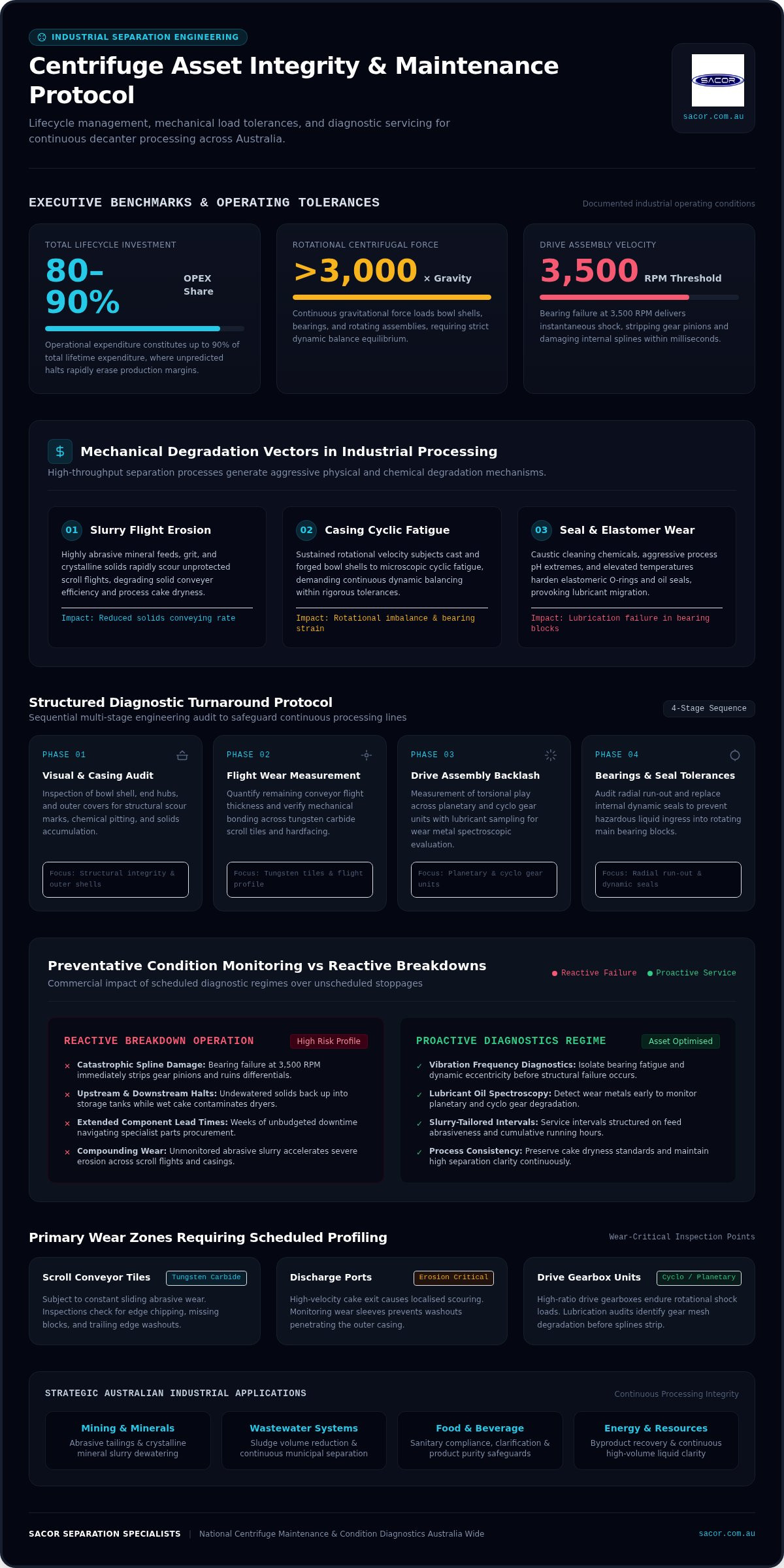
Heavy industrial separation differs fundamentally from small benchtop laboratory clarification. While standard centrifuge principles rely on rotational density separation, industrial processing subjects multi-tonne decanters and disc stack separators to relentless mechanical forces. In continuous processing environments across Australia, operational expenditure accounts for 80% to 90% of total lifecycle investment. Unplanned halts quickly erase operational margins. Engaging a specialised centrifuge maintenance service Australia wide ensures that mechanical wear is addressed before dynamic forces trigger catastrophic structural damage.
Mechanical Stresses in Continuous Solid-Liquid Separation
Industrial units generate rotational forces exceeding 3,000 times gravity. Operating continuously under these G-forces places immense mechanical loads on rotating bowl shells, main bearings, and rotating assemblies. At the same time, high-throughput applications introduce aggressive process slurries that compromise internal surfaces:
- Slurry flight erosion: Highly abrasive mineral feeds, grit, and crystalline solids rapidly scour unprotected scroll flights, degrading conveyer efficiency.
- Centrifugal casing stress: Sustained rotational velocity subjects cast and forged bowl shells to microscopic cyclic fatigue, requiring precise dynamic balance tolerances.
- Seal and elastomer degradation: Caustic cleaning chemicals, extreme operating pH levels, and elevated process temperatures harden elastomeric O-rings and oil seals, causing lubrication loss.
Left unchecked, uneven surface wear throws the rotating assembly out of dynamic equilibrium, leading to rapid bearing failure and severe structural damage across the drive head.
The True Cost of Unplanned Centrifuge Downtime
Rotational imbalance delivers an immediate shock to high-ratio planetary and cyclo gearboxes. When a bearing fails at 3,500 RPM, the resulting eccentricity strips gear pinions and damages internal splines within milliseconds. This sudden mechanical failure ripples through upstream and downstream processing lines. For a baseline understanding of mechanical geometry and rotating assemblies, review the fundamentals of an industrial decanter centrifuge Australia processors rely on for heavy duties.
A forced stoppage forces entire plants to throttle or halt production. Undewatered solids rapidly back up into storage tanks, while wet cake contaminates downstream drying systems. Establishing an end-to-end centrifuge maintenance service Australia plants can depend upon replaces unpredictable breakdown repairs with controlled, scheduled servicing. Planned overhauls preserve process cake dryness, safeguard separation clarity, and protect your capital machinery for decades of dependable operation.
Core Centrifuge Maintenance Procedures and Inspection Protocols
Rigorous servicing protocols safeguard continuous separation machinery from the accelerated degradation caused by heavy slurry feeds. Rather than relying on simple visual spot-checks, plant teams require a structured diagnostic sequence during scheduled turnarounds. Engaging an established centrifuge maintenance service Australia wide ensures these sequential inspection protocols are performed systematically, keeping equipment aligned with original engineering specifications.
- Visual and casing integrity checks: Inspect the bowl shell, end hubs, and outer covers for structural scour marks, pitting, or solids accumulation.
- Flight wear measurements: Quantify the remaining thickness of conveyor flights and verify the mechanical bond of hardfacing protection.
- Drive assembly backlash checks: Measure torsional play across differential gear units and obtain lubricant samples for wear metal evaluation.
- Bearing and seal clearances: Audit radial run-out and replace internal dynamic seals to stop fluid migration into rotating bearing blocks.
Rotating Assembly and Scroll Flight Inspections
Scroll flights endure continuous abrasive sliding contact. Technicians must inspect tungsten carbide tiles for missing blocks, edge chipping, and washouts along the trailing edges. Conical and cylindrical bowl shells require ultrasonic thickness testing to verify structural wall integrity. Technicians also clean all solids discharge ports thoroughly to prevent uneven cake packing, which otherwise induces severe dynamic unbalance upon restart.
Drive Systems, Gearboxes, and Bearings
Planetary and cyclo gearboxes experience high operational torque. Technicians measure rotational backlash across drive splines to confirm internal gear mesh tolerances remain within limits. At the same time, dial indicators verify radial and axial clearances across main pillow block bearings. Verify specific OEM bearing clearance tolerances against individual unit manuals before reassembly. When clearances exceed engineering limits, sourcing precision components through trusted industrial centrifuge spare parts Australia suppliers guarantees exact dimensional interchangeability.
Lubrication Management and Seal Integrity
Lubrication integrity dictates bearing longevity. Service regimes must enforce defined greasing intervals using high-temperature, EP-rated synthetic industrial lubricants formulated for high centrifugal fields. Technicians must systematically purge contaminated grease reservoirs to flush out abrasive particulate ingress.
Every major overhaul requires replacing internal mechanical face seals, radial lip seals, and labyrinth packings. Deteriorated elastomeric seals permit process liquid to wash out grease pockets, resulting in rapid metal-to-metal contact. Plant managers seeking to audit their scheduled turnaround routines can explore dedicated service agreements through Sacor to keep critical separation assets operating at peak availability.
Condition Monitoring: Preventative Diagnostics vs Reactive Repairs
Waiting for an industrial centrifuge to audibly shudder or trip out on high vibration is an expensive maintenance strategy. Reactive repairs routinely cost multiples of planned interventions, primarily because high-speed rotating components inflict catastrophic collateral damage when they fail under load. Modern condition monitoring replaces guesswork with quantifiable data. Integrating predictive diagnostics into your centrifuge maintenance service Australia contract ensures mechanical fatigue is identified and rectified during scheduled downtime windows.
Predictive analysis provides three clear operational advantages over reactive breakdown fixes:
- Fault isolation: Distinguish between superficial solids fouling and severe subsurface bearing fatigue before taking rotating assemblies offline.
- Component preservation: Prevent isolated bearing spalling from transferring destructive shock loads into precision planetary gear teeth.
- Inventory efficiency: Plan scheduled bearing and seal changeouts weeks ahead, eliminating expedited air-freight fees for heavy assemblies.
Vibration Signature Analysis and Dynamic Balancing
Centrifuges display distinct vibrational baselines across their horizontal and vertical axes. Baseline velocity and acceleration readings (typically measured in mm/s RMS and g peak) establish an operational benchmark for normal rotating behaviour. Spectral Fast Fourier Transform (FFT) analysis isolates the root source of emerging anomalies:
- 1X running speed peaks: Typically indicate rotational unbalance caused by uneven cake distribution or missing scroll tiles.
- Harmonic bearing frequencies (BPFI/BPFO): Pinpoint initial inner and outer race micro-spalling long before operational temperatures rise.
- Sub-harmonic peaks: Signal mechanical looseness within pillow block housings or foundation mounting pedestals.
Precision dynamic balancing corrects residual rotor imbalance directly on site, restoring smooth operation and preserving bearing life without requiring lengthy workshop freight cycles.
Oil Analysis and Thermal Diagnostic Profiling
Lubricating oil provides an immediate record of mechanical health inside planetary differentials and hydraulic drive systems. Plant engineers should draw lubricant samples every 500 operating hours to assess viscosity retention and check for acid development. Spectroscopic analysis checks for microscopic PPM concentrations of iron, copper, and bronze, giving early warning of gear tooth pitting or bronze bushing wear. Water contamination testing is equally vital; even a 1% moisture ingress across damaged seals degrades lubricating oil film thickness, drastically shortening gear service life.
Complementary thermographic profiling uses calibrated infrared imaging to track temperature patterns across pillow block housings and drive couplings. Steady temperature rises often indicate lubrication breakdown or seal friction before severe bearing seizure occurs. In demanding sectors handling dense slurries, such as municipal and industrial sludge dewatering centrifuge Australia sites, combining routine oil spectroscopy with periodic thermography is the surest way to prevent unpredicted mechanical halts.
Structuring a Lifecycle Centrifuge Service Contract in Australia
Evaluating an industrial service agreement requires moving beyond basic breakdown assistance. Plant managers must establish clear scope boundaries that separate minor field inspections from major workshop overhauls. A well-constructed lifecycle contract sets predictable operating budgets and guarantees engineering accountability. By aligning with a proven centrifuge maintenance service Australia wide, processing facilities turn unpredictable repair events into structured, manageable maintenance cycles.
Operating Hours vs Calendar-Based Servicing Intervals
Fixed calendar schedules rarely reflect real mechanical fatigue in plants running continuous shifts. Service agreements deliver far greater value when structured around cumulative operating hours and feed abrasiveness:
- Interim service (approx. 2,000 operating hours): On-site diagnostic audits focusing on lubrication flushes, seal health checks, dynamic backlash verification, and baseline vibration checks.
- Major overhaul (approx. 8,000 operating hours): Complete workshop strip-down, chemical decontamination, non-destructive testing (NDT) of rotating bowl welds, bearing replacement, and multi-plane dynamic balancing.
Operations processing heavy mineral slurries, abrasive sands, or corrosive chemical streams must compress these milestones accordingly. Severe duty cycles often require scroll flight inspections at 1,000-hour intervals to arrest rapid tungsten tile loss.
Essential Inclusions for Industrial Service Agreements
Before executing any industrial service agreement, plant engineers must verify that specific technical deliverables are explicitly defined in the scope of work. Contracts should never rely on vague inspection promises. Instead, demand formal documentation that tracks asset health across multiple production years.
Every commercial agreement should mandate the following technical inclusions:
- Documented wear profiling: Detailed ultrasonic thickness logs of bowl shells and precise remaining-thickness measurements along scroll conveyor flights.
- Dynamic balancing certification: Certified ISO 1940 balance reports detailing residual unbalance values after any rotor, bowl, or scroll repair.
- Diagnostic trend reporting: Comprehensive reporting following every service visit, linking vibration spectra and lube oil spectroscopy to previous baselines.
- Dedicated parts availability: Contractual allocation of critical wear components, including OEM-grade bearings, elastomeric seal kits, and drive components held in Australian inventory to minimise delivery lead times.
A rigorous service agreement protects your capital machinery from preventable wear while maintaining optimal process separation. You can structure a tailored centrifuge service agreement with Sacor to match your plant’s specific operational throughput, run hours, and feed characteristics.
Technical Servicing and Centrifuge Support with Sacor
Securing reliable process separation doesn’t stop at off-the-shelf mechanical assistance. Rotating equipment operating in demanding Australian processing sectors demands technical specialists who understand process rheology, dynamic balancing, and abrasive feed variables. Sacor delivers structured maintenance, precision field engineering, and equipment commissioning across Australian industrial sites. By pairing scheduled servicing with precision spare parts supply, Sacor ensures high-capital separation assets maintain peak operational throughput.
Multi-Industry Separation Servicing Expertise
Australian processing environments impose unique operational burdens on rotating machinery. Sacor provides dedicated technical support across diverse continuous separation sectors:
- Mining and mineral processing: Protecting decanters from intense abrasive scour in tailings dewatering and mineral recovery circuits.
- Wastewater treatment: Managing continuous dewatering duty cycles in municipal and industrial effluent processing facilities.
- Food and beverage processing: Maintaining hygienic standards while clarifying liquids and separating fats without product contamination.
- Energy and agriculture: Optimising three-phase centrifuges and disc separator systems for fuel purification, rendering, and bio-waste reclamation.
Our practical engineering capabilities cover heavy industrial decanter centrifuges, three-phase separators, and disc stack systems. We focus on long-term collaborative partnerships that prioritise cake dryness, centrate clarity, and extended asset longevity.
Planning Your Preventative Maintenance Schedule
Transitioning away from costly reactive breakdowns begins with a systematic audit of your installed mechanical infrastructure. Sacor engineers evaluate your specific feed characteristics, operating cycles, and cumulative run hours to establish baseline operating profiles. We then align inspection frequency, wear profiling, and parts changeout intervals with your planned plant shutdowns.
Partnering with a reliable centrifuge maintenance service Australia wide safeguards your machinery against unpredicted halts and premature component fatigue. Plant managers and reliability engineers can consult directly with our technical team to schedule site audits, review scheduled overhaul scopes, or establish lifecycle service support tailored to your plant’s production targets.
Securing Long-Term Reliability for Your Separation Infrastructure
Maintaining high-speed separation machinery requires disciplined oversight rather than reactive crisis management. Implementing condition-based vibration analysis, rigorous lubrication testing, and run-hour overhaul thresholds protects rotating assemblies from premature structural fatigue. Across continuous processing sites, partnering with a proven centrifuge maintenance service Australia wide converts unpredictable breakdown expenses into predictable operational reliability.
Sacor combines extensive engineering experience across industrial decanter centrifuges and disc separators with nationwide maintenance, commissioning, and precision spare parts support. Our technical specialists establish tailored servicing programmes designed specifically for demanding Australian industrial operating environments, ensuring your processing plant achieves consistent cake dryness and fluid recovery. Don’t leave critical plant uptime to chance; discuss your centrifuge maintenance requirements with Sacor to safeguard your capital assets for the long term.
Frequently Asked Questions
How often should an industrial decanter centrifuge undergo mechanical maintenance?
Maintenance frequency depends on cumulative operating hours and process conditions rather than the calendar. Plants typically execute minor inspections, greasing, and seal audits every 2,000 running hours. Major mechanical overhauls, involving full disassembly and bearing replacement, generally occur around 8,000 hours. Abrasive mineral feeds or corrosive chemical slurries require compressed intervals to protect rotating components from accelerated wear.
What are the early warning signs that an industrial centrifuge requires servicing?
Elevated vibration levels, unusual acoustic pitch changes, and rising bearing temperatures are the clearest mechanical warnings. Process indicators include wetter discharge cake, cloudy liquid centrate, or increased electrical current draw on drive motors. If vibration sensors register abnormal velocity spikes or gear oil samples contain microscopic metal debris, schedule an audit with a qualified centrifuge maintenance service Australia wide before mechanical seizure occurs.
Why is dynamic balancing necessary following scroll or bowl repair work?
Industrial centrifuges operate at speeds exceeding 3,000 RPM, where even tiny mass variances generate massive destructive forces. Welding, applying hardfacing tiles, or scouring surfaces unevenly shifts the rotational mass centre. Multi-plane dynamic balancing redistributes this mass according to ISO standards, ensuring the assembly rotates smoothly. Without precise balancing, residual unbalance transmits severe cyclic fatigue into pillow blocks, rapidly destroying new bearings and gear assemblies.
Can predictive condition monitoring eliminate unplanned centrifuge breakdowns entirely?
Predictive condition monitoring can’t eliminate sudden mechanical accidents like large tramp metal ingress, but it drastically reduces unpredicted breakdowns. Vibration analysis, oil spectroscopy, and thermal tracking detect bearing fatigue and gear degradation hundreds of hours before functional failure. This early detection enables maintenance teams to plan component replacements during scheduled plant shutdowns, preventing catastrophic structural damage and long production halts.
What is the difference between minor on-site servicing and a major workshop overhaul?
Minor on-site servicing focuses on preventative health checks, including dynamic seal replacement, grease purges, backlash checks, and vibration trending while the frame remains mounted. Conversely, a major workshop overhaul involves full machine strip-down. Technicians transport rotating assemblies to an engineering facility for non-destructive weld testing, scroll flight tile replacement, complete bearing renewals, and multi-plane dynamic balancing on dedicated balance rigs.
How does feed slurry abrasiveness influence centrifuge maintenance intervals?
Feed abrasiveness directly accelerates mechanical wear across feed ports, bowl linings, and scroll flight edges. In benign clarification environments, protective tiling lasts several years. Processing sharp silica, sand, or heavy mineral tailings scours flight protection within thousands of operating hours. High-wear slurries require compressed inspection intervals, frequent ultrasonic wall profiling, and prompt tile repairs to protect the parent steel flights beneath.
What critical spare parts should industrial facilities hold on site for centrifuges?
Facilities should maintain complete seal kits, main bearing sets, drive belts, and critical gaskets in on-site store rooms. Having matched replacement elastomers and feed zone wear liners avoids extended processing delays. Partnering with a dependable centrifuge maintenance service Australia network ensures access to precision rotating assembly spares, allowing plants to execute planned changeouts swiftly without waiting weeks for overseas freight.