
Catastrophic rotating assembly failures rarely stem from sudden equipment fatigue; they are almost always the direct outcome of overlooked operational drift. Plant engineers and maintenance managers understand how quickly unmonitored baseline vibration or scroll flight erosion from abrasive slurries can trigger gearbox seizures and compromise cake dryness. Standardising routine servicing across alternating operational shifts remains a persistent challenge on busy sites, yet implementing a rigorous decanter centrifuge preventative maintenance checklist provides the operational discipline required to protect critical high-speed machinery from premature failure.
This 2026 guide delivers a systematic preventative maintenance framework designed to eliminate unscheduled downtime and safeguard heavy-duty rotating assets across Australian industry. By aligning shift inspections with measurable wear limits, your team can optimise dynamic lubrication cycles, track differential gearbox performance, and significantly extend rotating assembly lifecycles. From daily condition monitoring to multi-year overhaul planning, this framework ensures site technicians accurately anticipate component fatigue and organise critical spare parts inventory well before an outage occurs.
Key Takeaways
- Implement an interval-based decanter centrifuge preventative maintenance checklist to standardise servicing across operating shifts and prevent mechanical breakdown.
- Protect high-speed rotating elements through dedicated lubrication management and precision vibration tracking to arrest premature bearing failure.
- Monitor conveyor flight wear profiles and erosion patterns proactively to preserve cake dryness and prevent destructive contact with the rotating bowl wall.
- Establish forward-looking spare parts inventory protocols to safeguard operational continuity and circumvent lengthy international component lead times.
- Engage qualified industrial centrifuge engineering specialists for major overhauls, planetary backdrive servicing, and high-precision dynamic balancing.
Core Components of a Decanter Centrifuge Maintenance Strategy
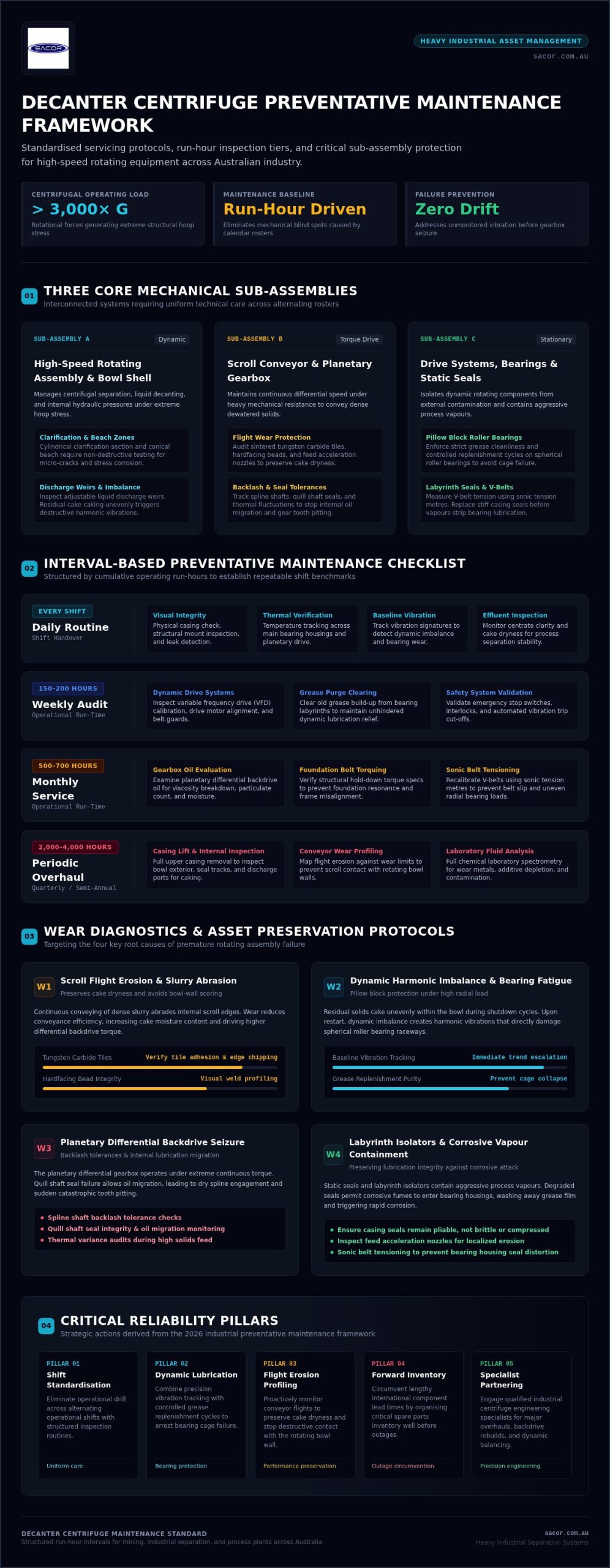
Operating at rotational speeds generating upwards of 3,000 times the force of gravity, an industrial centrifuge subjects its structural materials to intense mechanical loads. A comprehensive decanter centrifuge operating principle relies on balancing extreme rotational momentum against stationary housings while conveying dense solids continuously. Without a methodical preventative maintenance framework, minor dynamic imbalances or microscopic seal failures quickly cascade into catastrophic structural damage. Standardising these technical routines across multi-shift operational teams guarantees that critical mechanical assemblies receive uniform care regardless of roster changes.
A dependable decanter centrifuge preventative maintenance checklist addresses the unit as an interconnected system of distinct sub-assemblies:
- The rotating assembly: Manages centrifugal separation, liquid decanting, and internal hydraulic pressures.
- The planetary backdrive: Regulates the differential speed between the outer bowl and internal scroll conveyor.
- Stationary frames and seals: Isolate high-speed dynamic elements from external contaminants and contain aggressive process vapours.
The High-Speed Rotating Assembly and Bowl Shell
Bowl shells endure immense centrifugal hoop stress during standard operation. Technicians must conduct scheduled non-destructive testing to detect pitting or micro-cracks before stress corrosion compromises structural integrity. Routine physical inspections should examine the cylindrical clarification section, the conical beach zone, and the adjustable liquid discharge weirs. Residual solids cake unevenly within these areas during plant shutdowns, creating severe dynamic imbalances that transmit damaging harmonic vibrations directly into the main pillow block bearings.
Scroll Conveyor and Planetary Differential Gearbox
The internal scroll conveyor operates in constant contact with abrasive solids. Regular visual audits must verify the condition of sintered tungsten carbide tiles, hardfacing beads, and feed acceleration nozzles to prevent flight wear from reducing cake dryness. The planetary gearbox drives this scroll under immense torque. Technicians must inspect backlash tolerances, monitor thermal variations, and examine spline shafts and quill shaft seals to stop internal oil migration and premature gear tooth pitting.
Drive Systems, Bearings, and Static Seals
Main pillow block spherical roller bearings demand stringent grease cleanliness and controlled replenishment cycles to prevent cage failure. Simultaneously, transmission components require systematic auditing. Technicians must calibrate variable frequency drives and verify V-belt tension using sonic tension metres to prevent belt slip and uneven radial loading. Finally, casing seals and labyrinth isolators must remain pliable; worn seals permit corrosive vapours to bypass bearing housings, stripping lubrication films and accelerating mechanical breakdown.
Interval-Based Decanter Centrifuge Preventative Maintenance Checklist
Structuring servicing intervals around cumulative operating run-hours rather than arbitrary calendar dates prevents mechanical blind spots across high-throughput industrial sites. While production schedules often place continuous demands on separation equipment, adhering to a defined decanter centrifuge preventative maintenance checklist ensures technicians execute critical mechanical tasks before component wear initiates equipment shutdown. A disciplined hierarchy of daily, weekly, and periodic assessments establishes repeatable servicing benchmarks across all operating rosters.
The framework below organises fundamental maintenance routines into actionable inspection intervals:
- Daily (per shift): Visual integrity, thermal verification, baseline vibration readings, and effluent inspection.
- Weekly (150–200 operating hours): Dynamic drive checks, grease purge clearing, and safety system validation.
- Monthly (500–700 operating hours): Planetary gearbox oil evaluation, foundation bolt torquing, and belt tension recalibration.
- Quarterly to semi-annually (2,000–4,000 operating hours): Casing lift, internal conveyor wear tracking, and full lubricant laboratory analysis.
Daily Operational Checks: Shift Start and Running Inspections
Technicians must record main pillow block temperatures using permanently installed resistance temperature detectors (RTDs) or calibrated infrared instruments during steady-state processing. Logging overall vibration velocity and acceleration enveloping values detects early bearing raceway flaking before dynamic imbalance damages drive frames. Shift operators should also monitor gearbox oil sight glasses for oil level drops, foaming, or milky discolouration. Finally, verify that both the solids discharge casing and centrate liquid outlets flow freely without product buildup.
Weekly to Monthly Mechanical Servicing Protocols
Weekly inspections target dynamic drive systems and machine safety protections. Technicians should verify V-belt tracking, measure tension with a frequency gauge, and ensure bearing grease purge passages discharge expelled grease cleanly away from internal cavity seals. Monthly tasks demand mechanical fastener checks across the sub-base, skid isolators, and main bearing housings to eliminate micro-movement. It is equally essential to test functional safety mechanisms, confirming that automated vibration cut-out switches and mechanical cover interlocks respond correctly under simulated fault conditions.
Quarterly and Bi-Annual Internal Wear Assessments
Executing quarterly and semi-annual servicing requires isolating power, disengaging the drive assembly, and lifting the top casing. Maintenance teams should measure the radial clearance between the conveyor flight edges and the bowl shell wall using feeler gauges to monitor abrasive wear. Inspect feed acceleration ports and sintered tungsten carbide tiles for edge chipping or wash-out patterns. Simultaneously, draw an oil sample from the planetary differential gearbox to test for kinematic viscosity shift, water content, and ferrous particle contamination. For facilities seeking to formalise these procedures into tailored service regimes, partnering with experienced providers through structured planned maintenance contracts helps maintain factory-grade reliability across demanding operational cycles.
Lubrication Management and Condition Monitoring Standards
Lubrication failure remains the primary cause of premature bearing failure and gear degradation in continuous-duty separation equipment. Centrifuge bearings operate at peripheral speeds generating high internal shear stresses, requiring specialised synthetic lubricants that maintain film thickness without thermal thinning. Many maintenance teams assume applying grease regularly provides sufficient protection; however, over-lubricating is just as destructive as under-lubricating. Forcing excessive grease into a high-speed pillow block housing causes fluid churning friction, rapidly elevating operational temperatures and rupturing delicate labyrinth seal isolators.
Integrating condition monitoring into your decanter centrifuge preventative maintenance checklist turns static lubrication routines into an active diagnostic program:
- Dynamic greasing control: Dispense weighed volumes while the rotating assembly turns under slow coast-down or low-speed rotation to distribute grease evenly across rolling elements.
- Contaminant containment: Verify grease purge relief valves open under light hydraulic pressure to expel spent, degraded grease without pressurising internal seals.
- Viscosity tracking: Benchmark gearbox oil shear against manufacturer baseline data to detect thermal breakdown early.
Precision Bearing Lubrication Protocols
Main cylindrical roller and angular contact thrust bearings require precise quantities of synthetic extreme-pressure (EP) grease formulated with synthetic hydrocarbon base oils and lithium-complex or polyurea thickeners. Technicians must meter grease additions using calibrated dispensing guns rather than estimating stroke counts. Regreasing cycles must account for operating conditions. A machine processing hot slurries at 80°C requires far more frequent, smaller grease replenishment doses than an ambient wastewater dewatering installation to compensate for accelerated base-oil bleed.
Gearbox Oil Analysis and Flushing Procedures
Planetary differential gearboxes operate under high torque, requiring dedicated synthetic gear oils containing extreme-pressure additives. Technicians must draw laboratory oil samples from the midpoint of the gearbox housing using clean vacuum extraction kits rather than collecting sediment from drain petcocks. Laboratory analysis should measure Total Acid Number (TAN), water percentage by Karl Fischer titration, and particle distribution per ISO 4406 standards. When fluid oxidation or particulate counts cross operational limits, conduct a complete fluid flush to clear suspended debris before fresh oil is introduced.
Vibration Analysis and Critical Threshold Response
Routine vibration spectral analysis separates benign process harmonics from progressive mechanical faults. High-frequency acceleration enveloping detects bearing raceway micro-spalling months before temperatures rise, while 1X running-speed peaks reveal bowl unbalance caused by uneven solids cake discharge. Sub-harmonic or 2X vibration peaks indicate structural looseness or shaft misalignment. Maintenance personnel should consult the Industrial Decanter Centrifuge Australia: The 2026 Comprehensive Guide to align machine vibration velocity thresholds with structural mounting specifications and establish definitive alarm limits across all industrial installations.
Wear Protection, Spare Parts Planning, and Overhaul Timing
High-solid slurries steadily scour internal rotating components even during stable processing conditions. Fine silica, abrasive mineral tailings, and crystallized chemical salts create severe erosion patterns that diminish conveyor conveyance efficiency long before outward mechanical distress appears. Tracking internal component wear rates forms an indispensable pillar of any comprehensive decanter centrifuge preventative maintenance checklist, allowing plant engineers to intervene before conveyor flights make physical contact with the spinning bowl shell.
Proactive maintenance requires an operational strategy that balances continuous wear evaluation against structured spare parts holdings:
- Erosion boundary monitoring: Measure conveyor radial clearances periodically to ensure flight edges maintain correct hydraulic separation.
- Strategic inventory buffers: Stock mission-critical rotary seals and matched bearing arrangements on site to protect against extended international supply lead times.
- Predictive rebuild scheduling: Plan off-site dynamic balancing and complete overhauls around verified operating hours rather than waiting for structural failure.
Critical Wear Points on Conveyor and Discharge Ports
Sintered tungsten carbide tiles protecting conveyor flights endure severe abrasive impingement. Technicians must inspect tile matrices for cobalt binder leaching, tile cracking, and braze joint separation during scheduled casing lifts. The cake discharge ports demand equal scrutiny; replaceable tungsten carbide bushings and liquid weir plates experience accelerated washout from high-velocity particle exit streams. Additionally, operators should examine internal feed acceleration chambers, where localized erosion can pierce hub structures and cause severe dynamic unbalance.
Strategic On-Site Spare Parts Management
Operating critical separation infrastructure without on-site backup components leaves facilities vulnerable to prolonged operational stoppages. Plant storerooms must maintain climate-controlled storage for matched spherical roller bearing pairs to prevent false brinelling from external shop-floor vibrations. Critical inventory should also include complete fluoroelastomer seal kits, dedicated gearbox service sets, and pre-tensioned drive belts. Maintenance planners can review the Industrial Centrifuge Spare Parts Australia: A Strategic Maintenance Guide to establish targeted min-max inventory thresholds matching their operational risk profile.
Indicators for Workshop Overhaul and Dynamic Balancing
While routine site servicing addresses external mechanical wear, specialized workshop intervention becomes unavoidable over extended asset lifecycles. Major overhauls typically occur every 15,000 to 20,000 operating hours, depending on slurry abrasiveness. When a thoroughly cleaned rotating assembly continues to exhibit elevated 1X vibration harmonics, mass distribution has shifted due to asymmetrical metal loss, demanding high-speed dynamic balancing. Excessive backdrive backlash or metallic debris detected during gearbox oil analysis similarly mandates professional disassembly and gear-train rebuilding. To safeguard asset longevity across these extended milestones, contact Sacor for national technical support and spare parts planning to keep your separation equipment running at peak efficiency.
Selecting a Specialist Centrifuge Maintenance Partner
Servicing continuous-duty decanter centrifuges demands specialised engineering competence, dedicated diagnostic tooling, and dynamic balancing capabilities. While general mechanical fitters manage standard plant equipment effectively, high-speed rotating separation assemblies require technicians who understand rotational harmonics, planetary gear trains, and internal hydraulic pressures. Engaging an experienced technical partner ensures that your site decanter centrifuge preventative maintenance checklist aligns directly with original manufacturing tolerances, preventing minor assembly errors from triggering catastrophic mechanical failure.
When assessing prospective industrial centrifuge service providers, plant managers should evaluate several non-negotiable technical competencies:
- Diagnostic instrumentation: Access to calibrated multi-channel vibration spectrum analysers, thermal imaging, and portable laser alignment equipment.
- Differential drive expertise: Proven workshop rebuild capabilities for multi-stage planetary backdrives and hydraulic scroll drive systems.
- Rapid supply network: Established sourcing channels for precision-engineered wear tiles, custom labyrinth seals, and matched roller bearing arrangements.
Technical Capabilities to Verify in a Service Provider
A qualified service specialist must possess advanced vibration diagnostics to distinguish between dynamic unbalance, structural looseness, and bearing raceway degradation. Technicians must demonstrate deep practical experience across demanding industrial processes, from municipal dewatering to abrasive mining separation. Service providers should also maintain strict quality standards during assembly, ensuring torque specifications, bearing end-float clearances, and precision balance tolerances adhere to rigid technical criteria.
The Value of Planned Maintenance and Service Agreements
Structured maintenance contracts transform erratic emergency repairs into predictable operational maintenance budgets. Periodic engineering audits identify sub-surface fatigue, seal degradation, and backlash expansion months before symptoms impact daily production. Furthermore, structured service agreements often provide facilities with priority technical dispatch and managed consignment stock options, eliminating operational delays associated with global component sourcing.
How Sacor Delivers Lifecycle Engineering Support
Sacor supports industrial operations nationally by providing structured planned maintenance, precision rotating assembly refurbishment, and technical engineering support. Dedicated field specialists assist maintenance teams in adapting each decanter centrifuge preventative maintenance checklist to reflect site-specific slurry abrasiveness, rotational speeds, and run-hour targets. Learn how Sacor provides industrial decanter centrifuge maintenance and technical support to protect your high-speed rotating assets and secure lasting processing efficiency.
Securing Equipment Longevity Through Disciplined Maintenance
Protecting high-speed separation assets requires an operational shift from reactive repair to continuous technical vigilance. Implementing a systematic decanter centrifuge preventative maintenance checklist ensures that site technicians control dynamic bearing lubrication, detect conveyor flight erosion early, and track differential gearbox health across every operational shift. Standardising these interval-based protocols prevents minor dynamic imbalances from escalating into sudden structural failures, preserving solids dryness and protecting processing schedules.
Sustained reliability relies on pairing disciplined site routines with strategic technical foresight. Maintaining targeted on-site inventory buffers for critical wear items mitigates extended international supply delays, while scheduled dynamic balancing restores rotational equilibrium before harmonic fatigue compromises drive mounts. Sacor delivers comprehensive national technical support, scheduled planned maintenance agreements, and precision spare parts supply across mining, energy, wastewater, food, and agricultural processing sectors. Plant managers focused on optimising separation efficiency can discuss your decanter centrifuge maintenance and servicing requirements with Sacor to establish an enduring, lifecycle-focused asset management strategy.
Frequently Asked Questions
How often should decanter centrifuge main bearings be greased?
Main bearings typically require greasing every 150 to 500 operating hours, depending on operating temperature, process slurry heat, and rotational velocity. High-temperature applications or continuous harsh duty cycles demand shorter replenishment intervals. Always verify precise manufacturer specifications within your decanter centrifuge preventative maintenance checklist, and apply measured grease quantities slowly while the assembly rotates to guarantee even grease distribution without rupturing internal seals.
What are the most common causes of high vibration in decanter centrifuges?
Uneven solids cake accumulation inside the bowl shell represents the most frequent cause of elevated vibration. Other common mechanical triggers include worn main pillow block bearings, drive belt misalignment, degraded elastomeric vibration isolators, and asymmetrical flight tile loss on the internal conveyor. If high vibration persists after executing a full hot-water wash cycle, site technicians should immediately inspect mechanical fasteners, foundation integrity, and rotating assembly balance.
How do you check for internal scroll wear without complete machine disassembly?
Technicians can evaluate scroll condition through inspection ports or by lifting the upper casing cover without pulling the entire rotating assembly. Removing casing access covers allows measurement of radial clearances between conveyor flight tips and the bowl wall using long feeler gauges or bore scopes. Examining cake discharge ports and effluent weir ports with high-intensity optical tools reveals tile chipping, erosion patterns, and early tungsten matrix washout.
What is the typical lifespan of a decanter centrifuge planetary gearbox?
A planetary differential gearbox operating under optimal lubrication conditions typically achieves an operational lifespan between 15,000 and 30,000 run-hours. Maintaining this longevity requires regular synthetic oil changes, strict temperature tracking, and routine spectrographic oil sampling. Excessive continuous differential torque, thermal cycling, or processing abrasive slurries without appropriate torque limiter protection can dramatically shorten gearbox operational life, necessitating intermediate workshop rebuilds.
Can dynamic balancing of a centrifuge bowl be performed on site?
Minor single-plane trim balancing can occasionally occur on site using portable vibration analysers and external balance weights, but comprehensive two-plane dynamic balancing requires a specialised workshop. Because decanter centrifuge bowls spin at high critical speeds under intense G-forces, restoring true rotor equilibrium requires rigid balancing stands, specialized drive tooling, and precision calibration equipment that field settings simply cannot accommodate safely.
What happens if a decanter centrifuge is over-lubricated?
Over-lubricating centrifuge bearings causes internal fluid churning, leading to rapid friction-induced temperature spikes and accelerated thermal grease breakdown. The hydraulic pressure generated by excess grease pushes past bearing seals, displacing labyrinth rings and contaminating the process area. In severe cases, blown seals allow corrosive process vapours or abrasive wash water to enter bearing raceways, accelerating mechanical fatigue and causing premature bearing seizure.
Why is differential speed monitoring vital for decanter maintenance?
Differential speed dictates the relative rotational velocity between the bowl and scroll conveyor, directly controlling cake retention time and internal solids conveying torque. Monitoring differential trends within a decanter centrifuge preventative maintenance checklist helps operators detect conveyor jamming, hydraulic backdrive slippage, or planetary gear tooth wear before damage occurs. Unstable differential speed leads to uneven solids compaction, centrifuge flooding, and potential catastrophic backdrive failure.