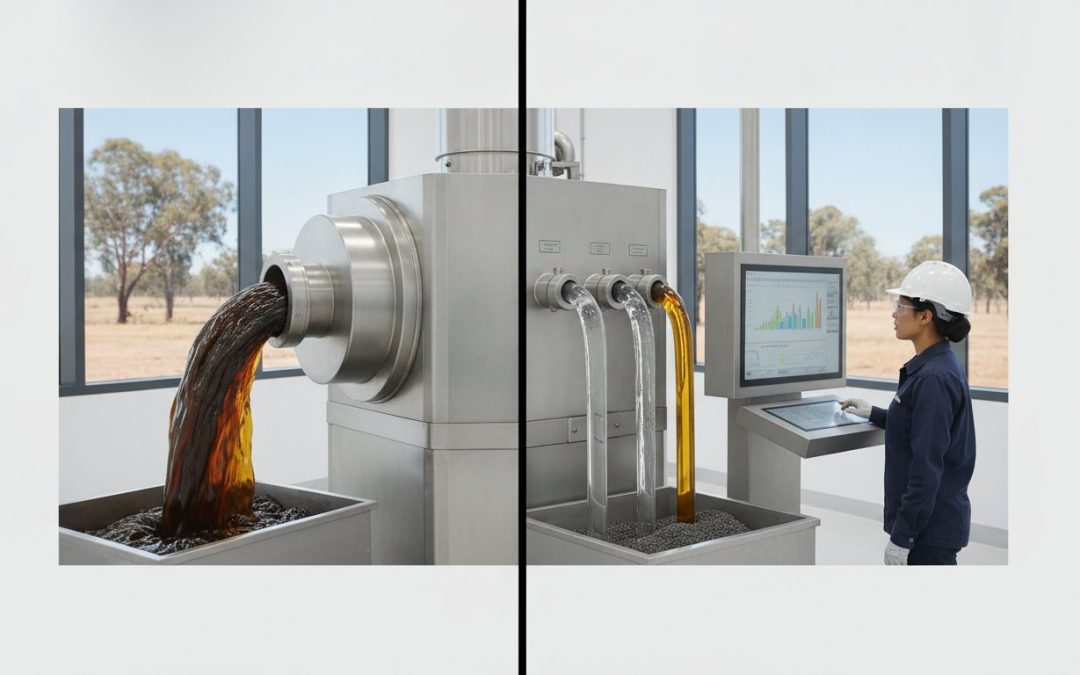
For many Australian industrial operations, oily sludge is viewed exclusively as a costly liability, yet this waste stream often contains significant volumes of recoverable hydrocarbons that are currently being trucked away at a premium. You likely recognise the mounting pressure of escalating disposal fees and the increasing scrutiny from state EPA bodies regarding discharge quality. This guide demonstrates how an oily sludge treatment centrifuge transforms these operational burdens into high-yield recovery opportunities while ensuring your site remains fully compliant with the latest environmental standards.
By implementing advanced separation technology, you can significantly reduce waste volume and reclaim valuable oil that would otherwise be lost. We will examine the mechanics of three-phase separation, the impact of the 2026 PFAS National Environmental Management Plan (PFAS NEMP 3.1), and the bespoke engineering required to lower your long-term operational costs through automated separation. This methodical approach ensures your facility meets the stringent 30 mg/L oil and grease effluent requirements while protecting your bottom line through efficient resource recovery.
Key Takeaways
- Understand the evolving regulatory landscape, including the 2026 PFAS NEMP 3.1, to ensure your facility meets stringent Australian EPA discharge requirements.
- Learn how an oily sludge treatment centrifuge utilises high G-force to break complex emulsions, allowing for the precise separation of oil, water, and solids.
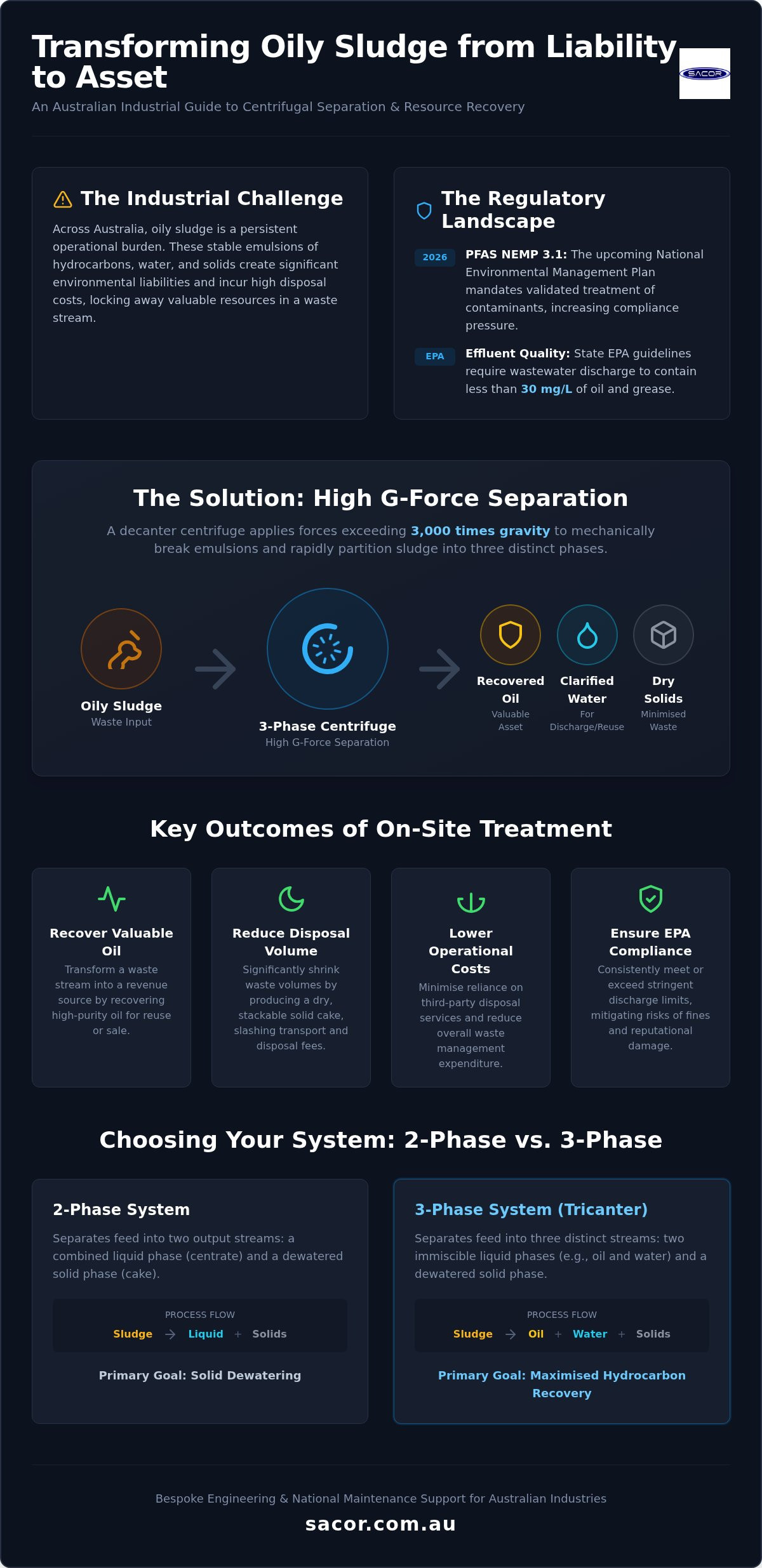
- Evaluate the technical differences between 2-phase and 3-phase systems to determine whether your priority is solid dewatering or maximised hydrocarbon recovery.
- Discover strategies for integrating centrifugal systems into existing plant infrastructure, including the use of chemical conditioning to enhance separation performance.
- Identify how bespoke engineering and national maintenance support can reduce waste disposal volumes and lower long-term operational costs.
Navigating Oily Sludge Management in Australian Industrial Contexts
Oily sludge remains a significant operational burden across Australia’s heavy industries. In sectors like mining and energy, these complex emulsions of hydrocarbons, water, and solids accumulate in storage tanks and tailing ponds, presenting substantial environmental liabilities. Managing this waste is no longer a matter of simple disposal; it requires a sophisticated approach to separation that aligns with modern environmental expectations. Technical professionals understand that these emulsions are stable, resisting gravity-based settling and requiring high-force mechanical intervention to break effectively.
The regulatory landscape in Australia has evolved to demand higher levels of accountability. With the commencement of the PFAS National Environmental Management Plan (PFAS NEMP) 3.1 in June 2026, the focus has shifted toward validated treatment of contaminants. Additionally, state EPA guidelines often mandate that wastewater treatment systems achieve effluent quality of less than 30 mg/L of oil and grease. Failing to meet these standards invites heavy penalties and reputational damage. Implementing an oily sludge treatment centrifuge allows operators to maintain compliance by consistently meeting these stringent discharge benchmarks across varied site conditions.
Environmental Compliance and Waste Minimisation
Adhering to the waste hierarchy is a core component of sustainable industrial practice. By prioritising recovery over disposal, firms can significantly reduce the volume of hazardous material requiring off-site transport. A high-performance Decanter centrifuge facilitates this by stripping water and oil from the solid phase, resulting in a stackable, dry cake that is far less expensive to manage. This process also mitigates the risk of soil and groundwater contamination, protecting the long-term integrity of the site and ensuring the “general environmental duty” mandated in jurisdictions like Victoria is upheld.
The Economic Case for Resource Recovery
The financial benefits of on-site treatment extend beyond simple cost avoidance. An oily sludge treatment centrifuge transforms what was once a waste stream into a source of revenue by recovering high-purity oil that can be returned to the process or sold. This recovery directly offsets the high costs associated with waste transport and disposal levies. When you factor in the reduced need for fresh water and the improved efficiency of downstream processes, the capital investment in advanced separation technology becomes a strategic economic advantage rather than a mere compliance cost. Efficiency in these systems ensures that every litre of recovered oil contributes to the plant’s overall profitability.
The Engineering Behind Oily Sludge Treatment Centrifuges
A decanter centrifuge is a horizontal rotating device that uses high G-force to separate materials based on density. This engineering principle is the foundation of modern waste processing, allowing for the rapid partition of solids, water, and oil. In a typical oily sludge treatment centrifuge, the feed material enters a high-speed rotating bowl where centrifugal forces, often exceeding 3,000 times the force of gravity, accelerate the sedimentation process. This creates distinct layers within the bowl; the heavy solids migrate to the outer wall, while the lighter liquid phases form concentric inner rings based on their specific gravities.
The mechanics involve a continuous cycle of feed and discharge. An internal screw conveyor, or scroll, rotates at a slightly different speed to the bowl, constantly pushing the settled solids toward the conical end for discharge. Simultaneously, the clarified liquid phases are decanted from the opposite end. This automated, high-throughput design is what makes the technology superior to traditional settling tanks, which are often too slow and inconsistent for high-volume Australian mining or energy operations.
How Centrifugal Force Breaks Emulsions
Oily sludge is notoriously difficult to treat because it exists as a stable emulsion where oil and water are tightly bound by surface tension and fine particles. Advanced research into petroleum sludge treatment methodologies confirms that high mechanical force is necessary to overcome these physical bonds. By adjusting the bowl speed and residence time, operators can fine-tune the separation resolution to account for varying sludge viscosities. This precision ensures that even the most stubborn emulsions are broken, allowing for the recovery of high-purity hydrocarbons.
Decanter vs. Disc Stack: Selecting the Correct Mechanism
Choosing the right equipment depends on the solid content of the feed. Decanter centrifuges are the industry standard for high-solids oily sludge because they can handle heavy grit and thick cakes without clogging. Conversely, disc stack separators are typically reserved for final oil polishing or clarification where the solid load is minimal but the required liquid purity is extremely high. Many sophisticated Australian plants now employ hybrid systems, using a decanter for primary bulk separation followed by a disc stack for refined polishing. Selecting the right configuration requires a deep understanding of site-specific feed characteristics; a process where our bespoke engineering team provides essential technical guidance.
Evaluating 2-Phase vs. 3-Phase Centrifugal Separation Systems
Selecting the correct oily sludge treatment centrifuge is a critical engineering decision that hinges on the composition of the feed material and the desired final products. The fundamental distinction between 2-phase and 3-phase systems lies in how the machine partitions the liquid discharge. A standard 2-phase decanter is designed to separate solids from a combined liquid phase, whereas a 3-phase centrifuge incorporates an adjustable impeller or separate discharge ports to isolate oil and water into discrete streams. This distinction is vital for Australian operators who must balance the high cost of waste disposal with the potential for resource reclamation.
For complex oilfield applications where hydrocarbon recovery is the primary driver, a 3-phase system is frequently the most efficient choice. You can find more detailed insights on these specific configurations in our Energy Sector Centrifuge Equipment guide.
When to Choose 2-Phase Dewatering
A 2-phase system is the appropriate choice for applications where the oil content in the sludge is negligible or where the oil and water phases are destined for a downstream treatment process that handles them as a single stream. In these scenarios, the primary goal is to maximise the dry solids content in the discharged cake to reduce the total mass of hazardous waste. This is particularly relevant for sites looking to lower their waste disposal levies and transportation logistics costs. Wastewater treatment plants often prefer this simplified process flow because it requires less complex monitoring while still ensuring the plant remains within its EPA-mandated discharge limits. It’s a robust solution for sites where volume reduction is the sole priority.
The Advantages of 3-Phase Resource Recovery
The 3-phase oily sludge treatment centrifuge offers significant advantages for operations involving crude oil tank cleaning, refinery slop oil, and lagoon remediation. By simultaneously recovering high-purity oil and clarified water, these units transform a waste liability into a valuable asset. The recovered oil can often be returned directly to the refinery process, while the clarified water can be reused on-site or discharged following minimal further treatment. This multi-stage separation also ensures that the resulting solid cake is as dry as possible, facilitating easier handling and further reducing disposal fees. For high-volume mining and energy sites, the ability to recover hydrocarbons while meeting the 30 mg/L oil and grease effluent standard is a key driver for 3-phase adoption.
Optimising Performance: Integration and Maintenance Strategies
The successful deployment of an oily sludge treatment centrifuge requires more than just mechanical installation; it necessitates a comprehensive integration strategy that accounts for fluctuating feed characteristics. Industrial sludge is rarely homogenous. Automated control systems are therefore essential for monitoring torque and bowl speed in real-time, allowing the machine to adjust its parameters without manual intervention. This level of precision ensures that the separation process remains efficient even when the solid-to-liquid ratio of the incoming feed varies significantly.
Chemical conditioning through the precise dosing of flocculants further enhances this process. These specialised polymers aggregate fine particles into larger flocs, which increases the sedimentation rate and improves the clarity of the discharged liquid phases. This is particularly important when dealing with stable emulsions that resist purely mechanical separation. By optimising the chemical and mechanical variables in tandem, operators can achieve the dry cake discharge and high-purity oil recovery required for modern industrial compliance.
System Commissioning and Process Integration
Process integration begins with aligning the centrifuge throughput with the existing upstream infrastructure. In the Australian mining and energy sectors, equipment must often perform in remote or harsh environments where temperatures and dust levels are extreme. Engineering design must account for these site-specific factors, ensuring that piping, pumping, and electrical systems are robust enough to handle the demand. A well-commissioned system minimises the risk of downstream bottlenecks and ensures that the separation unit complements the overall plant efficiency rather than becoming a point of failure.
Maintenance and Spare Parts Availability
High-uptime operations depend on a proactive maintenance programme and the immediate availability of critical components. In the Australian market, managing the supply chain for wear parts like scroll tiles and bearings is a strategic necessity. Scheduled maintenance intervals are the best defence against catastrophic failure, allowing for the inspection of internal components before wear affects separation performance. For a detailed framework on lifecycle planning and inventory management, refer to our guide on Industrial Centrifuge Spare Parts Australia. Maintaining a partnership with a provider that offers national maintenance support ensures that your site remains operational without the delays associated with international shipping. To discuss a customised maintenance schedule for your facility, contact our technical support team for a technical consultation.
Sacor: Authoritative Centrifugal Solutions for Oily Sludge
Sacor positions itself as a seasoned technical authority, offering strategic partnership rather than simple equipment supply. We deliver custom-engineered oily sludge treatment centrifuge systems that are specifically designed to withstand the rigours of Australian mining and energy operations. Our approach is built on a grounded conviction that technology must be matched to the specific application to yield reliable results. By working closely with plant managers and procurement decision-makers, we ensure that every installation is optimised for the unique feed characteristics of the site, providing a steady contribution to sustainable industrial practice. For a broader overview of how our technology serves various sectors, see our guide on Industrial Decanter Centrifuge Australia.
Bespoke Engineering for Specific Feed Profiles
Effective separation is a product of precision engineering. We start by analysing the client’s sludge characteristics, as the specific gravity of the solids and the stability of the oil-water emulsions directly influence the required bowl and scroll geometry. Our team tailors material selection to combat the abrasive nature of mineral-rich sludges or the corrosive properties of refinery waste. This methodical design process ensures that each oily sludge treatment centrifuge achieves the maximum possible separation resolution while maintaining high throughput. By customising the internal mechanics, we help operators avoid the inefficiencies of off-the-shelf solutions that often struggle with the variable feed profiles found in local industries.
National Capability and Technical Expertise
Reliability is a core theme of our service model. Being Australian-owned and operated from our Western Australian base gives us the agency to provide end-to-end support, from initial engineering design to national maintenance and spare parts supply. Our clients benefit from direct access to a dedicated team of separation specialists who possess deep domain expertise in Australian EPA compliance and discharge standards. We maintain a comprehensive local inventory to ensure that wear parts are available without the delays of international logistics, supporting high-uptime operations in even the most remote locations. It’s a commitment to helping industrial operators reduce their environmental footprint while lowering operational costs through superior resource recovery, a level of responsiveness that international vendors can’t match.
Advancing Industrial Efficiency through Strategic Separation
Effective management of oily sludge has transitioned from a logistical burden to a strategic opportunity for resource recovery. By integrating a high-performance oily sludge treatment centrifuge, your facility can consistently achieve discharge quality below 30 mg/L while reclaiming valuable hydrocarbons. It’s a transition that not only ensures compliance with the 2026 PFAS NEMP 3.1 standards but also significantly reduces the overheads associated with waste transport and disposal levies.
As Australian-owned separation technology specialists, we provide the bespoke engineering necessary to handle the specific feed profiles of the mining and energy sectors. Our commitment extends beyond equipment supply to include full national installation and maintenance support; this ensures your operations maintain high uptime and peak efficiency. Consult with a Sacor specialist about your oily sludge treatment requirements to discover how a customised centrifugal solution can optimise your site’s environmental and economic performance. We look forward to partnering with you to achieve a more sustainable and profitable industrial future.
Frequently Asked Questions
What is the main advantage of using a centrifuge for oily sludge treatment?
The primary advantage is the rapid reduction of hazardous waste volume and the simultaneous recovery of valuable hydrocarbons. Unlike traditional settling ponds, an oily sludge treatment centrifuge uses mechanical force to separate phases in seconds. This efficiency reduces the footprint of waste storage on-site and lowers the costs associated with transporting large volumes of liquid waste to disposal facilities. It effectively transforms a liability into a source of reusable oil.
How does a 3-phase centrifuge differ from a standard decanter?
A standard decanter centrifuge separates feed into two phases, typically a solid cake and a combined liquid effluent. In contrast, a 3-phase system, often called a tricanter, uses a specialised impeller or discharge ports to isolate two immiscible liquid phases alongside the solids. This allows for the discrete recovery of high-purity oil and clarified water. It’s the preferred choice for operations where hydrocarbon reclamation is an economic priority.
Can a centrifuge handle oily sludge with high sand or grit content?
Centrifuges are highly capable of handling abrasive materials like sand and grit, provided they’re engineered with appropriate wear protection. Sacor’s bespoke systems often feature tungsten carbide tiling or specialised hard-facing on the scroll and bowl to resist erosion. Without these modifications, high-grit sludge can cause premature mechanical wear. Correct engineering ensures the machine maintains performance while processing the heavy mineral loads common in Australian mining and energy sectors.
What are the typical maintenance requirements for an industrial centrifuge?
Typical maintenance involves regular lubrication of main bearings, vibration monitoring, and the inspection of wear components like discharge ports and scroll tiles. We recommend scheduled intervals to identify potential issues before they lead to mechanical failure. Accessing local technical support is vital for high-uptime operations. Maintaining a consistent supply of genuine spare parts ensures the system continues to operate at its designed separation efficiency throughout its operational lifecycle.
Is chemical conditioning always necessary for oily sludge separation?
Chemical conditioning isn’t strictly mandatory for every application, but it’s often essential for breaking stable oil-water emulsions. Flocculants and coagulants help aggregate fine particles, which increases the sedimentation speed and improves the clarity of the discharged liquid. In cases where the sludge has very high solids or simple separation requirements, mechanical force alone might suffice. However, most industrial sites use conditioning to maximise their hydrocarbon recovery rates and effluent quality.
How does centrifuge treatment help with Australian EPA compliance?
These systems help sites adhere to strict state EPA guidelines by consistently producing effluent with oil and grease levels below 30 mg/L. By reducing the total volume of hazardous waste, companies find it easier to meet the requirements of the 2026 PFAS NEMP 3.1 framework. The automated nature of the separation provides a verifiable treatment process, which is a core component of the general environmental duty mandated in several Australian jurisdictions.
What factors influence the cost of an oily sludge centrifuge system?
Several technical factors influence the capital cost, including the required throughput capacity, the complexity of the 3-phase separation, and the level of automation. Material selection for corrosive environments also plays a role. Since Sacor provides bespoke engineering, the final cost reflects the specific design requirements of your site feed characteristics. Ongoing operational expenses are generally offset by the reduced disposal fees and the value of the oil recovered during the process.
Can these systems be used for on-site crude oil tank cleaning?
Yes, these systems are frequently deployed for on-site crude oil tank cleaning and slop oil treatment. An oily sludge treatment centrifuge efficiently processes the heavy tank bottoms that accumulate over time, recovering the trapped hydrocarbons and reducing the volume of waste for disposal. This on-site approach eliminates the need for expensive vacuum truck transport and allows for the immediate return of recovered oil to the production stream, protecting your bottom line.