
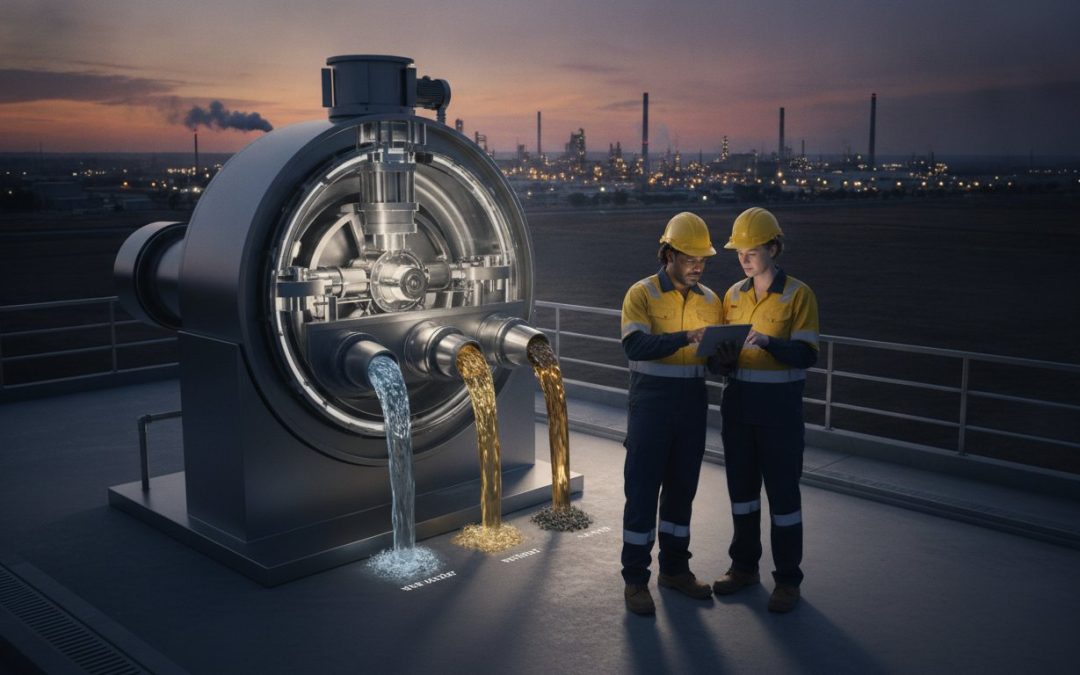
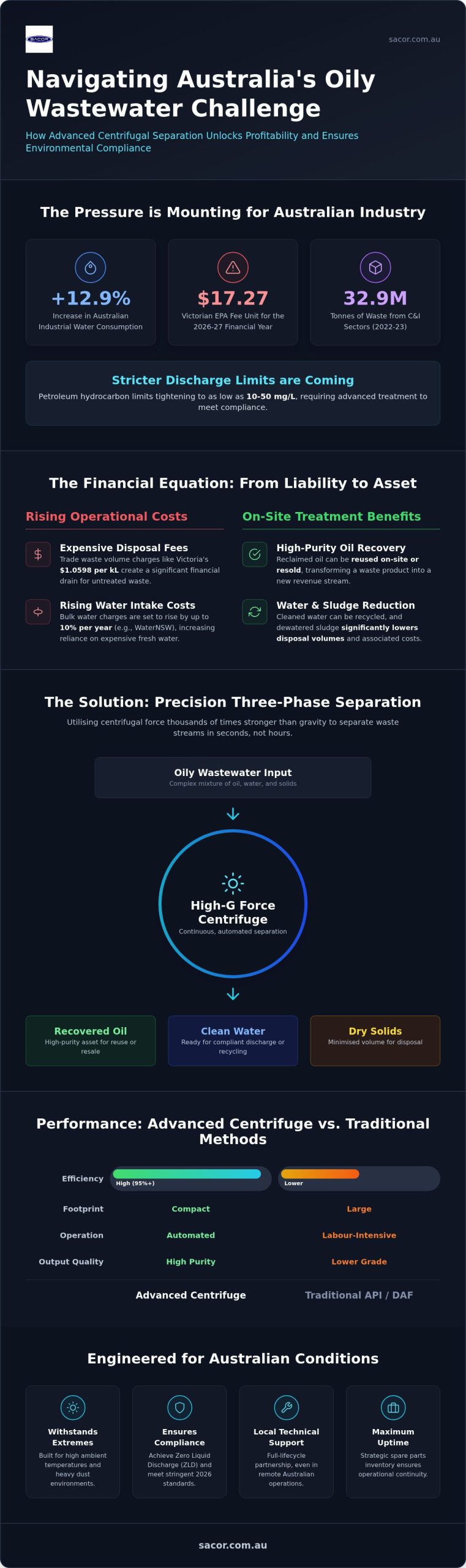
With Australian industrial water consumption rising by 12.9% and EPA fee units in Victoria climbing to $17.27 for the 2026-27 financial year, the cost of managing oily waste is no longer just an operational line item; it’s a direct threat to your bottom line. You’re likely feeling the pressure of meeting stringent discharge limits while trying to find a reliable oily wastewater treatment centrifuge Australia can depend on to minimise the expense of off-site disposal. It’s a difficult balance to maintain, especially in remote operations where water is scarce and technical support is often thousands of kilometres away.
This guide explains how advanced centrifugal separation enables your facility to transform a waste stream into a revenue source through high-purity oil recovery and compliant water discharge. We’ll examine the latest 2026 regulatory shifts, the mechanical advantages of three-phase separation, and the strategic maintenance protocols that ensure your plant remains both profitable and sustainable. By the end of this article, you’ll understand why modern centrifuge technology is the cornerstone of efficient industrial waste management.
Key Takeaways
- Understand the evolving 2026 regulatory landscape and how to align your operations with strict Australian environmental discharge standards to avoid rising levies.
- Learn the mechanics of three-phase centrifugal technology and its ability to recover high-purity oil for resale while producing clean water for reuse.
- Compare the performance of an oily wastewater treatment centrifuge Australia wide against traditional API and DAF systems to determine the most cost-effective solution for your site.
- Discover how custom-engineered separation systems are designed to withstand extreme Australian conditions such as high ambient temperatures and heavy dust.
- Identify the operational advantages of a full-lifecycle partnership that includes local technical support and a strategic spare parts inventory to ensure maximum uptime.
The Growing Challenge of Oily Wastewater Management in Australia
Australia’s industrial landscape is undergoing a fundamental shift in how it manages liquid waste. In the 2022-2023 financial year, the nation generated an estimated 75.6 million tonnes of waste, with the commercial and industrial sectors contributing 32.9 million tonnes of that total. For mining and energy operators, a substantial portion of this volume consists of complex oily wastewater. Traditional gravity-based separators often struggle to meet the increasingly stringent benchmarks set for 2026. As discharge limits for petroleum hydrocarbons tighten to as low as 10-50 mg/L depending on the local water authority, the reliance on an oily wastewater treatment centrifuge Australia wide has become a matter of operational necessity rather than a luxury.
Regulatory Pressures and Environmental Compliance
The regulatory environment is becoming more complex as authorities move toward risk-based frameworks. In New South Wales, the Landfill and Sewage Treatment Plant PFAS Monitoring Chemical Control Order commences on 1 October 2026, requiring rigorous reporting that’ll inevitably impact how industrial oily waste is pre-treated. Simultaneously, the Victorian EPA has set fee units at $17.27 for the 2026-2027 period. This means the cost of non-compliance has never been higher. Many Australian heavy industrial sites are now targeting Zero Liquid Discharge (ZLD) to protect their operational licences and corporate standing. Achieving these targets requires Three-Phase Centrifuge Technology to ensure that discharge water meets the precise quality standards required for release or reuse.
The Economic Case for Advanced Separation
Relying on external contractors to haul away untreated oily sludge is a significant financial drain. For instance, Greater Western Water in Victoria has established a non-residential trade waste volume charge of $1.0598 per kL for 2026-2027, alongside quality-based charges for suspended solids and chemical oxygen demand. These costs compound quickly. Efficient on-site separation changes the financial equation by converting a liability into an asset through a dedicated oily wastewater treatment centrifuge Australia based solution.
- Oil Recovery: Reclaiming high-purity oil allows for either on-site reuse or resale into the lubricants market.
- Water Recycling: Effective treatment reduces the need for expensive freshwater intake. This is critical as WaterNSW bulk water charges rise by up to 10% per year from July 2026.
- Sludge Reduction: Removing solids and water from the oil phase significantly lowers the volume of waste requiring off-site disposal.
Investing in automated separation ensures the process occurs continuously. It reduces the labour-intensive nature of traditional gravity methods while providing a consistent output that satisfies both environmental auditors and internal procurement teams. The result is a more resilient operation that’s better equipped to handle the rising costs of industrial water management.
Three-Phase Centrifuge Technology: Precision Separation of Oil, Water and Solids
A three-phase centrifuge is the definitive solution for complex industrial streams where solid contaminants and two immiscible liquids must be isolated simultaneously. Unlike traditional two-phase decanters that only separate solids from a single liquid, these systems utilise high-speed rotation to create a centrifugal force thousands of times stronger than gravity. This acceleration forces the heaviest particles (solids) to the bowl wall, while the water and oil form distinct concentric layers based on their specific gravities. It’s a mechanical process that replaces hours of settling time with seconds of high-intensity separation.
The core components of an oily wastewater treatment centrifuge Australia operators use include a cylindrical-conical bowl, an internal scroll conveyor, and dedicated discharge ports. The bowl rotates at high speeds, while the scroll rotates at a slightly different differential speed to continuously remove the dewatered solids. This mechanical precision is essential for maintaining Wastewater treatment compliance in Western Australia and other jurisdictions where discharge quality is non-negotiable. The ability to adjust these speeds allows for the fine-tuning of the separation process to suit specific site conditions.
The Three-Phase Separation Mechanism
Inside the rotating bowl, the feed material enters the separation zone where it’s immediately subjected to intense G-forces. The process follows a logical sequence:
- Solid Sedimentation: Heavy solids are flung against the bowl wall and scraped toward the discharge end by the scroll.
- Heavy Phase Discharge: The water phase, being denser than oil, forms the middle layer and is discharged through adjustable weir plates.
- Light Phase Recovery: The oil phase settles closest to the centre and is removed via a separate discharge path, often achieving purity levels high enough for immediate reuse.
These systems are remarkably resilient to fluctuating feed rates and varying oil concentrations. By adjusting the pond depth and differential speed, operators can maintain high-purity recovery even when the incoming waste stream is inconsistent. If your site requires a bespoke configuration for complex emulsions, exploring Three-Phase Centrifuge Systems can provide the necessary technical clarity for your specific application.
Advantages of Continuous Centrifugal Processing
Continuous processing offers a significant throughput advantage over batch treatment. It eliminates the need for vast settling lagoons or large-footprint API separators, which is a critical consideration for sites with limited space or those operating in sensitive environments. Three-phase separation is the most efficient method for oily wastewater. Because the separation happens mechanically, the reliance on expensive chemical flocculants is greatly reduced. This not only lowers operational costs but also simplifies the downstream management of the recovered phases. The result is a compact, automated, and highly reliable system that delivers consistent performance under demanding Australian conditions.
Centrifugal Separation vs. Traditional Oily Water Treatment Methods
Legacy systems like API separators and Dissolved Air Flotation (DAF) have long been staples of Australian industrial water treatment. However, as 2026 environmental standards tighten, the limitations of these methods become apparent. An API separator relies entirely on gravity and residence time, making it ineffective against emulsified oils or fine particles. In contrast, an oily wastewater treatment centrifuge Australia sites employ uses mechanical force to achieve separation levels that gravity alone cannot match. This allows for the immediate processing of waste streams that would otherwise require hours of stagnant settling time.
DAF systems require a continuous supply of compressed air and chemical coagulants to float oil to the surface. For remote Australian operations, the logistics of transporting chemicals and the energy required to run large compressors create significant overheads. Centrifuges offer a compact, mechanical alternative that handles high-solids loading without the risk of system fouling common in DAF units. This robustness is particularly valuable in mining environments where the feed composition can change rapidly between different ore bodies or processing phases.
Performance Benchmarks: Purity and Recovery
The primary metric for any separation system is the residual oil-in-water (OiW) concentration. While API separators often struggle to get below 50-100 mg/L, a three-phase centrifuge consistently reaches the 10-50 mg/L range required by most Australian water authorities. This precision is matched by the quality of the recovered solids. Centrifuges produce a dry cake rather than a thin sludge, which reduces the total volume of waste for disposal. Maximising oil recovery isn’t just about compliance; it’s about reclaiming a valuable resource that remains trapped in the wet sludge produced by traditional filtration methods.
Total Cost of Ownership (TCO) Analysis
Choosing a separation technology based solely on initial capital expenditure is a common pitfall. A TCO analysis reveals that while a decanter centrifuge represents a higher upfront investment than a simple settling tank, the long-term operational savings are substantial. Modern decanter drives are engineered for high torque at low power consumption, often outperforming the cumulative energy draw of air-intensive flotation systems. Automated centrifuge systems also require minimal operator intervention compared to the constant monitoring and chemical dosing needed for DAF plants.
By integrating an oily wastewater treatment centrifuge Australia based companies can reduce their physical footprint significantly. A skid-mounted centrifuge occupies a fraction of the space required for a DAF plant or a series of concrete API pits. This portability is a strategic advantage for sites that must adapt to changing production volumes or relocate equipment across different operational zones. The equipment’s longevity is further secured through the use of erosion-protected components, ensuring the system remains a reliable asset in harsh industrial environments.
Optimising Centrifuge Performance for Australian Industrial Site Conditions
Operating heavy machinery in the Australian outback presents unique environmental stressors that standard international specifications often fail to address. Ambient temperatures exceeding 45 degrees Celsius, high humidity in tropical regions, and pervasive abrasive dust can quickly degrade sensitive components. An oily wastewater treatment centrifuge Australia based operators install must be ruggedised to maintain peak performance under these conditions. This involves selecting high-grade stainless steels and specialised coatings to resist corrosion and erosion, alongside cooling systems that can handle extreme thermal loads without compromising separation efficiency.
Integrating these systems into existing plant infrastructure requires a methodical approach to ensure that feed pumps, electrical controls, and discharge conveyors work in harmony. Many Australian sites operate in remote basins where power and water are at a premium. Consequently, the centrifuge must be configured to deliver maximum throughput with minimal utility consumption. By customising the drive systems and automating the process controls, operators can achieve a stable, “set and forget” operation that handles the variability of industrial waste streams without constant manual intervention.
Custom Engineering for Feed Characteristics
A “one size fits all” approach is fundamentally inadequate for complex oily waste. Effective separation depends on a granular understanding of feed solids, oil viscosity, and temperature. Sacor’s methodology focuses on bespoke industrial decanter centrifuge Australia engineering, where the system is tailored to the specific chemical and physical profile of the waste stream. For example, high-viscosity oils in energy operations require different torque settings and pond depths compared to the fine particulate matter found in mining runoff. By analysing these variables during the design phase, we ensure the equipment delivers the required purity levels from the first day of commissioning.
Maintenance and Spare Parts Logistics
Uptime is the most critical metric for remote industrial sites. The logistical challenge of transporting components to distant mining or energy basins means that a reactive maintenance strategy is a recipe for prolonged downtime. Access to industrial centrifuge spare parts Australia wide is a core pillar of our support model. We encourage a tiered inventory approach, keeping high-wear items like tiles, seals, and bearings on-site for immediate replacement. Developing a scheduled maintenance programme ensures that an oily wastewater treatment centrifuge Australia relies on continues to operate within its design parameters for its entire lifecycle.
Remote monitoring technology now allows our technical team to provide real-time support to site engineers, regardless of their location. This connectivity enables proactive troubleshooting and performance tuning without the need for immediate site visits. If your operation is facing reliability issues with existing separation equipment, you can consult with our technical team to develop a site-specific optimisation plan that ensures consistent environmental compliance and resource recovery.
Custom Engineering and Maintenance: The Sacor Approach to Wastewater Efficiency
Selecting an oily wastewater treatment centrifuge Australia wide requires more than a simple procurement transaction; it demands a technical partnership rooted in deep domain expertise. Sacor positions itself as a seasoned authority, working alongside industrial operators to navigate the complexities of fluid separation. We understand that every site presents unique variables, from the specific gravity of the oil phase to the abrasive nature of the suspended solids. Our approach moves beyond supplying a standard unit; we provide a custom-engineered solution that’s meticulously integrated into your existing process flow to ensure long-term reliability and performance.
Bespoke Separation Solutions
The value of Australian-based engineering lies in the ability to produce technical documentation and equipment specifications that align with local operational standards. We don’t believe in “off-the-shelf” components for abrasive wastewater streams. Instead, we collaborate with plant engineers to tailor bowl materials and scroll coatings specifically for the waste profile on-site. This might involve utilising specialised tungsten carbide tiling or advanced ceramic components to protect against premature wear in high-solids environments. By precisely adjusting bowl geometry and drive configurations, we ensure the system meets your specific throughput targets while maintaining the highest possible purity in the recovered oil.
Full-Lifecycle Support and Commissioning
A successful project lifecycle extends far beyond the delivery of the centrifuge. Our team manages the entire process from initial site assessment through to on-site installation and commissioning. This ensures that the oily wastewater treatment centrifuge Australia based companies invest in is perfectly calibrated for its environment. Achieving environmental compliance in the energy sector centrifuge equipment field is a core capability, where we demonstrate how automated systems can drastically reduce environmental levies through superior separation efficiency.
Training plant personnel is a critical component of our commissioning phase. We provide comprehensive safety and operational training to ensure your team can manage the equipment with confidence. To secure the longevity of the asset, Sacor offers structured maintenance contracts that include regular performance audits and preventative servicing. This proactive model, supported by our technical team in Mandurah, ensures that Australian operators have immediate access to the expertise required to maintain maximum uptime. By combining high-performance technology with local technical support, we help our partners achieve a sustainable and profitable approach to industrial wastewater management.
Securing Operational Excellence through Advanced Separation
As Australian industrial regulations tighten and disposal costs climb, the transition to automated centrifugal technology is no longer optional for sites targeting long-term sustainability. Implementing a high-performance oily wastewater treatment centrifuge Australia wide ensures that your facility can meet stringent 2026 environmental standards while simultaneously recovering valuable resources. By shifting from traditional gravity-based methods to precision three-phase separation, you reduce the volume of waste requiring off-site disposal and reclaim high-purity oil for reuse or resale.
Sacor stands as a trusted technical partner for the mining and energy sectors. We’re an Australian-owned and operated business specialising in custom industrial separation engineering. Our commitment to your operation includes full-lifecycle support and a comprehensive national spare parts and maintenance network to guarantee maximum uptime in remote locations. We invite you to Consult with Sacor for a bespoke oily wastewater separation solution tailored to your specific site requirements. Investing in reliable technology today establishes a resilient foundation for the environmental and economic challenges of the future.
Frequently Asked Questions
How does a decanter centrifuge separate oil from wastewater?
A decanter centrifuge uses high-speed rotation to generate centrifugal force, which accelerates the separation of materials based on their density. In oily wastewater, the intense G-force causes the heaviest solids to migrate to the bowl wall, while the water and oil form distinct concentric layers. The internal scroll conveyor continuously removes the solids, while the liquid phases are discharged through separate ports. This mechanical process replaces traditional gravity settling with a high-intensity, automated alternative.
What are the benefits of using a three-phase centrifuge for oily water treatment?
A three-phase centrifuge allows for the simultaneous separation of solids, water, and oil in a single continuous process. This eliminates the need for multiple treatment stages and large settling tanks. Key benefits include the recovery of high-purity oil for resale, the production of compliant water for reuse, and a significant reduction in waste disposal volumes. It’s a highly efficient solution for complex industrial streams that contain significant particulate matter and emulsified oils.
Can a centrifuge help my site meet Australian EPA discharge standards?
Yes, integrating an oily wastewater treatment centrifuge Australia wide is a proven method for meeting stringent EPA discharge limits. These systems can consistently reduce petroleum hydrocarbon concentrations to between 10 and 50 mg/L, which aligns with most local water authority requirements. By removing emulsified oils and fine solids that gravity separators often miss, a centrifuge ensures your discharge remains compliant and helps your operation avoid the rising environmental levies associated with non-compliance.
What is the difference between a centrifuge and a DAF system for oily water?
The primary difference lies in the separation method; centrifuges use mechanical G-force while Dissolved Air Flotation (DAF) relies on compressed air and chemical coagulants. Centrifuges generally have a much smaller physical footprint and handle high-solids loading more effectively than DAF units. Additionally, centrifuges produce a drier waste cake and don’t require the constant chemical dosing and compressor maintenance often associated with flotation systems in remote Australian industrial environments.
How often does an industrial centrifuge require maintenance in Australian conditions?
Maintenance frequency depends on the abrasiveness of the feed and the site’s operating hours, but a tiered inspection schedule is recommended. High-wear components like seals and bearings should be monitored monthly, while a major service typically occurs annually. In harsh Australian conditions involving extreme heat and dust, proactive maintenance is essential. Sacor provides comprehensive national spare parts and maintenance support to ensure these systems maintain peak reliability throughout their entire operational life.
What industries in Australia benefit most from oily wastewater centrifuges?
Australian mining and energy operations benefit significantly due to the high volume of oily runoff and process water they generate. Food and beverage processors also utilise these systems to manage fats, oils, and greases in their effluent streams. Any sector facing high trade waste fees or strict environmental discharge limits will find that centrifugal separation provides a cost-effective way to manage complex waste while reclaiming valuable resources for reuse on-site.
How does reclaimed oil purity compare between centrifuges and gravity separators?
Centrifuges achieve substantially higher reclaimed oil purity than traditional gravity separators. While gravity systems often leave significant water and solids in the oil phase, the intense G-force of a centrifuge produces a clean oil stream that’s frequently suitable for immediate reuse or resale. This precision is vital for operators who view oily waste as a potential revenue stream rather than just a disposal cost, especially in large-scale industrial applications across the country.
Is it possible to automate an oily wastewater treatment centrifuge?
Automation is a standard feature of modern centrifugal separation systems. These units are equipped with advanced control panels that monitor torque, vibration, and flow rates in real time, allowing for a “set and forget” operation. This reduces the need for manual intervention and ensures the system adapts automatically to fluctuations in the waste stream’s composition. For remote Australian sites, automation is a critical factor in maintaining consistent performance with minimal labour requirements.