
The lowest capital quote can lead to the highest whole-of-life cost. A defensible total cost of ownership industrial separator model looks beyond purchase price to the energy, maintenance, consumables and downtime involved in meeting your process requirements over time.
Comparing quotes is difficult when operating assumptions aren’t consistent or clearly defined. A separator’s value depends on how well its performance fits your feed characteristics, throughput targets and site conditions, as well as the support required across its lifecycle. Start with clear, like-for-like inputs rather than a headline price.
This guide provides a practical framework for building that comparison, identifying commonly missed costs and testing which assumptions have the greatest effect on lifecycle cost. It also explains how to link equipment selection with measurable operating requirements, including maintenance planning, commissioning and spare-parts support. With a transparent model, your team can assess separator options against process fit and expected operating demands, then make a more informed decision for your plant.
Key Takeaways
- Build a total cost of ownership industrial separator model around a defined ownership period, separating one-off costs from recurring expenses.
- Use site-specific operating hours, duty and verified equipment data to assess energy use, rather than relying on assumed savings.
- Compare separator options using the same feed, output, throughput and analysis period, and record the evidence behind each cost estimate.
- Test how changes in uncertain assumptions affect the result, so you can focus on the factors with the greatest influence on lifecycle cost.
- Include process engineering, commissioning, maintenance planning and spare-parts support in ownership planning from the outset.
What total cost of ownership means for an industrial separator
Total cost of ownership is the combined cost of acquiring, operating and supporting equipment over a defined period. For an industrial separator, that means looking beyond the capital quote to the costs of providing the required separation service throughout the chosen ownership period. This follows the broader Total cost of ownership (TCO) principle of considering costs across an asset’s life cycle.
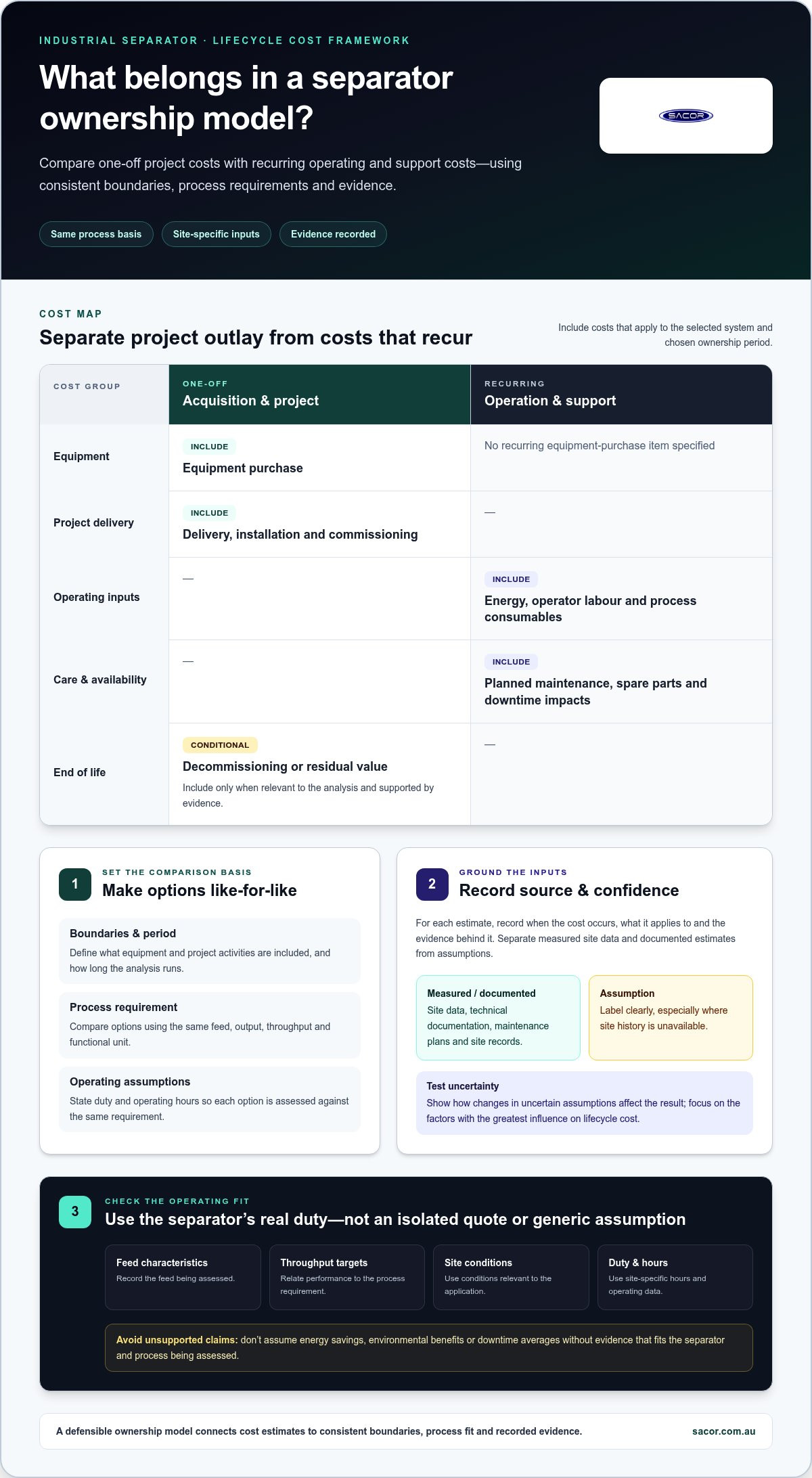
A useful total cost of ownership industrial separator assessment starts with clear boundaries. Define which equipment and project activities are included, how long the analysis runs, and the throughput or other functional unit used to compare options. State operating assumptions, such as duty and hours, so each option is assessed against the same process requirement. Without a common basis, a precise-looking result can still compare unlike scenarios.
Which costs belong inside a separator ownership model?
Separate one-off acquisition and project costs from recurring operating and support costs. Depending on the application and available evidence, the model may include:
- Acquisition and project: equipment, delivery, installation and commissioning.
- Recurring operation: energy, operator labour and process consumables.
- Support: planned maintenance, spare parts and downtime impacts.
Include decommissioning, end-of-life or residual-value items only when relevant to the analysis and supported by evidence. Record the source and confidence level for each input, distinguishing measured site data and documented estimates from assumptions. This makes the model easier to review and update as operating information improves.
Why purchase price alone can mislead
Purchase price remains essential for capital budgeting and procurement approval, but it describes only the initial outlay. It doesn’t show what it will cost to operate and support a separator under your plant’s conditions. Different assumptions about operating hours, throughput, labour, maintenance scope or downtime can make two quotes appear comparable even when they’re based on different duties.
Assess performance against the required process outcome, not an isolated equipment specification. For example, a throughput figure is meaningful only in relation to the feed and output requirements it must serve. Sacor’s solution design considers feed characteristics, throughput targets and site conditions to ground equipment selection in the application. Neither a higher nor a lower capital cost establishes lifecycle value on its own. The comparison depends on consistent boundaries, evidence and process fit.
The main cost drivers behind an industrial separator’s lifecycle cost
Energy, labour, consumables, maintenance, spare parts and downtime are cost drivers that usually need project-specific inputs. For a defensible total cost of ownership industrial separator assessment, map each item to the chosen ownership period and classify it as a one-off or recurring cost. Acquisition, installation and commissioning are generally project costs. Energy, service labour, consumables and parts recur according to operating conditions and maintenance requirements.
Keep the basis consistent: record when each cost occurs, what evidence supports it and whether it applies to the process being assessed. Include costs linked to surrounding process stages only where project data shows a direct effect. This prevents indirect or speculative impacts from being presented as established costs.
Energy, process inputs and operating conditions
Energy estimates should reflect the separator’s actual duty, not a generic figure. Document feed characteristics, expected operating hours, throughput and the required separation outcome, then use measured site data or supplier-supported equipment information under stated operating conditions. If feed composition or production schedules vary, model those variations explicitly rather than hiding them in an unexplained average.
Consider upstream or downstream effects only where project evidence demonstrates a connection, such as a measured change in process demand. Don’t assume an equipment option will reduce energy use or deliver environmental benefits without substantiated data. Clear inputs make energy assumptions easier to validate and revise.
Maintenance, consumables and downtime
Separate scheduled maintenance from condition-based inspections and corrective work. List the labour, service tasks, wear components, consumables and spare parts relevant to the selected system, using maintenance plans, technical documentation and site records to support timing and quantities. Research on the impact of maintenance on life cycle costs also highlights why maintenance strategy belongs in an ownership assessment, not just an operations schedule.
Downtime exposure depends on the plant’s process and operating context. Use site history where available. If it isn’t available, identify the downtime scenario as an assumption and show how it affects the model. Avoid generic downtime or maintenance averages that may not reflect the separator, feed or maintenance approach being assessed.
Early process engineering can ground these inputs in feed characteristics, throughput targets and site conditions. Maintenance planning and spare-parts support then give the ownership model a practical lifecycle basis. Explore industrial separator solutions and lifecycle support as part of that planning.
How to compare separator options on a like-for-like basis
A useful comparison holds the process duty constant. Assess each option against the same feed characteristics, required output, throughput, operating hours and analysis period, then compare the evidence behind each input. A lower purchase price matters for capital planning, but it doesn’t establish lifecycle value. Operating and support assumptions determine whether the options are genuinely comparable.
Match the separator type to the separation duty
Start with the required phase separation and the condition of the feed. Decanter centrifuge systems may suit duties requiring continuous solids-liquid separation. Three-phase systems address duties involving separation into two liquid phases and solids. Disc separator systems may suit liquid separation or clarification duties. The right fit depends on the application and output requirements, not a universal ranking. For additional technology context, see the industrial decanter centrifuge guide.
Use a comparison table that exposes assumptions
Record each option against the same categories and timeframe. Distinguish verified site data from estimates, and describe uncertainty plainly rather than disguising it with a single precise-looking total.
| Cost category | Option A | Option B | Input source and evidence | Timeframe | Uncertainty |
|---|---|---|---|---|---|
| Capital and project | Enter quoted scope | Enter quoted scope | Supplier quote; note inclusions | One-off | Scope gaps or exclusions |
| Energy | Enter duty-based estimate | Enter duty-based estimate | Measured data or supported equipment data | Recurring | Operating hours and load variation |
| Labour and maintenance | Enter task-based estimate | Enter task-based estimate | Site records and maintenance plans | Recurring | Service frequency and labour assumptions |
| Parts and consumables | List relevant items | List relevant items | Parts information and process records | Recurring | Usage and replacement intervals |
| Downtime | State exposure or assumption | State exposure or assumption | Site history or labelled scenario | As modelled | Process impact and duration |
Where reliable production or treatment data supports it, compare cost per relevant unit of process service, such as a unit of feed treated to the required output. Don’t use this measure if options produce different results or the underlying data isn’t comparable. Sensitivity checks can show whether changes in operating hours, energy assumptions or maintenance intervals affect the ranking. This makes a total cost of ownership industrial separator comparison more transparent and defensible than ranking options by capital price alone.
Build a defensible total-cost model for your plant
A useful model makes its scope, evidence and uncertainty visible, so engineering and procurement teams can review the comparison on a consistent basis. Use the same analysis period and functional unit for each option, such as a defined quantity of feed treated to the required output. The model supports project decisions, but it doesn’t replace validation against the specific application and site conditions.
- Set the scope. Define the equipment and project costs included, the ownership period, the process duty and the functional unit.
- Gather evidence. Collect supplier documentation, site operating data, maintenance records and project-specific installation assumptions. Label each input with its source.
- Model the cost categories. Separate one-off acquisition costs from recurring operating and support costs, then include relevant end-of-life items only where evidence supports them.
- Compare scenarios. Apply the same scope, period and process basis to each option, and test operating cases that reflect plausible plant conditions.
- Review uncertainty. Identify the assumptions that most affect the result, document exclusions and confidence levels, and have relevant technical and commercial reviewers assess the inputs.
Gather inputs and calculate lifecycle cost
A straightforward calculation is:
Lifecycle cost = included acquisition costs + operating costs + maintenance costs + supported end-of-life costs.
Supplier documents can inform equipment and project scope, while site records can support operating hours and maintenance assumptions. Keep estimates distinct from measured or documented inputs so reviewers can see where further validation would be useful. If the model uses an undiscounted total, report costs across the period without adjusting for when they occur. If it uses discounted cash-flow analysis, state the method and assumptions clearly. Don’t combine results calculated on different bases.
Test uncertainty before making a recommendation
Run sensitivity checks on inputs such as operating hours, energy use and maintenance intervals. Change one assumption at a time to see its effect, then test a combined scenario if several inputs could vary together. Record the input source, responsible reviewer, exclusions and confidence level alongside the model. Where spare-parts planning affects maintenance assumptions, the industrial centrifuge spare-parts guide provides related context.
This structured approach turns the total cost of ownership industrial separator model into a reviewable decision tool, rather than a single estimate without context. To ground your assumptions in the application, discuss separator solution design with Sacor, including feed characteristics, throughput targets and site conditions.
Plan separator ownership with Sacor from design through support
A lifecycle model is most useful when its assumptions reflect the process the separator must serve. Sacor’s solution design considers feed characteristics, throughput targets and site conditions, connecting equipment selection with the separation duty and operating environment. These project requirements also give engineering and procurement teams a sound basis for reviewing the inputs used in a total cost of ownership industrial separator assessment.
Translate the cost model into project requirements
Before finalising a comparison, bring together the core process requirements so each option is assessed against the same operating need. This information can include:
- Feed characteristics and any expected variation
- Target throughput and required separation outcomes
- Site conditions relevant to installation and integration
- Operating profile, including the planned duty and production pattern
Sacor uses these requirements to inform customised solution design and engineering for industrial decanter centrifuge, three-phase centrifuge and disc separator systems. The resulting project scope helps clarify which equipment and operating assumptions belong in the cost model. Performance and cost outcomes depend on the specific application, so validate assumptions against project evidence rather than treating them as guaranteed results.
Carry lifecycle assumptions into commissioning and maintenance
Ownership planning should continue beyond equipment selection. Sacor’s equipment supply includes technical documentation and commissioning support, which can be incorporated into project planning alongside installation and plant integration requirements. Commissioning also provides an opportunity to review model assumptions against the intended operating setup and process requirements.
Plan maintenance and spare-parts requirements as part of the equipment lifecycle, not as later additions to the procurement decision. Sacor provides maintenance, spare-parts supply and technical support, helping operators account for ongoing ownership requirements. The maintenance plan and parts requirements should reflect the supplied system and its operating context.
With process requirements, cost assumptions and support planning considered together, your team can make a more informed separator decision without relying on purchase price alone. Discuss an industrial separation project with Sacor to consider your feed, throughput, separation requirements and site conditions as part of a project-specific evaluation.
Make your separator decision on a whole-of-life basis
A sound separator decision starts with a clear process duty and a consistent comparison. Assess options against the same feed, required output, throughput and analysis period, then include operating and support costs that a capital quote alone can’t show. Test uncertain inputs, such as energy use and maintenance intervals, so your recommendation reflects the assumptions that matter most.
A defensible total cost of ownership industrial separator model supports engineering and procurement review, but it’s only as reliable as its project-specific evidence. Sacor’s customised solution design considers feed characteristics, throughput targets and site conditions. Equipment supply includes technical documentation and commissioning support, with maintenance, spare-parts supply and technical support forming part of lifecycle planning.
Bring your process requirements into the next stage of evaluation. Discuss your industrial separation requirements with Sacor and develop a project-specific basis for comparing suitable options. A well-grounded assessment gives your team a clearer path to selecting equipment that fits the process and its ongoing operating demands.
Frequently Asked Questions
What is the total cost of ownership of an industrial separator?
The total cost of ownership is the combined cost of acquiring, operating and supporting an industrial separator over a defined period. A total cost of ownership industrial separator assessment can include project and installation costs, energy, labour, consumables, maintenance, spare parts and relevant downtime impacts. Include end-of-life costs or residual value only when they’re relevant and supported by evidence. The purchase price remains important, but it isn’t the full lifecycle cost.
How do you calculate total cost of ownership for a separator?
Define the analysis period, equipment scope and process service being compared, then add the included acquisition, operating, maintenance and supported end-of-life costs. Gather supplier documentation, site operating data and maintenance records, and label estimates separately from verified inputs. Apply the same throughput basis, operating profile and output requirements to each option. If you use discounted cash-flow analysis rather than an undiscounted total, document the method and assumptions consistently.
Which operating costs should an industrial separator TCO include?
Include operating costs that apply to the separator’s actual duty: energy, operator labour, process consumables, planned maintenance, wear components, spare parts and relevant downtime exposure. The appropriate inputs depend on the system, feed, operating hours and site maintenance approach. Use measured records or project-specific documentation where available. Include effects on upstream or downstream processes only when project evidence demonstrates a connection, rather than assuming indirect costs or savings.
Is a lower-priced industrial separator always cheaper to own?
No. A lower purchase price establishes a lower initial outlay, not a lower lifecycle cost. Differences in operating hours, energy assumptions, maintenance needs, parts and process suitability can change the whole-of-life comparison. Compare options against the same feed, throughput, separation outcome and ownership period, then assess whether each meets the required process duty. A higher capital cost doesn’t prove better value either. The evidence and application fit determine the comparison.
How can I compare separator options when operating costs are uncertain?
Use a consistent comparison framework and make uncertainty visible. Record the source and confidence level for each input, separating measured site data from estimates and assumptions. Then test how plausible changes in operating hours, energy use, maintenance intervals or downtime affect the result. If a cost estimate lacks supporting evidence, label it clearly rather than presenting it as a confirmed figure. This helps reviewers identify which assumptions need further project validation.
Does total cost of ownership include maintenance and spare parts?
Yes. Maintenance and spare parts are relevant ownership costs when they apply during the chosen analysis period. Include scheduled service labour, expected maintenance tasks, relevant wear components and spare parts, drawing on technical documentation and site records where available. Distinguish planned work from condition-based or corrective maintenance, and state the basis for replacement assumptions. This gives engineering and procurement teams a clearer view of ongoing support requirements alongside the initial equipment outlay.
Should I use payback period or total cost of ownership to compare separators?
They answer different questions, so they can be used together. Payback period estimates how long it takes for an investment to recover its initial outlay under stated assumptions. Total cost of ownership compares included costs across a defined period, including operating and support requirements. Neither measure replaces process validation. Use consistent operating scenarios and documented inputs, and interpret results in the context of the required separation duty and plant priorities.