
The best alternative to an evaporation pond may not be a single replacement technology. For industrial sites, alternatives to evaporation ponds for wastewater need to suit the wastewater, available land and water-management objectives. Pond performance depends on climate, containment and operating conditions. Treatment systems bring their own demands for energy, monitoring and residuals management.
A direct comparison helps clarify the right process. A system that separates suspended solids will not necessarily remove dissolved salts or other contaminants. Water recovery can also leave a concentrated stream that still needs to be managed. This article compares the main treatment pathways by process fit, water recovery, residuals, site constraints and operating demands. It also outlines the process data needed for a sound project assessment and explains where mechanical solid-liquid separation, such as decanter centrifuge dewatering of sludge, can reduce the volume of solids-bearing residuals. The aim is to help project teams identify options that match their wastewater and site requirements, not to suggest one universal substitute.
Key Takeaways
- Compare alternatives to evaporation ponds for wastewater by the treatment duty they perform, not by technology name alone.
- Match each pathway to wastewater characteristics, required water quality and the destination for its residuals.
- Include site footprint, climate, energy demand, operator requirements and maintenance access in the assessment.
- Use representative sampling and, where useful, bench testing or a pilot to reduce uncertainty before designing a treatment train.
- Consider decanter centrifuge dewatering for suitable solids-bearing streams, while accounting for any further treatment needed for dissolved contaminants and final water quality.
Why consider alternatives to evaporation ponds for wastewater?
An evaporation pond stores wastewater in a contained basin and allows water to evaporate. This can concentrate dissolved material in the remaining liquid or leave solids behind. A pond can provide storage and gradual volume reduction, but its performance depends on weather, pond area, wastewater loading and operating conditions. The industrial wastewater treatment processes used at a site should therefore reflect the wastewater characteristics and required outcome, rather than assume a pond will perform the same way in every setting.
Project teams may assess alternatives to evaporation ponds for wastewater when land is constrained, evaporation conditions are unreliable for the required duty, or water reuse is a priority. These are operational considerations. Environmental risks such as seepage or loss of containment depend on pond design, condition and site-specific factors; they should not be treated as inevitable failures. Containment integrity and monitoring remain important wherever wastewater or concentrated residuals are stored.
What evaporation ponds do well, and where constraints arise
Ponds hold wastewater while natural evaporation reduces liquid volume. The rate and consistency of evaporation vary with climate and operating conditions. A large footprint may be needed to provide enough storage and exposed surface area, while prolonged wet or cool periods can affect evaporation. Teams also need to plan for containment, inspection and monitoring, as well as the management of accumulated sludge or concentrated liquor. These requirements can make a pond less suitable where space is limited or more controlled water recovery is needed.
Define the treatment objective before comparing technologies
First, separate the intended outcomes. Water recovery means producing water for a defined reuse or discharge pathway. Contaminant removal targets specific constituents, volume reduction concentrates the waste stream, and solids dewatering separates liquid from suspended material. These duties are related, but not interchangeable. A process that removes suspended solids may leave dissolved constituents in the liquid.
Characterise the feed before comparing options. Relevant features include suspended solids, dissolved constituents, oil, flow rate and variation between streams or over time. Then define the required effluent quality and the destination for each residual, including concentrated liquor and dewatered solids. A treatment train is a sequence of stages selected to meet specific treatment objectives. Unlike a pond used primarily for storage and evaporation, each stage in a treatment train has a defined separation or treatment duty.
Representative sampling helps establish the design basis. If feed variability or separation performance creates uncertainty, laboratory testing or a pilot can help validate process suitability and clarify residuals-management needs before selecting a full-scale system.
How do wastewater alternatives to evaporation ponds work?
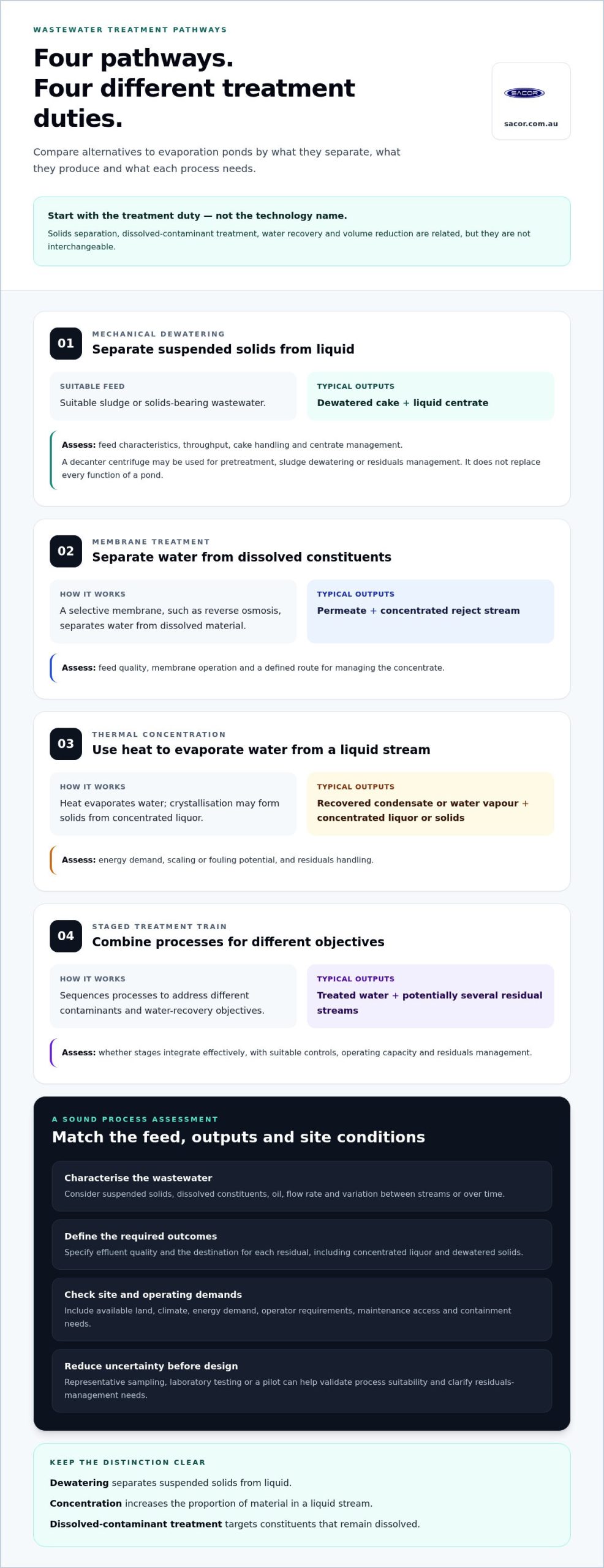
Each alternative performs a different treatment duty, so a useful comparison begins with the wastewater feed and required outputs. Mechanical separation, membrane treatment and thermal processes work in different ways and produce distinct residual streams. The table summarises their typical roles. Actual suitability and performance depend on wastewater composition, process design and operating conditions.
| Pathway | Function and suitable feed | Typical outputs | Key operating considerations |
|---|---|---|---|
| Mechanical dewatering | Separates suspended solids from liquid in suitable sludge or solids-bearing wastewater. | Dewatered cake and liquid centrate. | Feed characteristics, throughput, cake handling and centrate management influence process fit. |
| Membrane treatment | Uses a selective membrane, such as reverse osmosis, to separate water from dissolved constituents. | Permeate and a concentrated reject stream. | Feed quality, membrane operation and a defined concentrate-management route are important. |
| Thermal concentration | Uses heat to evaporate water from a liquid stream; crystallisation may form solids from concentrated liquor. | Recovered condensate or water vapour, plus concentrated liquor or solids. | Assess energy demand, scaling or fouling potential, and residuals handling. |
| Staged treatment train | Combines processes to address different contaminants and water-recovery objectives. | Treated water and potentially several residual streams. | Stages must integrate effectively, with suitable controls, operating capacity and residuals management. |
Mechanical separation and centrifuge dewatering
A decanter centrifuge uses centrifugal force to separate suspended solids from liquid in a suitable feed. Solids leave as cake, while the separated liquid is called centrate. The characteristics of both outputs depend on the feed and operating conditions, so testing can help determine whether the process suits the duty. A centrifuge can serve as pretreatment, sludge dewatering or residuals management within a wider treatment train. It does not replace every function of a pond.
Dewatering separates suspended solids from liquid; concentration increases the proportion of material in a liquid stream; dissolved-contaminant treatment targets constituents that remain dissolved. These are distinct treatment duties. Do not assume one process performs all three.
Membrane, thermal and integrated treatment pathways
Reverse osmosis separates water from dissolved constituents, but also produces a concentrate that needs its own management pathway. Thermal evaporation or crystallisation can further concentrate a stream. Energy requirements and residual characteristics need to be assessed for the specific project. A staged train might remove suspended solids first, then apply membrane or thermal treatment to the clarified liquid, with each step selected for a defined outcome.
For projects assessing alternatives to evaporation ponds for wastewater, Sacor supplies decanter centrifuge systems that can form part of a site-specific solid-liquid separation train where feed testing supports the fit.
Which evaporation-pond alternative best fits your wastewater process?
Selecting among alternatives to evaporation ponds for wastewater starts with the treatment target, not the equipment. Define the required discharge or reuse specification, how much water the process should recover, and where each residual stream will go. A pathway suited to steady, solids-rich sludge may not suit a variable feed containing oil or high dissolved-solids levels.
Match the process to wastewater composition and discharge goals
Build a representative feed profile before shortlisting processes. Suspended-solids concentration and particle size can influence whether mechanical separation is suitable and how the solids stream may behave. Oil content can affect process compatibility and the need for upstream separation. Salinity and other dissolved constituents help determine whether membrane or thermal processes warrant assessment, particularly when the target is water recovery or a specified effluent quality. Each parameter informs selection, but none alone establishes treatment performance.
Set the required output for each stream, including water for reuse or discharge and residuals for further processing or management. Base the specification on the next process step or the site’s intended water use, rather than an assumed generic standard.
Compare residuals, site demands and operating requirements
Assess the whole operating system, not just the treatment unit. Compare available footprint, energy and other utility needs, maintenance access, operator capability and connections to existing plant. Capital requirements and ongoing demands differ: equipment, civil works and integration affect project scope, while energy, consumables, maintenance and residuals handling shape ongoing operation. Assess these factors against site-specific duties without assuming a particular option will deliver savings.
| Treatment stage | Where centrifuge dewatering may complement it | What still needs consideration |
|---|---|---|
| Solids separation before membrane treatment | May reduce suspended solids in a suitable feed before downstream processing. | Dissolved constituents and membrane concentrate require their own treatment or management pathway. |
| Sludge dewatering after treatment | May separate liquid from suitable sludge and reduce the volume of solids-bearing residuals for further management, subject to testing. | The centrate and dewatered cake each need an appropriate destination. |
| Thermal concentration train | May handle a separate solids-bearing stream where feed testing supports the fit. | Thermal duty, concentrated liquor and any resulting solids remain part of the overall design. |
A decanter centrifuge is a solid-liquid separation step, not a substitute for treatment targeting dissolved contaminants or a complete pond-replacement system. For a closer look at its potential role, read the wastewater treatment centrifuge guide. A sound project comparison tracks feed variability, output quality, residuals destinations and operating demands together.
How to assess and implement a pond-alternative treatment train
A staged assessment turns the comparison of alternatives to evaporation ponds for wastewater into a process design grounded in evidence. Each stage should clarify what the system must achieve, what the wastewater contains, and how the resulting water and residuals will be managed.
A staged project assessment
- Step 1: Set the objectives. Define the flow range, required effluent quality, water-recovery goals and residuals-management boundaries. Specify whether the output is intended for reuse, discharge or further treatment, and identify constraints that could affect the design.
- Step 2: Characterise representative wastewater. Sample the relevant streams and document variation in feed composition, flow and operating conditions. Record site constraints such as available space, utility access and the location of existing treatment equipment.
- Step 3: Compare and test suitable pathways. Shortlist processes against agreed criteria, then use laboratory testing where feed behaviour or separation results are uncertain. Bench tests can assess solids separation and cake characteristics; a pilot may help evaluate longer operation or changing feed conditions. Include residual streams in the test plan, not just the treated liquid.
Testing is most useful when it answers a defined design question, such as whether a solids-bearing feed can be dewatered consistently or whether a concentrate can be managed within the site’s existing process. It can reduce uncertainty, but results apply to the samples and operating conditions tested. They should not be treated as a guarantee of full-scale performance.
From process design to commissioning and ongoing operation
- Step 4: Develop the process design. Base equipment selection and process interfaces on validated results, expected throughput, utilities, available footprint and the required destinations for all outputs. Define how the proposed train connects with existing plant and how operating changes will be managed.
- Step 5: Integrate, commission and review. Commission the system against defined acceptance criteria, then establish operating procedures, monitoring points and planned maintenance tasks. Review actual feed and output data during operation, and use the findings to guide process adjustments or further investigation.
For related solid-liquid separation context, see the sludge dewatering centrifuge guide. Sacor tailors separation solutions to feed characteristics, throughput targets and site conditions, with engineering, commissioning support and ongoing technical services for industrial operators across Australia.
Discuss your separation requirements with Sacor as you develop a project-specific treatment approach.
Where Sacor centrifuge systems fit in wastewater pond alternatives
A decanter centrifuge can support a wastewater treatment train when separating suspended solids from liquid is a defined process requirement. It is not a universal replacement for an evaporation pond or a complete wastewater treatment plant. Its role is specific: dewater suitable sludge or solids-bearing wastewater so the separated cake and liquid can be managed as distinct streams.
When centrifuge separation may support an alternative process
Where feed testing supports the fit, centrifuge dewatering can reduce the volume of solids-bearing residuals requiring further management. The separated cake may be easier to handle in a downstream process, while the liquid stream may return to treatment or move to another stage, depending on its characteristics and the site’s process design. Neither output should be assumed to meet a reuse or discharge specification without appropriate assessment.
A centrifuge separates suspended solids; it does not remove all dissolved salts or other dissolved contaminants. Further treatment may be needed to achieve the required water quality, and both cake and liquid residuals need an appropriate destination. For an overview of system fundamentals, read the industrial decanter centrifuge guide.
Discuss a wastewater separation project with Sacor
Good project inputs help align equipment selection and process integration with site requirements. Useful information includes:
- Feed composition: suspended solids, particle characteristics, oil content and relevant changes in wastewater quality.
- Flow and throughput: the flow range to be handled and the target throughput for the separation step.
- Process interfaces: existing treatment stages, available space and utilities, and the intended destinations for cake and liquid outputs.
Sacor supplies customised decanter centrifuge systems for industrial operators across Australia, tailoring separation solutions to feed characteristics, throughput targets and site conditions. Project support can include engineering, equipment supply, installation and commissioning, followed by maintenance, spare parts and technical support. Equipment documentation and commissioning support help teams integrate the separation step into the wider treatment process.
For projects assessing alternatives to evaporation ponds for wastewater, a centrifuge can be one useful part of a treatment train when solids separation aligns with the process objectives. Discuss your wastewater separation requirements with Sacor and share your feed characteristics, throughput targets and site conditions.
Build a wastewater pathway around your process requirements
The right alternatives to evaporation ponds for wastewater depend on the treatment duty, feed characteristics, site constraints and destination of every residual stream. Compare options against the required water quality and recovery objectives, then use representative sampling and testing to validate the proposed process before design and implementation.
A decanter centrifuge can support a treatment train where dewatering suspended solids is a defined requirement. It separates solids from liquid in a suitable feed, but dissolved contaminants and final water quality may require additional treatment. Matching each stage to its role keeps the assessment grounded in what the wastewater needs.
Sacor tailors separation solutions to feed characteristics, throughput targets and site conditions. Equipment supply includes technical documentation and commissioning support, with installation, maintenance, spare parts and technical support across the equipment lifecycle.
Discuss your wastewater separation requirements with Sacor to explore how a suitable separation step could fit your treatment train. A clear, evidence-based process assessment is a strong foundation for moving forward.
Frequently Asked Questions
What are the alternatives to evaporation ponds for wastewater?
Alternatives include mechanical dewatering, membrane treatment such as reverse osmosis, thermal concentration and staged treatment trains that combine several processes. The suitable option depends on the treatment duty: centrifuges separate suspended solids, membranes can target dissolved constituents, and thermal processes concentrate liquid streams. Compare each pathway by its outputs, energy and operating needs, site footprint, and how cake, concentrate or other residuals will be managed.
Can a centrifuge replace an evaporation pond?
A centrifuge generally cannot replace every function of an evaporation pond because it performs a specific solid-liquid separation duty. A decanter centrifuge separates suspended solids from liquid in a suitable wastewater or sludge feed, producing cake and centrate. It does not provide pond storage or evaporation, and it is not designed to remove all dissolved contaminants. Further treatment or residuals management may still be needed, depending on the site’s water-quality objectives.
How does reverse osmosis compare with evaporation ponds?
Reverse osmosis uses a membrane to separate water from dissolved constituents, producing permeate and a concentrated reject stream. An evaporation pond stores wastewater and relies on evaporation to reduce liquid volume, with performance influenced by climate and site conditions. Reverse osmosis provides a treatment step, but requires suitable feed conditions and a plan to manage concentrate. Neither option is automatically the better fit; compare outputs against reuse or discharge requirements.
Are zero-liquid-discharge systems an alternative to evaporation ponds?
Zero-liquid-discharge (ZLD) is a treatment objective that aims to avoid liquid effluent leaving a site, rather than a single technology. A ZLD train may combine processes such as membrane treatment, thermal concentration and crystallisation, depending on wastewater characteristics and the required outcome. It can reduce reliance on pond-based liquid management, but concentrated brine and solid residues still need appropriate handling. Assess process complexity, energy requirements and residuals destinations as part of the project design.
What wastewater information is needed to choose an alternative?
Start with representative information on wastewater composition and variability. Useful data include flow range, suspended-solids concentration, particle characteristics, oil content, salinity and relevant dissolved constituents. Also define the required effluent quality, whether treated water is intended for reuse or discharge, and the destination for solids or concentrate. These inputs help identify suitable process duties and testing requirements. If feed characteristics change over time, include those variations in the assessment.
Can a decanter centrifuge treat dissolved contaminants?
No. A decanter centrifuge separates suspended solids from liquid; it is not designed to remove dissolved contaminants such as salts. Dissolved constituents generally remain in the liquid stream and may require a separate treatment stage, depending on the intended water quality and process objectives. A centrifuge can still support the wider treatment train by dewatering suitable sludge or solids-bearing wastewater, subject to feed testing and a clear plan for managing both outputs.
What should an Australian operator assess before moving away from evaporation ponds?
Assess the treatment objective, representative wastewater data, site footprint, climate effects on pond performance, containment and monitoring needs, and the management route for every residual stream. Define the required water quality for reuse or discharge and identify relevant site-specific approvals or environmental requirements with the appropriate authority. Also consider utilities, operator capability, maintenance access and integration with existing plant. Bench testing or a pilot can help evaluate process suitability before design decisions are finalised.