A centrifuge isn’t automatically the right answer to every oil-and-water separation challenge. Its performance depends on how the oil is present, the solids load and the required process outcome. For anyone assessing an oil water separation centrifuge Australia-wide, understanding those conditions is a more useful starting point than comparing equipment names alone.
It’s sensible to compare centrifugal systems with gravity-based separators, especially when feed composition varies or solids complicate the process. Free oil, dispersed droplets and stable emulsions behave differently, so a system suited to one stream may not achieve the required result with another.
This guide explains how centrifuges separate oil, water and solids, when centrifugal separation may suit an industrial process, and which feed and performance details shape a sound specification. It also compares centrifuges with gravity separation and outlines the process information to prepare for an engineering discussion. A considered selection starts with representative operating data and clear recovery objectives.
Key Takeaways
- Assess whether the oil is free, dispersed or emulsified before choosing a separation approach.
- Compare centrifugal and gravity-based systems against feed characteristics, solids load and recovery objectives.
- Use representative feed samples and operating conditions to support a practical engineering assessment.
- For an oil water separation centrifuge Australia project, account for process continuity and site integration needs.
- Work with plant engineers and a supplier to shape the specification, equipment supply and commissioning support around the process.
Oil-water separation centrifuges: what they separate and where they fit
Definition: An oil-water separation centrifuge uses rotation to separate liquid phases, and sometimes suspended solids, according to differences in density. Its suitability depends on the feed and the separation duty.
That distinction matters in industrial applications. A centrifuge may be considered for a process fluid containing oil, water and solids, where the aim is to manage multiple phases or recover useful material. Removing a layer of free oil from wastewater is a different duty and may be addressed by a gravity-based separator. Select equipment according to the stream’s composition and required outputs, not the general label “oily water”.
Free oil, dispersed oil and emulsified oil are different feed conditions
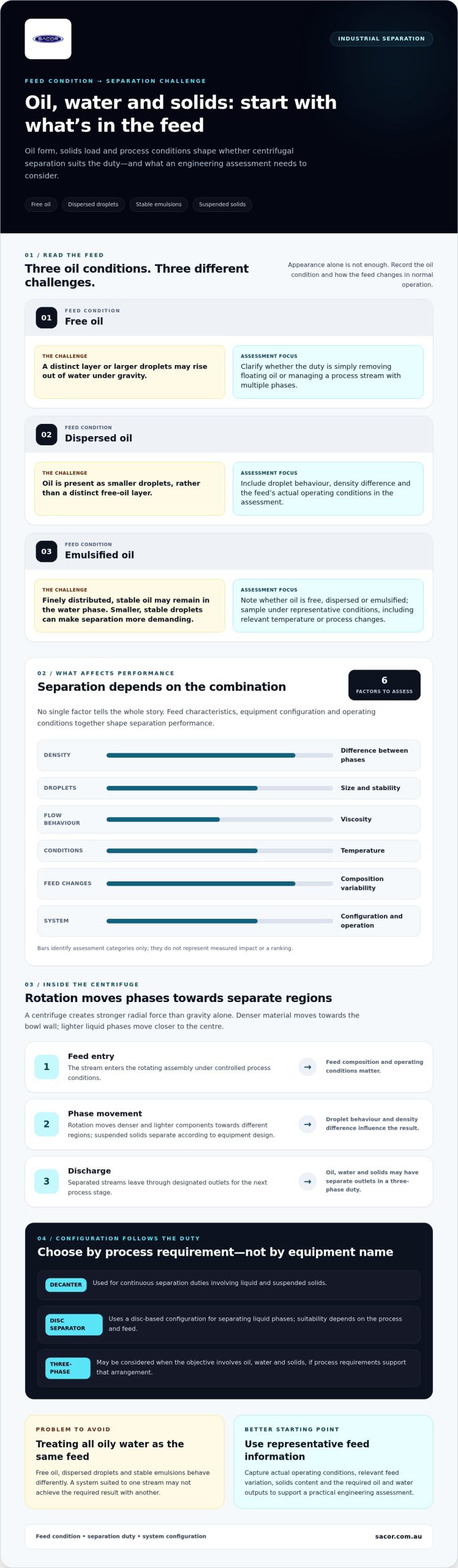
Visible free oil forms a distinct layer or larger droplets that can rise out of water under gravity. Dispersed oil is present as smaller droplets, while emulsified oil is more finely distributed and may remain stable in the water phase. Smaller droplets and more stable emulsions can make separation more demanding, so not every centrifuge will suit every feed.
Surfactants, temperature and process history can influence droplet behaviour and feed consistency. Sampling should reflect actual operating conditions, including relevant changes in temperature or process inputs. Record whether the oil is free, dispersed or emulsified, and note how the feed changes during normal operation. This gives an engineering assessment a more useful starting point than appearance alone.
What a centrifuge can separate from an industrial stream
Depending on its design and the process conditions, a centrifuge can separate liquid phases of different densities and remove suspended solids from a stream. In a three-phase duty, oil, water and solids may be directed into separate discharge streams. These are possible outputs, not a guarantee of complete separation. Results depend on feed characteristics, equipment configuration and performance targets.
This makes centrifuges relevant to some industrial process-fluid duties, including streams where solids and oil occur together, rather than only to simple removal of floating oil from wastewater. The centrifugal water-oil separator overview provides a general explanation of the mechanism. For broader Australian energy-sector context, see the energy sector centrifuge guide.
For an oil water separation centrifuge Australia project, first establish whether the feed and recovery objective suit centrifugal treatment. Droplet condition, solids content and the desired oil and water outputs help define that fit before system specification begins.
How centrifugal oil-water separation works in an industrial process
A centrifuge accelerates density-based separation by rotating the feed, creating a stronger radial force than gravity alone. The effect depends on the equipment configuration and operating conditions, so it shouldn’t be reduced to a universal speed or efficiency advantage over settling. A settling tank allows phases to separate over time under gravity. A centrifuge can support continuous processing, with feed entering and separated streams leaving as the equipment runs.
How density difference and droplet behaviour affect separation
Inside the rotating bowl, denser material moves towards the bowl wall while lighter liquid phases move closer to the centre. In an oil-water stream, the direction and degree of phase movement depend on the density difference and the way droplets behave within the feed. Separation performance reflects the combined effects of density difference, droplet size and stability, viscosity, temperature, feed variability and the equipment’s operating conditions.
Small droplets have less opportunity to move apart, while stable droplets may resist coalescing into larger ones. Both conditions can make separation more demanding than handling distinct free-oil and water layers. Viscosity, temperature and changes in feed composition also affect the assessment, and shouldn’t be treated as fixed conditions that apply equally to every process.
Decanter, disc separator and three-phase configurations
A decanter centrifuge is used for continuous separation duties involving liquid and suspended solids. A disc separator uses a disc-based configuration for separating liquid phases, with suitability determined by the process and feed. Where the objective involves oil, water and solids, a three-phase system may be considered if the process requirements support that arrangement.
The process sequence is straightforward, although the details depend on the system:
- Feed entry: The stream enters the rotating assembly under controlled process conditions.
- Phase movement: Rotation drives denser and lighter components towards different regions, while suspended solids separate according to the equipment design.
- Discharge: Separated streams leave through designated outlets for the next process stage.
Configuration matters because a system selected for one separation duty may not suit another. A broader overview of oil-water separation techniques places centrifugal methods alongside alternatives such as gravity separation, flotation and membrane technology. For an oil water separation centrifuge Australia project, match the arrangement to the actual feed and operating objective. Sacor works with plant teams to define process requirements and supply industrial centrifuge systems tailored to those needs.
Centrifuge or conventional oil-water separator: compare by feed and objective
Gravity-based separators and centrifuges address different separation duties. A gravity system may suit wastewater containing separable free oil, while centrifugal equipment may warrant evaluation where solids, smaller oil droplets or process-fluid recovery add complexity. Neither option is universally superior. Choose by assessing representative feed conditions, required outputs and how the separation stage fits into the wider process.
| Decision factor | Gravity-based separator | Centrifuge |
|---|---|---|
| Feed type | Often suited to wastewater with distinct, separable free oil. | May suit industrial streams with more demanding liquid-phase separation duties. |
| Solids | Settling or other treatment stages may be needed to manage suspended solids. | Some configurations can separate suspended solids alongside liquid phases, depending on design and feed. |
| Recovery objective | Can separate a free-oil layer from water where the phases separate readily. | May be considered when the process aims to separate oil and water, manage solids or recover process fluids. |
| Process continuity | Performance depends on flow and settling conditions. The arrangement may include holding or treatment stages. | Can support continuous processing when matched to the process and operating requirements. |
| Operating context | May fit wastewater treatment with a relatively straightforward free-oil removal duty. | May fit an industrial process stream where feed variability, solids or recovery goals call for closer assessment. |
When a gravity-based oil-water separator may be suitable
Where oil separates readily and the duty is to remove a visible free-oil layer from a wastewater flow, gravity treatment may be a practical option. Suitability still depends on flow conditions and the incoming stream. Suspended solids may need separate management, and further treatment may be required to achieve the intended process outcome. Discharge conditions depend on the site and receiving system, so equipment selection alone shouldn’t be taken as evidence of compliance.
When centrifugal separation deserves evaluation
Evaluate a centrifuge when the feed contains solids, difficult-to-separate droplets or a process fluid with potential recovery value. Consider whether the required separated-stream quality, throughput pattern and need for continuous operation align with plant objectives. Sampling under representative conditions can reveal variability that a single snapshot might miss.
Compare the full process, not just the separator. Include pretreatment, solids handling and downstream management of each stream. This gives engineers a more useful basis for choosing a technology or determining whether stages should work together. For an oil water separation centrifuge Australia project, matching the system to measured feed characteristics and defined outputs supports a more defensible specification.
How to specify an oil-water separation centrifuge for an Australian site
A useful specification starts with the process outcome, then works back through the feed, equipment duty and site conditions. For an oil water separation centrifuge Australia project, representative operating data gives engineers a stronger basis for matching a system to the actual process than a single nominal flow rate or an assumed feed composition.
- 1. Define the required outputs. State what each discharge stream needs to achieve, such as the intended oil recovery, water quality for the next process stage and how separated solids will be handled. Keep recovery objectives distinct from quality targets.
- 2. Establish the throughput duty. Record normal and peak flow rates, operating hours, whether operation is batch or continuous, and how often the feed changes. Throughput describes the volume to be processed; it doesn’t, by itself, define the required separation quality.
- 3. Characterise the feed. Provide representative samples and available laboratory results for oil, water and suspended solids. Note whether the oil is free, dispersed or emulsified, along with relevant temperature, viscosity and process conditions. Include expected variability and peak conditions so the assessment reflects more than a favourable sample.
- 4. Set process and handling limits. Document internal requirements for each separated stream, along with downstream treatment, storage or reuse needs. Identify how solids and recovered fluids will be managed after separation.
- 5. Review site integration. Map the available footprint, access for equipment and maintenance, utilities, control requirements and connections to existing plant systems. Include operator responsibilities, spare-parts planning and maintenance access when considering the operating arrangement.
- 6. Include commissioning and site requirements. Identify project interfaces, planned downtime and the support needed for installation and commissioning. Record applicable environmental and discharge requirements for site-specific review, since conditions depend on the location and receiving system.
Keeping these inputs organised helps plant teams compare equipment against both process performance needs and practical operating constraints. The industrial decanter centrifuge guide provides wider context on equipment selection. Sacor works with Australian plant engineers and managers to develop tailored solutions, supplying technical documentation and providing installation and commissioning support.
Prepare your feed data and site requirements for a discussion about centrifuge system selection.
Sacor’s approach to oil-water centrifuge projects across Australia
Sacor supplies industrial decanter, three-phase centrifuge and disc separator systems to operators across Australia, working with plant engineers and managers to align equipment selection with process requirements. An oil-water separation project starts with the duty the plant needs to perform, then considers feed characteristics, throughput targets and site conditions together. This creates a practical basis for selecting and integrating a system, rather than treating the centrifuge as a standalone purchase.
From process assessment to commissioned equipment
During project development, Sacor works alongside client teams to understand the feed and required outputs, review operating conditions and plan how the equipment will connect with the existing plant. The assessment considers throughput needs, separation objectives, site layout and operating requirements. These inputs inform a solution tailored to the application, with technical documentation to support project planning and equipment integration.
Equipment supply is one stage of the project pathway. Sacor also provides on-site installation and commissioning, integrating the supplied system with the plant infrastructure and operating requirements. Coordination between plant personnel and the equipment team helps define responsibilities and practical interfaces before the system is brought into operation.
Planning for reliability and responsible resource use
Appropriate separation can support more efficient process-fluid management and recovery objectives, while helping operators make considered use of water and other resources. The value depends on the application and how separated streams fit into the wider process, so performance expectations should be grounded in feed and operating data.
Lifecycle planning should consider maintenance access, operator responsibilities, spare-parts requirements and planned downtime. Sacor provides maintenance and technical support services alongside spare-parts supply to support equipment over its service life. The right maintenance approach depends on the equipment and site operating needs. The industrial centrifuge spare-parts guide offers further context for planning parts and maintenance.
For an oil water separation centrifuge Australia project, bringing process data and site requirements together gives the engineering discussion a clear starting point. Discuss your industrial separation project with Sacor to explore equipment supply and project support suited to your process.
Turn process data into a confident system decision
The right separation system depends on the stream, not just the presence of oil and water. Free, dispersed and emulsified oil behave differently, while solids, feed variability and recovery goals all influence whether centrifugal or gravity-based treatment is the better fit. Define the required outputs and assess representative feed and operating conditions before settling on a specification.
For an oil water separation centrifuge Australia project, consider throughput, separation quality and recovered-fluid objectives alongside site integration and ongoing operating needs. A well-grounded selection can support process efficiency and responsible resource use without assuming one configuration suits every application.
Sacor is an Australian supplier of industrial decanter, three-phase and disc separator systems. We work with plant teams on tailored engineering and equipment supply, and provide technical documentation, installation, commissioning, maintenance and spare parts.
Bring your process requirements and site considerations into the next project discussion. Discuss your oil-water separation requirements with Sacor and take a considered next step towards a system suited to your operation.
Frequently Asked Questions
Can a centrifuge separate oil from water?
Yes, a suitably configured centrifuge can separate oil and water by using rotation to act on their density difference. Performance depends on the feed, including droplet size and stability, viscosity, temperature and solids content. The equipment must match the process objective, such as separating liquid phases or recovering a process fluid. A centrifuge isn’t automatically suitable for every oily stream, so assess it against representative feed conditions.
What is the difference between an oil-water separator and an oil-water centrifuge?
An oil-water separator commonly refers to gravity-based equipment that allows separable free oil to rise out of water. An oil-water centrifuge uses rotation to accelerate density-based separation and may suit industrial streams with more complex separation duties, including suspended solids. The terms describe different approaches, so compare systems by feed characteristics, recovery goals, solids handling and process continuity rather than by name alone.
When should an industrial site consider a centrifuge for oil-water separation?
An industrial site should evaluate a centrifuge when its stream contains solids, difficult-to-separate oil droplets or process fluids with recovery value, particularly if the duty calls for continuous processing. The assessment should include feed variability, throughput, desired separated-stream quality and downstream handling needs. Representative sampling helps establish whether centrifugal separation suits the actual process, or whether gravity treatment or a combination of stages better matches site objectives.
Can a centrifuge separate oil, water and solids at the same time?
Yes, a three-phase centrifuge system can be configured to separate oil, water and solids where the equipment design and process requirements support that duty. The feed enters the rotating assembly, and the phases move differently according to their densities before discharging through designated outlets. This doesn’t guarantee complete separation: feed characteristics, operating conditions and required output quality all influence performance and should inform the system assessment.
What information is needed to select an oil-water separation centrifuge?
For an oil water separation centrifuge Australia project, provide normal and peak flow rates, operating hours and information on feed variability. Include representative samples and available laboratory data for oil, water and solids, plus relevant temperature and viscosity details. Define the required outputs, recovery objectives and downstream limits, then document site footprint, access, utilities, controls and maintenance needs. These inputs help engineers match equipment to the process.
Does a centrifuge remove emulsified oil from wastewater?
A centrifuge may separate some emulsified oil, but suitability depends on the emulsion’s stability, droplet behaviour, feed composition and equipment configuration. Fine, stable droplets can be more challenging to separate than free oil, so the presence of a centrifuge alone doesn’t establish the result. Assess representative samples and operating conditions against the required output quality. Any wastewater treatment or discharge objective also needs to be considered in its site-specific context.